
 My Inquiry
 My Account


Analog Devices Inc./Maxim Integrated MAX3667ECJ-T
- Part No.:
- MAX3667ECJ-T
- Manufacturer:
- Analog Devices Inc./Maxim Integrated
- Category:
- Laser Drivers
- Package:
- 32-LQFP
- Datasheet:
-
 MAX3667ECJ-T.pdf
- Description:
- SDH/SONET LASER DRIVER
- Quantity:
- Payment:

- Shipping:

Inventory:1,000
Please send an inquiry. Send us your inquiry, and we will respond immediately.
Product details
Overview
MAX3667ECJ-T from Maxim Integrated is a +3.3V, 622Mbps SDH/SONET laser driver IC with integrated automatic power control (APC), differential PECL input interface, single-ended bias (IBIAS) and modulation (IMOD) current outputs, and operation across –40°C to +85°C. It delivers 5–90mA bias current and 5–60mAP-P modulation current for fiber-optic transmitter applications in access nodes and repeaters.
For engineers reviewing the MAX3667ECJ-T datasheet, MAX3667ECJ-T pinout, MAX3667ECJ-T application, or MAX3667ECJ-T equivalent, key selection criteria include APC loop stability (CCOMP/CAPC configuration), PECL input compatibility, TTL-compatible disable timing (25ns response), bias/modulation current monitor gain accuracy (1/38 and 1/33), and TQFP-32 thermal performance under 622Mbps eye-diagram compliance.
Technical Context
The MAX3667ECJ-T implements a closed-loop APC architecture using an operational transconductance amplifier (OTA) that compares monitor photodiode current (MD) against a reference set by APCSET, driving COMP and APC pins to regulate IBIAS via BIASSET. Its modulation path accepts 620mVP-P minimum differential PECL inputs and delivers IMOD through an AC-coupled, 31Ω pullup-biased output stage optimized for 10Ω loads.
It features dual current monitors (BIASMON at 1/38×IBIAS, MODMON at 1/33×IQMOD), temperature-compensated 1.0V internal reference, and slow-start turn-on (>50ns). The device supports both open-loop (RBIASSET/MODSET programming) and closed-loop (APCSET + MD feedback) bias control, with output current limiting (170mA IBIAS, 140mA IQMOD at 3.3V).
Key Specifications
| Parameter | Value and Actual Design Meaning |
|---|---|
| Supply Voltage | +3.3V ±5% (also supports +5.0V operation) |
| Data Rate | 622Mbps - meets SDH/SONET OC-12/STM-4 timing and jitter requirements |
| Bias Current Range | 5mA to 90mA - programmable via RBIASSET or APCSET resistor, DC-coupled to laser cathode |
| Modulation Current | 5mAP-P to 60mAP-P - AC-coupled, PECL-driven, RFILT/RDAMP-tuned for minimal aberration |
| APC Loop Stability | CCOMP = 1µF, CAPC = 1nF - sets dominant pole for <12% droop over 100-bit runs at 1.6ns/bit |
| Disable Response | 25ns - TTL-compatible DISABLE pin halts IBIAS/IMOD while preserving reference and OTA readiness |
| Operating Temp | –40°C to +85°C - fully specified and guaranteed over industrial temperature range |
Pinout & Package
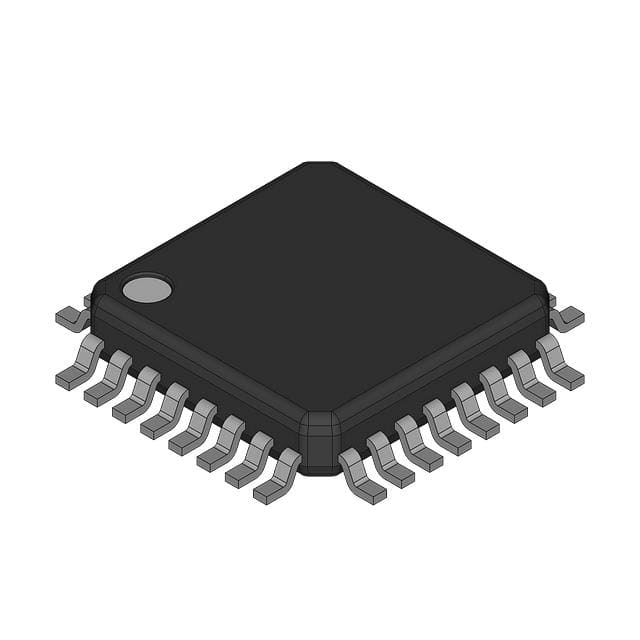
The MAX3667ECJ-T is housed in a 32-pin Thin Quad Flat Package (TQFP) with exposed thermal pad, 0.8mm pitch, and JEDEC MO-220 standard footprint. Pin 1 is located at top-left corner with dot marking; package dimensions are 7.0mm × 7.0mm × 1.0mm (max height).
| Pin/Terminal | Circuit Role | Design Meaning |
|---|---|---|
| VCC (Pins 1,2,23,24) | Supply Input | +3.3V main supply; decoupling required at each pin for high-frequency stability |
| GND (Pins 3,6,8,13,14,15,18,20,22) | Ground Reference | Low-inductance return path for bias, modulation, and analog monitoring circuits |
| IN+, IN- (Pins 4,5) | Differential PECL Input | Accepts 620mVP-P min swing; common-mode range 1.5V to VCC–0.75V; 50Ω termination recommended |
| DISABLE (Pin 7) | TTL Control Input | High = disable IBIAS/IMOD; preserves internal reference and enables fast reactivation (~25ns) |
| IBIAS (Pin 16) | Laser DC Bias Output | DC-coupled, 5–90mA sink; connects directly to laser diode cathode; requires R-L compensation (100Ω/470nH) |
| IMOD (Pins 19,21) | Laser Modulation Output | AC-coupled, 5–60mAP-P source; 31Ω internal pullup; requires 1µF blocking capacitor and series damping (4.7Ω) |
| APC, APCSET, COMP, MD (Pins 11,27,32,25) | APC Feedback Network | Form closed-loop bias control: MD → OTA → COMP → APC → BIASSET; CCOMP (1µF) and CAPC (1nF) set loop bandwidth |
| BIASMON, MODMON (Pins 29,30) | Analog Monitor Outputs | Open-collector PNP: BIASMON = IBIAS/38, MODMON = IQMOD/33; connect to ground if unused |
Key Features
| Feature | Design Value |
|---|---|
| Integrated APC Loop | Enables constant average optical output power across temperature and aging via MD photodiode feedback and OTA-based error correction |
| Temperature-Compensated Reference | 1.0V internal reference with <500ppm/°C drift ensures stable IBIAS/IMOD programming over –40°C to +85°C |
| Dual High-Speed Current Monitors | BIASMON (1/38×IBIAS) and MODMON (1/33×IQMOD) provide real-time analog supervision without loading laser paths |
| PECL-Compatible Input Interface | Accepts industry-standard differential logic with 620mVP-P minimum swing and 1.5V–(VCC–0.75V) common-mode range |
| TTL Disable with Fast Recovery | 25ns disable response and retained internal biasing allow sub-100ns re-enable for burst-mode transmission |
Applications
| 622Mbps SDH/SONET Access Node | Laser Driver Transmitter |
|---|---|
Use Scenario: Metro edge aggregation node transmitting OC-12/STM-4 data over single-mode fiber using 1300nm DFB lasers. IC Role / Device Role / Timing Role: Laser driver providing precise bias and modulation current control with APC to maintain link budget under temperature variation. Use Value: Enables >60km reach with <12% pulse-width distortion at 622Mbps and <3.2ps RMS jitter per eye diagram test. | Use Scenario: Pluggable SFP module with hot-plug capability requiring low-power, compact laser drive solution. IC Role / Device Role / Timing Role: Primary signal conditioning IC converting PECL-encoded serial data into controlled optical modulation. Use Value: Delivers 5–60mAP-P modulation into 10Ω load with <±10% output aberrations, meeting GR-468 reliability for telecom modules. |
| Section Repeater | Fiber-to-the-Home (FTTH) OLT |
Use Scenario: Regenerative repeater in long-haul backbone links where laser efficiency degrades over time and ambient temperature fluctuates. IC Role / Device Role / Timing Role: APC-enabled bias controller maintaining constant average optical power despite aging and thermal drift. Use Value: Achieves <1100ppm/°C bias stability and <1000ppm/°C modulation stability, extending maintenance intervals by >2× vs. open-loop drivers. | Use Scenario: Optical Line Terminal in GPON systems operating at 622Mbps downstream with strict Class 1 laser safety compliance. IC Role / Device Role / Timing Role: Safety-critical laser driver with disable control, current limiting, and monitored bias path for fault detection. Use Value: Supports IEC 60825-1 compliance when combined with external fault logic, due to programmable shutdown and current monitor outputs. |
Equivalent & Alternatives
The following parts are listed as comparable options for similar laser driver applications.
| Alternative Part | Technical Difference | Application Difference | Selection Advice |
|---|---|---|---|
| MAX3668ECJ-T | Same 32-pin TQFP package and APC architecture, but rated for 2.488Gbps (OC-48/STM-16); higher IMOD limit (100mAP-P) and tighter jitter spec (1.8ps RMS) | Targeted for metro core and DWDM systems requiring higher data rates; not drop-in compatible due to different AC characteristics and layout sensitivity | Select MAX3668ECJ-T only when upgrading to 2.488Gbps; verify RFILT/RDAMP tuning and eye mask compliance |
| LMH6522MA/NOPB | Wideband current-output DAC-based driver (not APC-integrated); no built-in photodiode feedback; requires external microcontroller for closed-loop control | Suitable for custom or non-telecom applications (e.g., instrumentation, test equipment) where APC is implemented externally | Choose LMH6522MA/NOPB only when full system-level control of bias/modulation is needed and APC loop design is handled separately |
Compared with MAX3667ECJ-T, MAX3668ECJ-T offers higher speed and tighter jitter but demands more stringent layout and filtering; LMH6522MA/NOPB provides flexibility at the cost of added complexity and missing integrated APC-making MAX3667ECJ-T optimal for cost-sensitive, standards-compliant 622Mbps SDH/SONET deployments.
Availability
MAX3667ECJ-T is available at Aetrix Electronics and suitable for 622Mbps SDH/SONET access nodes, fiber-optic repeaters, and pluggable optical transceivers requiring stable component supply, long-term lifecycle support, and guaranteed industrial temperature operation.
Supply support for MAX3667ECJ-T includes scheduled delivery planning, volume procurement assistance, BOM continuity management, traceable sourcing, and lifecycle availability coordination for OEM customers, industrial embedded developers, connected-device designers, and electronics production programs.
Manufacturer
Maxim Integrated (now part of Analog Devices) is a U.S.-based semiconductor company specializing in high-performance analog, mixed-signal, and power management ICs for communications, industrial, and computing markets.
The MAX3667ECJ-T belongs to Maxim's optical communications product line, designed specifically for reliable, low-jitter laser driving in telecom infrastructure equipment compliant with SDH/SONET OC-12/STM-4 standards.
FAQ
What is the maximum modulation current supported by the MAX3667ECJ-T at +3.3V operation?
The MAX3667ECJ-T supports a modulation current range of 5mAP-P to 60mAP-P at +3.3V operation. This is achieved through AC-coupled IMOD outputs with external RFILT (22Ω) and RDAMP (4.7Ω) components. Exceeding 60mAP-P requires +5.0V operation and DC-coupled configuration, which is not supported by the MAX3667ECJ-T's default AC-coupling architecture. The 60mAP-P upper limit is validated across –40°C to +85°C and guarantees <±10% output aberrations per datasheet AC specifications.
How does the APC loop in the MAX3667ECJ-T maintain constant laser output power?
The MAX3667ECJ-T's APC loop maintains constant laser output power by comparing the current from an external monitor photodiode (connected to MD pin) against a reference current set by the APCSET resistor. The internal OTA drives the COMP and APC pins to adjust the bias current at IBIAS until the two currents balance. With CCOMP = 1µF and CAPC = 1nF, the loop achieves stable regulation across temperature and aging, delivering <1100ppm/°C bias current stability and <1000ppm/°C modulation stability as confirmed in typical operating characteristics.
Can the MAX3667ECJ-T operate with +5.0V supply, and what changes are required?
Yes, the MAX3667ECJ-T supports +5.0V operation per its Absolute Maximum Ratings and DC Electrical Characteristics tables. At +5.0V, supply current increases to 134–160mA, modulation current range extends up to 60mAP-P (same max), and output aberrations improve slightly. No schematic changes are required, but RFILT/RDAMP values may need retuning for optimal eye quality. The PECL input common-mode range expands to 1.5V–4.25V, and disable timing remains at ~25ns. All temperature specs and APC functionality remain fully valid.
What is the function of the BIASMON and MODMON pins on the MAX3667ECJ-T?
BIASMON (Pin 29) and MODMON (Pin 30) are open-collector PNP current monitor outputs on the MAX3667ECJ-T. BIASMON delivers IBIAS/38 (e.g., 2.37mA for 90mA IBIAS), while MODMON delivers IQMOD/33 (e.g., 1.82mA for 60mA IQMOD). These signals enable real-time analog monitoring of laser bias and modulation currents without introducing parasitic loading. Both require external pull-down resistors to ground if used; leaving them unconnected disables monitoring without affecting MAX3667ECJ-T operation.
Is the MAX3667ECJ-T pin-compatible with other devices in the MAX366x family?
No, the MAX3667ECJ-T is not pin-compatible with other MAX366x devices such as MAX3668ECJ-T or MAX3691. Although all share the 32-pin TQFP package, pin functions differ significantly - for example, MAX3668ECJ-T repurposes several N.C. pins for additional monitoring or control, and its APC loop uses different compensation node assignments. The MAX3667ECJ-T pinout is unique to its APC architecture and must be laid out per its specific pin configuration diagram (page 11 of datasheet). Substitution requires full PCB redesign.
MAX3667ECJ-T Specifications
- Product attributes
- Attribute value
- Manufacturer:
- Analog Devices Inc./Maxim Integrated
- Series:
- -
- Package/Case:
- 32-LQFP
- Packaging:
- Bulk
- Product Status:
- Active
- Type:
- Laser Diode Driver (Fiber Optic)
- Data Rate:
- 622Mbps
- Number of Channels:
- 1
- Voltage - Supply:
- 3.135V ~ 5.25V
- Current - Supply:
- 112 mA
- Current - Modulation:
- 60mA
- Current - Bias:
- 90 mA
- Operating Temperature:
- -40°C ~ 85°C (TA)
- Grade:
- -
- Qualification:
- -
- Supplier Device Package:
- 32-TQFP (7x7)
- Mounting Type:
- Surface Mount
MAX3667ECJ-T FAQ
1.How can I place an order for MAX3667ECJ-T through Aetrix?
Please submit a Request for Quotation (RFQ) for MAX3667ECJ-T on Aetrix. Our sales agent will provide a competitive quotation and guide you through the order confirmation once you accept the terms.
2.Are the price and stock information for MAX3667ECJ-T reliable?
The price and inventory of MAX3667ECJ-T are updated periodically and may fluctuate due to market conditions. Stock and pricing data are typically refreshed every 24 hours. Quotation validity for MAX3667ECJ-T is usually 5 days.
3.What payment methods are accepted for MAX3667ECJ-T?
We accept Wire Transfer, PayPal, Credit Card, Western Union, MoneyGram, and Escrow for MAX3667ECJ-T transactions.
Note: Certain payment methods may incur a processing fee.
4.How is shipping managed for MAX3667ECJ-T?
MAX3667ECJ-T orders can be shipped via leading logistics carriers, including DHL, UPS, FedEx, TNT, or Registered Mail.
Once your MAX3667ECJ-T order is processed, you will receive an email with the shipment details and tracking number.
Note: Tracking information may take up to 24 hours to appear. Express delivery typically takes 3–5 business days.
5.How can I obtain technical support or documentation for MAX3667ECJ-T?
For technical support, including MAX3667ECJ-T datasheets, pinout diagrams, or application guidance, please contact our engineering support team. They can provide detailed documentation and assistance for your MAX3667ECJ-T requirements.
6.How does Aetrix verify that MAX3667ECJ-T is sourced from the original manufacturer or authorized distributors?
All MAX3667ECJ-T products on Aetrix are procured from qualified distributors and authorized channels. Our dedicated quality assurance team conducts strict verification, including traceability checks and, if necessary, third-party testing. This ensures that MAX3667ECJ-T meets industry standards.
7.What is the process for return or replacement of MAX3667ECJ-T?
All MAX3667ECJ-T units undergo pre-shipment inspection (PSI). If there is an issue with MAX3667ECJ-T, returns or replacements are accepted under the following conditions:
1.Quantity discrepancies, incorrect items, or visible external defects (such as breakage or corrosion), acknowledged by Aetrix.
2.The issue is reported within 90 days of delivery.
3.The MAX3667ECJ-T part is unused and in its original packaging.
Return procedure for MAX3667ECJ-T:
1.Submit a request within 90 days.
2.Obtain a Return Material Authorization (RMA) from Aetrix.
MAX3667ECJ-T Tags
-
EPC21701
EPC
-
EPC21601
EPC
-
MAX3799ETJ+T
Analog Devices Inc./Maxim Integrated
-
AD9665ACPZ-REEL7
Analog Devices Inc.
-
MAX3740AETG+T
Analog Devices Inc./Maxim Integrated
-
MAX3795ETG+
Analog Devices Inc./Maxim Integrated

-
EPC21603
EPC
-
ONET8501VRGPT
Texas Instruments
-
MAX3738ETG+T
Analog Devices Inc./Maxim Integrated
-
SY88022ALMG-TR
Microchip Technology
-
ISL78365ARZ-T7A
Renesas
-
EPC21603ENGRT
EPC
Tech Hub

A practical engineering guide to 3.3V and 5V logic compatibility, input thresholds, resistor dividers, translator ICs, MOSFET level shifting, I2C pull-ups, timing limits and power-sequencing risks.

The 74HC595 uses push-pull logic outputs, while the TPIC6B595 uses 50 V open-drain DMOS sinks for higher-power loads. This guide compares timing, current limits, 3.3 V interfacing, load wiring, thermal…

The 74HC595 converts serial data into eight stable parallel outputs. This guide covers pin functions, shift and storage timing, OE and MR behavior, drive-current limits, cascading, voltage compatibilit…

A technical comparison of level-sensitive latches and edge-triggered flip-flops, covering timing windows, setup and hold limits, master–slave operation, time borrowing, race-through, HDL inference and…

A D latch stores one bit while Enable controls when data can pass. This reference covers gate-level operation, truth tables, transparency, setup and hold timing, LE versus OE, common ICs and practical …

An SR latch stores one bit through cross-coupled feedback. This engineering reference covers NOR and NAND implementations, truth tables, forbidden-state recovery, gated operation, switch debouncing, fa…

Latch circuits retain one bit through feedback. This technical reference covers SR and D latches, truth tables, transparency, timing limits, latch-versus-flip-flop behavior, applications and common log…

An engineering guide to LED driver operation, constant-current and constant-voltage outputs, linear and switching topologies, dimming, IC selection, calculations, replacement compatibility, and fault c…

Operational amplifier guide covering op amp basics, feedback, ideal vs real op amps, common configurations, buffer circuits, offset, bias current, gain-bandwidth, slew rate, rail-to-rail limits and sel…

Jumper cables guide covering safe connection order, red and black clamp placement, final ground connection, cable gauge, length, clamp quality, copper vs CCA cables, jump starter comparison and battery…


