
 My Inquiry
 My Account


Analog Devices Inc./Maxim Integrated MAX4917BELT+T
- Part No.:
- MAX4917BELT+T
- Manufacturer:
- Analog Devices Inc./Maxim Integrated
- Category:
- Current Regulation/Management
- Package:
- -
- Datasheet:
-
 MAX4917BELT+T.pdf
- Description:
- IC SWITCH 1X1 6UTDFN
- Quantity:
- Payment:

- Shipping:

Inventory:2,680
Please send an inquiry. Send us your inquiry, and we will respond immediately.
Product details
Overview
MAX4917BELT+T from Maxim Integrated is a latchoff-mode, 300mA forward current-limit load switch with 0.2Ω on-resistance, 2.3V–5.5V supply range, and 14ms fault-blanking time-designed for SDIO port protection in handheld devices where overcurrent fault isolation and low reverse shutdown current (0.01μA) are critical.
For engineers reviewing the MAX4917BELT+T datasheet, MAX4917BELT+T pinout, MAX4917BELT+T application, or MAX4917BELT+T equivalent, key selection criteria include guaranteed 300mA forward current limit, latchoff (non-autoretry) fault response, μDFN-6 (2mm × 2mm) package compatibility, thermal shutdown at +150°C, and FLAG output assertion under overcurrent/UVLO/thermal faults.
Technical Context
The MAX4917BELT+T implements dual-direction current sensing using internal sense resistors and reference comparators to detect both forward (IN→OUT) and reverse (OUT→IN) overcurrent conditions. Its latchoff architecture disables the switch permanently after blanking time expiration and requires ON pin or VIN cycling to reset.
It integrates undervoltage lockout (UVLO) with 1.75V–2.25V rising-edge threshold and 100mV hysteresis, thermal shutdown at +150°C with 15°C hysteresis, and open-drain FLAG output with 0.4V logic-low voltage at 1mA sink-enabling microprocessor-level fault monitoring without external logic.
Key Specifications
| Parameter | Value and Actual Design Meaning |
|---|---|
| Forward Current Limit | 300mA min - guarantees robust load switching for SDIO cards and USB peripherals without tripping under nominal surge |
| On-Resistance | 0.2Ω typ at +25°C - minimizes voltage drop and power loss in battery-powered portable systems |
| Supply Voltage Range | 2.3V to 5.5V - supports single-cell Li-ion (2.7–4.2V), 3.3V, and 5V rail operation |
| Fault Blanking Time | 14ms min - suppresses false FLAG assertions during hot-swap transients and power-up inrush |
| Latchoff Current | 8μA max - enables ultra-low-power fault-hold state for extended battery life in standby |
| Reverse Shutdown Current | 0.01μA typ - prevents backfeed leakage when OUT is powered while IN is off, critical for multi-rail isolation |
| Turn-Off Time | 40ns - ensures rapid current cutoff during short-circuit events to protect downstream circuitry |
| Thermal Shutdown Threshold | +150°C - provides hard silicon-level protection against sustained overload or poor PCB thermal design |
Pinout & Package
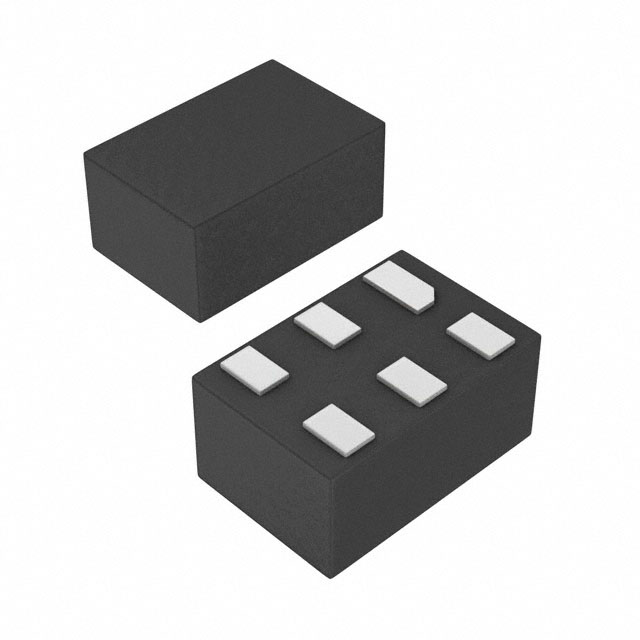
The MAX4917BELT+T is housed in a lead-free, RoHS-compliant 6-pin μDFN package (2mm × 2mm, outline L622-1), optimized for space-constrained portable designs with exposed pad for thermal dissipation.
| Pin/Terminal | Circuit Role | Design Meaning |
|---|---|---|
| 1 (N.C.) | No Connection | Not internally bonded - must be left floating or grounded per layout best practice; no electrical function |
| 2 (IN) | Power Input | Main supply input; requires local 0.1μF ceramic bypass to GND within 5mm to stabilize during short-circuit events |
| 3 (GND) | Ground Reference | Primary return path for load current and internal bias; connects to exposed thermal pad for enhanced heat transfer |
| 4 (FLAG) | Fault Indicator Output | Open-drain output requiring external pullup to IN; asserts low on overcurrent, UVLO, or thermal fault - no blanking delay for thermal/UVLO |
| 5 (ON) | Active-High Enable | Logic-high (>2.0V) enables switch; toggling low-to-high resets latchoff state - direct interface to GPIO without level-shifting |
| 6 (OUT) | Switched Load Output | Delivers current-limited power to SDIO card or peripheral; requires local 0.1μF ceramic bypass to GND to suppress turn-off inductive kick |
Key Features
| Feature | Design Value |
|---|---|
| Latchoff Fault Response | Permanently disables switch after 14ms blanking on overcurrent - eliminates retry-induced power cycling noise in sensitive RF sections |
| Reverse Current Protection | Guarantees ≤450mA reverse current limit and shuts off switch if exceeded - prevents backfeed damage when host is powered down but peripheral remains active |
| Low Shutdown Reverse Current | 0.01μA typical - enables true bidirectional isolation in multi-supply systems (e.g., USB OTG with VBUS and ID pin control) |
| Fast Current-Limit Response | 5μs detection time - cuts off short-circuit current before trace fusing or IC damage occurs in compact PCB layouts |
| Undervoltage Lockout | 1.75V–2.25V activation window with 100mV hysteresis - prevents erratic switching during brown-out or battery depletion |
| Thermal-Shutdown Hysteresis | 15°C - ensures stable re-enable after cooling, avoiding oscillation near thermal limit in thermally constrained enclosures |
Applications
| SDIO Card Port Protection | USB Peripheral Power Switching |
|---|---|
Use Scenario: Hot-plugging microSD cards into handheld GPS units with limited battery capacity and no user-accessible reset. IC Role / Device Role / Timing Role: Load switch providing 300mA current-limited, latchoff-protected power delivery to SDIO interface; FLAG signals fault to baseband processor for graceful card ejection. Use Value: Prevents system crash or data corruption from card insertion shorts while enabling firmware-driven recovery via ON pin toggle - no manual power cycle required. | Use Scenario: Isolating USB device power in smartphone accessory docks where multiple peripherals share a single 5V rail. IC Role / Device Role / Timing Role: Bidirectional current-limit switch enforcing 300mA forward/reverse limits and asserting FLAG on overcurrent - acts as smart fuse between host and peripheral. Use Value: Eliminates need for discrete polyfuses and external fault-handling logic; 0.01μA reverse shutdown current prevents backfeed into disabled ports during selective suspend. |
| Notebook ExpressCard Slot | Industrial Handheld Scanner |
Use Scenario: Powering ExpressCard modems in ultraportable notebooks where thermal headroom is minimal and fault recovery must be deterministic. IC Role / Device Role / Timing Role: Latchoff-mode current limiter with thermal shutdown and FLAG reporting - replaces mechanical fuse with programmable, monitorable protection. Use Value: Enables OS-level diagnostics via FLAG status; 0.2Ω RON avoids voltage droop that could cause modem handshake failures at 3.3V. | Use Scenario: Supplying regulated 3.3V to barcode scanner engine in ruggedized handheld terminals operating across -40°C to +85°C ambient. IC Role / Device Role / Timing Role: High-reliability load switch with guaranteed 300mA limit, 14ms blanking, and thermal shutdown - protects against motor stall or ESD-induced latch-up. Use Value: Maintains functional safety by latching off on persistent fault and signaling via FLAG to MCU for audible/visual alert - no silent failure mode. |
Equivalent & Alternatives
The following parts are listed as comparable options for similar current-limit switch applications.
| Alternative Part | Technical Difference | Application Difference | Selection Advice |
|---|---|---|---|
| MAX4917AEUK+T | Same 300mA current limit and μDFN-6 specs, but in 5-pin SOT23 package; autoretry (not latchoff) fault response | Preferred where automatic recovery from transient overloads is acceptable and board space permits SOT23 footprint | Select for cost-sensitive, non-safety-critical applications needing self-recovery - not suitable where deterministic fault hold is required |
| TPS22965DSGR | 3.6A current limit, 17mΩ RON, 1.6V–5.5V supply; no reverse current limit or FLAG output; no latchoff/autoretry modes | Suitable for high-current, single-direction loads without fault reporting - lacks reverse protection and diagnostic capability | Choose only when higher current capacity and lower RON outweigh need for reverse limiting, FLAG signaling, and controlled fault behavior |
Compared with MAX4917AEUK+T (autoretry) and TPS22965DSGR (no fault reporting), the MAX4917BELT+T uniquely delivers deterministic latchoff behavior, integrated reverse current limiting, and FLAG-based diagnostics - making it optimal for safety-aware portable systems requiring unambiguous fault isolation and software-controlled reset.
Availability
MAX4917BELT+T is available at Aetrix Electronics and suitable for SDIO port protection, USB peripheral isolation, ExpressCard power management, and industrial handheld scanner designs requiring stable component supply across extended temperature and long product lifecycles.
Supply support for MAX4917BELT+T includes scheduled delivery planning, volume procurement assistance, BOM continuity management, traceable sourcing, and lifecycle availability coordination for OEM customers, industrial embedded developers, connected-device designers, and electronics production programs.
Manufacturer
Maxim Integrated, now part of Analog Devices, designs precision analog, mixed-signal, and power management ICs for demanding industrial, automotive, and portable applications.
The MAX4914B/MAX4915A/B/MAX4917A/B family targets high-reliability load switching in space-constrained, battery-operated devices - emphasizing fault resilience, ultra-low quiescent current, and bidirectional current limiting for modern mobile interfaces.
FAQ
What is the guaranteed forward current limit for MAX4917BELT+T?
The MAX4917BELT+T guarantees a minimum forward current limit of 300mA under all operating conditions across the -40°C to +85°C temperature range. This value is specified with VOUT = GND and represents the threshold at which the device initiates fault detection and blanking timing - ensuring reliable protection for SDIO and USB peripherals without nuisance tripping during normal inrush.
Does MAX4917BELT+T support reverse current limiting, and what is its threshold?
Yes, the MAX4917BELT+T provides guaranteed reverse current limiting of 450mA minimum when VOUT – VIN ≥ 0.5V. This feature actively monitors current flow from OUT to IN and triggers the same 14ms blanking and latchoff sequence as forward faults - preventing backfeed damage in multi-rail systems where peripherals may remain powered while the host is off.
How does the latchoff behavior of MAX4917BELT+T differ from autoretry versions like MAX4917AEUK+T?
The MAX4917BELT+T enters a permanent latchoff state after fault blanking expires and remains off until the ON pin is cycled low-to-high or VIN drops below UVLO. In contrast, MAX4917AEUK+T automatically retries after tRETRY (~210ms). This makes MAX4917BELT+T ideal for applications requiring explicit software control over fault recovery - such as medical handhelds or secure peripherals where unintended auto-restart is unacceptable.
What is the role of the FLAG pin on MAX4917BELT+T, and how should it be interfaced?
The FLAG pin on MAX4917BELT+T is an open-drain output that asserts low during overcurrent (forward/reverse), thermal shutdown (+150°C), or undervoltage lockout (<1.75V). It requires an external pullup resistor to IN (not VCC) and sinks ≥1mA. During shutdown (ON = low), FLAG's pulldown is released to minimize leakage - enabling clean fault reporting without additional level-shifting circuitry in 3.3V/5V mixed-signal systems.
Can MAX4917BELT+T operate reliably at the minimum supply voltage of 2.3V?
Yes, the MAX4917BELT+T is fully specified from 2.3V to 5.5V. At 2.3V, its quiescent current is 80μA (typ), on-resistance rises to 0.5Ω (max), and ON input logic-high threshold remains 2.0V - ensuring robust enable/disable control even with aging Li-ion cells at end-of-discharge. UVLO prevents operation below 1.75V, adding margin against unstable regulation.
MAX4917BELT+T Specifications
- Product attributes
- Attribute value
- Manufacturer:
- Analog Devices Inc./Maxim Integrated
- Series:
- *
- Package/Case:
- -
- Packaging:
- Tape & Reel (TR)
- Product Status:
- Obsolete
- Function:
- -
- Sensing Method:
- -
- Accuracy:
- -
- Voltage - Input:
- -
- Current - Output:
- -
- Operating Temperature:
- -
- Grade:
- -
- Qualification:
- -
- Mounting Type:
- -
- Supplier Device Package:
- -
MAX4917BELT+T FAQ
1.How can I place an order for MAX4917BELT+T through Aetrix?
Please submit a Request for Quotation (RFQ) for MAX4917BELT+T on Aetrix. Our sales agent will provide a competitive quotation and guide you through the order confirmation once you accept the terms.
2.Are the price and stock information for MAX4917BELT+T reliable?
The price and inventory of MAX4917BELT+T are updated periodically and may fluctuate due to market conditions. Stock and pricing data are typically refreshed every 24 hours. Quotation validity for MAX4917BELT+T is usually 5 days.
3.What payment methods are accepted for MAX4917BELT+T?
We accept Wire Transfer, PayPal, Credit Card, Western Union, MoneyGram, and Escrow for MAX4917BELT+T transactions.
Note: Certain payment methods may incur a processing fee.
4.How is shipping managed for MAX4917BELT+T?
MAX4917BELT+T orders can be shipped via leading logistics carriers, including DHL, UPS, FedEx, TNT, or Registered Mail.
Once your MAX4917BELT+T order is processed, you will receive an email with the shipment details and tracking number.
Note: Tracking information may take up to 24 hours to appear. Express delivery typically takes 3–5 business days.
5.How can I obtain technical support or documentation for MAX4917BELT+T?
For technical support, including MAX4917BELT+T datasheets, pinout diagrams, or application guidance, please contact our engineering support team. They can provide detailed documentation and assistance for your MAX4917BELT+T requirements.
6.How does Aetrix verify that MAX4917BELT+T is sourced from the original manufacturer or authorized distributors?
All MAX4917BELT+T products on Aetrix are procured from qualified distributors and authorized channels. Our dedicated quality assurance team conducts strict verification, including traceability checks and, if necessary, third-party testing. This ensures that MAX4917BELT+T meets industry standards.
7.What is the process for return or replacement of MAX4917BELT+T?
All MAX4917BELT+T units undergo pre-shipment inspection (PSI). If there is an issue with MAX4917BELT+T, returns or replacements are accepted under the following conditions:
1.Quantity discrepancies, incorrect items, or visible external defects (such as breakage or corrosion), acknowledged by Aetrix.
2.The issue is reported within 90 days of delivery.
3.The MAX4917BELT+T part is unused and in its original packaging.
Return procedure for MAX4917BELT+T:
1.Submit a request within 90 days.
2.Obtain a Return Material Authorization (RMA) from Aetrix.
MAX4917BELT+T Tags
.jpg)
-
PSSI2021SAY,115
Nexperia USA Inc.
-
BCR401RE6327HTSA1
Infineon Technologies
-
INA199B2DCKR
Texas Instruments
-
INA199A1DCKR
Texas Instruments
-
INA199B1DCKR
Texas Instruments
-
NSI45015WT1G
onsemi
-
NSI45020T1G
onsemi
-
NSI45030AT1G
onsemi
-
NSI45025AT1G
onsemi
-
NSI45020AT1G
onsemi
-
NSI50010YT1G
onsemi
-
LM334Z/NOPB
Texas Instruments
Tech Hub

A practical engineering guide to 3.3V and 5V logic compatibility, input thresholds, resistor dividers, translator ICs, MOSFET level shifting, I2C pull-ups, timing limits and power-sequencing risks.

The 74HC595 uses push-pull logic outputs, while the TPIC6B595 uses 50 V open-drain DMOS sinks for higher-power loads. This guide compares timing, current limits, 3.3 V interfacing, load wiring, thermal…

The 74HC595 converts serial data into eight stable parallel outputs. This guide covers pin functions, shift and storage timing, OE and MR behavior, drive-current limits, cascading, voltage compatibilit…

A technical comparison of level-sensitive latches and edge-triggered flip-flops, covering timing windows, setup and hold limits, master–slave operation, time borrowing, race-through, HDL inference and…

A D latch stores one bit while Enable controls when data can pass. This reference covers gate-level operation, truth tables, transparency, setup and hold timing, LE versus OE, common ICs and practical …

An SR latch stores one bit through cross-coupled feedback. This engineering reference covers NOR and NAND implementations, truth tables, forbidden-state recovery, gated operation, switch debouncing, fa…

Latch circuits retain one bit through feedback. This technical reference covers SR and D latches, truth tables, transparency, timing limits, latch-versus-flip-flop behavior, applications and common log…

An engineering guide to LED driver operation, constant-current and constant-voltage outputs, linear and switching topologies, dimming, IC selection, calculations, replacement compatibility, and fault c…

Operational amplifier guide covering op amp basics, feedback, ideal vs real op amps, common configurations, buffer circuits, offset, bias current, gain-bandwidth, slew rate, rail-to-rail limits and sel…

Jumper cables guide covering safe connection order, red and black clamp placement, final ground connection, cable gauge, length, clamp quality, copper vs CCA cables, jump starter comparison and battery…


