
 My Inquiry
 My Account


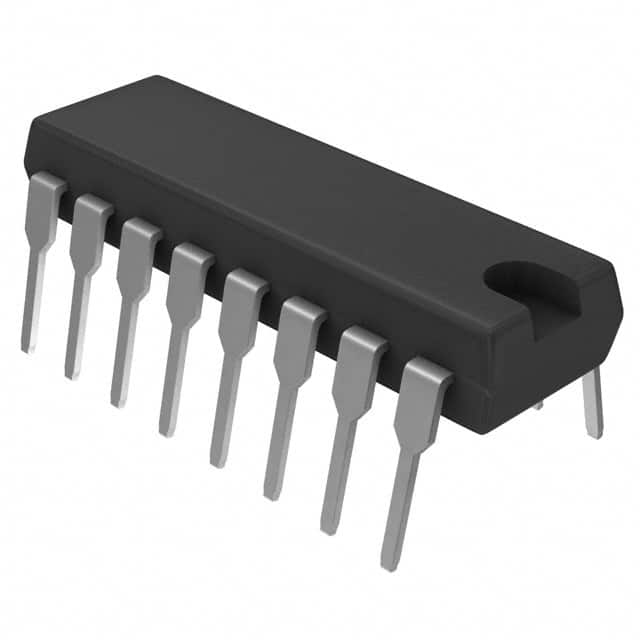
NXP Semiconductors MC145028P
- Part No.:
- MC145028P
- Manufacturer:
- NXP Semiconductors
- Category:
- Encoders, Decoders, Converters
- Package:
- 16-DIP (0.300", 7.62mm)
- Datasheet:
-
 MC145028P.pdf
- Description:
- IC DECODER 9 ADDR LINES 16-DIP
- Quantity:
- Payment:

- Shipping:

Inventory:4,707
Please send an inquiry. Send us your inquiry, and we will respond immediately.
Product details
Overview
MC145028P from Motorola is a CMOS 9-bit trinary address decoder IC used in remote control encoder/decoder systems. It decodes all nine input lines as address bits (19,683 possible codes with trinary encoding), operates from 4.5 V to 18 V, features internal RC oscillator support, and outputs a Valid Transmission (VT) signal only after two consecutive matching address words are received. It is commonly deployed in infrared, RF, and ultrasonic remote control transceivers.
For engineers reviewing the MC145028P datasheet, MC145028P pinout, MC145028P application, or MC145028P equivalent, key selection considerations include its 9-bit trinary address resolution, VT output timing behavior, R1/C1 and R2/C2 external timing component requirements, supply voltage range (4.5–18 V), and compatibility with MC145026P encoder pairs in security-critical remote systems.
Technical Context
The MC145028P implements a 9-bit shift register and address comparator architecture that validates incoming serial data against locally configured address pins (A1–A9). It requires two identical address words transmitted consecutively - with no intervening data bits - before asserting VT high, enhancing transmission security against noise or spurious pulses.
Timing is governed by external R1/C1 (for pulse width discrimination) and R2/C2 (for word and transmission end detection) networks referenced to the encoder's clock frequency. Its internal power-on reset forces all outputs low at startup, ensuring deterministic initial state without external circuitry.
Key Specifications
| Parameter | Value and Actual Design Meaning |
|---|---|
| Function | 9-bit trinary address decoder with VT output - no data outputs; validates full 9-bit address match across two consecutive words |
| Supply Voltage Range | 4.5 V to 18 V - supports wide-range industrial and battery-powered remote systems |
| Address Capacity | 19,683 unique codes (3⁹) with trinary inputs; 512 codes (2⁹) with binary inputs |
| Quiescent Current | 50 µA max @ 25°C - enables low-power standby in always-on receiver designs |
| Operating Temperature | –40°C to +85°C - qualified for automotive and industrial ambient environments |
| Input Capacitance | 7.5 pF - minimizes layout sensitivity and allows ±5% external R/C components |
| Decoder Frequency | Up to 450 kHz (at VDD = 15 V) - sets maximum compatible encoder clock rate |
Pinout & Package
MC145028P is housed in a 16-pin plastic DIP (Dual In-line Package), Case 648, with 0.3-inch body width and 0.1-inch lead pitch. Pin 1 is top-left corner when notch faces up.
| Pin/Terminal | Circuit Role | Design Meaning |
|---|---|---|
| 1–5, 12–15 | A1–A9 Address Inputs | Trinary/binary local address configuration pins - must match encoder A1–A9 states for VT assertion |
| 6, 7 | R1, C1 Timing Terminals | Set pulse-width discrimination threshold (R1 × C1 ≈ 3.95 × RTC × CTC) |
| 8 | VSS | Ground reference - must be low-impedance connection for stable decoding |
| 9 | Din | CMOS-level serial data input - accepts encoded stream from MC145026P or compatible encoder |
| 10 | R2/C2 | Word and transmission end detection node (R2 × C2 ≈ 77 × RTC × CTC) |
| 11 | VT | Valid Transmission output - goes high only after two consecutive matching address words |
| 16 | VDD | Positive supply - powers internal logic, oscillator interface, and output stage |
Key Features
| Feature | Design Value |
|---|---|
| Trinary address encoding | Enables 19,683 unique addresses using three-state (low/high/open) inputs - significantly increases code space vs binary-only alternatives |
| Two-word validation | VT asserts only after two identical address words are received consecutively - prevents false triggers from noise or single-bit errors |
| No crystal required | RC oscillator interface (via R1/C1/R2/C2) eliminates need for external crystal or ceramic resonator - reduces BOM cost and board area |
| Internal power-on reset | Forces VT low and latches stable initial state - removes need for external POR circuitry in remote receiver modules |
| High external component tolerance | Supports ±5% resistors and capacitors - simplifies sourcing and improves production yield in cost-sensitive consumer remotes |
Applications
| Infrared Remote Control Receiver | RF Garage Door Receiver |
|---|---|
Use Scenario: Standalone IR receiver module in TV or AC remote control system receiving commands from handheld transmitter. IC Role / Device Role / Timing Role: MC145028P acts as the address validation engine - compares incoming serial bitstream against fixed hardware address switches and asserts VT only on dual-word match. Use Value: Eliminates need for microcontroller-based decoding; provides hardware-level security against accidental activation via noise or partial transmissions. | Use Scenario: Fixed-address receiver in garage door opener system where tamper resistance and reliability are critical. IC Role / Device Role / Timing Role: MC145028P serves as the secure address gate - VT output directly enables relay driver only after confirmed valid transmission. Use Value: Prevents unauthorized access by rejecting single-word bursts or corrupted frames - meets basic security requirements for residential automation. |
| Ultrasonic Remote Transceiver | Industrial Wireless Sensor Node Receiver |
Use Scenario: Low-cost ultrasonic remote system for lighting or appliance control in noisy factory environments. IC Role / Device Role / Timing Role: MC145028P decodes amplitude-modulated ultrasonic carrier bursts into validated address signals. Use Value: Immune to RF interference common in industrial settings; leverages trinary encoding to maintain address uniqueness despite signal attenuation. | Use Scenario: Battery-powered wireless sensor node receiving configuration or command packets from central hub. IC Role / Device Role / Timing Role: MC145028P functions as wake-up validator - VT output triggers MCU from sleep only upon verified address match. Use Value: Reduces average system current by keeping MCU in deep sleep until authenticated command arrives - extends multi-year battery life. |
Equivalent & Alternatives
The following parts are listed as comparable options for similar address decoder applications.
| Alternative Part | Technical Difference | Application Difference | Selection Advice |
|---|---|---|---|
| SC41344P | Same 9-bit trinary decoder function but rated for 2.8–10 V operation - lower VDD min/max, higher quiescent current (60–150 µA) | Targeted at low-voltage battery systems (e.g., 3V coin cell remotes); not suitable for 12–18 V industrial rails | Select SC41344P only when supply is constrained to ≤10 V and ultra-low standby is secondary to voltage compatibility. |
| MC145027P | 5-bit address + 4-bit data decoder - includes D6–D9 output pins; VT requires both address AND data match across two words | Used where payload data (e.g., channel select, dimming level) must accompany address - adds functional complexity beyond pure address validation | Choose MC145027P when system requires decoded data bits alongside VT; avoid if only address validation is needed. |
Compared with SC41344P and MC145027P, the MC145028P offers the highest address density (19,683 codes) and simplest VT-only interface, making it optimal for dedicated secure address gating in 4.5–18 V remote receivers where data payload is unnecessary.
Availability
MC145028P is available at Aetrix Electronics and suitable for infrared remote control receivers, RF garage door openers, ultrasonic appliance controllers, and industrial wireless sensor node receivers requiring stable component supply and long-term obsolescence management.
Supply support for MC145028P includes scheduled delivery planning, volume procurement assistance, BOM continuity management, traceable sourcing, and lifecycle availability coordination for OEM customers, industrial embedded developers, connected-device designers, and electronics production programs.
Manufacturer
Motorola Semiconductor (now part of NXP Semiconductors) is a pioneer in analog and mixed-signal IC design, known for robust, industry-standard logic and interface products.
The MC14502x family was designed specifically for low-cost, high-reliability remote control systems - emphasizing hardware-based security, minimal external components, and wide supply voltage operation.
FAQ
What is the primary function of the MC145028P in a remote control system?
The MC145028P functions exclusively as a 9-bit trinary address decoder. It receives serial data from an encoder like the MC145026P, compares all nine address bits against locally configured inputs (A1–A9), and asserts the VT output only after two identical address words are received consecutively. Unlike MC145027P, it provides no data outputs - its sole purpose is secure address validation.
Does the MC145028P require an external crystal or resonator?
No, the MC145028P does not require an external crystal or resonator. It relies entirely on external RC timing components - R1/C1 for pulse discrimination and R2/C2 for word and transmission end detection - referenced to the encoder's oscillator frequency. This eliminates timing component cost and board space while maintaining reliable decoding across temperature and voltage.
What supply voltage range is supported by the MC145028P?
The MC145028P operates over a supply voltage range of 4.5 V to 18 V. This wide range supports both standard 5 V logic systems and higher-voltage industrial or automotive remote receivers. It is not rated for operation below 4.5 V - for low-voltage applications (e.g., 3 V), SC41344P is the designated alternative.
How does the VT output behave on the MC145028P?
The VT output on the MC145028P goes high only after two complete, identical address words are received consecutively. It remains high until either a mismatch occurs in subsequent reception or no valid signal is detected for four data periods. VT is internally reset low on power-up due to the device's built-in power-on reset circuit - no external reset is needed.
Can the MC145028P decode binary-encoded addresses?
Yes, the MC145028P supports binary encoding on its A1–A9 inputs, yielding 512 possible addresses (2⁹). However, its full capability - 19,683 addresses - is realized only with trinary (low/high/open) encoding. Binary mode sacrifices address space but simplifies switch design and eliminates ambiguity in open-circuit detection logic.
MC145028P Specifications
- Product attributes
- Attribute value
- Manufacturer:
- NXP Semiconductors
- Series:
- 4000
- Package/Case:
- 16-DIP (0.300", 7.62mm)
- Packaging:
- Tube
- Product Status:
- Obsolete
- Type:
- Encoder, Decoder
- Applications:
- Remote Control
- Voltage - Supply, Analog:
- 4.5V ~ 18V
- Voltage - Supply, Digital:
- 4.5V ~ 18V
- Grade:
- -
- Qualification:
- -
- Mounting Type:
- Through Hole
- Supplier Device Package:
- 16-PDIP
MC145028P FAQ
1.How can I place an order for MC145028P through Aetrix?
Please submit a Request for Quotation (RFQ) for MC145028P on Aetrix. Our sales agent will provide a competitive quotation and guide you through the order confirmation once you accept the terms.
2.Are the price and stock information for MC145028P reliable?
The price and inventory of MC145028P are updated periodically and may fluctuate due to market conditions. Stock and pricing data are typically refreshed every 24 hours. Quotation validity for MC145028P is usually 5 days.
3.What payment methods are accepted for MC145028P?
We accept Wire Transfer, PayPal, Credit Card, Western Union, MoneyGram, and Escrow for MC145028P transactions.
Note: Certain payment methods may incur a processing fee.
4.How is shipping managed for MC145028P?
MC145028P orders can be shipped via leading logistics carriers, including DHL, UPS, FedEx, TNT, or Registered Mail.
Once your MC145028P order is processed, you will receive an email with the shipment details and tracking number.
Note: Tracking information may take up to 24 hours to appear. Express delivery typically takes 3–5 business days.
5.How can I obtain technical support or documentation for MC145028P?
For technical support, including MC145028P datasheets, pinout diagrams, or application guidance, please contact our engineering support team. They can provide detailed documentation and assistance for your MC145028P requirements.
6.How does Aetrix verify that MC145028P is sourced from the original manufacturer or authorized distributors?
All MC145028P products on Aetrix are procured from qualified distributors and authorized channels. Our dedicated quality assurance team conducts strict verification, including traceability checks and, if necessary, third-party testing. This ensures that MC145028P meets industry standards.
7.What is the process for return or replacement of MC145028P?
All MC145028P units undergo pre-shipment inspection (PSI). If there is an issue with MC145028P, returns or replacements are accepted under the following conditions:
1.Quantity discrepancies, incorrect items, or visible external defects (such as breakage or corrosion), acknowledged by Aetrix.
2.The issue is reported within 90 days of delivery.
3.The MC145028P part is unused and in its original packaging.
Return procedure for MC145028P:
1.Submit a request within 90 days.
2.Obtain a Return Material Authorization (RMA) from Aetrix.
MC145028P Tags
-
MCP2120T-I/SL
Microchip Technology

-
LICAL-ENC-MS001
TE Connectivity Linx
-
TW9990AT-NA1-GR
Renesas Electronics Corporation
-
TVP5151IPBSR
Texas Instruments
-
TVP5150AM1IPBSR
Texas Instruments
-
LICAL-DEC-MS001-T
TE Connectivity Linx
-
ADV7391BCPZ
Analog Devices Inc.
-
ADV7393BCPZ-REEL
Analog Devices Inc.
-
ADV7393BCPZ
Analog Devices Inc.
-
ADV7391WBCPZ
Analog Devices Inc.
-
ADV7181DBCPZ
Analog Devices Inc.
-
ADV7181CBSTZ-REEL
Analog Devices Inc.
Tech Hub

A practical engineering guide to 3.3V and 5V logic compatibility, input thresholds, resistor dividers, translator ICs, MOSFET level shifting, I2C pull-ups, timing limits and power-sequencing risks.

The 74HC595 uses push-pull logic outputs, while the TPIC6B595 uses 50 V open-drain DMOS sinks for higher-power loads. This guide compares timing, current limits, 3.3 V interfacing, load wiring, thermal…

The 74HC595 converts serial data into eight stable parallel outputs. This guide covers pin functions, shift and storage timing, OE and MR behavior, drive-current limits, cascading, voltage compatibilit…

A technical comparison of level-sensitive latches and edge-triggered flip-flops, covering timing windows, setup and hold limits, master–slave operation, time borrowing, race-through, HDL inference and…

A D latch stores one bit while Enable controls when data can pass. This reference covers gate-level operation, truth tables, transparency, setup and hold timing, LE versus OE, common ICs and practical …

An SR latch stores one bit through cross-coupled feedback. This engineering reference covers NOR and NAND implementations, truth tables, forbidden-state recovery, gated operation, switch debouncing, fa…

Latch circuits retain one bit through feedback. This technical reference covers SR and D latches, truth tables, transparency, timing limits, latch-versus-flip-flop behavior, applications and common log…

An engineering guide to LED driver operation, constant-current and constant-voltage outputs, linear and switching topologies, dimming, IC selection, calculations, replacement compatibility, and fault c…

Operational amplifier guide covering op amp basics, feedback, ideal vs real op amps, common configurations, buffer circuits, offset, bias current, gain-bandwidth, slew rate, rail-to-rail limits and sel…

Jumper cables guide covering safe connection order, red and black clamp placement, final ground connection, cable gauge, length, clamp quality, copper vs CCA cables, jump starter comparison and battery…


