
 My Inquiry
 My Account


NXP Semiconductors MC56F80646VLFR

- Part No.:
- MC56F80646VLFR
- Manufacturer:
- NXP Semiconductors
- Category:
- DSP (Digital Signal Processors)
- Package:
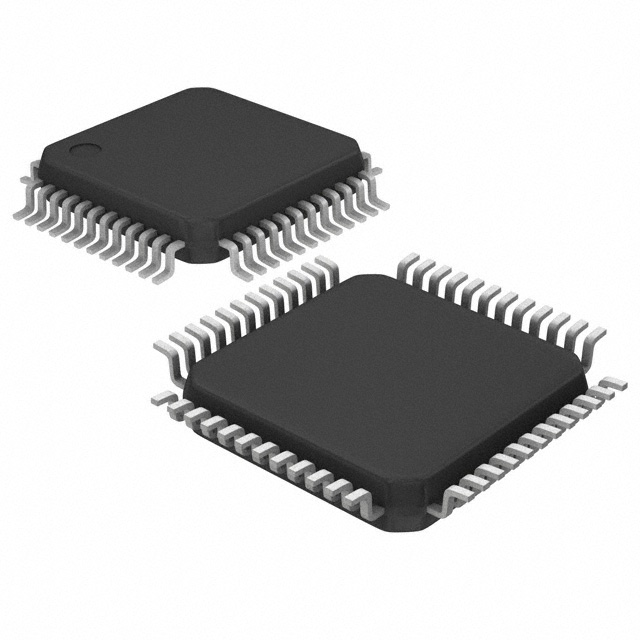
- 48-LQFP
- Datasheet:
-
 MC56F80646VLFR.pdf
- Description:
- MC56F80646VLFR
- Quantity:
- Payment:

- Shipping:

Inventory:1,684
Please send an inquiry. Send us your inquiry, and we will respond immediately.
Product details
Overview
MC56F80646VLFR from NXP Semiconductors is a 32-bit digital signal controller (DSC) based on the 56800EF core, operating at up to 100 MHz with 64 KB flash and 8 KB RAM. It integrates dual 12-bit ADCs with x1/x2/x4 programmable gain amplifiers, three analog comparators with 8-bit DAC references, and an eFlexPWM module supporting up to 12 outputs-including 8 channels with 312 ps NanoEdge resolution-targeting industrial motor control and solar inverter systems.
For engineers reviewing the MC56F80646VLFR datasheet, MC56F80646VLFR pinout, MC56F80646VLFR application, or MC56F80646VLFR equivalent, key selection criteria include V-grade temperature range (–40°C to +105°C), 64-pin LQFP package, 2.7–3.6 V single-supply operation, LIN-capable QSCI interfaces, and hardware CORDIC/eFPU acceleration for real-time control math.
Technical Context
The MC56F80646VLFR implements the 56800EF core with unified DSP/MCU architecture, featuring single-cycle 32×32→64-bit MAC, eFPU compliant with IEEE 754-2008, and CORDIC engine for trigonometric/hyperbolic functions in Q5.27 format. Its memory map supports simultaneous program/data access to both flash and RAM.
Peripheral integration centers on deterministic real-time control: eFlexPWM enables sub-nanosecond edge placement via NanoEdge; dual 12-bit ADCs support synchronized sampling with 10-cycle conversion time and programmable pre-amplification; and the inter-module crossbar routes events between ADC, PWM, timers, and comparators without CPU intervention.
Key Specifications
| Parameter | Value and Actual Design Meaning |
|---|---|
| Core | 32-bit 56800EF DSP/MCU hybrid, 100 MHz max frequency - enables deterministic 100 MIPS execution for closed-loop control loops. |
| Flash / RAM | 64 KB flash, 8 KB RAM - sufficient for complex motion algorithms and dual-channel sensor fusion firmware. |
| ADC | Dual 12-bit cyclic ADCs, 14-channel each, with x1/x2/x4 PGA - supports high-precision current/voltage sensing in motor drives. |
| eFlexPWM | Up to 12 PWM outputs, 8 with 312 ps NanoEdge resolution - delivers precise deadtime control and phase-shifted gate drive for 3-phase inverters. |
| Operating Temp | V grade: –40°C to +105°C - qualified for under-hood automotive power electronics and industrial variable-frequency drives. |
| Supply Voltage | 2.7 V to 3.6 V single supply - simplifies power design with no separate analog/digital rails required. |
| Package | 64-pin LQFP - provides 54 GPIOs and full peripheral pinout accessibility for prototyping and production PCB layout. |
Pinout & Package
MC56F80646VLFR is housed in a 64-pin LQFP package (10 mm × 10 mm, 0.5 mm pitch) with exposed thermal pad. Pin functions are multiplexed via GPIOx_PER and SIM GPSx registers; all pins default to GPIO input after reset except JTAG and RESET_B.
| Pin/Terminal | Circuit Role | Design Meaning |
|---|---|---|
| VDD (pins 29,44,60) | I/O Power Supply | 3.3 V digital I/O rail - requires local 100 nF + 4.7 µF decoupling per group to suppress switching noise. |
| VDDA (pin 22) | Analog Power Supply | 3.3 V analog domain rail - must be isolated from digital VDD with ferrite bead or separate LDO for ADC/CMP accuracy. |
| VCAP (pin 26) | Core Regulator Output | Stabilizes internal 1.2 V core voltage - mandates ≥2.2 µF ceramic capacitor to VSS for stable 100 MHz operation. |
| ADCA0–ADCA13 | Analog Input Channel | Primary ADC A inputs - support single-ended/differential acquisition with programmable gain for current shunt sensing. |
| PWM_A0–PWM_A7 | eFlexPWM Output | NanoEdge-capable PWM outputs - enable 312 ps edge placement for <1 ns deadtime tuning in SiC/GaN gate drivers. |
| QSCI0_TX/QSCI0_RX | LIN Slave Interface | Hardware LIN 2.2-compliant UART - allows direct connection to automotive body control modules without external transceiver. |
Key Features
| Feature | Design Value |
|---|---|
| NanoEdge PWM resolution | 312 ps edge placement precision - eliminates external delay ICs in high-frequency inverter designs. |
| CORDIC + eFPU co-processing | Hardware-accelerated sin/cos/tan/sqrt in <100 cycles - reduces CPU load for field-oriented control (FOC) math by >70% vs software-only. |
| Inter-Module Crossbar | Configurable event routing between ADC, PWM, timers, and comparators - enables zero-latency trigger chains without ISR overhead. |
| Dual 12-bit ADC with PGA | Programmable x1/x2/x4 gain per channel - accommodates ±50 mV shunt signals and ±10 V bus voltage in same design. |
| Windowed COP watchdog | Configurable timeout window with multiple clock sources - meets EN60730 Class B requirements for safety-critical motor control. |
Applications
| Industrial Motor Control | Solar Inverter |
|---|---|
Use Scenario: Closed-loop vector control of 3-phase PMSM/BLDC motors in HVAC compressors and CNC spindles. IC Role / Device Role / Timing Role: Real-time DSC executing FOC algorithm, sampling current/voltage at 20 kHz, generating 16 kHz PWM with adaptive deadtime. Use Value: NanoEdge PWM and CORDIC enable <5 µs current loop latency and <0.5° torque ripple reduction versus fixed-point MCU solutions. | Use Scenario: MPPT tracking and grid-synchronized DC/AC inversion in residential string inverters. IC Role / Device Role / Timing Role: Dual ADCs acquire PV voltage/current and AC line voltage simultaneously; eFlexPWM drives IGBT/SiC half-bridges with precise reactive power control. Use Value: Hardware CRC and windowed COP ensure ASIL-B compliance for fault detection during islanding prevention routines. |
| Uninterruptible Power Supply (UPS) | Smart Appliance Control |
Use Scenario: Bi-directional AC/DC and DC/AC conversion with battery charge management in online UPS systems. IC Role / Device Role / Timing Role: Coordinating buck-boost PFC stage and inverter stage via synchronized PWM triggers and shared ADC sampling. Use Value: Inter-module crossbar eliminates software synchronization delays, enabling <100 ns phase alignment between PFC and inverter legs. | Use Scenario: Sensor-fused washing machine drum control with vibration suppression and water-level adaptation. IC Role / Device Role / Timing Role: Running adaptive PID loops on motor position (eQDC), current (ADC), and temperature (on-chip sensor) data at 1 kHz. Use Value: On-chip temperature sensor and operational amplifiers reduce BOM cost by eliminating external signal-conditioning components. |
Equivalent & Alternatives
The following parts are listed as comparable options for similar digital signal controller applications.
| Alternative Part | Technical Difference | Application Difference | Selection Advice |
|---|---|---|---|
| MC56F80746VLFR | Same 64-pin LQFP package, higher flash (64 KB vs 64 KB), identical peripherals, but rated for M-grade temp (–40°C to +125°C). | Required for under-hood automotive traction inverters where ambient exceeds +105°C. | Select when extended temperature range is mandatory; otherwise MC56F80646VLFR offers identical functionality at lower cost. |
| dsPIC33CK256MP508-I/PT | 16-bit dsPIC core, 100 MIPS, 256 KB flash, 32 KB RAM, 12-bit ADC (12 ch), 10 ns PWM resolution, but lacks CORDIC and eFPU. | Better suited for cost-sensitive consumer appliances where floating-point math is not required. | Choose for legacy dsPIC codebase migration or when higher flash/RAM is needed without CORDIC dependency. |
Compared with MC56F80746VLFR, the MC56F80646VLFR trades M-grade thermal rating for V-grade qualification-reducing cost while retaining identical PWM, ADC, and crossbar capabilities. Against dsPIC33CK256MP508-I/PT, it offers superior real-time math acceleration (CORDIC/eFPU) but less flash capacity, making it optimal for thermally constrained industrial inverters requiring deterministic FOC.
Availability
MC56F80646VLFR is available at Aetrix Electronics and suitable for industrial motor control, solar inverter, and uninterruptible power supply (UPS) applications requiring stable component supply, long-term lifecycle assurance, and automotive-grade reliability.
Supply support for MC56F80646VLFR includes scheduled delivery planning, volume procurement assistance, BOM continuity management, traceable sourcing, and lifecycle availability coordination for OEM customers, industrial embedded developers, connected-device designers, and electronics production programs.
Manufacturer
NXP Semiconductors is a global semiconductor leader specializing in secure connectivity solutions for automotive, industrial, and IoT markets, with over 40 years of microcontroller innovation.
The MC56F80xxx family targets high-performance real-time control applications, combining DSP computational power with MCU flexibility to replace dual-chip solutions in motion, power, and sensor systems.
FAQ
What is the maximum operating frequency of the MC56F80646VLFR core?
The MC56F80646VLFR features a 32-bit 56800EF core rated for up to 100 MHz operation, delivering 100 MIPS performance. This frequency is achievable across the full V-grade temperature range (–40°C to +105°C) when supplied with 2.7–3.6 V and properly decoupled using the specified VCAP capacitor network. The core uses a modified dual-Harvard architecture with concurrent instruction fetch and dual data access capability.
Does the MC56F80646VLFR support LIN communication natively?
Yes, the MC56F80646VLFR includes two queued serial communication interface (QSCI) modules with integrated LIN slave functionality compliant with LIN 2.2. Each QSCI supports automatic header detection, checksum verification, and sleep/wake-up frame handling without CPU intervention. The LIN interface operates directly on the QSCI pins-no external transceiver is required for basic slave node implementation in automotive body electronics.
How many PWM outputs does the MC56F80646VLFR provide, and what is the finest resolution?
The MC56F80646VLFR integrates one eFlexPWM module supporting up to 12 PWM outputs, with 8 channels capable of NanoEdge placement at 312 ps resolution. This sub-nanosecond timing precision enables accurate deadtime insertion for SiC and GaN power devices. All PWM outputs are individually configurable for polarity, complementary pairing, and forced output states via hardware events.
What analog peripherals are integrated into the MC56F80646VLFR?
The MC56F80646VLFR integrates two independent 12-bit cyclic ADCs (ADCA and ADCB), each with 14 external input channels and a programmable x1/x2/x4 gain amplifier. It also includes three analog comparators with integrated 8-bit DAC references, two operational amplifiers configurable as PGAs or filters, and an on-chip temperature sensor. These resources support simultaneous current, voltage, and thermal monitoring in power conversion systems.
Is the MC56F80646VLFR pin-compatible with other members of the MC56F80xxx family?
Yes, the MC56F80646VLFR in 64-pin LQFP shares identical pinout and signal mapping with other 64-pin variants including MC56F80746VLFR and MC56F80648VLFR. This allows hardware reuse across performance tiers-e.g., upgrading flash size or temperature grade without PCB redesign. Pin compatibility is confirmed in Section 4 (Pinout) of the MC56F80XXX datasheet Rev. 2.1.
MC56F80646VLFR Specifications
- Product attributes
- Attribute value
- Manufacturer:
- NXP Semiconductors
- Series:
- 56F80xxx
- Package/Case:
- 48-LQFP
- Packaging:
- Tape & Reel (TR)
- Product Status:
- Active
- Type:
- DSP
- Interface:
- SCI, SPI
- Clock Rate:
- 100MHz
- Non-Volatile Memory:
- FLASH (64kB)
- On-Chip RAM:
- 8kB
- Voltage - I/O:
- 3.30V
- Voltage - Core:
- 3.30V
- Operating Temperature:
- -40°C ~ 105°C (TA)
- Grade:
- -
- Qualification:
- -
- Mounting Type:
- Surface Mount
- Supplier Device Package:
- 48-LQFP (7x7)
MC56F80646VLFR FAQ
1.How can I place an order for MC56F80646VLFR through Aetrix?
Please submit a Request for Quotation (RFQ) for MC56F80646VLFR on Aetrix. Our sales agent will provide a competitive quotation and guide you through the order confirmation once you accept the terms.
2.Are the price and stock information for MC56F80646VLFR reliable?
The price and inventory of MC56F80646VLFR are updated periodically and may fluctuate due to market conditions. Stock and pricing data are typically refreshed every 24 hours. Quotation validity for MC56F80646VLFR is usually 5 days.
3.What payment methods are accepted for MC56F80646VLFR?
We accept Wire Transfer, PayPal, Credit Card, Western Union, MoneyGram, and Escrow for MC56F80646VLFR transactions.
Note: Certain payment methods may incur a processing fee.
4.How is shipping managed for MC56F80646VLFR?
MC56F80646VLFR orders can be shipped via leading logistics carriers, including DHL, UPS, FedEx, TNT, or Registered Mail.
Once your MC56F80646VLFR order is processed, you will receive an email with the shipment details and tracking number.
Note: Tracking information may take up to 24 hours to appear. Express delivery typically takes 3–5 business days.
5.How can I obtain technical support or documentation for MC56F80646VLFR?
For technical support, including MC56F80646VLFR datasheets, pinout diagrams, or application guidance, please contact our engineering support team. They can provide detailed documentation and assistance for your MC56F80646VLFR requirements.
6.How does Aetrix verify that MC56F80646VLFR is sourced from the original manufacturer or authorized distributors?
All MC56F80646VLFR products on Aetrix are procured from qualified distributors and authorized channels. Our dedicated quality assurance team conducts strict verification, including traceability checks and, if necessary, third-party testing. This ensures that MC56F80646VLFR meets industry standards.
7.What is the process for return or replacement of MC56F80646VLFR?
All MC56F80646VLFR units undergo pre-shipment inspection (PSI). If there is an issue with MC56F80646VLFR, returns or replacements are accepted under the following conditions:
1.Quantity discrepancies, incorrect items, or visible external defects (such as breakage or corrosion), acknowledged by Aetrix.
2.The issue is reported within 90 days of delivery.
3.The MC56F80646VLFR part is unused and in its original packaging.
Return procedure for MC56F80646VLFR:
1.Submit a request within 90 days.
2.Obtain a Return Material Authorization (RMA) from Aetrix.
MC56F80646VLFR Tags
-
TMS320C5535AZAY10
Texas Instruments
-
TMS320VC5501PGF300
Texas Instruments
-
ADSP-BF592KCPZ
Analog Devices Inc.
-
ADAU1463WBCPZ150
Analog Devices Inc.
-
TMS320VC5402PGE100
Texas Instruments
-
ADAU1701JSTZ-RL
Analog Devices Inc.
-
ADAU1701JSTZ
Analog Devices Inc.
-
TMS320VC5502PGF300
Texas Instruments
-
ADAU1462WBCPZ300RL
Analog Devices Inc.
-
ADAU1452KCPZRL
Analog Devices Inc.
-
ADAU1452WBCPZ-RL
Analog Devices Inc.
-
TMS320C6747DZKB3
Texas Instruments
Tech Hub

A practical engineering guide to 3.3V and 5V logic compatibility, input thresholds, resistor dividers, translator ICs, MOSFET level shifting, I2C pull-ups, timing limits and power-sequencing risks.

The 74HC595 uses push-pull logic outputs, while the TPIC6B595 uses 50 V open-drain DMOS sinks for higher-power loads. This guide compares timing, current limits, 3.3 V interfacing, load wiring, thermal…

The 74HC595 converts serial data into eight stable parallel outputs. This guide covers pin functions, shift and storage timing, OE and MR behavior, drive-current limits, cascading, voltage compatibilit…

A technical comparison of level-sensitive latches and edge-triggered flip-flops, covering timing windows, setup and hold limits, master–slave operation, time borrowing, race-through, HDL inference and…

A D latch stores one bit while Enable controls when data can pass. This reference covers gate-level operation, truth tables, transparency, setup and hold timing, LE versus OE, common ICs and practical …

An SR latch stores one bit through cross-coupled feedback. This engineering reference covers NOR and NAND implementations, truth tables, forbidden-state recovery, gated operation, switch debouncing, fa…

Latch circuits retain one bit through feedback. This technical reference covers SR and D latches, truth tables, transparency, timing limits, latch-versus-flip-flop behavior, applications and common log…

An engineering guide to LED driver operation, constant-current and constant-voltage outputs, linear and switching topologies, dimming, IC selection, calculations, replacement compatibility, and fault c…

Operational amplifier guide covering op amp basics, feedback, ideal vs real op amps, common configurations, buffer circuits, offset, bias current, gain-bandwidth, slew rate, rail-to-rail limits and sel…

Jumper cables guide covering safe connection order, red and black clamp placement, final ground connection, cable gauge, length, clamp quality, copper vs CCA cables, jump starter comparison and battery…


