
 My Inquiry
 My Account


NXP Semiconductors MC7447AHX733NB
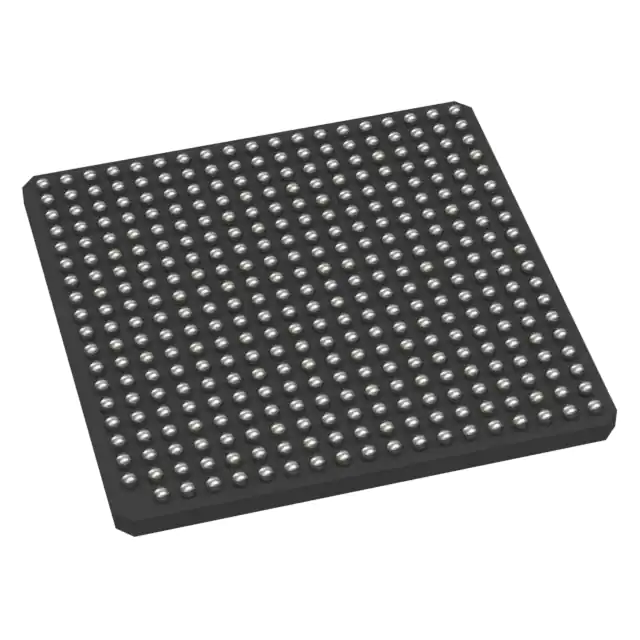
- Part No.:
- MC7447AHX733NB
- Manufacturer:
- NXP Semiconductors
- Category:
- Microprocessors
- Package:
- 360-BCBGA, FCCBGA
- Datasheet:
-
 MC7447AHX733NB.pdf
- Description:
- IC MPU MPC74XX 733MHZ 360FCCBGA
- Quantity:
- Payment:

- Shipping:

Inventory:1,170
Please send an inquiry. Send us your inquiry, and we will respond immediately.
Product details
Overview
MC7447AHX733NB from Freescale Semiconductor is a 32-bit PowerPC G4 RISC microprocessor with 512-Kbyte unified L2 cache, 32-Kbyte L1 instruction and data caches, and AltiVec™ SIMD engine. It operates at 733 MHz core frequency with 1.3 V core supply and supports MPX/60x bus protocols for high-performance computing and networking systems.
For engineers reviewing the MC7447AHX733NB datasheet, MC7447AHX733NB pinout, MC7447AHX733NB application, or MC7447AHX733NB equivalent, key selection criteria include dynamic frequency switching (DFS), integrated temperature diode, 360-ball ceramic BGA package, IEEE 754-compliant FPU, and hardware-enforced MESI cache coherency for multiprocessor designs.
Technical Context
The MC7447AHX733NB implements a seven-stage superscalar pipeline with up to 16 in-flight instructions, three independent issue queues (FIQ/VIQ/GIQ), and eleven execution units including four integer, five vector, and one scalar floating-point unit. It features dual MMUs with 128-entry two-way TLBs and 8-entry IBAT/DBAT arrays for 52-bit virtual addressing.
Its memory subsystem includes physically indexed L1 caches with PLRU replacement, 9-cycle L1 miss-to-L2 hit latency, and a fully pipelined 256-bit L2 interface delivering 32 bytes/cycle to L1. DFS enables software-controlled halving of core frequency to reduce power, while the on-die temperature diode supports thermal monitoring without external sensors.
Key Specifications
| Parameter | Value and Actual Design Meaning |
|---|---|
| Core Frequency | 733 MHz - Fixed-speed grade confirmed by part number suffix '733'; determines maximum instruction throughput and system timing budget. |
| L2 Cache | 512-Kbyte unified, eight-way set-associative - Reduces main memory bandwidth pressure and improves deterministic latency for real-time workloads. |
| Core Supply Voltage | 1.3 V ± 50 mV - Enables low-power operation while maintaining full performance; deratable to 1.2 V for further power reduction. |
| I/O Supply Voltage | 1.8 V or 2.5 V selectable via BVSEL - Supports legacy 1.8-V and newer 2.5-V system buses without level-shifting circuitry. |
| Package | 360-ball ceramic BGA (HCTE) - Provides thermal stability and signal integrity for high-speed MPX bus operation up to 142 MHz SYSCLK. |
| Thermal Diode | Integrated on-die sensor - Enables direct junction temperature measurement for closed-loop thermal management without external components. |
| Dynamic Frequency Switching | Software-controllable core clock halving - Reduces dynamic power by ~75% during low-load periods while preserving cache and register state. |
Pinout & Package
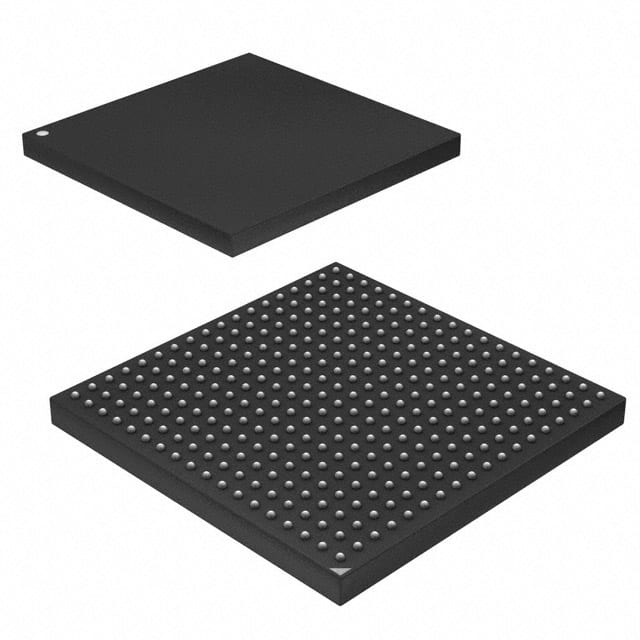
MC7447AHX733NB uses a surface-mount 360-ball ceramic ball grid array (HCTE) package with 1.27 mm pitch, designed for high thermal conductivity and signal integrity in demanding embedded computing applications.
| Pin/Terminal | Circuit Role | Design Meaning |
|---|---|---|
| VDD (Balls A1–A10, C1–C10, E1–E10, G1–G10) | Core power supply | 10× dedicated 1.3 V supply pins distributed across package corners and edges to minimize IR drop and noise coupling. |
| OVDD (Balls D1–D10, F1–F10) | I/O power supply | 10× configurable 1.8 V / 2.5 V supply pins supporting bus voltage selection via BVSEL pin state at HRESET negation. |
| AVDD (Ball H1) | PLL analog supply | Isolated analog power input for PLL circuitry; requires separate filtering per Section 9.2 to suppress jitter-sensitive noise. |
| BVSEL (Ball P1) | Bus voltage select | Configures processor bus I/O threshold: logic low = 1.8 V mode, logic high/HRESET = 2.5 V mode; must match OVDD voltage. |
| THERM (Ball T1) | Temperature diode output | Analog output pin providing voltage proportional to die temperature; used with external ADC for thermal monitoring. |
| DFS[0:1] (Balls R1, R2) | Dynamic frequency control | Two-bit input controlling core clock divider ratio: 00 = full speed, 01/10 = half speed, 11 = reserved; enables runtime power scaling. |
Key Features
| Feature | Design Value |
|---|---|
| AltiVec™ SIMD Engine | Four vector units (VIU1/VIU2/VFPU/VPU) with 32-entry VR file enabling parallel 128-bit integer/floating-point operations for media and signal processing. |
| Hardware Cache Coherency | MESI protocol enforcement in data cache eliminates need for software cache flushes in symmetric multiprocessing (SMP) configurations. |
| Branch Prediction | 128-entry BTIC + 2048-entry BHT + 8-entry link stack reduces misprediction penalty to 6 cycles and improves instruction fetch efficiency. |
| Memory Management | Dual MMUs with 128-entry TLBs, 8-entry BAT arrays, and hardware/software page table walk support flexible 4-KB to 256-MB memory mapping. |
| Power Management States | Nap, Sleep, and Deep Sleep modes disable progressively more logic blocks while retaining critical state, reducing idle power to ~4.1 W typical. |
Applications
| Networking Router Control Plane | Industrial Real-Time Controller |
|---|---|
|
Use Scenario: Running Linux-based routing stacks (e.g., Quagga, FRR) with packet classification and QoS policy enforcement. IC Role / Device Role / Timing Role: Primary application processor executing control-plane software, managing TCAM configuration, and synchronizing with data-path ASICs via MPX bus. Use Value: 733 MHz core + 512-KB L2 cache delivers sub-millisecond route convergence times while DFS reduces thermal load during low-traffic periods. |
Use Scenario: Deterministic motion control in CNC machines using EtherCAT or SERCOS III fieldbus interfaces. IC Role / Device Role / Timing Role: Real-time host controller coordinating servo drives, reading encoder feedback, and executing PID loops at 1–10 kHz rates. Use Value: Hardware-enforced cache coherency and precise exception model ensure predictable interrupt latency (< 500 ns) and deterministic execution under load. |
| High-End Print Server | Avionics Data Concentrator |
|
Use Scenario: RIP processing and raster image decompression for production-grade digital presses handling 100+ ppm throughput. IC Role / Device Role / Timing Role: Compute-intensive host CPU offloading graphics rendering to FPGA accelerators via local bus, managing job queue and memory buffers. Use Value: AltiVec™ engine accelerates JPEG2000 decode and color space conversion; 32-KB L1 caches minimize memory stalls during bursty print-job bursts. |
Use Scenario: ARINC 664 (AFDX) end-system aggregating sensor data from flight control, navigation, and environmental systems. IC Role / Device Role / Timing Role: Safety-critical deterministic processor executing DO-254/DO-178C certified partitioned software with time-triggered scheduling. Use Value: Integrated temperature diode and DFS enable closed-loop thermal throttling within DO-178C certifiable bounds; ECC-capable caches enhance reliability. |
Equivalent & Alternatives
The following parts are listed as comparable options for similar RISC microprocessor applications.
| Alternative Part | Technical Difference | Application Difference | Selection Advice |
|---|---|---|---|
| MPC7447AHX733B | Same core, identical 733 MHz speed grade, but in RoHS-compliant 360-ball ceramic BGA (HCTE) package with lead-free finish. | No functional difference; selected when lead-free compliance is required for final product certification (e.g., EU RoHS, China RoHS). | Direct drop-in replacement if board layout supports RoHS-compatible solder reflow profile and thermal pad design. |
| MPC7447AHX800B | Higher-speed grade: 800 MHz core frequency, same architecture, L2 cache, and pinout; requires higher VDD stability and improved thermal design. | Suitable for applications needing >8% higher Dhrystone MIPS (2.3 MIPs/MHz × 800 MHz vs. 733 MHz) without architectural changes. | Valid alternative only if system power delivery and cooling can support 25–30 W peak power at 800 MHz operation. |
Compared with MC7447AHX733NB, MPC7447AHX733B offers identical electrical and thermal behavior with RoHS compliance, while MPC7447AHX800B trades higher power and thermal requirements for increased compute throughput-both retain full software compatibility and pinout.
Availability
MC7447AHX733NB is available at Aetrix Electronics and suitable for networking router control planes, industrial real-time controllers, high-end print servers, and avionics data concentrators requiring stable component supply and long-term obsolescence management.
Supply support for MC7447AHX733NB includes scheduled delivery planning, volume procurement assistance, BOM continuity management, traceable sourcing, and lifecycle availability coordination for OEM customers, industrial embedded developers, connected-device designers, and electronics production programs.
Manufacturer
Freescale Semiconductor (now part of NXP Semiconductors) is a fabless semiconductor company specializing in embedded processing, connectivity, and analog solutions for automotive, industrial, and networking markets.
The MPC7447A product line was designed for high-performance embedded computing applications requiring deterministic real-time response, hardware-accelerated signal processing, and scalable multiprocessing support in thermally constrained environments.
FAQ
What is the core frequency of the MC7447AHX733NB?
The MC7447AHX733NB is a fixed-speed grade microprocessor operating at 733 MHz core frequency. This value is encoded in the part number suffix '733' and verified by factory screening per Freescale's AC timing specifications. The actual core clock is derived from the SYSCLK bus frequency multiplied by the PLL_CFG settings, and remains stable across temperature and voltage variations within the 1.3 V ± 50 mV operating range.
Does the MC7447AHX733NB support dynamic frequency switching (DFS)?
Yes, the MC7447AHX733NB includes hardware-supported dynamic frequency switching (DFS) that allows software to halve the core clock frequency on-the-fly. This feature reduces dynamic power consumption by approximately 75% during low-load periods while preserving cache contents and register state. DFS is controlled via the DFS[0:1] pins and documented in Section 9.8.5 of the MPC7447A Hardware Specifications.
What package type does the MC7447AHX733NB use?
The MC7447AHX733NB uses a 360-ball ceramic ball grid array (HCTE) package with 1.27 mm pitch. This surface-mount package provides superior thermal dissipation and signal integrity for high-speed MPX bus operation. It is footprint-compatible with other MPC7447A variants, including RoHS-compliant versions like MC7447AHX733B, though solder paste and reflow profiles may differ.
How does the integrated temperature diode function in the MC7447AHX733NB?
The MC7447AHX733NB includes an on-die temperature diode accessible via the THERM pin (Ball T1). When biased with a constant current source, this diode produces a voltage linearly proportional to junction temperature, enabling accurate die-temperature monitoring without external sensors. Calibration data is provided in Freescale's thermal management application notes for integration into system thermal control firmware.
Is the MC7447AHX733NB pin-compatible with the MPC7447 series?
Yes, the MC7447AHX733NB is footprint-compatible and electrically compatible with earlier MPC7447 devices, as confirmed in Freescale's documentation: "The MPC7447A is a footprint-compatible, drop-in replacement in an MPC7447 application if the core power supply is 1.3 V." Key differences-DFS and temperature diode-are implemented without altering pin assignments, power domains, or bus signaling protocols.
MC7447AHX733NB Specifications
- Product attributes
- Attribute value
- Manufacturer:
- NXP Semiconductors
- Package/Case:
- 360-BCBGA, FCCBGA
- Series:
- MPC74xx
- Packaging:
- Tray
- Product Status:
- Obsolete
- Core Processor:
- PowerPC G4
- Number of Cores/Bus Width:
- 1 Core, 32-Bit
- Speed:
- 733MHz
- Co-Processors/DSP:
- Multimedia; SIMD
- RAM Controllers:
- -
- Graphics Acceleration:
- No
- Display & Interface Controllers:
- -
- Ethernet:
- -
- SATA:
- -
- USB:
- -
- Voltage - I/O:
- 1.8V, 2.5V
- Operating Temperature:
- 0°C ~ 105°C (TA)
- Grade:
- -
- Qualification:
- -
- Security Features:
- -
- Mounting Type:
- Surface Mount
- Supplier Device Package:
- 360-FCCBGA (25x25)
- Additional Interfaces:
- -
MC7447AHX733NB FAQ
1.How can I place an order for MC7447AHX733NB through Aetrix?
Please submit a Request for Quotation (RFQ) for MC7447AHX733NB on Aetrix. Our sales agent will provide a competitive quotation and guide you through the order confirmation once you accept the terms.
2.Are the price and stock information for MC7447AHX733NB reliable?
The price and inventory of MC7447AHX733NB are updated periodically and may fluctuate due to market conditions. Stock and pricing data are typically refreshed every 24 hours. Quotation validity for MC7447AHX733NB is usually 5 days.
3.What payment methods are accepted for MC7447AHX733NB?
We accept Wire Transfer, PayPal, Credit Card, Western Union, MoneyGram, and Escrow for MC7447AHX733NB transactions.
Note: Certain payment methods may incur a processing fee.
4.How is shipping managed for MC7447AHX733NB?
MC7447AHX733NB orders can be shipped via leading logistics carriers, including DHL, UPS, FedEx, TNT, or Registered Mail.
Once your MC7447AHX733NB order is processed, you will receive an email with the shipment details and tracking number.
Note: Tracking information may take up to 24 hours to appear. Express delivery typically takes 3–5 business days.
5.How can I obtain technical support or documentation for MC7447AHX733NB?
For technical support, including MC7447AHX733NB datasheets, pinout diagrams, or application guidance, please contact our engineering support team. They can provide detailed documentation and assistance for your MC7447AHX733NB requirements.
6.How does Aetrix verify that MC7447AHX733NB is sourced from the original manufacturer or authorized distributors?
All MC7447AHX733NB products on Aetrix are procured from qualified distributors and authorized channels. Our dedicated quality assurance team conducts strict verification, including traceability checks and, if necessary, third-party testing. This ensures that MC7447AHX733NB meets industry standards.
7.What is the process for return or replacement of MC7447AHX733NB?
All MC7447AHX733NB units undergo pre-shipment inspection (PSI). If there is an issue with MC7447AHX733NB, returns or replacements are accepted under the following conditions:
1.Quantity discrepancies, incorrect items, or visible external defects (such as breakage or corrosion), acknowledged by Aetrix.
2.The issue is reported within 90 days of delivery.
3.The MC7447AHX733NB part is unused and in its original packaging.
Return procedure for MC7447AHX733NB:
1.Submit a request within 90 days.
2.Obtain a Return Material Authorization (RMA) from Aetrix.
MC7447AHX733NB Tags
-
AT91SAM9260B-CU-999
Microchip Technology
-
AT91SAM9G25-CU
Microchip Technology
-
ATSAMA5D27C-CU
Microchip Technology
-
AT91SAM9X35-CU
Microchip Technology
-
AT91SAM9X25-CU
Microchip Technology
-
MCIMX6Y2CVM08AB
NXP Semiconductors
.JPG)
-
AM3352BZCZ100
Texas Instruments
-
AT91SAM9260B-CU
Microchip Technology
-
AT91SAM9260B-QU
Microchip Technology
-
ATSAMA5D31A-CU
Microchip Technology
-
AT91SAM9G20B-CU-999
Microchip Technology
-
MCIMX6Y2CVM05AB
NXP Semiconductors
Tech Hub

A practical engineering guide to 3.3V and 5V logic compatibility, input thresholds, resistor dividers, translator ICs, MOSFET level shifting, I2C pull-ups, timing limits and power-sequencing risks.

The 74HC595 uses push-pull logic outputs, while the TPIC6B595 uses 50 V open-drain DMOS sinks for higher-power loads. This guide compares timing, current limits, 3.3 V interfacing, load wiring, thermal…

The 74HC595 converts serial data into eight stable parallel outputs. This guide covers pin functions, shift and storage timing, OE and MR behavior, drive-current limits, cascading, voltage compatibilit…

A technical comparison of level-sensitive latches and edge-triggered flip-flops, covering timing windows, setup and hold limits, master–slave operation, time borrowing, race-through, HDL inference and…

A D latch stores one bit while Enable controls when data can pass. This reference covers gate-level operation, truth tables, transparency, setup and hold timing, LE versus OE, common ICs and practical …

An SR latch stores one bit through cross-coupled feedback. This engineering reference covers NOR and NAND implementations, truth tables, forbidden-state recovery, gated operation, switch debouncing, fa…

Latch circuits retain one bit through feedback. This technical reference covers SR and D latches, truth tables, transparency, timing limits, latch-versus-flip-flop behavior, applications and common log…

An engineering guide to LED driver operation, constant-current and constant-voltage outputs, linear and switching topologies, dimming, IC selection, calculations, replacement compatibility, and fault c…

Operational amplifier guide covering op amp basics, feedback, ideal vs real op amps, common configurations, buffer circuits, offset, bias current, gain-bandwidth, slew rate, rail-to-rail limits and sel…

Jumper cables guide covering safe connection order, red and black clamp placement, final ground connection, cable gauge, length, clamp quality, copper vs CCA cables, jump starter comparison and battery…


