
 My Inquiry
 My Account


onsemi MC74VHCT14AMG
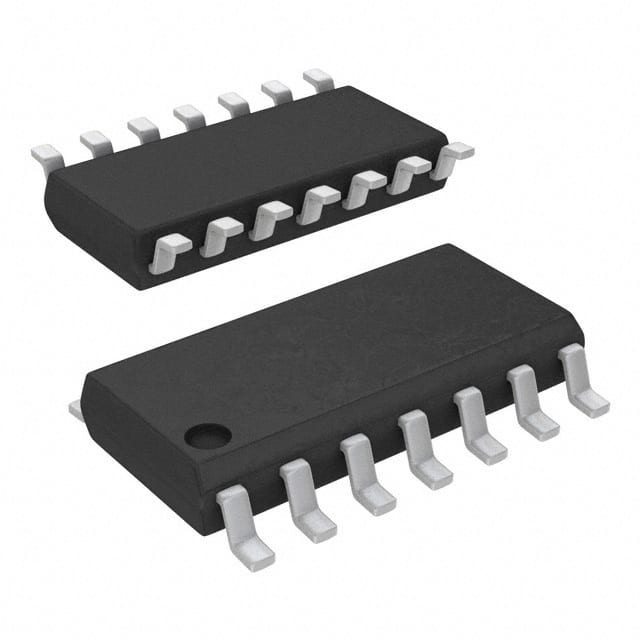
- Part No.:
- MC74VHCT14AMG
- Manufacturer:
- onsemi
- Category:
- Gates and Inverters
- Package:
- 14-SOIC (0.209", 5.30mm Width)
- Datasheet:
-
 MC74VHCT14AMG.pdf
- Description:
- IC INVERTER 6CH 1-INP SOEIAJ-14
- Quantity:
- Payment:

- Shipping:

Inventory:1,064
Please send an inquiry. Send us your inquiry, and we will respond immediately.
Product details
Overview
MC74VHCT14AMG from onsemi is a hex Schmitt-trigger inverter IC operating at 4.5–5.5 V supply, with 8 mA output drive, 7 ns typical propagation delay at 5 V, and TTL-compatible input thresholds. It performs signal conditioning and noise-immune digital inversion in microcontroller I/O expansion and sensor interface circuits.
For engineers reviewing the MC74VHCT14AMG datasheet, pinout, applications, or equivalent options, key selection criteria include input hysteresis width (≈0.8 V), rail-to-rail output swing, industrial temperature range (−40°C to +85°C), and SOIC-14 package compatibility with legacy 74-series logic layouts.
Technical Context
This device implements six independent CMOS Schmitt-trigger inverters using silicon-gate VHCT technology, ensuring TTL-level input recognition while maintaining CMOS power efficiency. Each gate features hysteresis of 0.5 V (min) to 1.0 V (max) for robust noise rejection on slow or noisy signals.
The MC74VHCT14AMG operates strictly within 4.5–5.5 V VCC, supports fan-out of 10 LSTTL loads per output, and guarantees AC/DC parametric performance across the full industrial temperature range without derating.
Key Specifications
| Parameter | Value and Actual Design Meaning |
|---|---|
| Supply Voltage | 4.5 V to 5.5 V - Ensures compatibility with standard 5 V logic rails and tolerance against supply ripple. |
| Input Hysteresis | 0.5 V (min) to 1.0 V (max) - Provides noise margin for debouncing mechanical switches or recovering degraded waveforms. |
| Propagation Delay | 7 ns (typ) at 5 V - Enables reliable timing in sub-15 MHz clock distribution and data strobing paths. |
| Output Drive | ±8 mA (IOH/IOL) - Sufficient to directly drive LED indicators or small capacitive loads (<30 pF). |
| Operating Temperature | −40°C to +85°C - Qualified for industrial control, automotive body electronics, and outdoor instrumentation. |
| Input Thresholds | VIL = 0.8 V (max), VIH = 2.0 V (min) - Matches TTL logic levels, allowing direct interfacing with legacy 74LS/74ALS outputs. |
Pinout & Package
MC74VHCT14AMG is housed in a 14-pin Small Outline Integrated Circuit (SOIC-14) package with 1.27 mm pitch, JEDEC MS-012AC compliant, and rated for surface-mount reflow assembly.
| Pin/Terminal | Circuit Role | Design Meaning |
|---|---|---|
| 1, 3, 5, 9, 11, 13 | Input (A1–A6) | Accepts TTL-level signals; Schmitt-trigger input ensures clean edge regeneration on slow-rising inputs. |
| 2, 4, 6, 8, 10, 12 | Output (Y1–Y6) | CMOS push-pull outputs deliver rail-to-rail swing and drive capability up to ±8 mA. |
| 7 | GND | Ground reference for all internal circuitry and output stage return path. |
| 14 | VCC | Positive supply input; must be decoupled locally with 0.1 µF ceramic capacitor. |
Key Features
| Feature | Design Value |
|---|---|
| TTL-Compatible Inputs | Guarantees interoperability with 74LS, 74ALS, and microcontroller GPIOs without level-shifting. |
| Schmitt-Trigger Action | Eliminates chatter on slow or noisy inputs-critical for switch debouncing and analog-signal digitization. |
| High Noise Immunity | Input hysteresis ≥0.5 V suppresses EMI-induced false triggering in motor-drive or relay-control environments. |
| Low Power Consumption | ICC = 2 µA (max) at 25°C enables use in always-on sensor nodes without compromising battery life. |
Applications
| Industrial Switch Debouncing | Microcontroller I/O Expansion |
|---|---|
Use Scenario: Mechanical pushbuttons and limit switches generate contact bounce lasting 1–10 ms in PLC input modules and HMI panels. IC Role / Device Role / Timing Role: MC74VHCT14AMG acts as a hardware debouncer-each inverter cleans one switch signal before routing to MCU interrupt pins. Use Value: Reduces firmware overhead by eliminating software debounce loops; ensures deterministic 7 ns response latency. | Use Scenario: An 8-bit microcontroller lacks sufficient GPIOs for driving 12 LEDs and reading 6 status switches simultaneously. IC Role / Device Role / Timing Role: MC74VHCT14AMG provides six additional buffered, inverted I/O channels via parallel connection to port expander lines. Use Value: Enables direct TTL-level interfacing without external pull-ups or level translators; maintains signal integrity up to 10 MHz. |
| Sensor Signal Conditioning | Legacy System Interface |
Use Scenario: Analog-output ambient light or temperature sensors produce slowly varying DC-biased signals prone to line noise. IC Role / Device Role / Timing Role: MC74VHCT14AMG converts analog thresholds into clean digital edges for microcontroller ADC trigger or comparator enable functions. Use Value: Input hysteresis rejects <100 mV noise spikes; rail-to-rail output ensures full logic swing into MCU input buffers. | Use Scenario: Retrofitting modern microcontrollers into aging industrial equipment originally designed around 74LS14 logic. IC Role / Device Role / Timing Role: MC74VHCT14AMG serves as a drop-in replacement for obsolete 74LS14, preserving PCB layout and timing margins. Use Value: Maintains identical pinout, propagation delay, and drive strength-no redesign or validation rework required. |
Equivalent & Alternatives
The following parts are listed as comparable options for similar hex Schmitt-trigger inverter applications.
| Alternative Part | Technical Difference | Application Difference | Selection Advice |
|---|---|---|---|
| SN74LV14APWR | Lower VCC range (2–5.5 V); 1.65 V min VIH at 2 V supply; 6.5 ns tpd (typ) | Better suited for mixed-voltage systems with 3.3 V logic domains; not TTL-input compatible | Select when interfacing with LVCMOS or mixed-supply designs-not for pure 5 V TTL legacy replacement |
| 74HC14D,653 | Wider VCC (2–6 V); higher input hysteresis (≈1.3 V); 20 ns tpd (typ) at 4.5 V | Higher noise immunity but slower timing; unsuitable where <10 ns delay is required | Choose for cost-sensitive, non-timing-critical applications where enhanced hysteresis outweighs speed penalty |
Compared with SN74LV14APWR and 74HC14D,653, the MC74VHCT14AMG uniquely delivers TTL-compatible inputs, 7 ns speed at 5 V, and industrial temperature rating in SOIC-14-making it the optimal choice for upgrading legacy 74LS14-based systems without layout or firmware changes.
Availability
MC74VHCT14AMG is available at Aetrix Electronics and suitable for industrial automation, sensor interface, and legacy system retrofit applications requiring stable component supply and long-term lifecycle support.
Supply support for MC74VHCT14AMG includes scheduled delivery planning, volume procurement assistance, BOM continuity management, traceable sourcing, and lifecycle availability coordination for OEM customers, industrial embedded developers, connected-device designers, and electronics production programs.
Manufacturer
onsemi is a global semiconductor leader delivering energy-efficient, intelligent power and sensing solutions for automotive, industrial, cloud, medical, and IoT applications.
The VHCT logic family-including MC74VHCT14AMG-is engineered for seamless TTL-to-CMOS migration in industrial and infrastructure systems, emphasizing pin compatibility, timing predictability, and extended temperature operation.
FAQ
What is the recommended operating voltage range for the MC74VHCT14AMG?
The MC74VHCT14AMG is specified to operate reliably between 4.5 V and 5.5 V. Operation outside this range may result in undefined logic states or degraded noise immunity. The device is not rated for 3.3 V operation, and its TTL-compatible inputs require minimum VIH of 2.0 V-ensuring compatibility only with 5 V logic families. Always use local 0.1 µF ceramic decoupling at VCC pin 14 for stable performance.
Does the MC74VHCT14AMG support true TTL input levels?
Yes, the MC74VHCT14AMG features TTL-compatible input thresholds: VIL ≤ 0.8 V (max) and VIH ≥ 2.0 V (min) at VCC = 5.0 V. This allows direct connection to legacy 74LS and 74ALS outputs without level translation. Unlike standard 74HC devices, the VHCT variant maintains these thresholds across temperature and supply variations-critical for field-replaceable industrial modules where signal integrity must be guaranteed.
Can the MC74VHCT14AMG be used as a hardware debouncer for mechanical switches?
Yes, the MC74VHCT14AMG is widely deployed for hardware debouncing due to its built-in Schmitt-trigger hysteresis (0.5–1.0 V). When a switch closes, the input transitions cleanly through the hysteresis band, producing a single, glitch-free output edge. This eliminates the need for RC filters or firmware polling loops. For optimal results, connect the switch between VCC and an input pin with a 10 kΩ pull-down resistor-then route the corresponding output to an MCU interrupt pin.
Is the MC74VHCT14AMG pin-compatible with the obsolete 74LS14?
Yes, the MC74VHCT14AMG uses the same SOIC-14 package and identical pinout as the 74LS14, including input/output pairing and power/ground locations. Electrical characteristics-including propagation delay (7 ns vs. 15 ns for LS), output drive (±8 mA vs. ±0.4 mA for LS), and input thresholds-are improved while preserving functional equivalence. This makes MC74VHCT14AMG a direct drop-in upgrade for boards originally designed for 74LS14.
What is the maximum capacitive load the MC74VHCT14AMG can drive without exceeding propagation delay specs?
The MC74VHCT14AMG is characterized up to 50 pF load capacitance in its datasheet. At 5 V supply and 25°C, tpd remains ≤7 ns with ≤30 pF; beyond 50 pF, delay increases nonlinearly and output rise/fall times degrade. For loads >30 pF, add series termination (e.g., 33 Ω) near the driver to suppress ringing. Avoid driving long traces or multiple parallel inputs without verifying timing margins in the target application.
MC74VHCT14AMG Specifications
- Product attributes
- Attribute value
- Manufacturer:
- onsemi
- Series:
- 74VHCT
- Package/Case:
- 14-SOIC (0.209", 5.30mm Width)
- Packaging:
- Tube
- Product Status:
- Obsolete
- Logic Type:
- Inverter
- Number of Circuits:
- 6
- Number of Inputs:
- 1
- Features:
- Schmitt Trigger
- Voltage - Supply:
- 4.5V ~ 5.5V
- Current - Quiescent (Max):
- 2 µA
- Current - Output High, Low:
- 8mA, 8mA
- Input Logic Level - Low:
- 0.5V ~ 0.6V
- Input Logic Level - High:
- 1.9V ~ 2.1V
- Max Propagation Delay @ V, Max CL:
- 9.6ns @ 5V, 50pF
- Operating Temperature:
- -55°C ~ 125°C
- Grade:
- -
- Qualification:
- -
- Mounting Type:
- Surface Mount
- Supplier Device Package:
- SOEIAJ-14
MC74VHCT14AMG FAQ
1.How can I place an order for MC74VHCT14AMG through Aetrix?
Please submit a Request for Quotation (RFQ) for MC74VHCT14AMG on Aetrix. Our sales agent will provide a competitive quotation and guide you through the order confirmation once you accept the terms.
2.Are the price and stock information for MC74VHCT14AMG reliable?
The price and inventory of MC74VHCT14AMG are updated periodically and may fluctuate due to market conditions. Stock and pricing data are typically refreshed every 24 hours. Quotation validity for MC74VHCT14AMG is usually 5 days.
3.What payment methods are accepted for MC74VHCT14AMG?
We accept Wire Transfer, PayPal, Credit Card, Western Union, MoneyGram, and Escrow for MC74VHCT14AMG transactions.
Note: Certain payment methods may incur a processing fee.
4.How is shipping managed for MC74VHCT14AMG?
MC74VHCT14AMG orders can be shipped via leading logistics carriers, including DHL, UPS, FedEx, TNT, or Registered Mail.
Once your MC74VHCT14AMG order is processed, you will receive an email with the shipment details and tracking number.
Note: Tracking information may take up to 24 hours to appear. Express delivery typically takes 3–5 business days.
5.How can I obtain technical support or documentation for MC74VHCT14AMG?
For technical support, including MC74VHCT14AMG datasheets, pinout diagrams, or application guidance, please contact our engineering support team. They can provide detailed documentation and assistance for your MC74VHCT14AMG requirements.
6.How does Aetrix verify that MC74VHCT14AMG is sourced from the original manufacturer or authorized distributors?
All MC74VHCT14AMG products on Aetrix are procured from qualified distributors and authorized channels. Our dedicated quality assurance team conducts strict verification, including traceability checks and, if necessary, third-party testing. This ensures that MC74VHCT14AMG meets industry standards.
7.What is the process for return or replacement of MC74VHCT14AMG?
All MC74VHCT14AMG units undergo pre-shipment inspection (PSI). If there is an issue with MC74VHCT14AMG, returns or replacements are accepted under the following conditions:
1.Quantity discrepancies, incorrect items, or visible external defects (such as breakage or corrosion), acknowledged by Aetrix.
2.The issue is reported within 90 days of delivery.
3.The MC74VHCT14AMG part is unused and in its original packaging.
Return procedure for MC74VHCT14AMG:
1.Submit a request within 90 days.
2.Obtain a Return Material Authorization (RMA) from Aetrix.
MC74VHCT14AMG Tags
-
SN74LVC1G14DBVR
Texas Instruments
-
SN74LVC1G14DCKR
Texas Instruments
-
SN74AHC1G14DBVR
Texas Instruments
-
SN74LVC1G08DBVR
Texas Instruments
-
SN74LVC1G08DCKR
Texas Instruments
-
SN74LVC1G32DCKR
Texas Instruments
-
SN74LVC1G04DBVR
Texas Instruments
.jpg)
-
74LVC1G08GW,125
Nexperia USA Inc.
-
SN74LVC1G04DCKR
Texas Instruments
-
SN74AHC1G08DBVR
Texas Instruments
-
SN74LVC1G32DBVR
Texas Instruments
-
SN74AHCT1G08DBVR
Texas Instruments
Tech Hub

Counterfeit components can hide behind convincing markings and passing basic function tests. This engineering reference covers source traceability, external inspection, X-ray, XRF, electrical testing, …

A practical engineering and sourcing framework covering lifecycle verification, lifetime-buy calculations, replacement qualification, supplier checks and counterfeit-risk controls.

TTL and CMOS logic families differ in thresholds, loading, output drive, power and timing. This engineering guide compares 74HC and 74HCT, calculates noise margins and checks 3.3 V/5 V compatibility.

A practical engineering guide to 3.3V and 5V logic compatibility, input thresholds, resistor dividers, translator ICs, MOSFET level shifting, I2C pull-ups, timing limits and power-sequencing risks.

The 74HC595 uses push-pull logic outputs, while the TPIC6B595 uses 50 V open-drain DMOS sinks for higher-power loads. This guide compares timing, current limits, 3.3 V interfacing, load wiring, thermal…

The 74HC595 converts serial data into eight stable parallel outputs. This guide covers pin functions, shift and storage timing, OE and MR behavior, drive-current limits, cascading, voltage compatibilit…

A technical comparison of level-sensitive latches and edge-triggered flip-flops, covering timing windows, setup and hold limits, master–slave operation, time borrowing, race-through, HDL inference and…

A D latch stores one bit while Enable controls when data can pass. This reference covers gate-level operation, truth tables, transparency, setup and hold timing, LE versus OE, common ICs and practical …

An SR latch stores one bit through cross-coupled feedback. This engineering reference covers NOR and NAND implementations, truth tables, forbidden-state recovery, gated operation, switch debouncing, fa…

Latch circuits retain one bit through feedback. This technical reference covers SR and D latches, truth tables, transparency, timing limits, latch-versus-flip-flop behavior, applications and common log…


