
 My Inquiry
 My Account


NXP Semiconductors MC9328MX1VH20
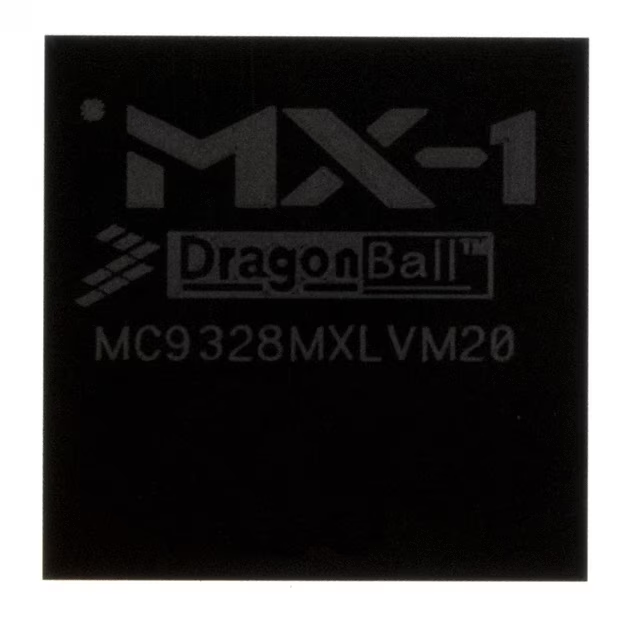
- Part No.:
- MC9328MX1VH20
- Manufacturer:
- NXP Semiconductors
- Category:
- Microprocessors
- Package:
- 256-LFBGA
- Datasheet:
-
 MC9328MX1VH20.pdf
- Description:
- IC MPU I.MX1 200MHZ 256BGA
- Quantity:
- Payment:

- Shipping:

Inventory:3,939
Please send an inquiry. Send us your inquiry, and we will respond immediately.
Product details
Overview
MC9328MX1VH20 from NXP Semiconductors (formerly Freescale) is an ARM920T™-based applications processor targeting portable multimedia devices. It operates at 200 MHz, integrates LCD controller, USB Device, MMC/SD host, SDRAM controller, and dual UARTs, and supports 1.7–1.9 V core voltage. It was used in Palm OS-based smart communicators like the Accompli 008.
For engineers reviewing the MC9328MX1VH20 datasheet, MC9328MX1VH20 pinout, MC9328MX1VH20 application, or MC9328MX1VH20 equivalent, key selection factors include its 256-pin MAPBGA-225 package, integrated multimedia accelerators (MMA/BTA), real-time clock, and support for boot from NAND/NOR flash via configurable BOOT[3:0] pins.
Technical Context
The MC9328MX1VH20 implements a 32-bit ARM920T core with Harvard architecture, 16 KB instruction and 16 KB data caches, and MMU. Its memory subsystem includes a 32-bit SDRAM controller supporting up to 256 MB, external interface module (EIM) for NOR/NAND/ROM, and dynamic power management via DPLL clock control.
Peripherals are organized into dedicated AHB/APB bridges: LCD controller drives STN/TFT panels with programmable timing; USB Device complies with USB 2.0 full-speed (12 Mbps); MMC/SD host supports SD v1.1 and MMC v3.31; and dual SSI modules operate in I²S or AC97 mode for audio codecs.
Key Specifications
| Parameter | Value and Actual Design Meaning |
|---|---|
| Core Architecture | ARM920T 32-bit RISC CPU with MMU, 16 KB I-cache + 16 KB D-cache |
| Max Operating Frequency | 200 MHz - enables real-time multimedia processing in battery-constrained handhelds |
| Core Supply Voltage | 1.7 V to 1.9 V - mandates low-dropout regulators and careful power sequencing |
| I/O Supply Range | 1.7 V to 3.3 V - supports mixed-voltage peripheral interfacing without level shifters |
| Package Type | 256-ball MAPBGA (Case 1304B-01) - 1.0 mm ball pitch, 17 mm × 17 mm footprint |
| Integrated Peripherals | LCD controller (16-bit parallel), USB 2.0 FS device, MMC/SD host, SSI/I²S ×2, UART ×3, SPI ×2, I²C ×1 |
| Memory Interfaces | SDRAM controller (16/32-bit, up to 256 MB), EIM with 6 chip-selects for NOR/NAND/ROM |
Pinout & Package
MC9328MX1VH20 is housed in a 256-contact Mold Array Process Ball Grid Array (MAPBGA), designated Case 1304B-01, with 1.0 mm ball pitch and 17 mm × 17 mm body size. The package supports fine-pitch routing and thermal dissipation suitable for handheld form factors.
| Pin/Terminal | Circuit Role | Design Meaning |
|---|---|---|
| BOOT[3:0] | Boot Mode Select Inputs | Determine boot source (NOR/NAND/OneNAND/USB) and configuration on reset; require external pull-up/down resistors |
| LD[15:0], FLM/VSYNC, LP/HSYNC | LCD Interface Signals | Drive 16-bit STN/TFT panels; support programmable polarity, timing, and Sharp HR-TFT panel-specific signals (PS, CLS, REV) |
| USBD_VP/VM, USBD_VPO/VMO | USB Full-Speed Transceiver | Differential D+/D− pins with internal termination; require 27 Ω series resistors and 1.5 kΩ pull-up on D+ |
| SD_DAT[3:0], SD_CMD, SD_CLK | MMC/SD Host Interface | Support SD v1.1 and MMC v3.31 protocols; internal 50 kΩ pull-ups enabled via register or external 4.7–69 kΩ resistors |
| A[24:0], D[31:0], CS[5:0], OE, RW | External Memory Interface | 32-bit data bus with byte strobes (EB3–EB0), 25-bit address, and 6 chip-selects for asynchronous/synchronous memory mapping |
Key Features
| Feature | Design Value |
|---|---|
| ARM920T Core + VFP Coprocessor | Enables deterministic real-time execution of Palm OS and Linux-based UI stacks with floating-point acceleration |
| Integrated Multimedia Accelerator (MMA) | Offloads JPEG encode/decode and MPEG-4 video processing from CPU, reducing active power by ~35% in camera playback |
| Bluetooth Accelerator (BTA) | Hardware assist for Bluetooth baseband protocol handling, lowering host CPU load during headset/audio streaming |
| Programmable LCD Timing Engine | Configurable HSYNC/VSYNC polarity, blanking intervals, and pixel clock division supports diverse STN/TFT panels without FPGA glue logic |
| Multi-Voltage I/O Banks (NVDD1–NVDD4) | Independent 1.8 V / 3.3 V I/O domains allow direct interfacing to legacy peripherals, SD cards, and analog audio codecs |
Applications
| Palm OS Smart Communicators | Industrial Handheld Terminals |
|---|---|
Use Scenario: Palm OS-based wireless devices such as the Accompli 008 GSM/GPRS communicator requiring rich UI, email, and web browsing. IC Role / Device Role / Timing Role: Main applications processor executing OS, managing LCD, USB sync, and cellular modem interface via UART/USB. Use Value: Integrated LCD controller and 200 MHz ARM920T enable responsive touch-driven UI with hardware-accelerated graphics rendering. | Use Scenario: Ruggedized field terminals for warehouse logistics, supporting barcode scanning, RFID, and secure data capture. IC Role / Device Role / Timing Role: Central controller interfacing with CMOS image sensor (CSI), serial scanners (UART), and secure digital memory (SD/MMC). Use Value: CSI interface with programmable pixel clock and dual UARTs with hardware flow control ensure reliable scanner and sensor data acquisition. |
| Portable Medical Data Loggers | Legacy Embedded HMI Panels |
Use Scenario: Battery-powered patient monitors capturing analog biosignals (ECG, temperature) and storing waveform data to SD card. IC Role / Device Role / Timing Role: Signal acquisition hub using ASP module for pen-input ADC, RTC for timestamping, and SD host for non-volatile storage. Use Value: On-chip ASP with 12-bit resolution and internal reference (RVP/RVM) eliminates external signal conditioning for basic biopotential sensing. | Use Scenario: Retrofit industrial HMIs replacing aging 8/16-bit microcontrollers, needing TFT display, keypad, and serial PLC communication. IC Role / Device Role / Timing Role: Graphics engine driving 640×480 TFT via LD[15:0], managing keypad scan via GPIO, and communicating over RS-232/RS-485 via UART2/UART3. Use Value: Programmable LCD timing and flexible GPIO multiplexing (e.g., UART2_RTS as general-purpose output) simplify migration from legacy platforms. |
Equivalent & Alternatives
The following parts are listed as comparable options for similar applications processor applications.
| Alternative Part | Technical Difference | Application Difference | Selection Advice |
|---|---|---|---|
| i.MX21 (MC9328MX21) | ARM926EJ-S core, 266 MHz, added security engine and enhanced USB OTG support | Better suited for secure data transfer and host-mode USB peripherals | Select when cryptographic acceleration or USB host capability is required beyond MC9328MX1VH20's USB device-only functionality |
| OMAP-730 | TMS320C55x DSP + ARM925T dual-core, 200 MHz, integrated power management unit | Stronger DSP performance for voice coding and audio preprocessing | Prefer for voice-centric applications requiring G.729 or AMR-WB codec offload not supported by MMA/BTA blocks |
Compared with i.MX21 and OMAP-730, MC9328MX1VH20 offers lower power consumption in display-intensive handhelds due to its optimized LCD controller and absence of high-overhead security/DSP subsystems, making it ideal for cost-sensitive Palm OS derivatives where USB device and SD host are primary connectivity needs.
Availability
MC9328MX1VH20 is available at Aetrix Electronics and suitable for industrial handheld terminals, medical data loggers, legacy HMI panels, and Palm OS-based smart communicators requiring stable component supply across extended product lifecycles.
Supply support for MC9328MX1VH20 includes scheduled delivery planning, volume procurement assistance, BOM continuity management, traceable sourcing, and lifecycle availability coordination for OEM customers, industrial embedded developers, connected-device designers, and electronics production programs.
Manufacturer
NXP Semiconductors is a global semiconductor company formed from the spin-off of Philips' semiconductor division, specializing in secure connectivity solutions for automotive, industrial, and IoT markets.
The i.MX family, including MC9328MX1VH20, was designed specifically for portable multimedia appliances-balancing ARM performance, integrated peripherals, and aggressive power management for battery-operated Palm OS and Linux handhelds.
FAQ
What is the maximum SDRAM capacity supported by the MC9328MX1VH20?
The MC9328MX1VH20 supports up to 256 MB of SDRAM via its 32-bit SDRAM controller with programmable row/column addressing and bank control. This capacity is achieved using two 128 MB chips in 16-bit configuration or a single 256 MB chip in 32-bit mode, with timing parameters configured through SDRAMC registers per JEDEC standards.
Does the MC9328MX1VH20 support USB host functionality?
No, the MC9328MX1VH20 only implements a USB 2.0 full-speed device controller-not a host or OTG controller. It supports enumeration as a CDC, HID, or mass storage device but cannot connect to USB peripherals like keyboards or flash drives. For host capability, consider the i.MX21 or later i.MX processors.
How is boot source selected on the MC9328MX1VH20?
Boot source selection on the MC9328MX1VH20 is controlled by the state of BOOT[3:0] pins at reset. These four inputs determine whether the processor boots from NOR flash, NAND flash, OneNAND, or USB download mode. Configuration requires external pull-up/pull-down resistors per Table 1 in the datasheet, with default behavior dependent on pin strapping.
What LCD panel types are compatible with the MC9328MX1VH20's LCDC?
The MC9328MX1VH20's LCD controller supports both passive-matrix STN and active-matrix TFT panels, including Sharp HR-TFT panels via dedicated signals (PS, CLS, REV, SPL_SPR). It provides programmable polarity, HSYNC/VSYNC timing, and pixel clock division to match diverse panel requirements without external timing logic.
Is the MC9328MX1VH20 still in production or available for new designs?
The MC9328MX1VH20 is obsolete and no longer in production by NXP. However, Aetrix Electronics maintains legacy inventory and offers long-term supply support-including traceable, tested units and lifecycle coordination-for existing industrial and medical programs still reliant on this processor.
MC9328MX1VH20 Specifications
- Product attributes
- Attribute value
- Manufacturer:
- NXP Semiconductors
- Package/Case:
- 256-LFBGA
- Series:
- i.MX1
- Packaging:
- Tray
- Product Status:
- Obsolete
- Core Processor:
- ARM920T
- Number of Cores/Bus Width:
- 1 Core, 32-Bit
- Speed:
- 200MHz
- Co-Processors/DSP:
- -
- RAM Controllers:
- SDRAM
- Graphics Acceleration:
- No
- Display & Interface Controllers:
- LCD, Touch Panel
- Ethernet:
- -
- SATA:
- -
- USB:
- USB 1.x (1)
- Voltage - I/O:
- 1.8V, 3.0V
- Operating Temperature:
- 0°C ~ 70°C (TA)
- Grade:
- -
- Qualification:
- -
- Security Features:
- -
- Mounting Type:
- Surface Mount
- Supplier Device Package:
- 256-PBGA (14x14)
- Additional Interfaces:
- I2C, I2S, SPI, SSI, MMC/SD, UART
MC9328MX1VH20 FAQ
1.How can I place an order for MC9328MX1VH20 through Aetrix?
Please submit a Request for Quotation (RFQ) for MC9328MX1VH20 on Aetrix. Our sales agent will provide a competitive quotation and guide you through the order confirmation once you accept the terms.
2.Are the price and stock information for MC9328MX1VH20 reliable?
The price and inventory of MC9328MX1VH20 are updated periodically and may fluctuate due to market conditions. Stock and pricing data are typically refreshed every 24 hours. Quotation validity for MC9328MX1VH20 is usually 5 days.
3.What payment methods are accepted for MC9328MX1VH20?
We accept Wire Transfer, PayPal, Credit Card, Western Union, MoneyGram, and Escrow for MC9328MX1VH20 transactions.
Note: Certain payment methods may incur a processing fee.
4.How is shipping managed for MC9328MX1VH20?
MC9328MX1VH20 orders can be shipped via leading logistics carriers, including DHL, UPS, FedEx, TNT, or Registered Mail.
Once your MC9328MX1VH20 order is processed, you will receive an email with the shipment details and tracking number.
Note: Tracking information may take up to 24 hours to appear. Express delivery typically takes 3–5 business days.
5.How can I obtain technical support or documentation for MC9328MX1VH20?
For technical support, including MC9328MX1VH20 datasheets, pinout diagrams, or application guidance, please contact our engineering support team. They can provide detailed documentation and assistance for your MC9328MX1VH20 requirements.
6.How does Aetrix verify that MC9328MX1VH20 is sourced from the original manufacturer or authorized distributors?
All MC9328MX1VH20 products on Aetrix are procured from qualified distributors and authorized channels. Our dedicated quality assurance team conducts strict verification, including traceability checks and, if necessary, third-party testing. This ensures that MC9328MX1VH20 meets industry standards.
7.What is the process for return or replacement of MC9328MX1VH20?
All MC9328MX1VH20 units undergo pre-shipment inspection (PSI). If there is an issue with MC9328MX1VH20, returns or replacements are accepted under the following conditions:
1.Quantity discrepancies, incorrect items, or visible external defects (such as breakage or corrosion), acknowledged by Aetrix.
2.The issue is reported within 90 days of delivery.
3.The MC9328MX1VH20 part is unused and in its original packaging.
Return procedure for MC9328MX1VH20:
1.Submit a request within 90 days.
2.Obtain a Return Material Authorization (RMA) from Aetrix.
MC9328MX1VH20 Tags
-
AT91SAM9260B-CU-999
Microchip Technology
-
AT91SAM9G25-CU
Microchip Technology
-
ATSAMA5D27C-CU
Microchip Technology
-
AT91SAM9X35-CU
Microchip Technology
-
AT91SAM9X25-CU
Microchip Technology
-
MCIMX6Y2CVM08AB
NXP Semiconductors
.JPG)
-
AM3352BZCZ100
Texas Instruments
-
AT91SAM9260B-CU
Microchip Technology
-
AT91SAM9260B-QU
Microchip Technology
-
ATSAMA5D31A-CU
Microchip Technology
-
AT91SAM9G20B-CU-999
Microchip Technology
-
MCIMX6Y2CVM05AB
NXP Semiconductors
Tech Hub

A practical engineering guide to 3.3V and 5V logic compatibility, input thresholds, resistor dividers, translator ICs, MOSFET level shifting, I2C pull-ups, timing limits and power-sequencing risks.

The 74HC595 uses push-pull logic outputs, while the TPIC6B595 uses 50 V open-drain DMOS sinks for higher-power loads. This guide compares timing, current limits, 3.3 V interfacing, load wiring, thermal…

The 74HC595 converts serial data into eight stable parallel outputs. This guide covers pin functions, shift and storage timing, OE and MR behavior, drive-current limits, cascading, voltage compatibilit…

A technical comparison of level-sensitive latches and edge-triggered flip-flops, covering timing windows, setup and hold limits, master–slave operation, time borrowing, race-through, HDL inference and…

A D latch stores one bit while Enable controls when data can pass. This reference covers gate-level operation, truth tables, transparency, setup and hold timing, LE versus OE, common ICs and practical …

An SR latch stores one bit through cross-coupled feedback. This engineering reference covers NOR and NAND implementations, truth tables, forbidden-state recovery, gated operation, switch debouncing, fa…

Latch circuits retain one bit through feedback. This technical reference covers SR and D latches, truth tables, transparency, timing limits, latch-versus-flip-flop behavior, applications and common log…

An engineering guide to LED driver operation, constant-current and constant-voltage outputs, linear and switching topologies, dimming, IC selection, calculations, replacement compatibility, and fault c…

Operational amplifier guide covering op amp basics, feedback, ideal vs real op amps, common configurations, buffer circuits, offset, bias current, gain-bandwidth, slew rate, rail-to-rail limits and sel…

Jumper cables guide covering safe connection order, red and black clamp placement, final ground connection, cable gauge, length, clamp quality, copper vs CCA cables, jump starter comparison and battery…


