
 My Inquiry
 My Account


Microchip Technology MCP23008T-E/SSVAO
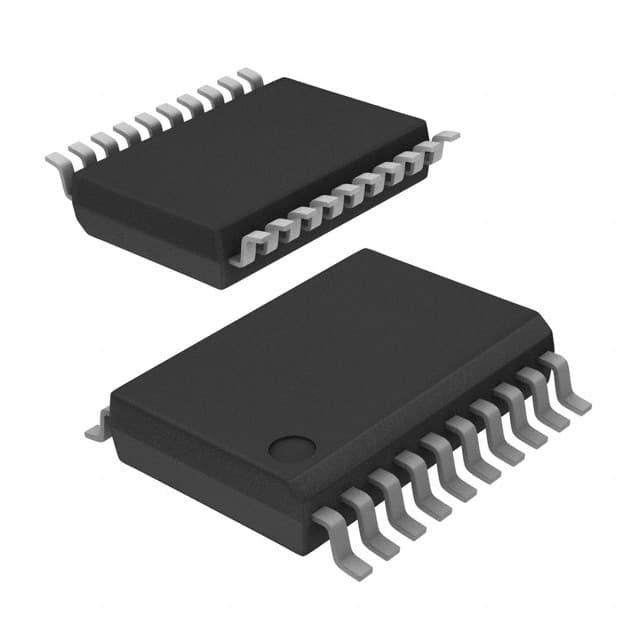
- Part No.:
- MCP23008T-E/SSVAO
- Manufacturer:
- Microchip Technology
- Category:
- I/O Expanders
- Package:
- 20-SSOP (0.209", 5.30mm Width)
- Datasheet:
-
 MCP23008T-E/SSVAO.pdf
- Description:
- IC XPNDR 10MHZ I2C 20SSOP
- Quantity:
- Payment:

- Shipping:

Inventory:2,420
Please send an inquiry. Send us your inquiry, and we will respond immediately.
Product details
Overview
MCP23008T-E/SSVAO from Microchip Technology is an 8-bit I²C-compatible GPIO expander IC designed for remote parallel I/O expansion in space-constrained embedded systems. It features 8 bidirectional I/O pins (GP0–GP7), hardware address pins A2–A0 enabling up to eight devices on one I²C bus, configurable interrupt output (INT), and operates from 1.8V to 5.5V across –40°C to +85°C. It is commonly used to extend microcontroller I/O in industrial control panels and sensor interface modules.
For engineers reviewing the MCP23008T-E/SSVAO datasheet, MCP23008T-E/SSVAO pinout, MCP23008T-E/SSVAO application, or MCP23008T-E/SSVAO equivalent, key selection criteria include its I²C interface speed (up to 1.7 MHz), low standby current (1 µA max), interrupt-on-change capability with DEFVAL/INTCON register support, and 20-pin SSOP package compatibility with standard surface-mount assembly processes.
Technical Context
The MCP23008T-E/SSVAO implements a register-mapped I²C slave interface with eleven 8-bit configuration registers (IODIR, IPOL, GPINTEN, DEFVAL, INTCON, IOCON, GPPU, INTF, INTCAP, GPIO, OLAT) accessible via 7-bit slave address (0x20–0x27). Its interrupt logic supports two mutually exclusive modes: interrupt-on-change from previous state or from programmable DEFVAL register comparison - both captured in INTCAP upon assertion.
Each of the eight GPIO pins can be individually configured as input or output via IODIR, with optional internal 100 kΩ pull-ups (GPPU), polarity inversion (IPOL), and interrupt-enable control (GPINTEN). The INT pin is software-configurable as active-high, active-low, or open-drain via IOCON bits ODR and INTPOL - critical for interfacing with diverse host interrupt controllers.
Key Specifications
| Parameter | Value and Actual Design Meaning |
|---|---|
| I²C Speed | Up to 1.7 MHz - enables high-throughput I/O polling in real-time control loops without bus contention. |
| Supply Voltage Range | 1.8V to 5.5V - supports direct interfacing with 1.8V, 3.3V, and 5V logic domains without level shifters. |
| Standby Current | 1 µA maximum - minimizes power draw in battery-backed or energy-harvesting applications. |
| GPIO Count & Type | 8 bidirectional CMOS I/O pins (GP0–GP7) - each configurable as input with weak pull-up or push-pull output. |
| Interrupt Logic | Configurable interrupt-on-change with DEFVAL/INTCON register pair - allows precise edge- or level-triggered event detection per pin. |
| Hardware Addressing | Three address pins (A2, A1, A0) - supports up to eight uniquely addressed devices on a single I²C bus segment. |
| Operating Temperature | –40°C to +85°C - qualified for industrial-grade operation in factory automation and outdoor equipment. |
Pinout & Package
Package: 20-pin SSOP (0.209" body width, 0.025" pitch), RoHS-compliant, moisture-sensitive level 3.
| Pin/Terminal | Circuit Role | Design Meaning |
|---|---|---|
| 1 | GP3 | General-purpose bidirectional I/O pin; supports interrupt-on-change and internal pull-up. |
| 2 | VDD | Positive supply rail (1.8V–5.5V); must be decoupled with ≥0.1 µF ceramic capacitor near pin. |
| 3 | GP7 | General-purpose bidirectional I/O pin; supports interrupt-on-change and internal pull-up. |
| 4 | GP6 | General-purpose bidirectional I/O pin; supports interrupt-on-change and internal pull-up. |
| 5 | GP5 | General-purpose bidirectional I/O pin; supports interrupt-on-change and internal pull-up. |
| 6 | GP2 | General-purpose bidirectional I/O pin; supports interrupt-on-change and internal pull-up. |
| 7 | GP1 | General-purpose bidirectional I/O pin; supports interrupt-on-change and internal pull-up. |
| 8 | GP0 | General-purpose bidirectional I/O pin; supports interrupt-on-change and internal pull-up. |
| 9 | N/C | No-connect terminal - must remain unconnected per datasheet; not internally bonded. |
| 10 | GP4 | General-purpose bidirectional I/O pin; supports interrupt-on-change and internal pull-up. |
| 11 | SDA | I²C bidirectional data line; requires external pull-up resistor (typically 2.2–10 kΩ to VDD). |
| 12 | SCL | I²C clock input; driven by master; requires external pull-up resistor (same as SDA). |
| 13 | VSS | Ground reference; must be connected to system common ground with low-impedance path. |
| 14 | A0 | Hardware address input (LSB); externally biased HIGH/LOW to set device I²C address bit 0. |
| 15 | N/C | No-connect terminal - must remain unconnected per datasheet; not internally bonded. |
| 16 | A1 | Hardware address input (middle bit); externally biased HIGH/LOW to set device I²C address bit 1. |
| 17 | RESET | Active-low asynchronous reset input; must be pulled HIGH via ≥10 kΩ resistor; falling edge resets all registers. |
| 18 | A2 | Hardware address input (MSB); externally biased HIGH/LOW to set device I²C address bit 2. |
| 19 | N/C | No-connect terminal - must remain unconnected per datasheet; not internally bonded. |
| 20 | INT | Open-drain or push-pull interrupt output; asserts when enabled GPIO pins change state per INTCON/DEFVAL settings. |
Key Features
| Feature | Design Value |
|---|---|
| Register-based I/O configuration | Eleven 8-bit registers (e.g., IODIR, GPPU, GPINTEN) allow runtime reconfiguration of direction, pull-ups, and interrupt behavior without hardware changes. |
| Interrupt capture register (INTCAP) | Freezes port state at interrupt trigger time - enables deterministic fault logging and eliminates race conditions during host read-back. |
| Configurable interrupt polarity & drive | IOCON bits ODR and INTPOL let INT pin operate as active-high push-pull, active-low push-pull, or open-drain - matching host MCU requirements. |
| Two interrupt-on-change modes | Supports either pin-edge detection (vs. prior state) or level-sensitive detection (vs. DEFVAL register), selected per-pin via INTCON bits. |
| Internal weak pull-up resistors | 100 kΩ pull-ups per GPIO (enabled via GPPU register) reduce BOM count and simplify switch/button interface design. |
Applications
| Industrial HMI Keypad Interface | Smart Sensor Node Expansion |
|---|---|
|
Use Scenario: Adding 8 tactile buttons and 4 status LEDs to a PLC-mounted HMI panel using only two I²C lines from the main controller. IC Role / Device Role / Timing Role: MCP23008T-E/SSVAO acts as a remote I/O bridge, scanning button states via interrupt-on-change and driving LEDs via GPIO outputs. Use Value: Eliminates need for additional MCU GPIOs; reduces wiring complexity; enables fast response (<100 µs INT latency) to user input. |
Use Scenario: Extending I/O on a battery-powered environmental sensor node to support analog multiplexing control and digital alarm outputs. IC Role / Device Role / Timing Role: MCP23008T-E/SSVAO provides configurable GPIOs for ADC channel selection and latched alarm signaling under ultra-low-power sleep mode. Use Value: Achieves 1 µA standby current during deep-sleep cycles; supports wake-on-button-press via INT-driven interrupt. |
| IoT Gateway Peripheral Control | Automated Test Equipment (ATE) Fixture |
|
Use Scenario: Managing 8 relay drivers and 8 opto-isolated inputs in a Wi-Fi-enabled home automation gateway board. IC Role / Device Role / Timing Role: MCP23008T-E/SSVAO serves as isolated I/O expander, interfacing with relay coils and field sensors via level-shifted GPIOs. Use Value: Enables centralized I²C control of distributed peripherals; simplifies firmware by abstracting I/O state into register reads/writes. |
Use Scenario: Controlling DUT power sequencing, test signal routing, and pass/fail indicator LEDs in a benchtop ATE fixture. IC Role / Device Role / Timing Role: MCP23008T-E/SSVAO functions as a deterministic I/O sequencer, synchronizing power rails and measurement triggers via register writes. Use Value: Guarantees repeatable timing (no software jitter) via hardware-register access; supports hot-plug detection via interrupt-on-change. |
Equivalent & Alternatives
The following parts are listed as comparable options for similar I/O expander applications.
| Alternative Part | Technical Difference | Application Difference | Selection Advice |
|---|---|---|---|
| PCA9554APW,118 | 8-bit I²C expander with identical 20-pin TSSOP package and 1.65–5.5V range; lacks DEFVAL/INTCON register pair for advanced interrupt modes. | Supports basic interrupt-on-change only (vs. dual-mode in MCP23008T-E/SSVAO); no polarity inversion register (IPOL). | Select when interrupt requirements are simple edge-detection only and PCB layout reuse is prioritized. |
| TCA6408APWR | 8-bit I²C expander with 1.65–5.5V operation and 20-pin TSSOP; includes reset pin but no hardware address pins - fixed I²C address (0x20). | Only one device per I²C bus unless external mux used; no A2/A1/A0 addressing flexibility for multi-device networks. | Choose for single-expander designs where address conflict avoidance is unnecessary and reset integration is valued. |
Compared with PCA9554APW,118 and TCA6408APWR, the MCP23008T-E/SSVAO offers superior interrupt flexibility (dual-mode detection, DEFVAL capture), full hardware addressability (A2–A0), and polarity inversion - making it optimal for complex, multi-node industrial I/O systems requiring deterministic event handling.
Availability
MCP23008T-E/SSVAO is available at Aetrix Electronics and suitable for industrial HMI, smart sensor nodes, IoT gateways, and automated test equipment requiring stable component supply and long-term manufacturability.
Supply support for MCP23008T-E/SSVAO includes scheduled delivery planning, volume procurement assistance, BOM continuity management, traceable sourcing, and lifecycle availability coordination for OEM customers, industrial embedded developers, connected-device designers, and electronics production programs.
Manufacturer
Microchip Technology Inc. is a leading provider of microcontrollers, analog components, and connectivity solutions, headquartered in Chandler, Arizona, with global design and manufacturing operations.
The MCP23X08 product line was developed specifically for cost-effective, low-power I/O expansion in resource-constrained embedded systems - emphasizing register-level configurability, interrupt intelligence, and broad voltage compatibility.
FAQ
What is the maximum I²C clock frequency supported by the MCP23008T-E/SSVAO?
The MCP23008T-E/SSVAO supports I²C operation up to 1.7 MHz under 4.5V–5.5V supply and –40°C to +125°C conditions. At 1.8V–5.5V and –40°C to +85°C, it supports 100 kHz, 400 kHz, and 1.7 MHz modes - verified in DS20001919F Section 1.3.2. This enables high-speed polling in time-critical applications without sacrificing noise immunity.
Does the MCP23008T-E/SSVAO require external pull-up resistors on SDA and SCL lines?
Yes, the MCP23008T-E/SSVAO requires external pull-up resistors on both SDA and SCL lines to ensure proper I²C bus operation. Typical values range from 2.2 kΩ to 10 kΩ to VDD, selected based on bus capacitance and desired rise time. The device itself does not integrate internal pull-ups on these lines.
How does the interrupt capture register (INTCAP) function in the MCP23008T-E/SSVAO?
The INTCAP register in the MCP23008T-E/SSVAO captures the exact GPIO port state at the moment an interrupt is triggered. It is read-only and updated only on interrupt assertion. Reading INTCAP (or GPIO) clears the interrupt condition - ensuring the host can reliably log the cause before subsequent events overwrite the capture.
Can the MCP23008T-E/SSVAO operate from a 1.8V supply?
Yes, the MCP23008T-E/SSVAO is fully specified for 1.8V to 5.5V operation across –40°C to +85°C. At 1.8V, it supports I²C speeds up to 100 kHz (DS20001919F page 1), making it compatible with ultra-low-voltage microcontrollers and energy-efficient sensor nodes.
What is the purpose of the A2, A1, and A0 pins on the MCP23008T-E/SSVAO?
The A2, A1, and A0 pins on the MCP23008T-E/SSVAO are hardware address inputs that determine the device's 7-bit I²C slave address (bits 4–2). With three binary-selectable pins, up to eight MCP23008T-E/SSVAO devices can share one I²C bus without address conflict - essential for modular I/O expansion systems.
MCP23008T-E/SSVAO Specifications
- Product attributes
- Attribute value
- Manufacturer:
- Microchip Technology
- Series:
- -
- Package/Case:
- 20-SSOP (0.209", 5.30mm Width)
- Packaging:
- Tape & Reel (TR)
- Product Status:
- Active
- Programmable:
- Not Verified
- Number of I/O:
- 8
- Interface:
- I2C
- Interrupt Output:
- Yes
- Features:
- POR
- Output Type:
- Push-Pull
- Current - Output Source/Sink:
- 25mA
- Clock Frequency:
- 10 MHz
- Voltage - Supply:
- 4.5V ~ 5.5V
- Operating Temperature:
- -40°C ~ 125°C
- Grade:
- Automotive
- Qualification:
- AEC-Q100
- Mounting Type:
- Surface Mount
- Supplier Device Package:
- 20-SSOP
MCP23008T-E/SSVAO FAQ
1.How can I place an order for MCP23008T-E/SSVAO through Aetrix?
Please submit a Request for Quotation (RFQ) for MCP23008T-E/SSVAO on Aetrix. Our sales agent will provide a competitive quotation and guide you through the order confirmation once you accept the terms.
2.Are the price and stock information for MCP23008T-E/SSVAO reliable?
The price and inventory of MCP23008T-E/SSVAO are updated periodically and may fluctuate due to market conditions. Stock and pricing data are typically refreshed every 24 hours. Quotation validity for MCP23008T-E/SSVAO is usually 5 days.
3.What payment methods are accepted for MCP23008T-E/SSVAO?
We accept Wire Transfer, PayPal, Credit Card, Western Union, MoneyGram, and Escrow for MCP23008T-E/SSVAO transactions.
Note: Certain payment methods may incur a processing fee.
4.How is shipping managed for MCP23008T-E/SSVAO?
MCP23008T-E/SSVAO orders can be shipped via leading logistics carriers, including DHL, UPS, FedEx, TNT, or Registered Mail.
Once your MCP23008T-E/SSVAO order is processed, you will receive an email with the shipment details and tracking number.
Note: Tracking information may take up to 24 hours to appear. Express delivery typically takes 3–5 business days.
5.How can I obtain technical support or documentation for MCP23008T-E/SSVAO?
For technical support, including MCP23008T-E/SSVAO datasheets, pinout diagrams, or application guidance, please contact our engineering support team. They can provide detailed documentation and assistance for your MCP23008T-E/SSVAO requirements.
6.How does Aetrix verify that MCP23008T-E/SSVAO is sourced from the original manufacturer or authorized distributors?
All MCP23008T-E/SSVAO products on Aetrix are procured from qualified distributors and authorized channels. Our dedicated quality assurance team conducts strict verification, including traceability checks and, if necessary, third-party testing. This ensures that MCP23008T-E/SSVAO meets industry standards.
7.What is the process for return or replacement of MCP23008T-E/SSVAO?
All MCP23008T-E/SSVAO units undergo pre-shipment inspection (PSI). If there is an issue with MCP23008T-E/SSVAO, returns or replacements are accepted under the following conditions:
1.Quantity discrepancies, incorrect items, or visible external defects (such as breakage or corrosion), acknowledged by Aetrix.
2.The issue is reported within 90 days of delivery.
3.The MCP23008T-E/SSVAO part is unused and in its original packaging.
Return procedure for MCP23008T-E/SSVAO:
1.Submit a request within 90 days.
2.Obtain a Return Material Authorization (RMA) from Aetrix.
MCP23008T-E/SSVAO Tags
-
TCA6408ARSVR
Texas Instruments
-
TCA9535RTWR
Texas Instruments
-
FXL6408UMX
onsemi
-
PCF8574ADWR
Texas Instruments
-
PCF8574APWR
Texas Instruments
-
TCA9555PWR
Texas Instruments
-
TCA9554PWR
Texas Instruments
-
TCA9554APWR
Texas Instruments
-
TCA9539PWR
Texas Instruments
-
TCA9534PWR
Texas Instruments
-
TCA9555RTWR
Texas Instruments
-
TCA9535PWR
Texas Instruments
Tech Hub

TTL and CMOS logic families differ in thresholds, loading, output drive, power and timing. This engineering guide compares 74HC and 74HCT, calculates noise margins and checks 3.3 V/5 V compatibility.

A practical engineering guide to 3.3V and 5V logic compatibility, input thresholds, resistor dividers, translator ICs, MOSFET level shifting, I2C pull-ups, timing limits and power-sequencing risks.

The 74HC595 uses push-pull logic outputs, while the TPIC6B595 uses 50 V open-drain DMOS sinks for higher-power loads. This guide compares timing, current limits, 3.3 V interfacing, load wiring, thermal…

The 74HC595 converts serial data into eight stable parallel outputs. This guide covers pin functions, shift and storage timing, OE and MR behavior, drive-current limits, cascading, voltage compatibilit…

A technical comparison of level-sensitive latches and edge-triggered flip-flops, covering timing windows, setup and hold limits, master–slave operation, time borrowing, race-through, HDL inference and…

A D latch stores one bit while Enable controls when data can pass. This reference covers gate-level operation, truth tables, transparency, setup and hold timing, LE versus OE, common ICs and practical …

An SR latch stores one bit through cross-coupled feedback. This engineering reference covers NOR and NAND implementations, truth tables, forbidden-state recovery, gated operation, switch debouncing, fa…

Latch circuits retain one bit through feedback. This technical reference covers SR and D latches, truth tables, transparency, timing limits, latch-versus-flip-flop behavior, applications and common log…

An engineering guide to LED driver operation, constant-current and constant-voltage outputs, linear and switching topologies, dimming, IC selection, calculations, replacement compatibility, and fault c…

Operational amplifier guide covering op amp basics, feedback, ideal vs real op amps, common configurations, buffer circuits, offset, bias current, gain-bandwidth, slew rate, rail-to-rail limits and sel…


