
 My Inquiry
 My Account


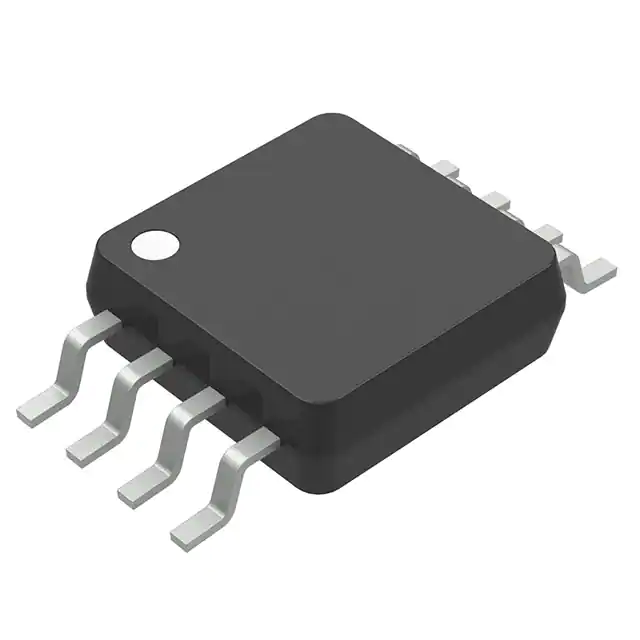
Microchip Technology MCP4821-E/MS
- Part No.:
- MCP4821-E/MS
- Manufacturer:
- Microchip Technology
- Category:
- Digital to Analog Converters (DAC)
- Package:
- 8-TSSOP, 8-MSOP (0.118", 3.00mm Width)
- Datasheet:
-
 MCP4821-E/MS.pdf
- Description:
- IC DAC 12BIT V-OUT 8MSOP
- Quantity:
- Payment:

- Shipping:

Inventory:4,655
Please send an inquiry. Send us your inquiry, and we will respond immediately.
Product details
Overview
MCP4821-E/MS from Microchip Technology is a 12-bit buffered voltage-output DAC with rail-to-rail output amplifier, internal 2.048V reference (50 ppm/°C), SPI interface (20 MHz max), 4.5 µs settling time, and selectable 1x/2x gain. It operates from 2.7V to 5.5V over –40°C to +125°C and is used for precision sensor calibration and portable instrumentation.
For engineers reviewing the MCP4821-E/MS datasheet, MCP4821-E/MS pinout, MCP4821-E/MS application, or MCP4821-E/MS equivalent, key selection criteria include guaranteed monotonic 12-bit resolution, ±4 LSb INL at +125°C, hardware/software shutdown modes, LDAC-synchronized output latching, and MSOP-8 package compatibility with analog ground isolation requirements.
Technical Context
The MCP4821-E/MS implements a resistive string DAC architecture ensuring low DNL (±0.25 LSb typical), low ratio-metric temperature coefficient, and fast settling. Its double-buffered registers enable synchronous updates via the LDAC pin, while the internal Power-on Reset (POR) circuit ensures high-impedance output until valid configuration.
It integrates a precision CMOS output amplifier supporting rail-to-rail swing (0.01 V to VDD – 0.04 V), programmable gain (1x or 2x), and stable operation into 5 kΩ loads with 100 pF capacitance. The 2.048V internal reference features 125 ppm/°C TC over –40°C to 0°C and 45 ppm/°C over 0°C to +85°C.
Key Specifications
| Parameter | Value and Actual Design Meaning |
|---|---|
| Resolution | 12-bit - delivers 4096 discrete output levels with guaranteed monotonicity across full temperature range |
| INL Error | ±4 LSb (max at +125°C) - limits absolute accuracy in closed-loop calibration systems |
| Settling Time | 4.5 µs to ½ LSb - enables update rates up to ~200 kSPS in dynamic control loops |
| Reference Voltage | 2.048V ±40 mV - provides 0–4.096V full-scale range with 2x gain; 0.5 mV/LSb at 1x gain |
| SPI Clock Rate | 20 MHz - supports minimal 16-bit write cycles of 800 ns, compatible with high-speed MCUs |
| Supply Range | 2.7V to 5.5V - allows direct interfacing with 3.3V and 5V logic without level shifting |
| Temp Range | –40°C to +125°C - qualified for automotive under-hood and industrial motor-control environments |
Pinout & Package
The MCP4821-E/MS is housed in an 8-pin MSOP package (3.0 mm × 4.9 mm, 0.65 mm pitch) with exposed thermal pad electrically tied to VSS. Pin 1 is VDD; pins are arranged counterclockwise with CS (2), SCK (3), SDI (4), LDAC (5), SHDN (6), VSS (7), and VOUT (8).
| Pin/Terminal | Circuit Role | Design Meaning |
|---|---|---|
| VDD | Positive supply input | 2.7–5.5V single supply; requires 0.1 µF ceramic + 10 µF tantalum bypassing for noise-sensitive analog output |
| CS | Active-low chip select | Enables SPI communication; must remain low for full 16-bit write cycle; supports Mode 0,0 and Mode 1,1 |
| SCK | SPI clock input | Rising-edge sampled; 20 MHz max frequency; timing-critical for reliable data capture |
| SDI | SPI serial data input | 16-bit command-only interface (no readback); bit 15 = write control, bits 14–12 = command, bits 11–0 = DAC code |
| LDAC | Latch DAC synchronization | Low pulse transfers input register to DAC register; can be tied to VSS for auto-update on CS rising edge |
| SHDN | Hardware shutdown control | Active-low; forces output to 500 kΩ high-Z state; disables amplifier but preserves reference and SPI interface |
| VSS | Analog ground reference | Must connect to low-impedance analog ground plane; EP pad internally bonded to VSS |
| VOUT | Analog voltage output | Rail-to-rail buffered output; swing limited to 10 mV–(VDD–40 mV) for 1 LSb accuracy; drives 5 kΩ || 100 pF |
Key Features
| Feature | Design Value |
|---|---|
| Internal 2.048V reference | Eliminates external reference component; 50 ppm/°C TC enables stable calibration over extended temperature |
| Selectable 1x/2x gain | Configurable full-scale range (2.048V or 4.096V) via GA bit; default 2x supports wider dynamic range |
| Double-buffered registers | Enables glitch-free simultaneous updates across multiple DACs using shared LDAC signal |
| Hardware & software shutdown | Reduces current to ≤1.5 µA (hardware) or ≤5 µA (software); preserves SPI readiness during low-power states |
| Rail-to-rail output amplifier | Delivers usable output down to 10 mV above VSS and within 40 mV of VDD-critical for low-voltage systems |
Applications
| Set Point Trimming | Sensor Calibration |
|---|---|
Use Scenario: Adjusting bias voltage in precision op-amp circuits to null offset drift over temperature. IC Role / Device Role / Timing Role: Voltage-output DAC providing stable, digitally controlled DC trim point with <4.5 µs response. Use Value: Replaces manual potentiometers; enables factory/field recalibration via firmware without hardware change. | Use Scenario: Compensating nonlinearity and offset in pressure transducer outputs before ADC sampling. IC Role / Device Role / Timing Role: High-accuracy 12-bit DAC generating correction voltage synchronized to sensor excitation cycle. Use Value: Achieves ±0.1% FSR calibration accuracy using internal 2.048V reference and 1x gain mode. |
| Precision Voltage Reference | Portable Instrumentation |
Use Scenario: Generating stable, programmable reference for multi-channel ADCs in data acquisition modules. IC Role / Device Role / Timing Role: Buffered voltage source with rail-to-rail swing and low output impedance (<1 Ω). Use Value: Delivers 4.096V full-scale (2x gain) with <0.5 mV/°C drift-reducing system-level temperature compensation burden. | Use Scenario: Controlling LED brightness or laser diode bias in handheld test equipment powered by Li-ion batteries. IC Role / Device Role / Timing Role: Low-quiescent-current DAC (350 µA typical) operating from 2.7V battery supply. Use Value: Enables >100-hour battery life in active mode; hardware shutdown reduces current to <2 µA during standby. |
Equivalent & Alternatives
The following parts are listed as comparable options for similar voltage-output DAC applications.
| Alternative Part | Technical Difference | Application Difference | Selection Advice |
|---|---|---|---|
| MCP4822-E/MS | Dual-channel 12-bit DAC in same MSOP-8 package; shares identical reference, gain, and timing specs | Supports two independent analog outputs; requires additional channel control logic | Choose when dual-output capability justifies added software complexity and cost premium |
| MCP4921-E/MS | 12-bit DAC with external reference input only; no internal VREF; higher INL (±8 LSb) at +125°C | Requires external precision reference; better suited for systems with shared high-accuracy reference rails | Choose when system already provides ultra-stable external reference and board space permits extra component |
Compared with MCP4822-E/MS and MCP4921-E/MS, the MCP4821-E/MS offers optimal balance of single-channel simplicity, integrated reference stability, and extended-temperature performance-making it ideal for space-constrained, self-contained calibration nodes.
Availability
MCP4821-E/MS is available at Aetrix Electronics and suitable for sensor calibration, portable instrumentation, and precision set-point trimming requiring stable component supply across automotive, industrial, and medical device production programs.
Supply support for MCP4821-E/MS includes scheduled delivery planning, volume procurement assistance, BOM continuity management, traceable sourcing, and lifecycle availability coordination for OEM customers, industrial embedded developers, connected-device designers, and electronics production programs.
Manufacturer
Microchip Technology Inc. is a leading provider of microcontroller, mixed-signal, analog, and Flash-IP solutions, serving automotive, industrial, consumer, and communications markets.
The MCP48xx family was designed specifically for high-accuracy, low-power digital-to-analog conversion in embedded systems where integration, temperature resilience, and SPI simplicity are critical-targeting calibration, trimming, and programmable reference applications.
FAQ
What is the maximum SPI clock frequency supported by the MCP4821-E/MS?
The MCP4821-E/MS supports SPI clock frequencies up to 20 MHz at +25°C. At extended temperatures (–40°C to +125°C), timing specifications remain valid per AC characteristics table; design margin should account for tHI/tLO minimums of 15 ns and setup/hold times of 15 ns/10 ns respectively. This allows reliable interfacing with modern ARM Cortex-M and PIC32 microcontrollers without clock division.
How does the MCP4821-E/MS handle power-on initialization?
The MCP4821-E/MS incorporates an internal Power-on Reset (POR) circuit that holds the output in high-impedance state (~500 kΩ) until VDD exceeds VPOR (1.85V min) and a valid 16-bit write command is received with LDAC meeting low-threshold conditions. This prevents undefined output transients during power ramp-up and ensures deterministic startup behavior in safety-critical systems.
Can the MCP4821-E/MS operate with a 3.3V supply and still achieve rail-to-rail output?
Yes. The MCP4821-E/MS operates from 2.7V to 5.5V and delivers rail-to-rail output swing: VOUT ranges from 0.01 V to VDD – 0.04 V with 1 LSb accuracy maintained across the full 10 mV to (VDD – 40 mV) window. At 3.3V supply, this yields usable output from 10 mV to 3.26 V-sufficient for most 3.3V-system references and sensor interfaces.
What is the purpose of the exposed thermal pad (EP) on the MCP4821-E/MS MSOP package?
The exposed thermal pad (EP) on the MCP4821-E/MS MSOP package is internally connected to VSS and must be soldered to a PCB copper pour tied to analog ground. It reduces thermal resistance (θJA = 211°C/W for MSOP), improves long-term reliability under continuous load, and enhances analog performance by lowering ground impedance and minimizing thermal drift in the output amplifier and reference circuitry.
Does the MCP4821-E/MS support simultaneous multi-DAC updates?
Yes. The MCP4821-E/MS uses double-buffered registers and an asynchronous LDAC pin to enable synchronized output updates across multiple devices. When LDAC is asserted low, all MCP4821-E/MS units sharing the same LDAC line update their VOUT simultaneously-eliminating inter-channel glitches in multi-axis control or phased-array systems.
MCP4821-E/MS Specifications
- Product attributes
- Attribute value
- Manufacturer:
- Microchip Technology
- Series:
- -
- Package/Case:
- 8-TSSOP, 8-MSOP (0.118", 3.00mm Width)
- Packaging:
- Tube
- Product Status:
- Active
- Programmable:
- Not Verified
- Number of Bits:
- 12
- Number of D/A Converters:
- 1
- Settling Time:
- 4.5µs (Typ)
- Output Type:
- Voltage - Buffered
- Differential Output:
- No
- Data Interface:
- SPI
- Reference Type:
- Internal
- Voltage - Supply, Analog:
- 2.7V ~ 5.5V
- Voltage - Supply, Digital:
- 2.7V ~ 5.5V
- INL/DNL (LSB):
- ±4, ±0.25
- Architecture:
- String DAC
- Operating Temperature:
- -40°C ~ 125°C
- Supplier Device Package:
- 8-MSOP
- Mounting Type:
- Surface Mount
- Grade:
- -
- Qualification:
- -
MCP4821-E/MS FAQ
1.How can I place an order for MCP4821-E/MS through Aetrix?
Please submit a Request for Quotation (RFQ) for MCP4821-E/MS on Aetrix. Our sales agent will provide a competitive quotation and guide you through the order confirmation once you accept the terms.
2.Are the price and stock information for MCP4821-E/MS reliable?
The price and inventory of MCP4821-E/MS are updated periodically and may fluctuate due to market conditions. Stock and pricing data are typically refreshed every 24 hours. Quotation validity for MCP4821-E/MS is usually 5 days.
3.What payment methods are accepted for MCP4821-E/MS?
We accept Wire Transfer, PayPal, Credit Card, Western Union, MoneyGram, and Escrow for MCP4821-E/MS transactions.
Note: Certain payment methods may incur a processing fee.
4.How is shipping managed for MCP4821-E/MS?
MCP4821-E/MS orders can be shipped via leading logistics carriers, including DHL, UPS, FedEx, TNT, or Registered Mail.
Once your MCP4821-E/MS order is processed, you will receive an email with the shipment details and tracking number.
Note: Tracking information may take up to 24 hours to appear. Express delivery typically takes 3–5 business days.
5.How can I obtain technical support or documentation for MCP4821-E/MS?
For technical support, including MCP4821-E/MS datasheets, pinout diagrams, or application guidance, please contact our engineering support team. They can provide detailed documentation and assistance for your MCP4821-E/MS requirements.
6.How does Aetrix verify that MCP4821-E/MS is sourced from the original manufacturer or authorized distributors?
All MCP4821-E/MS products on Aetrix are procured from qualified distributors and authorized channels. Our dedicated quality assurance team conducts strict verification, including traceability checks and, if necessary, third-party testing. This ensures that MCP4821-E/MS meets industry standards.
7.What is the process for return or replacement of MCP4821-E/MS?
All MCP4821-E/MS units undergo pre-shipment inspection (PSI). If there is an issue with MCP4821-E/MS, returns or replacements are accepted under the following conditions:
1.Quantity discrepancies, incorrect items, or visible external defects (such as breakage or corrosion), acknowledged by Aetrix.
2.The issue is reported within 90 days of delivery.
3.The MCP4821-E/MS part is unused and in its original packaging.
Return procedure for MCP4821-E/MS:
1.Submit a request within 90 days.
2.Obtain a Return Material Authorization (RMA) from Aetrix.
MCP4821-E/MS Tags
-
MCP47A1T-A0E/LT
Microchip Technology

-
MCP4706A0T-E/CH
Microchip Technology
-
MCP4716A0T-E/MAY
Microchip Technology
-
MCP4716A0T-E/CH
Microchip Technology
-
MCP4726A0T-E/CH
Microchip Technology
-
MCP4725A0T-E/CH
Microchip Technology
-
MCP4725A1T-E/CH
Microchip Technology
-
MCP4725A2T-E/CH
Microchip Technology
-
MCP4726A1T-E/CH
Microchip Technology
-
MCP4726A3T-E/CH
Microchip Technology
-
MCP4726A2T-E/CH
Microchip Technology
-
MCP4726A0T-E/MAY
Microchip Technology
Tech Hub

TTL and CMOS logic families differ in thresholds, loading, output drive, power and timing. This engineering guide compares 74HC and 74HCT, calculates noise margins and checks 3.3 V/5 V compatibility.

A practical engineering guide to 3.3V and 5V logic compatibility, input thresholds, resistor dividers, translator ICs, MOSFET level shifting, I2C pull-ups, timing limits and power-sequencing risks.

The 74HC595 uses push-pull logic outputs, while the TPIC6B595 uses 50 V open-drain DMOS sinks for higher-power loads. This guide compares timing, current limits, 3.3 V interfacing, load wiring, thermal…

The 74HC595 converts serial data into eight stable parallel outputs. This guide covers pin functions, shift and storage timing, OE and MR behavior, drive-current limits, cascading, voltage compatibilit…

A technical comparison of level-sensitive latches and edge-triggered flip-flops, covering timing windows, setup and hold limits, master–slave operation, time borrowing, race-through, HDL inference and…

A D latch stores one bit while Enable controls when data can pass. This reference covers gate-level operation, truth tables, transparency, setup and hold timing, LE versus OE, common ICs and practical …

An SR latch stores one bit through cross-coupled feedback. This engineering reference covers NOR and NAND implementations, truth tables, forbidden-state recovery, gated operation, switch debouncing, fa…

Latch circuits retain one bit through feedback. This technical reference covers SR and D latches, truth tables, transparency, timing limits, latch-versus-flip-flop behavior, applications and common log…

An engineering guide to LED driver operation, constant-current and constant-voltage outputs, linear and switching topologies, dimming, IC selection, calculations, replacement compatibility, and fault c…

Operational amplifier guide covering op amp basics, feedback, ideal vs real op amps, common configurations, buffer circuits, offset, bias current, gain-bandwidth, slew rate, rail-to-rail limits and sel…


