
 My Inquiry
 My Account


Microchip Technology MCP96L00-E/MX
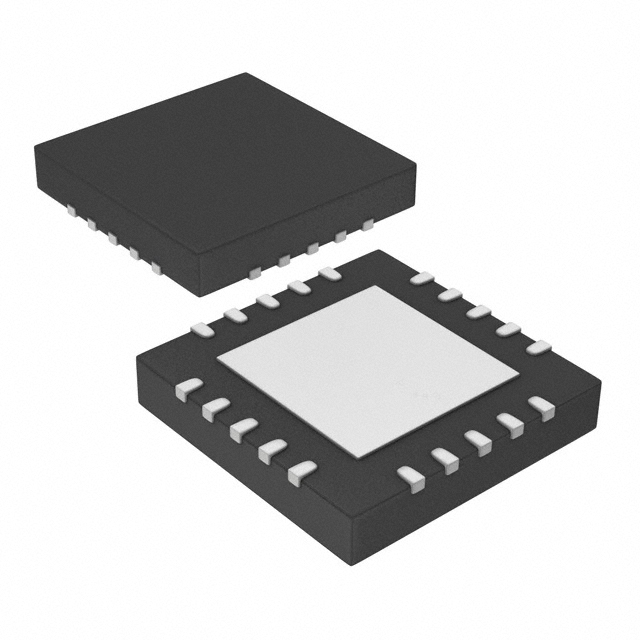
- Part No.:
- MCP96L00-E/MX
- Manufacturer:
- Microchip Technology
- Category:
- Sensor and Detector Interfaces
- Package:
- 20-VQFN Exposed Pad
- Datasheet:
-
 MCP96L00-E/MX.pdf
- Description:
- +/- 4.0C THERMOCOUPLE TO I2C CON
- Quantity:
- Payment:

- Shipping:

Inventory:2,407
Please send an inquiry. Send us your inquiry, and we will respond immediately.
Product details
Overview
MCP96L00-E/MX from Microchip Technology Inc. is a thermocouple EMF-to-°C converter IC with integrated cold-junction compensation, ±2.0°C typical hot-junction accuracy (Type K, 0°C to +85°C), 0.0625°C measurement resolution, and I²C-compatible two-wire interface operating up to 100 kHz - used in industrial oven temperature monitoring, handheld thermal meters, and engine thermal management systems.
For engineers reviewing the MCP96L00-E/MX datasheet, MCP96L00-E/MX pinout, MCP96L00-E/MX application, or MCP96L00-E/MX equivalent, this page delivers verified technical context, package mapping, alert configuration logic, thermocouple type support (K/J/T/N/E/B/S/R), and design-meaningful specifications for thermal sensing system integration.
Technical Context
The MCP96L00-E/MX implements NIST ITS-90 thermocouple voltage-to-temperature conversion in the millivolt domain, applying polynomial correction coefficients to eight standard thermocouple types. Its ADC core supports 12–18-bit programmable resolution with configurable digital filtering for transient suppression.
It features four independent, user-programmable alert outputs with rising/falling edge detection and up to +255°C hysteresis, plus low-power modes (shutdown: 2 µA typ., burst sampling: 1–128 samples). Unlike the L01 variant, the MCP96L00-E/MX lacks integrated open-circuit and short-circuit detection on the thermocouple inputs.
Key Specifications
| Parameter | Value and Actual Design Meaning |
|---|---|
| Hot-Junction Accuracy | ±2.0°C (typ.) / ±4.0°C (max.) at 0°C to +85°C - defines worst-case error budget for closed-loop thermal control in commercial ovens. |
| Temperature Resolution | 0.0625°C (18-bit mode) - enables fine-grained setpoint tuning in precision heating applications. |
| I²C Interface Speed | 100 kHz max - supports standard-mode bus timing without clock stretching dependency in microcontroller-based systems. |
| Operating Voltage | 2.7V to 5.5V - compatible with both 3.3V and 5V industrial MCU supply rails without level-shifting. |
| Supply Current | 300 µA (typ.) active, 2 µA (typ.) shutdown - suitable for battery-powered handheld instruments with multi-day runtime. |
| Supported Thermocouples | Type K, J, T, N, E, B, S, R - full NIST ITS-90 coverage enables drop-in replacement across legacy thermal sensor platforms. |
| Alert Outputs | 4 programmable push-pull outputs - allows concurrent monitoring of hot-junction, cold-junction, delta-T, and safety thresholds in single-device architecture. |
Pinout & Package
Package: 20-Lead 5 mm × 5 mm MQFN with exposed thermal pad (EP).
| Pin/Terminal | Circuit Role | Design Meaning |
|---|---|---|
| 1, 3, 5, 13, 17 | GND | System ground reference; multiple pins reduce impedance and improve noise immunity in high-EMI environments. |
| 2 | VIN+ | Thermocouple positive input; differential pair with VIN− accepts ±250 mV EMF range for all supported thermocouple types. |
| 4 | VIN− | Thermocouple negative input; matched to VIN+ for common-mode rejection >105 dB. |
| 6, 7, 9, 10, 18 | GND (tie-to-ground) | Non-signal ground connections required for internal bias stability and thermal pad thermal conduction. |
| 8 | VDD | Power supply input; decoupling capacitor placement near this pin minimizes supply ripple-induced measurement drift. |
| 11–14, 16, 19, 20 | Alert 1–4 | Configurable push-pull outputs; each independently assigned to hot/cold junction or delta-T with polarity and hysteresis control. |
| 15 | SDA | I²C data line; bidirectional, open-drain compatible with 3.3V/5V pull-ups; supports up to 8 devices per bus via ADDR pin. |
| 16 | SCL | I²C clock line; synchronous timing reference for register reads/writes and alert status polling. |
| 19 | ADDR | I²C address selection input; sets one of eight device addresses via voltage divider or direct VDD/GND tie. |
| 20 | EP | Exposed thermal pad; must be soldered to PCB ground plane for thermal dissipation and electrical noise reduction. |
Key Features
| Feature | Design Value |
|---|---|
| NIST ITS-90 thermocouple conversion | Direct millivolt-domain calculation using certified coefficients - eliminates need for external lookup tables or firmware interpolation. |
| Programmable digital filter | Adjustable FIR filter depth suppresses thermal transients without sacrificing update rate - critical for furnace ramp/soak control. |
| Four independent alert outputs | Each output configurable for rising/falling threshold detection with 255°C hysteresis - enables dual-zone overtemp and undercool alarms. |
| Burst sampling mode | 1–128 sample averaging per conversion cycle - improves SNR in noisy industrial settings while maintaining deterministic latency. |
| Cold-junction compensation | On-die silicon temperature sensor with ±0.5°C typical accuracy - removes need for external RTD or thermistor in reference junction measurement. |
Applications
| Industrial Oven Control | Handheld Thermal Meter |
|---|---|
Use Scenario: Monitoring and regulating chamber temperature in commercial convection ovens with Type K thermocouples. IC Role / Device Role / Timing Role: Primary thermocouple signal conditioner and cold-junction compensator, providing calibrated °C output every 320 ms (18-bit mode). Use Value: Enables ±2°C closed-loop control stability without external calibration, reducing field service intervals by eliminating analog front-end drift. |
Use Scenario: Portable temperature probe used by HVAC technicians for duct and equipment surface measurements. IC Role / Device Role / Timing Role: Low-power thermocouple interface with burst sampling and alert-triggered wake-up for battery life extension. Use Value: 2 µA shutdown current extends AA battery life to >12 months; 0.0625°C resolution supports diagnostic-grade readings in field conditions. |
| Engine Block Thermal Monitor | Temperature Detection Rack |
Use Scenario: Real-time hot-junction monitoring of diesel engine cylinder head temperatures using Type J thermocouples. IC Role / Device Role / Timing Role: High-accuracy EMF-to-°C converter with programmable alerts for overtemperature shutdown signaling. Use Value: ±4.0°C maximum error at −40°C to +125°C ambient ensures reliable trip-point detection before mechanical failure thresholds are exceeded. |
Use Scenario: Multi-channel thermal rack for server rack inlet/outlet air monitoring using Type T thermocouples. IC Role / Device Role / Timing Role: I²C slave device supporting up to 8 units on shared bus for synchronized temperature logging. Use Value: Eight-device addressing simplifies BOM consolidation and reduces PCB footprint vs. discrete ADC solutions. |
Equivalent & Alternatives
The following parts are listed as comparable options for similar thermocouple interface applications.
| Alternative Part | Technical Difference | Application Difference | Selection Advice |
|---|---|---|---|
| MCP9600-E/MX | ±0.5°C typical hot-junction accuracy; same pinout and register map; includes open-circuit detection (not present in MCP96L00-E/MX). | Higher-accuracy industrial control where <±1°C error is required; adds fault detection capability for safety-critical systems. | Select when tighter accuracy and thermocouple break detection are mandatory; requires no layout change. |
| AD8495ARZ | Analog output thermocouple amplifier (mV/°C); no integrated cold-junction compensation or digital interface; requires external ADC and microcontroller. | Systems with existing analog signal chains or space-constrained designs avoiding I²C routing overhead. | Choose when analog integration simplifies signal path but increases firmware complexity for linearization and cold-junction correction. |
Compared with MCP9600-E/MX, the MCP96L00-E/MX trades ±1.5°C higher hot-junction error for lower cost and simplified qualification, while AD8495ARZ shifts processing burden to the host system but avoids digital protocol dependencies entirely.
Availability
MCP96L00-E/MX is available at Aetrix Electronics and suitable for industrial oven control, handheld thermal meter development, and engine thermal monitor designs requiring stable component supply across extended production lifecycles.
Supply support for MCP96L00-E/MX includes scheduled delivery planning, volume procurement assistance, BOM continuity management, traceable sourcing, and lifecycle availability coordination for OEM customers, industrial embedded developers, connected-device designers, and electronics production programs.
Manufacturer
Microchip Technology Inc. is a global semiconductor manufacturer specializing in microcontrollers, analog devices, and interface ICs for industrial, automotive, and consumer applications.
The MCP960X/L0X family was designed to simplify high-accuracy thermocouple-based temperature measurement by integrating NIST-certified conversion, cold-junction compensation, and programmable alerts into a single I²C device - targeting thermal management in cost-sensitive industrial systems.
FAQ
What thermocouple types does the MCP96L00-E/MX support?
The MCP96L00-E/MX supports Type K, J, T, N, E, B, S, and R thermocouples per NIST ITS-90 standards. Configuration is performed via its user registers, and all types share the same ±2.0°C typical hot-junction accuracy specification within 0°C to +85°C ambient. The MCP96L00-E/MX applies validated polynomial coefficients internally - no external lookup table or firmware interpolation is required for any of these types.
Does the MCP96L00-E/MX include open-circuit or short-circuit detection?
No, the MCP96L00-E/MX does not include integrated thermocouple open-circuit or short-circuit detection. That feature is exclusive to the MCP96L01-E/MX and MCP9601-E/MX variants. The MCP96L00-E/MX relies on external circuitry or host firmware to detect broken or shorted thermocouple wires, as confirmed by the absence of VSENSE, OC Alert, and SC Alert pins in its pinout and functional description.
What is the maximum I²C clock frequency supported by the MCP96L00-E/MX?
The MCP96L00-E/MX supports standard-mode I²C operation up to 100 kHz, as specified in its timing characteristics. It does not support fast-mode (400 kHz) or high-speed mode. The device requires tSU:DAT ≥250 ns for reliable communication, and clock stretching is implemented during temperature calculations (tSTRETCH ≈60 µs), which must be accommodated by the host controller.
How many devices can share the same I²C bus with the MCP96L00-E/MX?
Up to eight MCP96L00-E/MX devices can operate on a single I²C bus. Device addressing is controlled via the ADDR pin, which accepts eight distinct voltage levels (GND through VDD in 1/8-VDD steps) to configure unique 3-bit address bits. This allows scalable multi-sensor deployments - such as thermal racks or distributed engine monitoring - without bus contention or address conflicts.
What power modes does the MCP96L00-E/MX offer for low-energy operation?
The MCP96L00-E/MX provides three power modes: active (300 µA typ.), burst sampling (configurable 1–128 conversions per cycle), and shutdown (2 µA typ.). Burst mode reduces average current by gating conversion cycles, while shutdown disables the ADC and I²C interface entirely. These modes are software-controlled via register writes and enable multi-year battery life in portable thermal instruments using the MCP96L00-E/MX.
MCP96L00-E/MX Specifications
- Product attributes
- Attribute value
- Manufacturer:
- Microchip Technology
- Package/Case:
- 20-VQFN Exposed Pad
- Series:
- -
- Packaging:
- Tube
- Product Status:
- Active
- Programmable:
- Not Verified
- Type:
- Thermocouple to Digital Converter
- Input Type:
- Thermocouple
- Output Type:
- I2C
- Current - Supply:
- 300 µA
- Operating Temperature:
- -40°C ~ 125°C
- Grade:
- -
- Qualification:
- -
- Mounting Type:
- Surface Mount
- Supplier Device Package:
- 20-MQFN (5x5)
MCP96L00-E/MX FAQ
1.How can I place an order for MCP96L00-E/MX through Aetrix?
Please submit a Request for Quotation (RFQ) for MCP96L00-E/MX on Aetrix. Our sales agent will provide a competitive quotation and guide you through the order confirmation once you accept the terms.
2.Are the price and stock information for MCP96L00-E/MX reliable?
The price and inventory of MCP96L00-E/MX are updated periodically and may fluctuate due to market conditions. Stock and pricing data are typically refreshed every 24 hours. Quotation validity for MCP96L00-E/MX is usually 5 days.
3.What payment methods are accepted for MCP96L00-E/MX?
We accept Wire Transfer, PayPal, Credit Card, Western Union, MoneyGram, and Escrow for MCP96L00-E/MX transactions.
Note: Certain payment methods may incur a processing fee.
4.How is shipping managed for MCP96L00-E/MX?
MCP96L00-E/MX orders can be shipped via leading logistics carriers, including DHL, UPS, FedEx, TNT, or Registered Mail.
Once your MCP96L00-E/MX order is processed, you will receive an email with the shipment details and tracking number.
Note: Tracking information may take up to 24 hours to appear. Express delivery typically takes 3–5 business days.
5.How can I obtain technical support or documentation for MCP96L00-E/MX?
For technical support, including MCP96L00-E/MX datasheets, pinout diagrams, or application guidance, please contact our engineering support team. They can provide detailed documentation and assistance for your MCP96L00-E/MX requirements.
6.How does Aetrix verify that MCP96L00-E/MX is sourced from the original manufacturer or authorized distributors?
All MCP96L00-E/MX products on Aetrix are procured from qualified distributors and authorized channels. Our dedicated quality assurance team conducts strict verification, including traceability checks and, if necessary, third-party testing. This ensures that MCP96L00-E/MX meets industry standards.
7.What is the process for return or replacement of MCP96L00-E/MX?
All MCP96L00-E/MX units undergo pre-shipment inspection (PSI). If there is an issue with MCP96L00-E/MX, returns or replacements are accepted under the following conditions:
1.Quantity discrepancies, incorrect items, or visible external defects (such as breakage or corrosion), acknowledged by Aetrix.
2.The issue is reported within 90 days of delivery.
3.The MCP96L00-E/MX part is unused and in its original packaging.
Return procedure for MCP96L00-E/MX:
1.Submit a request within 90 days.
2.Obtain a Return Material Authorization (RMA) from Aetrix.
MCP96L00-E/MX Tags

-
RE46C100S8TF
Microchip Technology
-
XTR111AIDRCR
Texas Instruments
-
XTR111AIDGQR
Texas Instruments
-
XTR117AIDGKR
Texas Instruments
-
XTR111AIDGQT
Texas Instruments

-
XTR115UA/2K5
Texas Instruments
-
MAX14626ETT+T
Analog Devices Inc./Maxim Integrated
-
XTR116UA/2K5
Texas Instruments
-
XTR115U/2K5
Texas Instruments
-
XTR116U/2K5
Texas Instruments
-
PGA308AIDGSR
Texas Instruments
-
XTR300AIRGWR
Texas Instruments
Tech Hub

TTL and CMOS logic families differ in thresholds, loading, output drive, power and timing. This engineering guide compares 74HC and 74HCT, calculates noise margins and checks 3.3 V/5 V compatibility.

A practical engineering guide to 3.3V and 5V logic compatibility, input thresholds, resistor dividers, translator ICs, MOSFET level shifting, I2C pull-ups, timing limits and power-sequencing risks.

The 74HC595 uses push-pull logic outputs, while the TPIC6B595 uses 50 V open-drain DMOS sinks for higher-power loads. This guide compares timing, current limits, 3.3 V interfacing, load wiring, thermal…

The 74HC595 converts serial data into eight stable parallel outputs. This guide covers pin functions, shift and storage timing, OE and MR behavior, drive-current limits, cascading, voltage compatibilit…

A technical comparison of level-sensitive latches and edge-triggered flip-flops, covering timing windows, setup and hold limits, master–slave operation, time borrowing, race-through, HDL inference and…

A D latch stores one bit while Enable controls when data can pass. This reference covers gate-level operation, truth tables, transparency, setup and hold timing, LE versus OE, common ICs and practical …

An SR latch stores one bit through cross-coupled feedback. This engineering reference covers NOR and NAND implementations, truth tables, forbidden-state recovery, gated operation, switch debouncing, fa…

Latch circuits retain one bit through feedback. This technical reference covers SR and D latches, truth tables, transparency, timing limits, latch-versus-flip-flop behavior, applications and common log…

An engineering guide to LED driver operation, constant-current and constant-voltage outputs, linear and switching topologies, dimming, IC selection, calculations, replacement compatibility, and fault c…

Operational amplifier guide covering op amp basics, feedback, ideal vs real op amps, common configurations, buffer circuits, offset, bias current, gain-bandwidth, slew rate, rail-to-rail limits and sel…


