
 My Inquiry
 My Account


Microchip Technology MCP98242T-BE/MCBAA
- Part No.:
- MCP98242T-BE/MCBAA
- Manufacturer:
- Microchip Technology
- Category:
- Thermal Management
- Package:
- 8-VFDFN Exposed Pad
- Datasheet:
-
 MCP98242T-BE/MCBAA.pdf
- Description:
- IC TEMP SENSOR 2WIRE 8-DFN
- Quantity:
- Payment:

- Shipping:

Inventory:1,263
Please send an inquiry. Send us your inquiry, and we will respond immediately.
Product details
Overview
MCP98242T-BE/MCBAA from Microchip Technology is a JEDEC JC42.4-compliant digital temperature sensor with integrated 256-byte I²C/SMBus EEPROM for Serial Presence Detect (SPD) in memory modules. It delivers ±0.5°C typical accuracy from +75°C to +95°C, operates from 3.0V to 3.6V, draws 200 µA typical active current and 3 µA max shutdown current, and features an open-drain Event output for thermal alerting in DIMM applications.
For engineers reviewing the MCP98242T-BE/MCBAA datasheet, MCP98242T-BE/MCBAA pinout, MCP98242T-BE/MCBAA application, or MCP98242T-BE/MCBAA equivalent, this page provides verified technical context, validated pin functions, confirmed SPD EEPROM architecture, JEDEC-compliant thermal accuracy bands, and real-world DIMM module integration guidance - all grounded in Microchip's DS21996D specification.
Technical Context
The MCP98242T-BE/MCBAA integrates a band-gap temperature sensor with a delta-sigma ADC and user-programmable registers for boundary-triggered event generation. Its dual-function architecture supports simultaneous high-accuracy ambient sensing (−40°C to +125°C) and SPD data storage via a shared 2-wire I²C/SMBus interface compliant with standard-mode timing (10–100 kHz).
It implements three independent temperature trip registers (TUPPER, TLOWER, TCRIT), configurable hysteresis (0°C/1.5°C/3°C/6°C), programmable resolution (0.0625°C to 0.5°C), and EEPROM write protection modes - including permanent (PWP) and software-reversible (SWP) protection for addresses 00h–7Fh - all optimized for DDR memory module thermal management and vendor ID storage.
Key Specifications
| Parameter | Value and Actual Design Meaning |
|---|---|
| Temp Accuracy (typ./max) | ±0.5°C / ±1.0°C from +75°C to +95°C - meets JEDEC JC42.4 Active Range requirement for DIMM thermal monitoring |
| Operating Voltage | 3.0V to 3.6V - matches DDR memory module VDD_SPD rail; not rated for 1.8V or 5V operation |
| Active Current | 200 µA typical - enables low-power thermal polling without impacting system power budget |
| Shutdown Current | ≤3 µA maximum - allows persistent thermal monitoring during system sleep states |
| EEPROM Size & Type | 256 bytes organized as 256×8 - fully compatible with JEDEC SPD byte mapping for DDR2/DDR3 DIMMs |
| I²C/SMBus Speed | 10–100 kHz - supports standard-mode timing; includes 40 ms timeout for bus recovery |
| Event Output | Open-drain, configurable polarity - directly drives SMBus ALERT# or microcontroller interrupt pins without external logic |
Pinout & Package
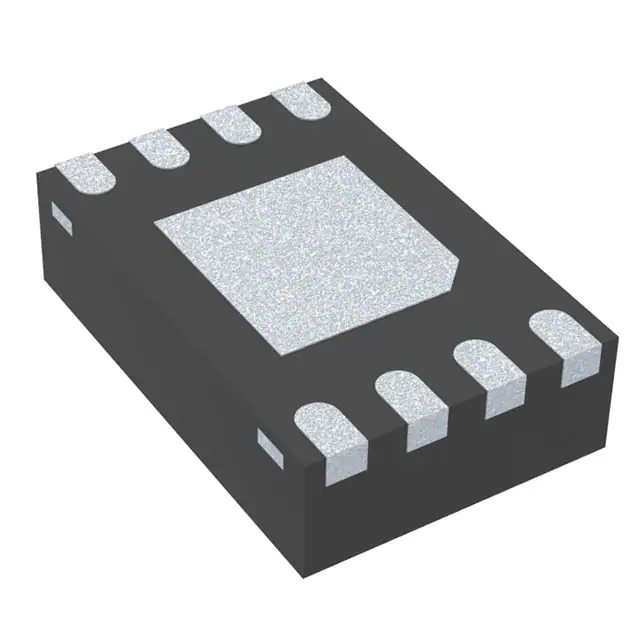
Package: 8-pin DFN (2 mm × 3 mm, exposed thermal pad). Pin 9 (EP) is internally connected to GND and must be soldered to PCB ground plane for thermal and electrical integrity.
| Pin/Terminal | Circuit Role | Design Meaning |
|---|---|---|
| A0–A2 | Slave Address Inputs | Set LSBs of 7-bit I²C address (0011xxx); enable up to 8 devices on same bus |
| GND | Ground Reference | Common return for analog sensor, digital logic, and EP thermal path |
| SDA | Bidirectional Data Line | Open-drain I²C data line requiring external pull-up; shares bus with EEPROM and sensor registers |
| SCLK | Clock Input | Master-generated clock; timing-critical for register reads/writes and EEPROM access |
| Event | Open-Drain Alert Output | Asserts when TA exceeds TUPPER/TLOWER/TCRIT; polarity and mode (comparator/interrupt) are software-configurable |
| VDD | Power Supply | 3.0–3.6V only; powers both temperature sensor and EEPROM; POR threshold at 2.3V (sensor) / 1.6V (EEPROM) |
Key Features
| Feature | Design Value |
|---|---|
| JEDEC JC42.4 Compliance | Fully satisfies Mobile Platform Memory Module Thermal Sensor Component spec - required for DDR2/DDR3 DIMM qualification |
| SPD EEPROM Architecture | 256-byte block with split protection: lower 128 bytes (00h–7Fh) support PWP/SWP; upper 128 bytes (80h–FFh) are unprotected general-purpose storage |
| User-Programmable Trip Limits | Three independent registers (TUPPER, TLOWER, TCRIT) with lock bits prevent accidental overwrite during runtime |
| Configurable Resolution & Hysteresis | Selectable resolution (0.0625°C–0.5°C) and hysteresis (0°C–6°C) optimize response speed vs. noise immunity for specific DIMM thermal profiles |
| Shared I²C Interface | Single 2-wire bus controls both temperature sensing and EEPROM operations - reduces PCB routing complexity and BOM count |
Applications
| DIMM Thermal Monitoring | DDR Memory SPD Storage |
|---|---|
Use Scenario: Real-time temperature tracking of DDR2/DDR3 memory modules during server boot, stress testing, and sustained workload operation. IC Role / Device Role / Timing Role: Primary JEDEC-compliant thermal sensor providing boundary-triggered alerts to memory controller or BMC via SMBus ALERT#. Use Value: Enables dynamic memory throttling or system shutdown before thermal derating occurs, preserving data integrity and module lifetime. | Use Scenario: Storing JEDEC-defined SPD data (vendor ID, part number, timing parameters, thermal specs) on DDR memory modules. IC Role / Device Role / Timing Role: Integrated 256-byte EEPROM serving as SPD device; accessed during system POST to configure memory controller timing. Use Value: Eliminates need for discrete SPD EEPROM, reducing component count and PCB area while ensuring JEDEC compliance. |
| Laptop Memory Thermal Management | Industrial Embedded Memory Modules |
Use Scenario: Monitoring temperature gradients across SO-DIMM slots in thin-and-light laptops under CPU/GPU load. IC Role / Device Role / Timing Role: Low-power temperature sensor with shutdown mode (3 µA) enabling periodic wake-up polling without draining battery. Use Value: Supports fanless or adaptive cooling strategies by delivering accurate thermal feedback at minimal energy cost. | Use Scenario: Providing reliable thermal sensing and SPD storage in extended-temperature industrial memory modules (-40°C to +125°C ambient). IC Role / Device Role / Timing Role: Dual-function IC meeting both JEDEC thermal accuracy requirements and EEPROM endurance (1M write cycles at +25°C). Use Value: Ensures long-term data retention and thermal reliability in harsh environments where discrete solutions may fail. |
Equivalent & Alternatives
The following parts are listed as comparable options for similar temperature sensor + SPD EEPROM applications.
| Alternative Part | Technical Difference | Application Difference | Selection Advice |
|---|---|---|---|
| AT30TS75-MA8-Y | ±0.5°C accuracy over −20°C to +100°C; no integrated EEPROM; requires external SPD EEPROM | Used in DIMMs where thermal sensing and SPD storage are implemented separately | Select when design separates sensor and SPD functions or requires wider temperature range than MCP98242T-BE/MCBAA's +75°C to +95°C accuracy band |
| MCP9808-E/MS | ±0.25°C accuracy over −40°C to +125°C; no EEPROM; I²C-compatible but lacks SPD-specific register map and write-protection features | Used in non-SPD applications like CPU thermal monitoring or environmental sensing | Select when highest accuracy is prioritized over SPD compliance, or when EEPROM functionality is unnecessary |
Compared with AT30TS75-MA8-Y and MCP9808-E/MS, the MCP98242T-BE/MCBAA uniquely combines JEDEC JC42.4 thermal accuracy with SPD EEPROM in one package - eliminating inter-device timing skew, reducing layout complexity, and guaranteeing SPD byte-level compatibility required for DDR memory qualification.
Availability
MCP98242T-BE/MCBAA is available at Aetrix Electronics and suitable for DIMM thermal monitoring, DDR memory SPD storage, laptop memory thermal management, and industrial embedded memory modules requiring stable component supply across production lifecycles.
Supply support for MCP98242T-BE/MCBAA includes scheduled delivery planning, volume procurement assistance, BOM continuity management, traceable sourcing, and lifecycle availability coordination for OEM customers, industrial embedded developers, connected-device designers, and electronics production programs.
Manufacturer
Microchip Technology Inc. is a leading provider of microcontrollers, analog components, and memory solutions, with core expertise in embedded control and thermal sensing.
The MCP98242 product line was designed specifically for JEDEC-compliant DDR memory module thermal monitoring and Serial Presence Detect (SPD) storage - integrating sensor and EEPROM into a single, space-constrained 8-pin DFN package.
FAQ
What is the operating voltage range for the MCP98242T-BE/MCBAA?
The MCP98242T-BE/MCBAA operates strictly from 3.0V to 3.6V. This matches the DDR memory module VDD_SPD rail and ensures compatibility with JEDEC SPD specifications. Operation outside this range - including at 1.8V or 5V - is not supported and may cause functional failure or damage. The Power-on Reset threshold is 2.3V for the sensor and 1.6V for the EEPROM.
Does the MCP98242T-BE/MCBAA meet JEDEC JC42.4 requirements?
Yes, the MCP98242T-BE/MCBAA is explicitly designed and specified to meet JEDEC JC42.4 Mobile Platform Memory Module Thermal Sensor Component requirements. Its ±0.5°C typical accuracy from +75°C to +95°C, programmable trip limits, open-drain Event output, and SPD EEPROM architecture are all aligned with JC42.4 compliance testing and validation criteria for DDR2/DDR3 DIMMs.
How is the EEPROM protected in the MCP98242T-BE/MCBAA?
The MCP98242T-BE/MCBAA EEPROM implements two protection modes: Permanent Write-Protection (PWP) and Software Reversible Write-Protection (SWP) for addresses 00h–7Fh (lower 128 bytes), used for critical SPD data. Addresses 80h–FFh (upper 128 bytes) remain unprotected for general-purpose use. Protection is enabled via high-voltage pulse (8–12V) applied to the A0 pin, as defined in Section 5.4 of DS21996D.
Can the MCP98242T-BE/MCBAA be used in systems with multiple DIMMs?
Yes, the MCP98242T-BE/MCBAA supports up to eight devices on a single I²C/SMBus through hardware-addressable A0–A2 pins (0011xxx base address). Each DIMM can use unique A0–A2 strap combinations, enabling individual temperature monitoring and SPD access without bus contention - essential for multi-channel server memory configurations.
What is the thermal response time of the MCP98242T-BE/MCBAA in its DFN package?
In the 8-pin DFN package (2 mm × 3 mm), the MCP98242T-BE/MCBAA has a thermal response time (tRES) of 0.7 seconds to reach 63% of final temperature when transitioning from 25°C air to 125°C oil bath. This fast response enables timely detection of rapid thermal transients in high-performance memory modules, supporting effective thermal management decisions.
MCP98242T-BE/MCBAA Specifications
- Product attributes
- Attribute value
- Manufacturer:
- Microchip Technology
- Series:
- -
- Package/Case:
- 8-VFDFN Exposed Pad
- Packaging:
- Tape & Reel (TR)
- Product Status:
- Active
- Function:
- Temp Monitoring System (Sensor), DIMM DDR Memory
- Sensor Type:
- Internal
- Sensing Temperature:
- -40°C ~ 125°C
- Accuracy:
- ±3°C(Max)
- Topology:
- ADC (Sigma Delta), Register Bank
- Output Type:
- I2C/SMBus
- Output Alarm:
- Yes
- Output Fan:
- Yes
- Voltage - Supply:
- 3V ~ 3.6V
- Operating Temperature:
- -40°C ~ 125°C
- Grade:
- -
- Qualification:
- -
- Mounting Type:
- Surface Mount
- Supplier Device Package:
- 8-DFN (2x3)
MCP98242T-BE/MCBAA FAQ
1.How can I place an order for MCP98242T-BE/MCBAA through Aetrix?
Please submit a Request for Quotation (RFQ) for MCP98242T-BE/MCBAA on Aetrix. Our sales agent will provide a competitive quotation and guide you through the order confirmation once you accept the terms.
2.Are the price and stock information for MCP98242T-BE/MCBAA reliable?
The price and inventory of MCP98242T-BE/MCBAA are updated periodically and may fluctuate due to market conditions. Stock and pricing data are typically refreshed every 24 hours. Quotation validity for MCP98242T-BE/MCBAA is usually 5 days.
3.What payment methods are accepted for MCP98242T-BE/MCBAA?
We accept Wire Transfer, PayPal, Credit Card, Western Union, MoneyGram, and Escrow for MCP98242T-BE/MCBAA transactions.
Note: Certain payment methods may incur a processing fee.
4.How is shipping managed for MCP98242T-BE/MCBAA?
MCP98242T-BE/MCBAA orders can be shipped via leading logistics carriers, including DHL, UPS, FedEx, TNT, or Registered Mail.
Once your MCP98242T-BE/MCBAA order is processed, you will receive an email with the shipment details and tracking number.
Note: Tracking information may take up to 24 hours to appear. Express delivery typically takes 3–5 business days.
5.How can I obtain technical support or documentation for MCP98242T-BE/MCBAA?
For technical support, including MCP98242T-BE/MCBAA datasheets, pinout diagrams, or application guidance, please contact our engineering support team. They can provide detailed documentation and assistance for your MCP98242T-BE/MCBAA requirements.
6.How does Aetrix verify that MCP98242T-BE/MCBAA is sourced from the original manufacturer or authorized distributors?
All MCP98242T-BE/MCBAA products on Aetrix are procured from qualified distributors and authorized channels. Our dedicated quality assurance team conducts strict verification, including traceability checks and, if necessary, third-party testing. This ensures that MCP98242T-BE/MCBAA meets industry standards.
7.What is the process for return or replacement of MCP98242T-BE/MCBAA?
All MCP98242T-BE/MCBAA units undergo pre-shipment inspection (PSI). If there is an issue with MCP98242T-BE/MCBAA, returns or replacements are accepted under the following conditions:
1.Quantity discrepancies, incorrect items, or visible external defects (such as breakage or corrosion), acknowledged by Aetrix.
2.The issue is reported within 90 days of delivery.
3.The MCP98242T-BE/MCBAA part is unused and in its original packaging.
Return procedure for MCP98242T-BE/MCBAA:
1.Submit a request within 90 days.
2.Obtain a Return Material Authorization (RMA) from Aetrix.
MCP98242T-BE/MCBAA Tags
-
EMC2101-ACZL-TR
Microchip Technology
-
MCP9844T-BE/MNY
Microchip Technology
-
EMC2101-R-ACZL-TR
Microchip Technology
-
MCP98244T-BE/MNY
Microchip Technology

-
TC670ECHTR
Microchip Technology
-
SE98ATP,547
NXP Semiconductors
-
AMC6821SDBQR
Texas Instruments

-
MAX6604AATA+T
Analog Devices Inc./Maxim Integrated
-
ADT7475ARQZ-REEL
onsemi
-
MAX6643LBBAEE+
Analog Devices Inc./Maxim Integrated
-
MAX6684ESA+T
Analog Devices Inc./Maxim Integrated
-
MAX6639AEE+
Analog Devices Inc./Maxim Integrated
Tech Hub

TTL and CMOS logic families differ in thresholds, loading, output drive, power and timing. This engineering guide compares 74HC and 74HCT, calculates noise margins and checks 3.3 V/5 V compatibility.

A practical engineering guide to 3.3V and 5V logic compatibility, input thresholds, resistor dividers, translator ICs, MOSFET level shifting, I2C pull-ups, timing limits and power-sequencing risks.

The 74HC595 uses push-pull logic outputs, while the TPIC6B595 uses 50 V open-drain DMOS sinks for higher-power loads. This guide compares timing, current limits, 3.3 V interfacing, load wiring, thermal…

The 74HC595 converts serial data into eight stable parallel outputs. This guide covers pin functions, shift and storage timing, OE and MR behavior, drive-current limits, cascading, voltage compatibilit…

A technical comparison of level-sensitive latches and edge-triggered flip-flops, covering timing windows, setup and hold limits, master–slave operation, time borrowing, race-through, HDL inference and…

A D latch stores one bit while Enable controls when data can pass. This reference covers gate-level operation, truth tables, transparency, setup and hold timing, LE versus OE, common ICs and practical …

An SR latch stores one bit through cross-coupled feedback. This engineering reference covers NOR and NAND implementations, truth tables, forbidden-state recovery, gated operation, switch debouncing, fa…

Latch circuits retain one bit through feedback. This technical reference covers SR and D latches, truth tables, transparency, timing limits, latch-versus-flip-flop behavior, applications and common log…

An engineering guide to LED driver operation, constant-current and constant-voltage outputs, linear and switching topologies, dimming, IC selection, calculations, replacement compatibility, and fault c…

Operational amplifier guide covering op amp basics, feedback, ideal vs real op amps, common configurations, buffer circuits, offset, bias current, gain-bandwidth, slew rate, rail-to-rail limits and sel…


