
 My Inquiry
 My Account


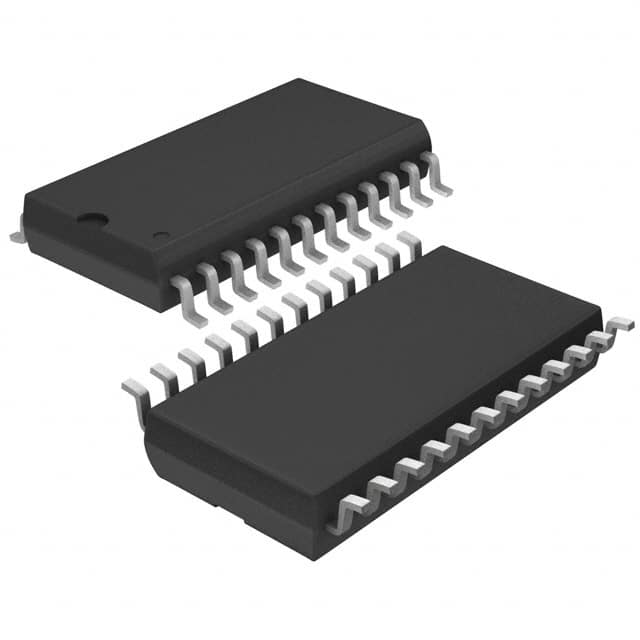
NXP Semiconductors MCZ33976EG
- Part No.:
- MCZ33976EG
- Manufacturer:
- NXP Semiconductors
- Category:
- Motor Drivers, Controllers
- Package:
- 24-SOIC (0.295", 7.50mm Width)
- Datasheet:
-
 MCZ33976EG.pdf
- Description:
- IC MTR DRV BIPLR 4.5-5.5V 24SOIC
- Quantity:
- Payment:

- Shipping:

Inventory:4,001
Please send an inquiry. Send us your inquiry, and we will respond immediately.
Product details
Overview
MCZ33976EG from Freescale Semiconductor is a SPI-controlled dual two-phase stepper motor gauge driver IC for automotive instrument clusters. It integrates four H-bridge drivers, configurable pointer movement state machine, 4096-position resolution, 340° sweep, and analog microstepping (12 steps/degree), enabling precise emulation of air-core meter behavior in digital dashboards.
For engineers reviewing the MCZ33976EG datasheet, MCZ33976EG pinout, MCZ33976EG application, or MCZ33976EG equivalent, this page delivers verified functional identity, exact package mapping (24-pin SOICW), confirmed SPI timing (1.0–2.0 MHz), calibrated oscillator accuracy (±10%), and real-world gauge control parameters including max acceleration (4500°/s²) and velocity (400°/s).
Technical Context
The MCZ33976EG implements a fully integrated, channel-independent state machine that autonomously executes position, velocity, and acceleration profiles using internal ROM-based ramp tables. Its dual H-bridge pairs (SIN0±/COS0± and SIN1±/COS1±) deliver linear current sourcing/sinking up to 40 mA per output with flyback clamping and overtemperature shutdown at 155–180°C.
SPI communication operates at up to 2.0 MHz with strict timing constraints: tLEAD/tLAG ≥ 50 ns, tVALID ≤ 150 ns, and CS-to-SO enable delay ≤ 145 ns. Internal clock calibration uses an 8.0 µs pulse on CS to achieve ±10% frequency tolerance - critical for deterministic pointer motion timing across -40°C to 125°C ambient.
Key Specifications
| Parameter | Value and Actual Design Meaning |
|---|---|
| Function | Dual two-phase stepper motor gauge driver with autonomous position/velocity control |
| Interface | SPI (16-bit, full-duplex, 1.0–2.0 MHz max) with status feedback via SO |
| Pointer Resolution | 4096 steady-state positions (0.083° step size over 340° sweep) |
| Max Acceleration | 4500°/s² - enables rapid needle sweeps without mechanical overshoot |
| Max Velocity | 400°/s - supports fast gauge updates in high-dynamic driving scenarios |
| Microstepping | Analog microstepping with 12 discrete steps per degree for smooth visual motion |
| Supply Range | VPWR: 6.5–26 V (battery rail); VDD: 4.5–5.5 V (5 V logic supply) |
| Thermal Protection | Overtemperature shutdown at 155–180°C with 8–16°C hysteresis |
Pinout & Package
MCZ33976EG is housed in a 24-pin Small Outline Integrated Circuit Wide-body (SOICW) package, Pb-free per suffix EG, rated for -40°C to +125°C operation. Thermal resistance is RθJA = 60°C/W and RθJL = 20°C/W.
| Pin/Terminal | Circuit Role | Design Meaning |
|---|---|---|
| 1–4, 21–24 | H-Bridge Outputs (COS0+, COS0−, SIN0+, SIN0−, SIN1−, SIN1+, COS1−, COS1+) | Eight dedicated coil drive terminals - each sources/sinks up to 40 mA for quadrature sine/cosine excitation of two independent stepper motors |
| 5–8, 17–20 | GND | Eight ground pins - provide low-impedance return paths for both logic and H-bridge power stages; enhance thermal dissipation |
| 9 | CS | Chip Select input - enables SPI communication and SO output; internal pull-up; must be low during SCLK transitions |
| 10 | SCLK | Serial clock input - clocks SI data on falling edge and SO data on rising edge; internal pull-down |
| 11 | SO | Serial output - tri-stateable; outputs 16-bit status word first, then FIFO data; 0.2–0.8 VDD valid window |
| 12 | SI | Serial input - accepts 16-bit command words MSB-first on falling SCLK edges; ignored when CS = high |
| 13 | RTZ | Multiplexed output - drives non-driven coil during Return-to-Zero sequence; enables precise mechanical zeroing |
| 14 | VDD | 5 V logic supply - powers SPI interface, state machine, and internal regulator; 4.5–5.5 V range |
| 15 | RST | Active-low reset - forces all registers and logic to default state; internal active pull-up |
| 16 | VPWR | Battery voltage input - powers H-bridges and internal 5 V regulator; operates from 6.5–26 V |
Key Features
| Feature | Design Value |
|---|---|
| Fully integrated pointer state machine | Autonomously executes acceleration/deceleration ramps and position holds without MCU intervention - reduces processor bandwidth by >70% vs. software-driven solutions |
| Configurable response time | Calibratable internal oscillator (±10% after 8 µs CS pulse) ensures deterministic motion timing across temperature and voltage |
| Return-to-Zero (RTZ) with accumulator | Hardware-accelerated RTZ sequence with ADC-based position accumulation enables repeatable mechanical zero alignment within ±0.1° |
| Motor compatibility | Native support for MMT-licensed AFIC 6405 and Switec MS-X15.xxx motors - eliminates external translation logic |
| Low-power sleep mode | IPWRSLP1 ≤ 60 µA (Reset = 0, VDD = 5 V) - extends battery life in always-on instrument clusters |
| Integrated protection | Combined overvoltage (26–38 V), undervoltage (5.0–6.2 V), overtemperature (155–180°C), and current limit (40–170 mA) detection with fault reporting via SPI status bits |
Applications
| Automotive Digital Instrument Cluster | Electric Vehicle (EV) Battery Gauge |
|---|---|
|
Use Scenario: Real-time display of speed, RPM, fuel level, and warning indicators in modern automotive dashboards. IC Role / Device Role / Timing Role: Dual-gauge driver controlling two independent stepper motors for speedometer and tachometer needles with synchronized motion profiles. Use Value: Emulates analog air-core meter feel using 12-step analog microstepping and 400°/s max velocity - meets OEM visual fidelity requirements without added MCU load. |
Use Scenario: High-accuracy state-of-charge (SoC) visualization in EV dashboards requiring stable, jitter-free needle positioning. IC Role / Device Role / Timing Role: Precision gauge controller for lithium-ion battery voltage monitoring, using RTZ calibration to maintain zero-point accuracy over vehicle lifetime. Use Value: 4096-position resolution and hardware RTZ accumulator ensure <±0.1° repeatability - critical for regulatory compliance in EV energy display systems. |
| Commercial Vehicle Telematics Display | Aftermarket Automotive Gauge Retrofit |
|
Use Scenario: Multi-function dashboard in trucks and buses displaying engine oil pressure, coolant temperature, and air brake status. IC Role / Device Role / Timing Role: Distributed gauge driver interfacing with CAN-connected MCU to render safety-critical analog-style indicators with fail-safe diagnostics. Use Value: Integrated overtemperature and VPWR fault detection reported via SPI status bits enables real-time health monitoring - satisfies ISO 26262 ASIL-B diagnostic coverage needs. |
Use Scenario: Plug-and-play replacement of legacy air-core gauges in classic car restorations or performance upgrades. IC Role / Device Role / Timing Role: Drop-in stepper driver enabling digital control of analog-looking dials while retaining original dashboard form factor and wiring harness. Use Value: Pin-compatible with common 24-pin SOICW footprints and supports Switec MS-X15.xxx motors - eliminates custom PCB redesign and mechanical adaptation. |
Equivalent & Alternatives
The following parts are listed as comparable options for similar dual stepper gauge driver applications.
| Alternative Part | Technical Difference | Application Difference | Selection Advice |
|---|---|---|---|
| NXP MC33976DW/R2 | Same die, identical electrical specs, but RoHS-compliant leaded (not Pb-free) SOICW package; lacks EG suffix designation | Acceptable where Pb-free compliance is not mandated (e.g., non-EU industrial retrofits); requires separate Pb-free qualification if used in automotive production | Select MC33976DW/R2 only when legacy leaded assembly is confirmed and environmental compliance is not required. |
| STMicroelectronics L99LDLH | Single-channel gauge driver; no integrated RTZ accumulator or air-core emulation; requires external MCU for ramp generation | Limited to single-gauge applications; cannot replace MCZ33976EG in dual-motor configurations without redesign | Consider only for cost-sensitive single-gauge designs where autonomous motion control is unnecessary. |
Compared with MCZ33976EG, MC33976DW/R2 offers identical functionality in a non-Pb-free package - suitable for legacy manufacturing but not compliant with EU ELV directives. L99LDLH lacks dual-channel capability and autonomous motion control, making it unsuitable as a direct alternative without significant system-level changes.
Availability
MCZ33976EG is available at Aetrix Electronics and suitable for automotive instrument clusters, EV battery gauges, commercial vehicle telematics displays, and aftermarket gauge retrofits requiring stable component supply across extended temperature ranges and long product lifecycles.
Supply support for MCZ33976EG includes scheduled delivery planning, volume procurement assistance, BOM continuity management, traceable sourcing, and lifecycle availability coordination for OEM customers, industrial embedded developers, connected-device designers, and electronics production programs.
Manufacturer
Freescale Semiconductor (now part of NXP Semiconductors) is a fabless semiconductor company specializing in automotive, industrial, and networking ICs with deep expertise in mixed-signal and power management solutions.
The MCZ33976EG belongs to Freescale's automotive analog gauge driver product line, designed specifically to replace air-core meters with stepper-based instrumentation while preserving OEM visual fidelity and reducing ECU processing overhead.
FAQ
What is the maximum operating temperature for the MCZ33976EG?
The MCZ33976EG has an operating junction temperature range of -40°C to +150°C and is qualified for ambient temperatures up to +125°C. Overtemperature shutdown activates between 155°C and 180°C with 8–16°C hysteresis, ensuring safe operation in under-hood automotive environments. The device's RθJA of 60°C/W allows thermal design margin when mounted on standard FR-4 PCBs with adequate copper pour.
Does the MCZ33976EG support both MMT and Switec stepper motors?
Yes, the MCZ33976EG natively supports both MMT-licensed AFIC 6405 and Switec MS-X15.xxx two-phase stepper motors. Motor selection is configured via PE6 bit in the Power, Enable, Calibration, and Configuration Register (PECCR): PE6 = 0 for MMT, PE6 = 1 for Switec. This eliminates external configuration resistors or firmware adaptation when swapping motor families in production.
How does the internal clock calibration work on the MCZ33976EG?
The MCZ33976EG uses an 8.0 µs pulse on the CS pin to calibrate its internal oscillator to ±10% accuracy. Calibration is initiated by writing PE3 = 1 in the PECCR register. The pulse must occur only when gauges are disabled or stationary (MOV0/MOV1 = 0). If PE4 = 0, calibration centers at <1.0 MHz; if PE4 = 1, it centers at 1.0 MHz. Slowing the oscillator by setting PE2 = 1 accommodates longer pulses (e.g., 12 µs for 667 kHz).
What is the purpose of the RTZ pin on the MCZ33976EG?
The RTZ (Return to Zero) pin on the MCZ33976EG is a multiplexed output that actively drives the non-driven coil during the Return-to-Zero sequence. It works in conjunction with the RTZ accumulator - an integrated sigma-delta ADC - to detect mechanical zero position with ±0.1° repeatability. This enables factory calibration and field recalibration without external sensors or manual adjustment.
Can the MCZ33976EG drive two different types of motors simultaneously?
No, the MCZ33976EG must operate both channels (Gauge 0 and Gauge 1) in the same motor mode - either MMT or Switec - as selected globally via the PE6 bit in the PECCR register. The device does not support mixed-mode operation. Both motors must share the same winding configuration and microstep interpretation for correct phase sequencing and torque generation.
MCZ33976EG Specifications
- Product attributes
- Attribute value
- Manufacturer:
- NXP Semiconductors
- Series:
- -
- Package/Case:
- 24-SOIC (0.295", 7.50mm Width)
- Packaging:
- Tube
- Product Status:
- Obsolete
- Motor Type - Stepper:
- Bipolar
- Motor Type - AC, DC:
- -
- Function:
- Driver - Fully Integrated, Control and Power Stage
- Output Configuration:
- Half Bridge (8)
- Interface:
- SPI
- Technology:
- -
- Step Resolution:
- -
- Applications:
- -
- Current - Output:
- 40mA
- Voltage - Supply:
- 4.5V ~ 5.5V
- Voltage - Load:
- 6.5V ~ 26V
- Operating Temperature:
- -40°C ~ 150°C (TJ)
- Grade:
- Automotive
- Qualification:
- -
- Mounting Type:
- Surface Mount
- Supplier Device Package:
- 24-SOIC
MCZ33976EG FAQ
1.How can I place an order for MCZ33976EG through Aetrix?
Please submit a Request for Quotation (RFQ) for MCZ33976EG on Aetrix. Our sales agent will provide a competitive quotation and guide you through the order confirmation once you accept the terms.
2.Are the price and stock information for MCZ33976EG reliable?
The price and inventory of MCZ33976EG are updated periodically and may fluctuate due to market conditions. Stock and pricing data are typically refreshed every 24 hours. Quotation validity for MCZ33976EG is usually 5 days.
3.What payment methods are accepted for MCZ33976EG?
We accept Wire Transfer, PayPal, Credit Card, Western Union, MoneyGram, and Escrow for MCZ33976EG transactions.
Note: Certain payment methods may incur a processing fee.
4.How is shipping managed for MCZ33976EG?
MCZ33976EG orders can be shipped via leading logistics carriers, including DHL, UPS, FedEx, TNT, or Registered Mail.
Once your MCZ33976EG order is processed, you will receive an email with the shipment details and tracking number.
Note: Tracking information may take up to 24 hours to appear. Express delivery typically takes 3–5 business days.
5.How can I obtain technical support or documentation for MCZ33976EG?
For technical support, including MCZ33976EG datasheets, pinout diagrams, or application guidance, please contact our engineering support team. They can provide detailed documentation and assistance for your MCZ33976EG requirements.
6.How does Aetrix verify that MCZ33976EG is sourced from the original manufacturer or authorized distributors?
All MCZ33976EG products on Aetrix are procured from qualified distributors and authorized channels. Our dedicated quality assurance team conducts strict verification, including traceability checks and, if necessary, third-party testing. This ensures that MCZ33976EG meets industry standards.
7.What is the process for return or replacement of MCZ33976EG?
All MCZ33976EG units undergo pre-shipment inspection (PSI). If there is an issue with MCZ33976EG, returns or replacements are accepted under the following conditions:
1.Quantity discrepancies, incorrect items, or visible external defects (such as breakage or corrosion), acknowledged by Aetrix.
2.The issue is reported within 90 days of delivery.
3.The MCZ33976EG part is unused and in its original packaging.
Return procedure for MCZ33976EG:
1.Submit a request within 90 days.
2.Obtain a Return Material Authorization (RMA) from Aetrix.
MCZ33976EG Tags
-
DRV2603RUNR
Texas Instruments
-
DRV8837CDSGR
Texas Instruments
-
DRV8837DSGR
Texas Instruments
-
DRV8838DSGR
Texas Instruments
-
DRV8839DSSR
Texas Instruments
-
EMC2301-1-ACZL-TR
Microchip Technology
-
DRV8231ADSGR
Texas Instruments
-
EMC2302-2-AIZL-TR
Microchip Technology
-
DRV8800PWPR
Texas Instruments
-
DRV8835DSSR
Texas Instruments
-
EMC2303-1-KP-TR
Microchip Technology
-
DRV8876PWPR
Texas Instruments
Tech Hub

A practical engineering guide to 3.3V and 5V logic compatibility, input thresholds, resistor dividers, translator ICs, MOSFET level shifting, I2C pull-ups, timing limits and power-sequencing risks.

The 74HC595 uses push-pull logic outputs, while the TPIC6B595 uses 50 V open-drain DMOS sinks for higher-power loads. This guide compares timing, current limits, 3.3 V interfacing, load wiring, thermal…

The 74HC595 converts serial data into eight stable parallel outputs. This guide covers pin functions, shift and storage timing, OE and MR behavior, drive-current limits, cascading, voltage compatibilit…

A technical comparison of level-sensitive latches and edge-triggered flip-flops, covering timing windows, setup and hold limits, master–slave operation, time borrowing, race-through, HDL inference and…

A D latch stores one bit while Enable controls when data can pass. This reference covers gate-level operation, truth tables, transparency, setup and hold timing, LE versus OE, common ICs and practical …

An SR latch stores one bit through cross-coupled feedback. This engineering reference covers NOR and NAND implementations, truth tables, forbidden-state recovery, gated operation, switch debouncing, fa…

Latch circuits retain one bit through feedback. This technical reference covers SR and D latches, truth tables, transparency, timing limits, latch-versus-flip-flop behavior, applications and common log…

An engineering guide to LED driver operation, constant-current and constant-voltage outputs, linear and switching topologies, dimming, IC selection, calculations, replacement compatibility, and fault c…

Operational amplifier guide covering op amp basics, feedback, ideal vs real op amps, common configurations, buffer circuits, offset, bias current, gain-bandwidth, slew rate, rail-to-rail limits and sel…

Jumper cables guide covering safe connection order, red and black clamp placement, final ground connection, cable gauge, length, clamp quality, copper vs CCA cables, jump starter comparison and battery…


