
 My Inquiry
 My Account


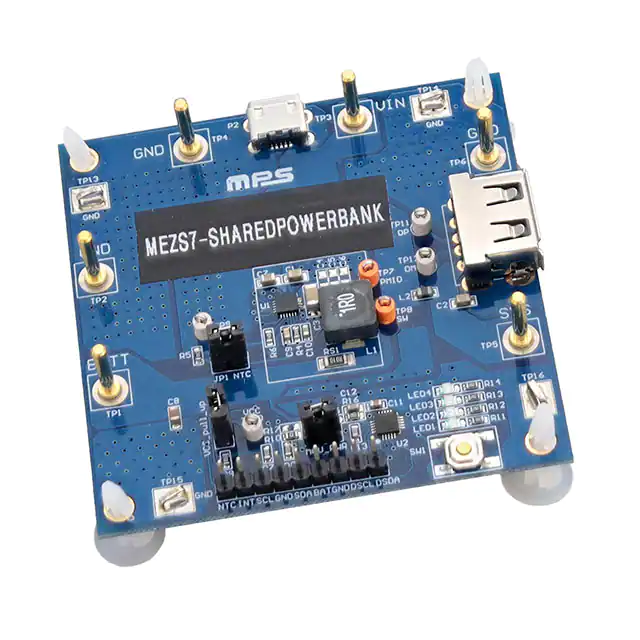
Monolithic Power Systems Inc. MEZS7-SHAREDPOWERBANK
- Part No.:
- MEZS7-SHAREDPOWERBANK
- Manufacturer:
- Monolithic Power Systems Inc.
- Package:
- Datasheet:
-
 MEZS7-SHAREDPOWERBANK.pdf
- Description:
- EVAL BOARD FOR MP2696A
- Quantity:
- Payment:

- Shipping:

Inventory:4,411
Please send an inquiry. Send us your inquiry, and we will respond immediately.
Product details
Overview
MEZS7-SHAREDPOWERBANK from Monolithic Power Systems is a complete, I²C-controlled solution module built around the MP2696A single-cell switching charger and boost controller, integrating MCU-based power-path management, LED state-of-charge indication, and USB-A output regulation. It delivers up to 3.6A charge current from 5V micro-USB input and supplies regulated 5.05–5.25V at up to 3.6A for external device charging in shared power bank deployments.
For engineers reviewing the MEZS7-SHAREDPOWERBANK datasheet, MEZS7-SHAREDPOWERBANK pinout, MEZS7-SHAREDPOWERBANK application, or MEZS7-SHAREDPOWERBANK equivalent, this module provides turnkey implementation of dual-direction power-path control, programmable JEITA-compliant charging, USB cable compensation, and real-time battery current monitoring via analog IB output - all accessible through standardized I²C commands.
Technical Context
The MEZS7-SHAREDPOWERBANK implements a fully integrated power bank reference design with three operational states: charge mode (4–6V input → battery), boost mode (battery → 5V SYS output), and sleep mode (auto-entry after 32s no-load). Its core MP2696A IC manages bidirectional power flow using synchronous buck-boost topology with adaptive input current limiting and minimum input voltage loop for adapter power tracking.
System-level intelligence is provided by an ABOV MC96F1206UBN MCU that handles LED state-of-charge sequencing, button-triggered SYS activation, NTC thermistor interfacing, and BC1.2/legacy adapter detection via DP/DM interface - enabling robust plug-and-play behavior without host processor dependency.
Key Specifications
| Parameter | Value and Actual Design Meaning |
|---|---|
| Input voltage range | 4–6 V - supports standard 5V micro-USB adapters; withstands up to 16V transient input |
| Charge current | Up to 3.6 A, programmable - enables fast single-cell Li-ion charging with thermal-aware current scaling |
| Charge voltage range | 3.6–4.45 V, programmable - covers full Li-ion voltage profile including low-voltage pre-charge and CV termination |
| Boost output voltage | 5.05–5.25 V, programmable - maintains USB-IF compliant output under load with cable drop compensation |
| Boost output current | 2.1–3.6 A, programmable - supports high-current smartphone/tablet charging with overcurrent fault protection |
| Output power | Up to 18 W - sufficient for simultaneous multi-device charging at USB-A port |
| I²C interface | Standard-mode (100 kHz) and fast-mode (400 kHz) - enables real-time parameter read/write and status polling |
Availability
MEZS7-SHAREDPOWERBANK is available at Aetrix Electronics and suitable for shared power bank kiosks, rental station battery backup systems, and USB Type-A portable charging stations requiring stable component supply, rapid time-to-market, and field-upgradable firmware control.
Supply support for MEZS7-SHAREDPOWERBANK includes scheduled delivery planning, volume procurement assistance, BOM continuity management, traceable sourcing, and lifecycle availability coordination for OEM customers, industrial embedded developers, connected-device designers, and electronics production programs.
Manufacturer
Monolithic Power Systems (MPS) is a fabless semiconductor company specializing in high-performance power management ICs, with expertise in DC/DC conversion, battery management, and motor drivers for consumer, industrial, and automotive applications.
The MEZS7-SHAREDPOWERBANK belongs to MPS's reference design module portfolio, engineered to accelerate development of certified, production-ready shared power infrastructure - reducing validation effort while ensuring compliance with USB power delivery expectations and JEITA thermal safety standards.
FAQ
What are the required connections to operate the MEZS7-SHAREDPOWERBANK in standalone mode?
Standalone operation requires only three connections: battery (TP1/TP2), 5V input (P2 micro-USB or TP3/TP4), and load (P1 USB-A or TP5/TP6). The onboard MCU automatically initiates charge or boost based on presence of input power and load, with SW1 button providing manual SYS output enable.
How does the board handle battery under-voltage lockout (UVLO)?
The MEZS7-SHAREDPOWERBANK enforces BATT_UVLO protection per MP2696A specification: if battery voltage drops below ~2.8V during discharge, the boost converter disables and enters sleep mode until recharge begins. The quick-start guide explicitly warns against operating with deeply discharged cells to prevent UVLO lockout.
Can the JEITA charging profile be customized, and how is it implemented?
Yes - the JEITA profile is fully customizable via I²C registers controlling temperature thresholds and corresponding charge voltage/current limits across cold, cool, normal, warm, and hot zones. The onboard NTC circuit (JP1 installed) feeds temperature data to the MP2696A, which executes the programmed thermal policy without MCU intervention.
What is the role of the MC96F1206UBN MCU on the board?
The ABOV MC96F1206UBN MCU manages non-power-path functions: LED state-of-charge sequencing (LED1–LED4), SW1 button debouncing and SYS toggle, BC1.2/DP-DN handshake detection, and I²C bridge between host PC and MP2696A registers - enabling GUI-based configuration without modifying the charger IC's firmware.
Does the module support USB cable compensation, and how is it configured?
Yes - the MP2696A implements programmable USB cable compensation to maintain 5V ±5% at the load end. Compensation is enabled via I²C register and calibrated using external resistors (R11–R14) that set the voltage drop estimate; typical configuration yields ±150mV compensation over 0.5–2A load range.
What safety protections are implemented beyond JEITA and thermal shutdown?
In addition to JEITA and thermal shutdown, the module implements input over-voltage protection (OVP), SYS over-current and short-circuit protection, charge safety timer (programmable up to 12 hours), and automatic sleep mode entry after 32 seconds of SYS no-load - all enforced by the MP2696A hardware logic independent of MCU control.
MEZS7-SHAREDPOWERBANK Specifications
- Product attributes
- Attribute value
- Manufacturer:
- Monolithic Power Systems Inc.
- Series:
- -
- Packaging:
- Box
- Product Status:
- Active
- Type:
- Power Management
- Function:
- Battery Charger
- Embedded:
- Yes
- Utilized IC / Part:
- MP2696A
- Primary Attributes:
- -
- Secondary Attributes:
- I2C Interface(s), Graphical User Interface (GUI)
- Contents:
- Board(s)
MEZS7-SHAREDPOWERBANK FAQ
1.How can I place an order for MEZS7-SHAREDPOWERBANK through Aetrix?
Please submit a Request for Quotation (RFQ) for MEZS7-SHAREDPOWERBANK on Aetrix. Our sales agent will provide a competitive quotation and guide you through the order confirmation once you accept the terms.
2.Are the price and stock information for MEZS7-SHAREDPOWERBANK reliable?
The price and inventory of MEZS7-SHAREDPOWERBANK are updated periodically and may fluctuate due to market conditions. Stock and pricing data are typically refreshed every 24 hours. Quotation validity for MEZS7-SHAREDPOWERBANK is usually 5 days.
3.What payment methods are accepted for MEZS7-SHAREDPOWERBANK?
We accept Wire Transfer, PayPal, Credit Card, Western Union, MoneyGram, and Escrow for MEZS7-SHAREDPOWERBANK transactions.
Note: Certain payment methods may incur a processing fee.
4.How is shipping managed for MEZS7-SHAREDPOWERBANK?
MEZS7-SHAREDPOWERBANK orders can be shipped via leading logistics carriers, including DHL, UPS, FedEx, TNT, or Registered Mail.
Once your MEZS7-SHAREDPOWERBANK order is processed, you will receive an email with the shipment details and tracking number.
Note: Tracking information may take up to 24 hours to appear. Express delivery typically takes 3–5 business days.
5.How can I obtain technical support or documentation for MEZS7-SHAREDPOWERBANK?
For technical support, including MEZS7-SHAREDPOWERBANK datasheets, pinout diagrams, or application guidance, please contact our engineering support team. They can provide detailed documentation and assistance for your MEZS7-SHAREDPOWERBANK requirements.
6.How does Aetrix verify that MEZS7-SHAREDPOWERBANK is sourced from the original manufacturer or authorized distributors?
All MEZS7-SHAREDPOWERBANK products on Aetrix are procured from qualified distributors and authorized channels. Our dedicated quality assurance team conducts strict verification, including traceability checks and, if necessary, third-party testing. This ensures that MEZS7-SHAREDPOWERBANK meets industry standards.
7.What is the process for return or replacement of MEZS7-SHAREDPOWERBANK?
All MEZS7-SHAREDPOWERBANK units undergo pre-shipment inspection (PSI). If there is an issue with MEZS7-SHAREDPOWERBANK, returns or replacements are accepted under the following conditions:
1.Quantity discrepancies, incorrect items, or visible external defects (such as breakage or corrosion), acknowledged by Aetrix.
2.The issue is reported within 90 days of delivery.
3.The MEZS7-SHAREDPOWERBANK part is unused and in its original packaging.
Return procedure for MEZS7-SHAREDPOWERBANK:
1.Submit a request within 90 days.
2.Obtain a Return Material Authorization (RMA) from Aetrix.
MEZS7-SHAREDPOWERBANK Tags
-
BOB-12009
SparkFun Electronics
-
106990290
Seeed Technology Co., Ltd
-
BOB-11771
SparkFun Electronics
-
BOB-09118
SparkFun Electronics

-
4410
Adafruit Industries LLC
-
5335
Adafruit Industries LLC
-
BOB-11189
SparkFun Electronics
-
3295
Adafruit Industries LLC
-
3421
Adafruit Industries LLC
-
1904
Adafruit Industries LLC
-
2717
Adafruit Industries LLC
-
3190
Adafruit Industries LLC
Tech Hub

Operational amplifier guide covering op amp basics, feedback, ideal vs real op amps, common configurations, buffer circuits, offset, bias current, gain-bandwidth, slew rate, rail-to-rail limits and sel…

Jumper cables guide covering safe connection order, red and black clamp placement, final ground connection, cable gauge, length, clamp quality, copper vs CCA cables, jump starter comparison and battery…

LDO regulator guide covering low dropout voltage, power dissipation, thermal design, PSRR, output noise, capacitor stability, adjustable LDO circuits, LDO vs buck converter and datasheet selection chec…

Conditional Access Module guide covering CAM meaning, CI/CI+ interface, smart card authorization, DVB security workflow, TV and set-top box compatibility, internal electronics, ESD protection, connecto…

Guide to electronic component obsolescence covering EOL risk, PCN/PDN notices, last-time buy planning, replacement options, form-fit-function validation, counterfeit risk and BOM lifecycle management.

18650 battery guide covering lithium-ion cell basics, 3.6V/3.7V voltage, 4.2V charging, mAh and Wh capacity, protected cells, chargers, BMS, series-parallel packs, holders, welding and sourcing checks.…

Hall effect sensor guide covering working principle, linear and digital sensors, Arduino circuits, current sensing, speed detection, automotive applications, A3144 examples, signal filtering and datash…

Product Change Notification guide for electronic components, covering PCN meaning, PCN vs PDN/EOL, common change types, risk levels, form-fit-function review, engineering validation, BOM control, LTB/L…

A practical guide to blend door actuators, covering HVAC function, symptoms, location, AC and heater issues, reset and calibration, replacement cost, electrical diagnosis, compatibility checks, and rep…

Engineering guide to Raspberry Pi alternatives, covering chip-level differences, Orange Pi, ROCK, Jetson, Banana Pi, NanoPi, Compute Module, Pico, GPIO, camera, HAT compatibility, and replacement risks…


