
 My Inquiry
 My Account


STMicroelectronics MP34DT01
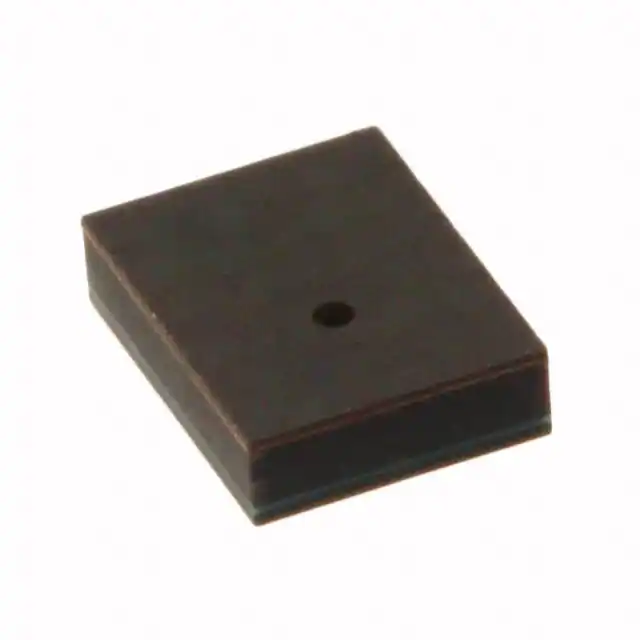
- Part No.:
- MP34DT01
- Manufacturer:
- STMicroelectronics
- Category:
- Microphones
- Package:
- Datasheet:
-
 MP34DT01.pdf
- Description:
- MIC MEMS DIGITAL PDM OMNI -26DB
- Quantity:
- Payment:

- Shipping:

Inventory:2,177
Please send an inquiry. Send us your inquiry, and we will respond immediately.
Product details
Overview
MP34DT01 from STMicroelectronics is an omnidirectional digital MEMS microphone with PDM output, designed for audio capture in space-constrained portable electronics. It features –26 dBFS sensitivity, 63 dB SNR, 120 dBSPL acoustic overload point, operates from 1.64–3.6 V, and is housed in a 3×4×1 mm HCLGA top-port package rated for –40 °C to +85 °C.
For engineers reviewing the MP34DT01 datasheet, MP34DT01 pinout, MP34DT01 application, or MP34DT01 equivalent, key selection criteria include PDM interface compatibility, low-power operation (0.6 mA typical), EMI-shielded top-port packaging, and L/R channel selection capability via dedicated control pin.
Technical Context
The MP34DT01 integrates a capacitive silicon MEMS sensing element with a CMOS ASIC that outputs a single-bit PDM stream synchronized to an external clock (1–3.25 MHz). Its L/R pin configures data validity timing per clock edge, enabling stereo pair configuration without additional controllers.
Acoustic performance is defined by A-weighted 63 dB SNR at 1 kHz/1 Pa, ±2 dBr flatness from 100 Hz–4 kHz, and <1% THD+N at 100 dBSPL. Power-down mode draws only 20 µA, and turn-on time is guaranteed at ≤10 ms from first clock edge.
Key Specifications
| Parameter | Value and Actual Design Meaning |
|---|---|
| Sensitivity | –26 dBFS (±3 dB): Directly maps acoustic pressure to digital full-scale level; enables consistent gain staging in PDM-based audio front-ends. |
| SNR | 63 dB A-weighted: High dynamic range for clear voice capture in noisy environments like mobile handsets or VoIP headsets. |
| AOP | 120 dBSPL: Withstands loud transients (e.g., speaker feedback, gunshot sounds) without clipping or distortion. |
| Supply Voltage | 1.64–3.6 V: Compatible with single-cell Li-ion (3.0–3.6 V) and low-voltage logic rails (1.8 V), simplifying power architecture. |
| Current Consumption | 0.6 mA typical (normal mode); 20 µA (power-down): Enables battery life extension in always-on voice wake-up systems. |
| Output Format | PDM (1-bit, 1–3.25 MHz clock): Reduces interface complexity vs. I²S; eliminates need for external ADC and decimation filters. |
| Operating Temp | –40 °C to +85 °C: Validated for automotive infotainment, industrial handhelds, and outdoor consumer devices. |
Pinout & Package
The MP34DT01 uses a 4-lead HCLGA (3 × 4 × 1 mm) top-port surface-mount package with integrated EMI shielding, ECOPACK® compliance, and RoHS/Green certification. The ground ring (Pin 5) surrounds the active area but is not electrically connected to internal circuitry - it serves as mechanical and EMI reference.
| Pin/Terminal | Circuit Role | Design Meaning |
|---|---|---|
| 1 Vdd | Power supply input | Accepts 1.64–3.6 V; requires local 1 µF ceramic decoupling adjacent to pin for stable PDM output integrity. |
| 2 LR | Left/right channel select | Logic-level control: GND = left-data-valid-on-CLK-high; Vdd = right-data-valid-on-CLK-high - enables dual-mic stereo sync without master clock arbitration. |
| 3 CLK | External synchronization clock | Accepts 1–3.25 MHz square wave (40–60% duty); defines PDM bit rate and sampling timing; no internal oscillator required. |
| 4 DOUT | PDM serial data output | Single-bit stream aligned to CLK edges per LR state; high-impedance when inactive - allows wired-OR of multiple mics on shared bus. |
| 5 (ground ring) | EMI shield & mechanical reference | Not electrically connected to IC die; must be soldered to PCB ground plane to maintain RF immunity and acoustic port sealing. |
Key Features
| Feature | Design Value |
|---|---|
| Omnidirectional top-port design | Enables flush mounting behind metal/glass covers in smartphones and laptops without acoustic path obstruction or directional bias. |
| EMI-shielded HCLGA package | Prevents RF interference from cellular/Wi-Fi modules from corrupting PDM bitstream - critical for certified wireless audio devices. |
| L/R channel selection pin | Eliminates need for external multiplexers or dual-clock routing in stereo arrays; reduces BOM count and PCB routing congestion. |
| Low-power power-down mode | 20 µA quiescent current allows integration into always-listening voice assistants while meeting stringent energy budgets (e.g., <10 µW avg). |
| –40 °C to +85 °C operation | Validated across full industrial temperature range - supports deployment in automotive cabins, factory-floor tablets, and outdoor security cameras. |
Applications
| Mobile Voice Capture | Voice-Controlled IoT Devices |
|---|---|
Use Scenario: Dual-mic noise cancellation in smartphone call processing and voice assistant activation. IC Role / Device Role / Timing Role: Primary acoustic sensor providing PDM stream synchronized to SoC's audio clock; L/R pin configures stereo pairing. Use Value: 63 dB SNR and 120 dBSPL AOP ensure intelligible speech capture even during loud ambient conditions or proximity to loudspeakers. | Use Scenario: Far-field voice wake word detection in smart speakers and home hubs. IC Role / Device Role / Timing Role: Always-on low-power audio sensor feeding PDM data to DSP; power-down mode activated between wake events. Use Value: 20 µA power-down current extends battery life in portable or USB-powered units; top-port design allows seamless integration under fabric grilles. |
| Laptop Array Microphones | Industrial Speech Interfaces |
Use Scenario: Beamforming microphone array in ultrabooks and video conferencing systems. IC Role / Device Role / Timing Role: Synchronized PDM node in multi-mic array; CLK and LR pins enable precise inter-channel phase alignment. Use Value: Tight ±2 dBr frequency response tolerance (100 Hz–4 kHz) ensures consistent beamformer filter coefficients across all channels. | Use Scenario: Hands-free voice command interface in ruggedized industrial tablets and warehouse scanners. IC Role / Device Role / Timing Role: Ruggedized acoustic input tolerant of vibration, dust ingress (via sealed top-port), and wide thermal swings. Use Value: –40 °C to +85 °C rating and EMI shielding maintain reliable operation near motors, inverters, and RF equipment. |
Equivalent & Alternatives
The following parts are listed as comparable options for similar digital MEMS microphone applications.
| Alternative Part | Technical Difference | Application Difference | Selection Advice |
|---|---|---|---|
| Knowles SPH0641LU4H-1 | PDM output, same 3×4 mm package, but –26 dBFS sensitivity and 64 dB SNR; requires 1.8 V ±5% supply (tighter than MP34DT01's 1.64–3.6 V range). | Optimized for ultra-low-noise headset mics; lacks L/R pin - stereo requires two independent clocks or post-processing alignment. | Select when SNR margin >1 dB is critical and supply rail is tightly regulated; avoid if flexible voltage or stereo sync simplicity is required. |
| InvenSense IAM-20380 | I²S output (not PDM), integrated digital low-pass filter, 61 dB SNR, 3.3 V only; larger 4×3×1.2 mm package with bottom port. | Targets motion-audio fusion (IMU + mic); bottom-port layout complicates front-panel mounting and increases acoustic crosstalk risk. | Select only when I²S interface and motion sensing are co-required; avoid for space-constrained top-port designs or PDM-native SoCs. |
Compared with SPH0641LU4H-1 and IAM-20380, the MP34DT01 uniquely balances wide supply range, integrated L/R stereo control, top-port EMI shielding, and industrial temperature rating - making it optimal for cost-sensitive, high-volume portable audio where layout simplicity and robustness are prioritized over marginal SNR gains or multimodal sensing.
Availability
MP34DT01 is available at Aetrix Electronics and suitable for mobile terminals, laptop audio subsystems, and VoIP endpoints requiring stable component supply across extended production lifecycles.
Supply support for MP34DT01 includes scheduled delivery planning, volume procurement assistance, BOM continuity management, traceable sourcing, and lifecycle availability coordination for OEM customers, industrial embedded developers, connected-device designers, and electronics production programs.
Manufacturer
STMicroelectronics is a global semiconductor leader headquartered in Geneva, Switzerland, delivering microcontrollers, sensors, power ICs, and analog/mixed-signal solutions for industrial, automotive, and consumer markets.
The MP34DT01 belongs to ST's MEMS audio sensor product line, engineered specifically for high-fidelity, low-power digital voice capture in compact, EMI-challenged portable devices - emphasizing top-port integration, PDM simplicity, and industrial-grade reliability.
FAQ
What is the recommended PCB land pattern for MP34DT01?
The official land pattern specifies four 0.85×0.85 mm solder pads spaced at 1.35 mm (horizontal) and 0.85 mm (vertical) pitch, with a central ground ring pad matching the package outline (3.10×2.10 mm). ST recommends using solder mask defined pads and avoiding solder paste on the ground ring to prevent tombstoning and ensure acoustic port integrity.
Does MP34DT01 require external clock conditioning?
No external clock conditioning is required. The MP34DT01 accepts a standard CMOS-level square wave (1–3.25 MHz, 40–60% duty cycle) directly on the CLK pin. Jitter tolerance is specified at ±1 ns; typical SoC GPIO or dedicated audio clock generators meet this without buffers or PLLs.
How does the L/R pin affect PDM data timing?
When LR = GND, valid PDM data appears on DOUT during CLK high; when LR = Vdd, valid data appears during CLK low. This allows two MP34DT01 devices sharing one CLK line to output interleaved left/right samples without time-division multiplexing overhead or additional control signals.
Can MP34DT01 be used in waterproof or dustproof enclosures?
Yes - its top-port design and hermetically sealed HCLGA package allow integration behind IP-rated membranes or gaskets. ST confirms acoustic performance remains stable when covered with 0.1 mm silicone or polyurethane films; however, total acoustic attenuation must be characterized per final enclosure design.
MP34DT01 Specifications
- Product attributes
- Attribute value
- Manufacturer:
- STMicroelectronics
- Series:
- -
- Packaging:
- Tray
- Product Status:
- Active
- Type:
- MEMS (Silicon)
- Output Type:
- Digital, PDM
- Direction:
- Omnidirectional
- Frequency Range:
- 100 Hz ~ 10 kHz
- Sensitivity:
- -26dB ±3dB @ 94dB SPL
- S/N Ratio:
- 63dB
- Impedance:
- -
- Voltage - Rated:
- 1.8 V
- Voltage Range:
- 1.64 V ~ 3.6 V
- Current - Supply:
- 600 µA
- Port Location:
- Top
- Ratings:
- -
- Termination:
- Solder Pads
- Size / Dimension:
- 0.157" L x 0.118" W (4.00mm x 3.00mm)
- Height (Max):
- 0.043" (1.10mm)
- Shape:
- Rectangular
- Grade:
- -
- Qualification:
- -
MP34DT01 FAQ
1.How can I place an order for MP34DT01 through Aetrix?
Please submit a Request for Quotation (RFQ) for MP34DT01 on Aetrix. Our sales agent will provide a competitive quotation and guide you through the order confirmation once you accept the terms.
2.Are the price and stock information for MP34DT01 reliable?
The price and inventory of MP34DT01 are updated periodically and may fluctuate due to market conditions. Stock and pricing data are typically refreshed every 24 hours. Quotation validity for MP34DT01 is usually 5 days.
3.What payment methods are accepted for MP34DT01?
We accept Wire Transfer, PayPal, Credit Card, Western Union, MoneyGram, and Escrow for MP34DT01 transactions.
Note: Certain payment methods may incur a processing fee.
4.How is shipping managed for MP34DT01?
MP34DT01 orders can be shipped via leading logistics carriers, including DHL, UPS, FedEx, TNT, or Registered Mail.
Once your MP34DT01 order is processed, you will receive an email with the shipment details and tracking number.
Note: Tracking information may take up to 24 hours to appear. Express delivery typically takes 3–5 business days.
5.How can I obtain technical support or documentation for MP34DT01?
For technical support, including MP34DT01 datasheets, pinout diagrams, or application guidance, please contact our engineering support team. They can provide detailed documentation and assistance for your MP34DT01 requirements.
6.How does Aetrix verify that MP34DT01 is sourced from the original manufacturer or authorized distributors?
All MP34DT01 products on Aetrix are procured from qualified distributors and authorized channels. Our dedicated quality assurance team conducts strict verification, including traceability checks and, if necessary, third-party testing. This ensures that MP34DT01 meets industry standards.
7.What is the process for return or replacement of MP34DT01?
All MP34DT01 units undergo pre-shipment inspection (PSI). If there is an issue with MP34DT01, returns or replacements are accepted under the following conditions:
1.Quantity discrepancies, incorrect items, or visible external defects (such as breakage or corrosion), acknowledged by Aetrix.
2.The issue is reported within 90 days of delivery.
3.The MP34DT01 part is unused and in its original packaging.
Return procedure for MP34DT01:
1.Submit a request within 90 days.
2.Obtain a Return Material Authorization (RMA) from Aetrix.
MP34DT01 Tags
-
SPU0410LR5H-QB
Knowles
-
CMA-4544PF-W
Same Sky (Formerly CUI Devices)
-
CMB-6544PF
Same Sky (Formerly CUI Devices)
-
SPH0641LM4H-1
Knowles
-
CMA-6542PF
Same Sky (Formerly CUI Devices)

-
SPV0142LR5H-1
Knowles
-
AOM-4544P-2-R
PUI Audio, Inc.
-
MMICT390200012
TDK InvenSense
-
SPH0690LM4H-1
Knowles
-
EM-6022P
Soberton Inc.
-
SPH6611LR5H-1
Knowles
-
AMM-3738-B-R
PUI Audio, Inc.
Tech Hub

An engineering guide to LED driver operation, constant-current and constant-voltage outputs, linear and switching topologies, dimming, IC selection, calculations, replacement compatibility, and fault c…

Operational amplifier guide covering op amp basics, feedback, ideal vs real op amps, common configurations, buffer circuits, offset, bias current, gain-bandwidth, slew rate, rail-to-rail limits and sel…

Jumper cables guide covering safe connection order, red and black clamp placement, final ground connection, cable gauge, length, clamp quality, copper vs CCA cables, jump starter comparison and battery…

LDO regulator guide covering low dropout voltage, power dissipation, thermal design, PSRR, output noise, capacitor stability, adjustable LDO circuits, LDO vs buck converter and datasheet selection chec…

Conditional Access Module guide covering CAM meaning, CI/CI+ interface, smart card authorization, DVB security workflow, TV and set-top box compatibility, internal electronics, ESD protection, connecto…

Guide to electronic component obsolescence covering EOL risk, PCN/PDN notices, last-time buy planning, replacement options, form-fit-function validation, counterfeit risk and BOM lifecycle management.

18650 battery guide covering lithium-ion cell basics, 3.6V/3.7V voltage, 4.2V charging, mAh and Wh capacity, protected cells, chargers, BMS, series-parallel packs, holders, welding and sourcing checks.…

Hall effect sensor guide covering working principle, linear and digital sensors, Arduino circuits, current sensing, speed detection, automotive applications, A3144 examples, signal filtering and datash…

Product Change Notification guide for electronic components, covering PCN meaning, PCN vs PDN/EOL, common change types, risk levels, form-fit-function review, engineering validation, BOM control, LTB/L…

A practical guide to blend door actuators, covering HVAC function, symptoms, location, AC and heater issues, reset and calibration, replacement cost, electrical diagnosis, compatibility checks, and rep…


