
 My Inquiry
 My Account


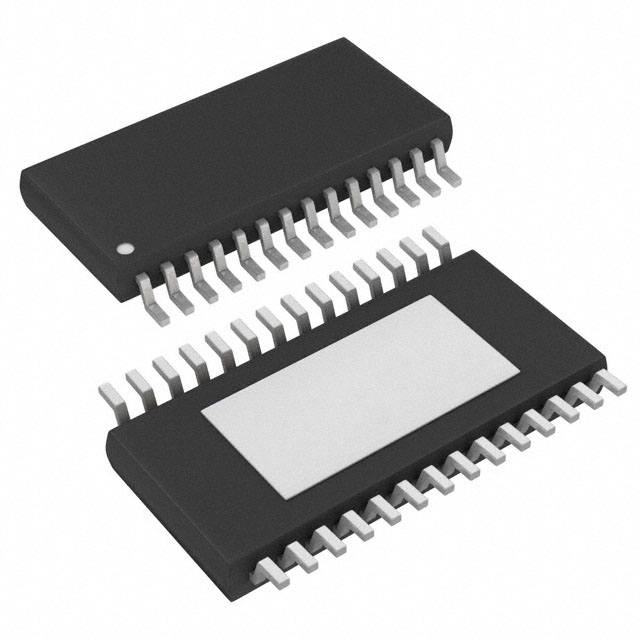
Monolithic Power Systems Inc. MP6500GF
- Part No.:
- MP6500GF
- Manufacturer:
- Monolithic Power Systems Inc.
- Category:
- Motor Drivers, Controllers
- Package:
- 28-TSSOP (0.173", 4.40mm Width) Exposed Pad
- Datasheet:
-
 MP6500GF.pdf
- Description:
- IC MTR DRV BIPLR 4.5-35V 28TSSOP
- Quantity:
- Payment:

- Shipping:

Inventory:2,694
Please send an inquiry. Send us your inquiry, and we will respond immediately.
Product details
Overview
MP6500GF from Monolithic Power Systems is a bipolar stepper motor driver IC with integrated translator, internal current sensing, and dual full-bridge output stage. It operates from 4.5V to 35V input, delivers up to 2.5A per phase (dependent on thermal design), supports full/half/quarter/eighth-step microstepping, and includes OCP, OVP, UVLO, and thermal shutdown. It is used in precision motion control for compact printers and automated lab equipment.
For engineers reviewing the MP6500GF datasheet, MP6500GF pinout, MP6500GF application, or MP6500GF equivalent, key selection considerations include its TSSOP-28 EP package, internal current regulation eliminating external sense resistors, automatic decay mode, fault reporting via open-drain nFAULT, and compatibility with 3.3V/5V logic interfaces.
Technical Context
The MP6500GF integrates two N-channel H-bridges with HS/LS on-resistances of 195mΩ/170mΩ at 25°C, enabling efficient bipolar stepper drive up to 2.5A per winding. Its programmable constant off-time PWM uses ROSC and ISET pins to set decay timing and peak current, respectively, with blanking time (2µs) suppressing switching transients.
It implements fully automatic decay mode: slow decay initiates each off-cycle, and fast decay engages only if winding current remains above trip threshold at off-time end-enabling precise microstep current waveform shaping without external decay control logic.
Key Specifications
| Parameter | Value and Actual Design Meaning |
|---|---|
| Supply Voltage Range | 4.5V to 35V - supports wide-input industrial and automotive-grade power rails without external regulators. |
| Output Current Capability | ±2.5A per phase - enables direct drive of NEMA 17–23 size bipolar stepper motors under typical PCB thermal conditions. |
| Step Resolution Modes | Full-, half-, quarter-, eighth-step - provides up to 32 microsteps per electrical cycle for smooth low-speed operation and reduced resonance. |
| HS/LS MOSFET RDS(on) | 195mΩ / 170mΩ at 25°C - minimizes conduction loss and thermal rise during continuous current delivery. |
| Fault Protection | OCP (6A trip), OVP (37.5V threshold), UVLO (4.5V rising), thermal shutdown (165°C) - ensures robust operation in unregulated or noisy supply environments. |
| Logic Interface | 3.3V/5V compatible, internal pull-downs on DIR/nENBL/MS1/MS2 - simplifies MCU interface without external biasing components. |
| Package | TSSOP-28 EP - thermally enhanced surface-mount package with exposed pad for >3.9W power dissipation at +25°C ambient. |
Pinout & Package
TSSOP-28 EP package with exposed thermal pad; 0.65mm pitch, 9.7mm × 4.4mm body; JEDEC MO-153 compliant; requires solder paste stencil optimization for thermal pad reflow.
| Pin/Terminal | Circuit Role | Design Meaning |
|---|---|---|
| 11 DIR | Direction control input | Internal pull-down; sets motor rotation direction on each STEP edge; TTL/CMOS compatible. |
| 12 nFAULT | Fault status output | Open-drain signal pulled low during OCP/OVP/OTP/UVLO; requires external pull-up for host MCU monitoring. |
| 13 ISET | Current regulation programming | Resistor-to-ground sets full-scale current (e.g., 71kΩ → 1.0A); enables precise microstep amplitude tuning. |
| 14 AGND | Analog ground reference | Separate analog return for current sense and DAC circuitry; must be star-connected to minimize noise coupling. |
| 15 ROSC | Constant off-time timing | Resistor-to-ground sets PWM off-time (e.g., 200kΩ → 23µs); directly controls current regulation frequency and decay behavior. |
| 16 MS2 / 17 MS1 | Microstep mode selection | Binary-coded inputs (L/L = full, H/H = eighth-step); internal pull-downs eliminate floating-state risk. |
| 18 nENBL | Bridge enable control | Active-low; disables H-bridge outputs and translator when high; allows dynamic torque disable without STEP interruption. |
| 19 nSLEEP | Low-power standby control | Active-low; halts charge pump and all internal logic; <1µA quiescent current; 1ms wake-up stabilization required. |
| 20 BOUT1 / 21 BOUT2 | Bridge B output terminals | Drive one motor winding; rated for ±2.5A continuous; require low-inductance PCB routing and local decoupling. |
| 22 VIN | Main power input | 4.5–35V supply; dual pins for lower impedance; requires ≥100nF ceramic capacitor to GND near package. |
| 23 AOUT2 / 24 AOUT1 | Bridge A output terminals | Drive second motor winding; identical rating and layout requirements as BOUT1/BOUT2. |
| 25 VCP | Charge pump output | Drives gate voltage boost; requires 1µF/16V ceramic cap to VIN; critical for high-side MOSFET turn-on above supply rail. |
| 28 CP2 / 1 CP1 | Charge pump capacitor terminals | Form flying capacitor network with VCP; 100nF/16V ceramic cap required between CP1–CP2; placement affects gate drive stability. |
| 2 VG | Low-side gate drive supply | Internal LDO output; powers LS-FET gates; requires 220nF/16V ceramic cap to AGND for ripple suppression. |
| 3,17,26,27 NC | No-connect terminals | Not internally bonded; must remain unconnected per datasheet; no routing or copper fill allowed. |
Key Features
| Feature | Design Value |
|---|---|
| Integrated current sensing | Eliminates external sense resistors and associated PCB area, power loss, and layout sensitivity-reducing BOM count and thermal drift error. |
| Automatic decay mode | Dynamically selects slow/fast decay per PWM cycle based on real-time winding current, ensuring accurate microstep current tracking without MCU intervention. |
| Programmable constant off-time | ROSC resistor sets fixed off-time (20–26µs typ.), enabling predictable current regulation frequency and consistent step response across load conditions. |
| Thermally enhanced TSSOP-28 EP | Exposed pad delivers θJA = 32°C/W and θJC = 6°C/W-supports 2.5A continuous operation with minimal heatsinking on 4-layer boards. |
| Fault reporting with auto-recovery | nFAULT signals OCP/OVP/OTP/UVLO events; OCP auto-resets after 2.4ms, allowing graceful recovery from transient overloads without host reset. |
Applications
| Printer Motion Control | Lab Automation Stage |
|---|---|
|
Use Scenario: Bidirectional paper feed and carriage positioning in compact inkjet printers. IC Role / Device Role / Timing Role: Stepper driver with integrated translator executing microstep sequences from MCU STEP/DIR commands; manages current decay timing per step. Use Value: Eighth-step resolution eliminates audible vibration and mechanical resonance, enabling quiet, jitter-free print head movement at low speeds. |
Use Scenario: Precision XYZ positioning of pipetting nozzles in automated liquid handling systems. IC Role / Device Role / Timing Role: Bipolar stepper controller regulating phase current to ±2.5A with automatic decay; interprets STEP pulses to advance motor position in sub-millimeter increments. Use Value: Internal current sensing ensures repeatable torque delivery across temperature, maintaining positional accuracy during extended duty cycles. |
| CNC Engraving Head | Medical Imaging Scanner |
|
Use Scenario: High-resolution engraving toolpath execution on desktop CNC mills using NEMA 17 motors. IC Role / Device Role / Timing Role: Full-bridge driver delivering 2.5A peak current with OCP and thermal shutdown; accepts STEP commands at up to 1kHz for rapid acceleration profiles. Use Value: Wide 4.5–35V input range accommodates 24V industrial supplies while supporting battery-backed operation during brief outages. |
Use Scenario: Linear translation of X-ray detector arrays in portable diagnostic imaging devices. IC Role / Device Role / Timing Role: Low-noise stepper actuator with nSLEEP-enabled ultra-low-power standby (<1µA); wakes within 1ms to execute calibrated scan movements. Use Value: Fault reporting via nFAULT enables real-time safety interlock monitoring-critical for compliance with IEC 62304 medical device software standards. |
Equivalent & Alternatives
The following parts are listed as comparable options for similar stepper motor driver applications.
| Alternative Part | Technical Difference | Application Difference | Selection Advice |
|---|---|---|---|
| TB6600HG | Higher voltage (44V max), higher current (4A), but requires external current sense resistors and separate logic supply. | Better suited for high-torque NEMA 23+ motors; less space-efficient due to external components. | Select when >2.5A peak current or >35V operation is required; accept added BOM and layout complexity. |
| DRV8825 | Lower voltage (45V), lower current (2.2A), integrated current control, but lacks OVP and has higher RDS(on) (0.35Ω). | Cost-optimized for low-power 3D printer extruders; limited thermal margin at 2.2A continuous. | Select for cost-sensitive consumer applications where 35V input and robust OVP are not required. |
Compared with TB6600HG and DRV8825, the MP6500GF offers superior integration (no external sense resistors), tighter protection thresholds (37.5V OVP vs. none or 44V), and optimized thermal performance in TSSOP-28 EP-making it ideal for space-constrained industrial motion systems requiring reliability and simplified layout.
Availability
MP6500GF is available at Aetrix Electronics and suitable for printer motion control, lab automation stages, CNC engraving heads, and medical imaging scanners requiring stable component supply, long-term lifecycle support, and RoHS-compliant packaging.
Supply support for MP6500GF includes scheduled delivery planning, volume procurement assistance, BOM continuity management, traceable sourcing, and lifecycle availability coordination for OEM customers, industrial embedded developers, connected-device designers, and electronics production programs.
Manufacturer
Monolithic Power Systems (MPS) is a fabless semiconductor company specializing in high-performance analog and power ICs, with core expertise in DC/DC conversion, motor control, and LED drivers.
The MP6500 product line targets compact, thermally constrained stepper motor applications-designed to replace discrete H-bridge solutions with integrated current regulation, protection, and microstepping logic in single-package form.
FAQ
What is the maximum continuous output current for MP6500GF in TSSOP-28 EP package?
The MP6500GF supports up to 2.5A per phase continuously under standard thermal conditions: 4-layer PCB with 2oz copper, 1in² thermal pad area, and +25°C ambient. Derating is required above +25°C ambient or with reduced copper area-junction temperature must stay below +125°C per datasheet limits.
Does MP6500GF require external current sense resistors?
No. The MP6500GF uses internal current sensing architecture, eliminating the need for external sense resistors. Current regulation is set via the ISET pin resistor value and ROSC pin timing resistor-reducing component count, board space, and thermal measurement error.
How does the automatic decay mode function in MP6500GF?
The MP6500GF begins each PWM off-cycle in slow decay. If winding current remains above the trip threshold at the end of the fixed off-time, it automatically switches to fast decay for the remainder of that cycle. This dual-mode operation ensures accurate microstep current waveforms without external decay control signals.
What is the purpose of the VG pin, and what capacitor is required?
The VG pin supplies the low-side gate drive voltage generated by an internal LDO. A 220nF/16V ceramic capacitor must be placed between VG and AGND to stabilize the gate drive supply and suppress switching noise-failure to install this capacitor causes erratic H-bridge operation and potential shoot-through.
Can MP6500GF operate with a 3.3V logic supply only?
Yes. All logic inputs (STEP, DIR, MS1, MS2, nENBL, nSLEEP) are 3.3V and 5V compatible, with VIH = 2.1V min and VIL = 0.8V max. No level-shifting is needed when interfacing directly with 3.3V microcontrollers such as STM32 or ESP32.
What happens during an over-current fault, and how is recovery handled?
When over-current is detected for longer than 1µs deglitch time, all H-bridge MOSFETs disable and nFAULT pulls low. The device remains latched off for ~2.4ms, then automatically resumes operation. This self-recovering behavior avoids system lockup during transient overload events like motor stall.
Is the TSSOP-28 EP package lead-free and RoHS-compliant?
Yes. The MP6500GF is lead-free, halogen-free, and fully compliant with the EU RoHS directive. MPS confirms green status on its official Quality Assurance page, and the device carries the "Pb-Free" marking per JEDEC J-STD-609.
MP6500GF Specifications
- Product attributes
- Attribute value
- Manufacturer:
- Monolithic Power Systems Inc.
- Series:
- -
- Package/Case:
- 28-TSSOP (0.173", 4.40mm Width) Exposed Pad
- Packaging:
- Tube
- Product Status:
- Active
- Motor Type - Stepper:
- Bipolar
- Motor Type - AC, DC:
- Brushed DC
- Function:
- Driver - Fully Integrated, Control and Power Stage
- Output Configuration:
- Half Bridge (4)
- Interface:
- Logic
- Technology:
- Power MOSFET
- Step Resolution:
- 1, 1/2, 1/4, 1/8
- Applications:
- Printer
- Current - Output:
- 2.5A
- Voltage - Supply:
- 4.5V ~ 35V
- Voltage - Load:
- 3.3V, 5V
- Operating Temperature:
- -40°C ~ 125°C (TJ)
- Grade:
- -
- Qualification:
- -
- Mounting Type:
- Surface Mount
- Supplier Device Package:
- 28-TSSOP-EP
MP6500GF FAQ
1.How can I place an order for MP6500GF through Aetrix?
Please submit a Request for Quotation (RFQ) for MP6500GF on Aetrix. Our sales agent will provide a competitive quotation and guide you through the order confirmation once you accept the terms.
2.Are the price and stock information for MP6500GF reliable?
The price and inventory of MP6500GF are updated periodically and may fluctuate due to market conditions. Stock and pricing data are typically refreshed every 24 hours. Quotation validity for MP6500GF is usually 5 days.
3.What payment methods are accepted for MP6500GF?
We accept Wire Transfer, PayPal, Credit Card, Western Union, MoneyGram, and Escrow for MP6500GF transactions.
Note: Certain payment methods may incur a processing fee.
4.How is shipping managed for MP6500GF?
MP6500GF orders can be shipped via leading logistics carriers, including DHL, UPS, FedEx, TNT, or Registered Mail.
Once your MP6500GF order is processed, you will receive an email with the shipment details and tracking number.
Note: Tracking information may take up to 24 hours to appear. Express delivery typically takes 3–5 business days.
5.How can I obtain technical support or documentation for MP6500GF?
For technical support, including MP6500GF datasheets, pinout diagrams, or application guidance, please contact our engineering support team. They can provide detailed documentation and assistance for your MP6500GF requirements.
6.How does Aetrix verify that MP6500GF is sourced from the original manufacturer or authorized distributors?
All MP6500GF products on Aetrix are procured from qualified distributors and authorized channels. Our dedicated quality assurance team conducts strict verification, including traceability checks and, if necessary, third-party testing. This ensures that MP6500GF meets industry standards.
7.What is the process for return or replacement of MP6500GF?
All MP6500GF units undergo pre-shipment inspection (PSI). If there is an issue with MP6500GF, returns or replacements are accepted under the following conditions:
1.Quantity discrepancies, incorrect items, or visible external defects (such as breakage or corrosion), acknowledged by Aetrix.
2.The issue is reported within 90 days of delivery.
3.The MP6500GF part is unused and in its original packaging.
Return procedure for MP6500GF:
1.Submit a request within 90 days.
2.Obtain a Return Material Authorization (RMA) from Aetrix.
MP6500GF Tags
-
DRV2603RUNR
Texas Instruments
-
DRV8837CDSGR
Texas Instruments
-
DRV8837DSGR
Texas Instruments
-
DRV8838DSGR
Texas Instruments
-
DRV8839DSSR
Texas Instruments
-
EMC2301-1-ACZL-TR
Microchip Technology
-
DRV8231ADSGR
Texas Instruments
-
EMC2302-2-AIZL-TR
Microchip Technology
-
DRV8800PWPR
Texas Instruments
-
DRV8835DSSR
Texas Instruments
-
EMC2303-1-KP-TR
Microchip Technology
-
DRV8876PWPR
Texas Instruments
Tech Hub

Operational amplifier guide covering op amp basics, feedback, ideal vs real op amps, common configurations, buffer circuits, offset, bias current, gain-bandwidth, slew rate, rail-to-rail limits and sel…

Jumper cables guide covering safe connection order, red and black clamp placement, final ground connection, cable gauge, length, clamp quality, copper vs CCA cables, jump starter comparison and battery…

LDO regulator guide covering low dropout voltage, power dissipation, thermal design, PSRR, output noise, capacitor stability, adjustable LDO circuits, LDO vs buck converter and datasheet selection chec…

Conditional Access Module guide covering CAM meaning, CI/CI+ interface, smart card authorization, DVB security workflow, TV and set-top box compatibility, internal electronics, ESD protection, connecto…

Guide to electronic component obsolescence covering EOL risk, PCN/PDN notices, last-time buy planning, replacement options, form-fit-function validation, counterfeit risk and BOM lifecycle management.

18650 battery guide covering lithium-ion cell basics, 3.6V/3.7V voltage, 4.2V charging, mAh and Wh capacity, protected cells, chargers, BMS, series-parallel packs, holders, welding and sourcing checks.…

Hall effect sensor guide covering working principle, linear and digital sensors, Arduino circuits, current sensing, speed detection, automotive applications, A3144 examples, signal filtering and datash…

Product Change Notification guide for electronic components, covering PCN meaning, PCN vs PDN/EOL, common change types, risk levels, form-fit-function review, engineering validation, BOM control, LTB/L…

A practical guide to blend door actuators, covering HVAC function, symptoms, location, AC and heater issues, reset and calibration, replacement cost, electrical diagnosis, compatibility checks, and rep…

Engineering guide to Raspberry Pi alternatives, covering chip-level differences, Orange Pi, ROCK, Jetson, Banana Pi, NanoPi, Compute Module, Pico, GPIO, camera, HAT compatibility, and replacement risks…


