
 My Inquiry
 My Account


Monolithic Power Systems Inc. MP6651GD-0000-Z

- Part No.:
- MP6651GD-0000-Z
- Manufacturer:
- Monolithic Power Systems Inc.
- Category:
- Motor Drivers, Controllers
- Package:
- 10-VFQFN
- Datasheet:
-
 MP6651GD-0000-Z.pdf
- Description:
- 2A, SINGLE-PHASE BRUSHLESS DC DR
- Quantity:
- Payment:

- Shipping:

Inventory:4,997
Please send an inquiry. Send us your inquiry, and we will respond immediately.
Product details
Overview
MP6651GD-0000-Z from Monolithic Power Systems is a single-phase brushless DC (BLDC) motor driver IC with integrated Hall-effect sensor, dual power MOSFETs, and configurable commutation logic. It operates from 3.3V to 18V input, delivers 2A continuous output in QFN-10 package, supports 2kHz–100kHz PWM speed control, and provides rotor lock detection via open-drain FG/RD pin - used in high-reliability CPU cooling fan modules.
For engineers reviewing the MP6651GD-0000-Z datasheet, MP6651GD-0000-Z pinout, MP6651GD-0000-Z application, or MP6651GD-0000-Z equivalent, key selection criteria include Hall offset angle configurability (±45°), soft-on/off commutation angle tuning (up to 45°), cycle-by-cycle OCP thresholds (1A–4A), thermal shutdown recovery behavior, and FG/RD dual-mode functionality (speed indication vs. rotor lock flag).
Technical Context
The MP6651GD-0000-Z implements closed-loop BLDC commutation using an on-die Hall sensor whose signal is phase-shifted via programmable HAL_ANG registers (three ranges mapped to PWM duty bands), enabling independent low- and high-speed torque optimization. Its H-bridge drives OUT1/OUT2 with fixed 27kHz switching frequency and configurable soft-start timing (2.4s–19.2s).
Control logic includes register-mapped parameters for DIN_MIN/DO_MIN (start/output duty), SPD_ZERO (zero-speed mode), LOCK_SEL (rotor lock retry interval), and FGRD_SEL (FG/RD functional mode). All configuration is stored in OTP memory with two-program capability, and digital oscillator frequency (SPD_SEL) sets minimum achievable RPM (100–1600rpm).
Key Specifications
| Parameter | Value and Actual Design Meaning |
|---|---|
| Input Voltage Range | 3.3V to 18V - supports wide-input 12V fan rails including transient overvoltage conditions up to 24V absolute max. |
| Continuous Output Current | 2A - rated for QFN-10 package at TA = 25°C; derates per θJA = 65°C/W to ~1.4A at 85°C ambient. |
| Switching Frequency | 27kHz - fixed internal oscillator frequency set by 20kΩ OSC-to-GND resistor; enables EMI-controlled fan drive. |
| PWM Input Range | 2kHz to 100kHz - compatible with standard microcontroller PWM peripherals without external prescaling. |
| Hall Offset Angle Range | ±45° - configurable in three PWM-duty-dependent zones (HAL_ANG1/2/3) to optimize commutation timing across full speed range. |
| Soft-On/Off Angle | Up to 45° - adjustable via SON_ANG/SOFF_ANG registers (1.4° resolution) to reduce acoustic noise and mechanical stress during transitions. |
| OCP Threshold Options | 1A / 2A / 3A / 4A - selected by OCP_SEL bits; enables precise current limiting matched to motor winding resistance and thermal margin. |
| Rotor Lock Detection | 0.6s timeout - triggers automatic LS-FET activation and recovery after LOCK_SEL-configured retry delay (3.6s–8.4s). |
Pinout & Package
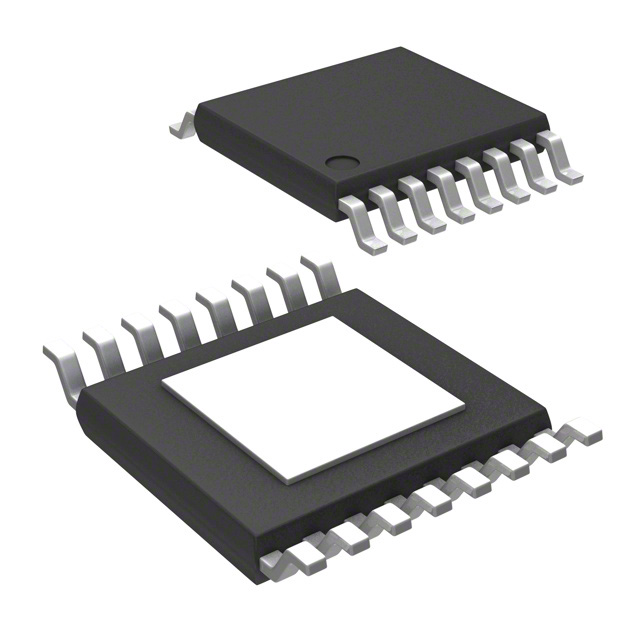
MP6651GD-0000-Z uses a 2mm × 3mm, 10-pin QFN package with exposed thermal pad (RoHS-compliant, MSL Level 1). Pin 1 is marked by dot; pins 4 and 5 are internally connected GND terminals for enhanced thermal and electrical performance.
| Pin/Terminal | Circuit Role | Design Meaning |
|---|---|---|
| 1 (FG/RD) | Open-drain status output | Selectable as tachometer (FG) pulse output (1x/1/2x/2/3x/2x Hall frequency) or active-high/low rotor lock flag (RD) per FGRD_SEL and RD_H_L registers. |
| 2 (PWM) | Digital speed command input | Accepts 2kHz–100kHz PWM signal; internal 190kΩ pull-up enables single-wire interface; duty cycle directly maps to motor speed reference. |
| 3 (OUT1) | H-bridge high-side output | Drives one motor terminal; sinks current when Hall signal is low; complements OUT2 in push-pull commutation sequence. |
| 4,5 (GND) | Power and signal ground | Dual GND pins reduce impedance path for high di/dt switching currents and improve Hall sensor noise immunity. |
| 6 (VCC) | Supply input | 3.3V–18V input with UVLO (3.3V rising) and OVP (19V rising); internal LDO powers logic and Hall circuitry. |
| 7 (TST) | Factory test interface | Must be tied to GND in normal operation; used during OTP programming and register read/write in test mode. |
| 8 (OSC) | Oscillator timing node | Requires 20kΩ ±1% resistor to GND to set 27kHz fSW; deviation alters timing accuracy and speed regulation linearity. |
| 9 (OUT2) | H-bridge low-side output | Drives complementary motor terminal; sinks current when Hall signal is high; synchronized with OUT1 for 180° commutation. |
| 10 (GND) | Thermal pad connection | Exposed pad must be soldered to PCB copper pour for θJC = 12°C/W thermal path and 1.9W power dissipation capability. |
Key Features
| Feature | Design Value |
|---|---|
| Integrated Hall sensor with offset compensation | Three-zone programmable Hall angle (±45°) enables optimized torque delivery at both stall and full speed without external sensor alignment. |
| Configurable soft commutation | Independent soft-on (SON_ANG) and soft-off (SOFF_ANG) angles up to 45° reduce audible noise and mechanical jerk during startup/shutdown. |
| Dual-mode FG/RD pin | Single pin serves as either tachometer feedback (FG) or rotor lock fault indicator (RD), reducing system BOM count and PCB routing complexity. |
| OTP-based configuration storage | Two-time programmable memory retains DIN_MIN, DO_MIN, TIME_SS, OCP_SEL, and SPD_ZERO settings across power cycles - eliminates external EEPROM. |
| Auto-recovering protections | OVP, UVLO, thermal shutdown, and locked rotor all resume normal operation after fault clearance - no manual reset required in fan applications. |
| Pre-startup duty slope control | DUTY_SLOPE[1:0] selects 1.2ms–9.3ms ramp time before PWM takeover, limiting inrush current during cold start of high-inertia fans. |
Applications
| CPU Cooling Fan Control | Server Chassis Airflow Management |
|---|---|
Use Scenario: Regulating 12V, 2A axial fans in x86 server CPUs where thermal headroom is constrained and acoustic noise must stay below 25 dBA. IC Role / Device Role / Timing Role: Single-chip BLDC driver executing Hall-synchronized commutation, interpreting PWM commands from BMC/IPMI, and reporting RPM via FG pulses. Use Value: Integrated Hall sensor eliminates external sensor placement tolerance; soft-commutation angles suppress 27kHz switching noise; 2A drive sustains full-speed operation under dust-clogged conditions. | Use Scenario: Controlling redundant 40mm–60mm blowers in telecom chassis requiring fail-safe rotor lock detection and auto-recovery without host intervention. IC Role / Device Role / Timing Role: Motor controller providing FG feedback to system manager and asserting RD flag on stall, enabling hot-swap-aware airflow redundancy logic. Use Value: Rotor lock detection time (0.6s) and configurable retry delay (LOCK_SEL) ensure rapid fault isolation; QFN-10 footprint enables dense multi-fan layouts. |
| Industrial PC Fan Module | Medical Imaging Equipment Cooling |
Use Scenario: Driving sealed 24V BLDC fans in fanless IPC enclosures where reliability over 10-year field life and -40°C cold-start capability are mandatory. IC Role / Device Role / Timing Role: Primary motor interface handling UVLO hysteresis (0.17V), thermal shutdown (160°C trip), and standby mode (750µA) during idle periods. Use Value: Wide 3.3V–18V input accommodates aging PSU rails; OTP configuration ensures consistent startup behavior across production batches; SOIC-8 and QFN-10 options support legacy and next-gen board designs. | Use Scenario: Managing cooling for MRI gradient amplifier heatsinks where EMI-sensitive analog circuits require low-noise, fixed-frequency 27kHz drive and zero speed droop. IC Role / Device Role / Timing Role: Precision speed regulator using SPD_SEL to set 1600rpm minimum and FG/RD for closed-loop RPM verification in safety-critical thermal management loop. Use Value: Digital oscillator resolution (SPD_SEL=11) enables <1% speed error at 3000rpm; Hall offset tuning compensates for magnet aging over 15-year service life. |
Equivalent & Alternatives
The following parts are listed as comparable options for similar single-phase BLDC fan driver applications.
| Alternative Part | Technical Difference | Application Difference | Selection Advice |
|---|---|---|---|
| MP6652GD-Z | Higher 3A continuous rating; adds I²C interface for real-time register access and telemetry; same pinout and OTP architecture. | Required when dynamic OCP adjustment or runtime diagnostics (e.g., die temperature readback) are needed beyond MP6651's static configuration. | Select MP6652GD-Z if firmware-level control of commutation parameters or field-upgradable configurations are required. |
| TB6612FNG | No integrated Hall sensor; discrete H-bridge only; requires external Hall latches and MCU-based commutation logic; 1.2A rating. | Suitable only for designs with existing motor control firmware stack and space for external sensing components. | Choose TB6612FNG only when leveraging existing MCU-based BLDC algorithms and cost sensitivity outweighs integration benefits. |
Compared with MP6652GD-Z, MP6651GD-0000-Z trades runtime configurability for lower BOM cost and simpler layout; versus TB6612FNG, it eliminates Hall sensor placement, timing calibration, and firmware development effort - delivering turnkey fan control in minimal footprint.
Availability
MP6651GD-0000-Z is available at Aetrix Electronics and suitable for CPU cooling fan modules, server airflow systems, industrial PC thermal management, and medical imaging equipment requiring stable component supply, long-lifecycle support, and RoHS-compliant packaging.
Supply support for MP6651GD-0000-Z includes scheduled delivery planning, volume procurement assistance, BOM continuity management, traceable sourcing, and lifecycle availability coordination for OEM customers, industrial embedded developers, connected-device designers, and electronics production programs.
Manufacturer
Monolithic Power Systems (MPS) is a fabless semiconductor company specializing in high-performance power management ICs, with design centers in the US, China, and Taiwan, and global distribution through authorized partners.
The MP6651 belongs to MPS's fan driver product line, engineered specifically for intelligent, self-contained BLDC fan control in computing, communications, and industrial thermal systems - emphasizing integration, configurability, and robust protection without external components.
FAQ
What is the function of the TST pin on MP6651GD-0000-Z?
The TST (Test) pin must be connected to GND in normal operation. It enables factory test mode for OTP programming and register read/write access. Leaving TST floating or applying voltage may cause undefined behavior or prevent startup. No external circuitry is required - direct GND tie-down is mandatory per datasheet Section 5.
Can MP6651GD-0000-Z drive a 24V fan?
No - MP6651GD-0000-Z has a maximum recommended operating input voltage of 18V and absolute maximum VCC rating of 24V. Applying 24V continuously exceeds its UVLO and OVP thresholds (19V rising), risking latch-up or premature OVP shutdown. For 24V fans, use MPQ6651-AEC1 (automotive-grade, 36V-rated) or redesign with external step-down.
How does the Hall offset angle improve motor performance?
The Hall offset angle adjusts the phase relationship between the Hall sensor output and MOSFET switching timing. By shifting the commutation point forward (leading) or backward (lagging) up to ±45°, it compensates for magnetic lag, winding inductance, and back-EMF timing - increasing torque at low speeds and reducing torque ripple at high speeds without mechanical sensor repositioning.
Is the FG/RD pin truly open-drain, and what pull-up value is recommended?
Yes - FG/RD is a true open-drain output with 0.19V max low-level voltage at 1mA sink. A 4.7kΩ to 10kΩ pull-up to VCC is recommended for clean edge integrity and noise immunity. Values below 2.2kΩ increase power consumption unnecessarily; above 47kΩ risk slow rise times and false FG pulse misses at high RPM.
What determines the soft-start time, and how is it configured?
Soft-start time (2.4s to 19.2s) is set by the TIME_SS[2:0] bits in REG06h and controls the duration for the output duty cycle to ramp from 0% to 100% at power-on. Default value 010 yields 7.2s. Configuration is stored in OTP memory and requires MPS Fan Driver GUI software or compatible programmer - not runtime-modifiable.
Does MP6651GD-0000-Z support reverse rotation?
No - MP6651GD-0000-Z implements unidirectional Hall-based commutation only. The internal logic sequences OUT1/OUT2 based on Hall polarity transitions and does not provide direction reversal logic or external DIR pin. Reverse rotation requires external hardware inversion or a bidirectional driver like MP6550.
What is the thermal performance difference between SOIC-8 SL and QFN-10 packages?
QFN-10 offers θJA = 65°C/W vs. SOIC-8 SL's 96°C/W - a 32% improvement in junction-to-ambient thermal resistance. At 2A load, QFN-10 maintains ~15°C lower die temperature, enabling full 2A continuous operation up to 85°C ambient; SOIC-8 SL is limited to 1.5A continuous above 60°C ambient per derating curves.
MP6651GD-0000-Z Specifications
- Product attributes
- Attribute value
- Manufacturer:
- Monolithic Power Systems Inc.
- Series:
- -
- Package/Case:
- 10-VFQFN
- Packaging:
- Tape & Reel (TR)
- Product Status:
- Active
- Motor Type - Stepper:
- Bipolar
- Motor Type - AC, DC:
- Brushless DC (BLDC)
- Function:
- Driver - Fully Integrated, Control and Power Stage
- Output Configuration:
- Half Bridge (2)
- Interface:
- PWM
- Technology:
- Power MOSFET
- Step Resolution:
- -
- Applications:
- Fan Motor Driver
- Current - Output:
- 2A
- Voltage - Supply:
- 3.3V ~ 18V
- Voltage - Load:
- 3.3V ~ 18V
- Operating Temperature:
- -40°C ~ 125°C (TJ)
- Grade:
- -
- Qualification:
- -
- Mounting Type:
- Surface Mount
- Supplier Device Package:
- 10-QFN (2x3)
MP6651GD-0000-Z FAQ
1.How can I place an order for MP6651GD-0000-Z through Aetrix?
Please submit a Request for Quotation (RFQ) for MP6651GD-0000-Z on Aetrix. Our sales agent will provide a competitive quotation and guide you through the order confirmation once you accept the terms.
2.Are the price and stock information for MP6651GD-0000-Z reliable?
The price and inventory of MP6651GD-0000-Z are updated periodically and may fluctuate due to market conditions. Stock and pricing data are typically refreshed every 24 hours. Quotation validity for MP6651GD-0000-Z is usually 5 days.
3.What payment methods are accepted for MP6651GD-0000-Z?
We accept Wire Transfer, PayPal, Credit Card, Western Union, MoneyGram, and Escrow for MP6651GD-0000-Z transactions.
Note: Certain payment methods may incur a processing fee.
4.How is shipping managed for MP6651GD-0000-Z?
MP6651GD-0000-Z orders can be shipped via leading logistics carriers, including DHL, UPS, FedEx, TNT, or Registered Mail.
Once your MP6651GD-0000-Z order is processed, you will receive an email with the shipment details and tracking number.
Note: Tracking information may take up to 24 hours to appear. Express delivery typically takes 3–5 business days.
5.How can I obtain technical support or documentation for MP6651GD-0000-Z?
For technical support, including MP6651GD-0000-Z datasheets, pinout diagrams, or application guidance, please contact our engineering support team. They can provide detailed documentation and assistance for your MP6651GD-0000-Z requirements.
6.How does Aetrix verify that MP6651GD-0000-Z is sourced from the original manufacturer or authorized distributors?
All MP6651GD-0000-Z products on Aetrix are procured from qualified distributors and authorized channels. Our dedicated quality assurance team conducts strict verification, including traceability checks and, if necessary, third-party testing. This ensures that MP6651GD-0000-Z meets industry standards.
7.What is the process for return or replacement of MP6651GD-0000-Z?
All MP6651GD-0000-Z units undergo pre-shipment inspection (PSI). If there is an issue with MP6651GD-0000-Z, returns or replacements are accepted under the following conditions:
1.Quantity discrepancies, incorrect items, or visible external defects (such as breakage or corrosion), acknowledged by Aetrix.
2.The issue is reported within 90 days of delivery.
3.The MP6651GD-0000-Z part is unused and in its original packaging.
Return procedure for MP6651GD-0000-Z:
1.Submit a request within 90 days.
2.Obtain a Return Material Authorization (RMA) from Aetrix.
MP6651GD-0000-Z Tags
-
DRV2603RUNR
Texas Instruments
-
DRV8837CDSGR
Texas Instruments
-
DRV8837DSGR
Texas Instruments
-
DRV8838DSGR
Texas Instruments
-
DRV8839DSSR
Texas Instruments
-
EMC2301-1-ACZL-TR
Microchip Technology
-
DRV8231ADSGR
Texas Instruments
-
EMC2302-2-AIZL-TR
Microchip Technology
-
DRV8800PWPR
Texas Instruments
-
DRV8835DSSR
Texas Instruments
-
EMC2303-1-KP-TR
Microchip Technology
-
DRV8876PWPR
Texas Instruments
Tech Hub

A practical engineering guide to 3.3V and 5V logic compatibility, input thresholds, resistor dividers, translator ICs, MOSFET level shifting, I2C pull-ups, timing limits and power-sequencing risks.

The 74HC595 uses push-pull logic outputs, while the TPIC6B595 uses 50 V open-drain DMOS sinks for higher-power loads. This guide compares timing, current limits, 3.3 V interfacing, load wiring, thermal…

The 74HC595 converts serial data into eight stable parallel outputs. This guide covers pin functions, shift and storage timing, OE and MR behavior, drive-current limits, cascading, voltage compatibilit…

A technical comparison of level-sensitive latches and edge-triggered flip-flops, covering timing windows, setup and hold limits, master–slave operation, time borrowing, race-through, HDL inference and…

A D latch stores one bit while Enable controls when data can pass. This reference covers gate-level operation, truth tables, transparency, setup and hold timing, LE versus OE, common ICs and practical …

An SR latch stores one bit through cross-coupled feedback. This engineering reference covers NOR and NAND implementations, truth tables, forbidden-state recovery, gated operation, switch debouncing, fa…

Latch circuits retain one bit through feedback. This technical reference covers SR and D latches, truth tables, transparency, timing limits, latch-versus-flip-flop behavior, applications and common log…

An engineering guide to LED driver operation, constant-current and constant-voltage outputs, linear and switching topologies, dimming, IC selection, calculations, replacement compatibility, and fault c…

Operational amplifier guide covering op amp basics, feedback, ideal vs real op amps, common configurations, buffer circuits, offset, bias current, gain-bandwidth, slew rate, rail-to-rail limits and sel…

Jumper cables guide covering safe connection order, red and black clamp placement, final ground connection, cable gauge, length, clamp quality, copper vs CCA cables, jump starter comparison and battery…


