
 My Inquiry
 My Account


NXP Semiconductors MSC8151TAG1000B
- Part No.:
- MSC8151TAG1000B
- Manufacturer:
- NXP Semiconductors
- Category:
- DSP (Digital Signal Processors)
- Package:
- 783-BBGA, FCBGA
- Datasheet:
-
 MSC8151TAG1000B.pdf
- Description:
- IC DSP 1X 1GHZ SC3850 783FCBGA
- Quantity:
- Payment:

- Shipping:

Inventory:1,690
Please send an inquiry. Send us your inquiry, and we will respond immediately.
Product details
Overview
MSC8151TAG1000B from NXP Semiconductors (formerly Freescale) is a single-core StarCore SC3850 digital signal processor fabricated in 45 nm SOI CMOS, operating at 1 GHz with 32 KB L1 instruction cache, 32 KB L1 data cache, and 512 KB configurable L2 cache/M2 memory. It integrates MAPLE-B baseband accelerators, dual DDR2/DDR3 controllers (800 MT/s), Serial RapidIO (3.125 Gbaud), PCI Express x4, and QUICC Engine subsystem for telecom infrastructure processing.
For engineers reviewing the MSC8151TAG1000B datasheet, MSC8151TAG1000B pinout, MSC8151TAG1000B application, or MSC8151TAG1000B equivalent, key selection criteria include its 783-ball FC-PBGA package, 1 GHz DSP core clock, 1056 KB on-chip M3 memory, support for TDM/E1/T1 interfaces, and low-power operation modes including Wait, Stop, and power-down.
Technical Context
The MSC8151TAG1000B implements a tightly coupled architecture where the SC3850 DSP core interfaces via CLASS arbitration fabric to DDR controllers, MAPLE-B accelerator, and QUICC Engine. Its memory hierarchy includes separate GVDD1/GVDD2 power domains for M1/M2 DDR interfaces and dedicated SXCVDD/SXPVDD rails for SerDes PLLs and high-speed serial I/O.
Hardware acceleration is partitioned across three domains: MAPLE-B handles Turbo/Viterbi decoding and FFT/iFFT up to 2048-point, QUICC Engine offloads Gigabit Ethernet (RGMII/SGMII) scheduling, and the DMA controller supports 32 unidirectional channels with 1024 buffer descriptors per channel-optimized for DDR SDRAM burst transfers.
Key Specifications
| Parameter | Value and Actual Design Meaning |
|---|---|
| Core Architecture | StarCore SC3850 DSP core, 1 GHz fixed-frequency operation with MMU and EPIC interrupt controller. |
| L1 Cache | 32 KB instruction + 32 KB data cache, Harvard architecture enabling simultaneous fetch/execute for real-time signal processing. |
| L2 / M2 Memory | 512 KB unified L2 cache configurable in 64 KB increments as M2 memory for deterministic latency-critical code/data storage. |
| M3 Memory | 1056 KB on-chip 128-bit wide SRAM; 1024 KB disableable to reduce dynamic power in idle subsystems. |
| DDR Interface | Dual 64/32-bit DDR2/DDR3 controllers, 400 MHz clock (800 MT/s), supporting up to 2 GB total across four banks (two per controller). |
| High-Speed Serial | Two Serial RapidIO (x1/x4, 3.125 Gbaud), one PCI Express x4 controller, and two multiplexed SGMII ports. |
| Baseband Acceleration | MAPLE-B engine with programmable Turbo decoder (up to 128 iterations), Viterbi decoder (K=9, 64-state), and FFT/iFFT (2048-point max). |
Pinout & Package
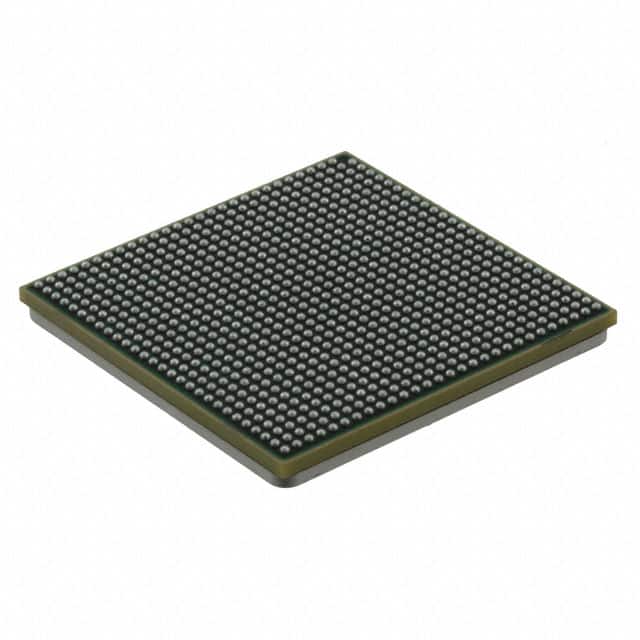
MSC8151TAG1000B uses a 29 mm × 29 mm FC-PBGA–783 package with 783 solder balls arranged in a 28×28 grid (excluding corner blanks). Power delivery is segmented across multiple voltage domains: VDD (1.0 V core), GVDD1/GVDD2 (1.5 V DDR I/O), MVDD (1.8 V I/O), QVDD (1.2 V JTAG/RTC), NVDD (2.5 V GPIO/QUICC), and SerDes-specific SXCVDD/SXPVDD (1.0 V analog/1.2 V digital).
| Pin/Terminal | Circuit Role | Design Meaning |
|---|---|---|
| M1DQ0–M1DQ63 | DDR1 Data I/O | 64-bit bidirectional data bus for first DDR interface; requires matched trace lengths and controlled-impedance routing (40 Ω differential). |
| M2DQ0–M2DQ63 | DDR2 Data I/O | 64-bit bidirectional data bus for second DDR interface; independent timing calibration from M1 domain. |
| SR1_RXD0–SR1_RXD3 | Serial RapidIO Receiver | Differential inputs for first RapidIO port; AC-coupled with internal 100 Ω termination referenced to SXCVDD1. |
| SR2_TXD0–SR2_TXD3 | Serial RapidIO Transmitter | Differential outputs for second RapidIO port; swing of 800 mVpp into 100 Ω load, compliant with RapidIO Gen2 spec. |
| GE1_TD0–GE1_TD3 | Gigabit Ethernet TX | TDM2RCK/GE1_TD0 multiplexed pin; when configured for Ethernet, drives RGMII TX clock and data signals at 125 MHz. |
| GPIO0–GPIO31 | General Purpose I/O | 32-bit NVDD-referenced (2.5 V) programmable pins; 16 support external interrupt generation with edge/level sensitivity. |
Key Features
| Feature | Design Value |
|---|---|
| MAPLE-B Baseband Acceleration | Offloads Turbo/Viterbi decoding and FFT/iFFT from DSP core, reducing latency by >60% in LTE eNodeB baseband stacks. |
| CLASS Arbitration Fabric | Non-blocking crossbar connecting core, DDR, MAPLE-B, and QUICC Engine-enabling concurrent memory access without arbitration stalls. |
| Dual DDR Controllers | Independent 64-bit DDR2/DDR3 interfaces allow simultaneous access to program memory and packet buffers, eliminating memory contention bottlenecks. |
| QUICC Engine Subsystem | Dual RISC processors with 48 KB RAM each handle Gigabit Ethernet framing, checksum offload, and SPI control-freeing SC3850 core for algorithmic tasks. |
| Low-Power Operation Modes | Wait mode reduces leakage by 40%; Stop mode cuts dynamic power to <5 mW; power-down mode retains register state with 1.2 μA retention current. |
Applications
| Wireless Base Station Processing | VoIP Media Gateway |
|---|---|
Use Scenario: Real-time LTE-Advanced physical layer processing in macrocell eNodeB units requiring multi-carrier FFT, channel estimation, and Turbo decoding. IC Role / Device Role / Timing Role: Primary DSP engine executing Layer 1 algorithms; MAPLE-B handles 95% of compute-intensive decoding while SC3850 manages scheduling and control loops. Use Value: Achieves 2× throughput vs. dual-CPU solutions at 30% lower power, enabled by hardware-accelerated FFT (2048-pt in 1.8 μs) and Turbo decode (100 Mbps). | Use Scenario: High-density VoIP gateway aggregating 2048+ voice channels with transcoding, echo cancellation, and SIP signaling. IC Role / Device Role / Timing Role: Central media processor running G.729/G.711 codecs and TDM-to-Ethernet bridging; QUICC Engine handles RGMII packet forwarding while SC3850 executes DSP kernels. Use Value: Supports 256-channel HD voice transcoding at <5 ms end-to-end latency using 4× TDM modules with A-law/μ-law hardware conversion. |
| Industrial Wireless Backhaul | Avionics Data Concentrator |
Use Scenario: Point-to-multipoint microwave backhaul unit in harsh environments requiring ECC-protected memory and extended temperature operation. IC Role / Device Role / Timing Role: System-on-chip combining RF interface control (via GPIO/TDM), packet processing (QUICC), and forward error correction (MAPLE-B). Use Value: Full ECC/EDC protection across L1/L2 caches, DDR, and boot ROM enables >100,000 MTBF in outdoor deployments per Telcordia GR-468. | Use Scenario: ARINC 664 (AFDX) data concentrator in flight control systems requiring deterministic latency and DO-254 compliance. IC Role / Device Role / Timing Role: Safety-critical processing node with lockstep-capable timers, virtual NMI assertion, and JTAG boundary scan for structural test. Use Value: Eight hardware semaphores and 32 virtual interrupts enable certified partitioning of ARINC 653 time/space partitions with <1 μs context switch. |
Equivalent & Alternatives
The following parts are listed as comparable options for similar digital signal processor applications.
| Alternative Part | Technical Difference | Application Difference | Selection Advice |
|---|---|---|---|
| MSC8152TAG1000B | Dual-core SC3850 DSP (2× 1 GHz), identical peripherals and pinout; 25% higher power draw at full load. | Suitable for MIMO baseband where parallel processing exceeds single-core capacity; not drop-in due to thermal and power delivery changes. | Select when algorithm parallelization justifies 2× core count and board-level cooling upgrades. |
| TMS320C6678ACYPA | Octal-core C66x DSP (1.25 GHz/core), different ISA, no MAPLE-B; supports SRIO/PCIe but lacks QUICC Engine or TDM hardware. | Better for general-purpose floating-point workloads (e.g., radar beamforming); requires full software porting and new driver stack. | Choose for floating-point intensive tasks where TI's C66x toolchain and ecosystem outweigh loss of telecom-specific accelerators. |
Compared with MSC8152TAG1000B, the MSC8151TAG1000B delivers identical feature set at lower power and cost for single-threaded baseband loads; versus TMS320C6678ACYPA, it provides superior integration for TDM/E1/T1 and legacy telecom protocols but lacks floating-point performance and multicore scalability.
Availability
MSC8151TAG1000B is available at Aetrix Electronics and suitable for wireless infrastructure, VoIP gateways, and industrial backhaul systems requiring stable component supply, long-term lifecycle support, and qualified automotive-grade reliability.
Supply support for MSC8151TAG1000B includes scheduled delivery planning, volume procurement assistance, BOM continuity management, traceable sourcing, and lifecycle availability coordination for OEM customers, industrial embedded developers, connected-device designers, and electronics production programs.
Manufacturer
NXP Semiconductors is a global semiconductor leader focused on secure connectivity solutions for automotive, industrial, and communication markets, with roots in Freescale's DSP heritage.
The MSC8151TAG1000B belongs to NXP's StarCore DSP family designed specifically for carrier-grade wireless infrastructure, emphasizing hardware acceleration for 3G/4G physical layer processing and deterministic real-time performance.
FAQ
What is the maximum DDR3 data rate supported by the MSC8151TAG1000B?
The MSC8151TAG1000B supports DDR3 data rates up to 800 MT/s (400 MHz clock) on both DDR controllers. This is achieved using 64-bit wide buses with on-die termination and programmable read/write leveling, enabling sustained bandwidth of 6.4 GB/s per interface in optimal configurations.
Does the MSC8151TAG1000B include hardware support for Turbo decoding?
Yes, the MSC8151TAG1000B includes the MAPLE-B subsystem which provides dedicated hardware Turbo decoding capable of up to 128 iterations per codeword, supporting LTE Release 8–10 standards with throughput exceeding 100 Mbps under typical channel conditions.
How many Serial RapidIO lanes does the MSC8151TAG1000B support?
The MSC8151TAG1000B supports two independent Serial RapidIO interfaces, each configurable for x1 or x4 lane operation at 3.125 Gbaud. Each interface includes a dedicated messaging unit and two DMA engines, enabling concurrent high-throughput inter-processor communication in distributed baseband architectures.
What is the function of the QUICC Engine in the MSC8151TAG1000B?
The QUICC Engine in the MSC8151TAG1000B is a dual-RISC coprocessor subsystem that offloads packet processing tasks-including Gigabit Ethernet (RGMII/SGMII) framing, checksum calculation, and SPI peripheral control-from the main SC3850 DSP core, improving overall system efficiency and reducing real-time scheduling overhead.
Can the MSC8151TAG1000B operate in extended temperature ranges?
The MSC8151TAG1000B is qualified for industrial temperature range (–40°C to +105°C ambient) per Freescale documentation. Its 45 nm SOI CMOS process and integrated thermal monitoring circuitry enable reliable operation in base station remote radio units and outdoor backhaul equipment without derating.
MSC8151TAG1000B Specifications
- Product attributes
- Attribute value
- Manufacturer:
- NXP Semiconductors
- Series:
- StarCore
- Package/Case:
- 783-BBGA, FCBGA
- Packaging:
- Bulk
- Product Status:
- Obsolete
- Type:
- SC3850 Single Core
- Interface:
- Ethernet, I2C, PCI, RGMII, Serial RapidIO, SGMII, SPI, UART/USART
- Clock Rate:
- 1GHz
- Non-Volatile Memory:
- ROM (96kB)
- On-Chip RAM:
- 576kB
- Voltage - I/O:
- 2.50V
- Voltage - Core:
- 1.00V
- Operating Temperature:
- -40°C ~ 105°C (TJ)
- Grade:
- -
- Qualification:
- -
- Mounting Type:
- Surface Mount
- Supplier Device Package:
- 783-FCPBGA (29x29)
MSC8151TAG1000B FAQ
1.How can I place an order for MSC8151TAG1000B through Aetrix?
Please submit a Request for Quotation (RFQ) for MSC8151TAG1000B on Aetrix. Our sales agent will provide a competitive quotation and guide you through the order confirmation once you accept the terms.
2.Are the price and stock information for MSC8151TAG1000B reliable?
The price and inventory of MSC8151TAG1000B are updated periodically and may fluctuate due to market conditions. Stock and pricing data are typically refreshed every 24 hours. Quotation validity for MSC8151TAG1000B is usually 5 days.
3.What payment methods are accepted for MSC8151TAG1000B?
We accept Wire Transfer, PayPal, Credit Card, Western Union, MoneyGram, and Escrow for MSC8151TAG1000B transactions.
Note: Certain payment methods may incur a processing fee.
4.How is shipping managed for MSC8151TAG1000B?
MSC8151TAG1000B orders can be shipped via leading logistics carriers, including DHL, UPS, FedEx, TNT, or Registered Mail.
Once your MSC8151TAG1000B order is processed, you will receive an email with the shipment details and tracking number.
Note: Tracking information may take up to 24 hours to appear. Express delivery typically takes 3–5 business days.
5.How can I obtain technical support or documentation for MSC8151TAG1000B?
For technical support, including MSC8151TAG1000B datasheets, pinout diagrams, or application guidance, please contact our engineering support team. They can provide detailed documentation and assistance for your MSC8151TAG1000B requirements.
6.How does Aetrix verify that MSC8151TAG1000B is sourced from the original manufacturer or authorized distributors?
All MSC8151TAG1000B products on Aetrix are procured from qualified distributors and authorized channels. Our dedicated quality assurance team conducts strict verification, including traceability checks and, if necessary, third-party testing. This ensures that MSC8151TAG1000B meets industry standards.
7.What is the process for return or replacement of MSC8151TAG1000B?
All MSC8151TAG1000B units undergo pre-shipment inspection (PSI). If there is an issue with MSC8151TAG1000B, returns or replacements are accepted under the following conditions:
1.Quantity discrepancies, incorrect items, or visible external defects (such as breakage or corrosion), acknowledged by Aetrix.
2.The issue is reported within 90 days of delivery.
3.The MSC8151TAG1000B part is unused and in its original packaging.
Return procedure for MSC8151TAG1000B:
1.Submit a request within 90 days.
2.Obtain a Return Material Authorization (RMA) from Aetrix.
MSC8151TAG1000B Tags
-
TMS320C5535AZAY10
Texas Instruments
-
TMS320VC5501PGF300
Texas Instruments
-
ADSP-BF592KCPZ
Analog Devices Inc.
-
ADAU1463WBCPZ150
Analog Devices Inc.
-
TMS320VC5402PGE100
Texas Instruments
-
ADAU1701JSTZ-RL
Analog Devices Inc.
-
ADAU1701JSTZ
Analog Devices Inc.
-
TMS320VC5502PGF300
Texas Instruments
-
ADAU1462WBCPZ300RL
Analog Devices Inc.
-
ADAU1452KCPZRL
Analog Devices Inc.
-
ADAU1452WBCPZ-RL
Analog Devices Inc.
-
TMS320C6747DZKB3
Texas Instruments
Tech Hub

A practical engineering guide to 3.3V and 5V logic compatibility, input thresholds, resistor dividers, translator ICs, MOSFET level shifting, I2C pull-ups, timing limits and power-sequencing risks.

The 74HC595 uses push-pull logic outputs, while the TPIC6B595 uses 50 V open-drain DMOS sinks for higher-power loads. This guide compares timing, current limits, 3.3 V interfacing, load wiring, thermal…

The 74HC595 converts serial data into eight stable parallel outputs. This guide covers pin functions, shift and storage timing, OE and MR behavior, drive-current limits, cascading, voltage compatibilit…

A technical comparison of level-sensitive latches and edge-triggered flip-flops, covering timing windows, setup and hold limits, master–slave operation, time borrowing, race-through, HDL inference and…

A D latch stores one bit while Enable controls when data can pass. This reference covers gate-level operation, truth tables, transparency, setup and hold timing, LE versus OE, common ICs and practical …

An SR latch stores one bit through cross-coupled feedback. This engineering reference covers NOR and NAND implementations, truth tables, forbidden-state recovery, gated operation, switch debouncing, fa…

Latch circuits retain one bit through feedback. This technical reference covers SR and D latches, truth tables, transparency, timing limits, latch-versus-flip-flop behavior, applications and common log…

An engineering guide to LED driver operation, constant-current and constant-voltage outputs, linear and switching topologies, dimming, IC selection, calculations, replacement compatibility, and fault c…

Operational amplifier guide covering op amp basics, feedback, ideal vs real op amps, common configurations, buffer circuits, offset, bias current, gain-bandwidth, slew rate, rail-to-rail limits and sel…

Jumper cables guide covering safe connection order, red and black clamp placement, final ground connection, cable gauge, length, clamp quality, copper vs CCA cables, jump starter comparison and battery…


