
 My Inquiry
 My Account


NXP Semiconductors MSC8251TAG1000B
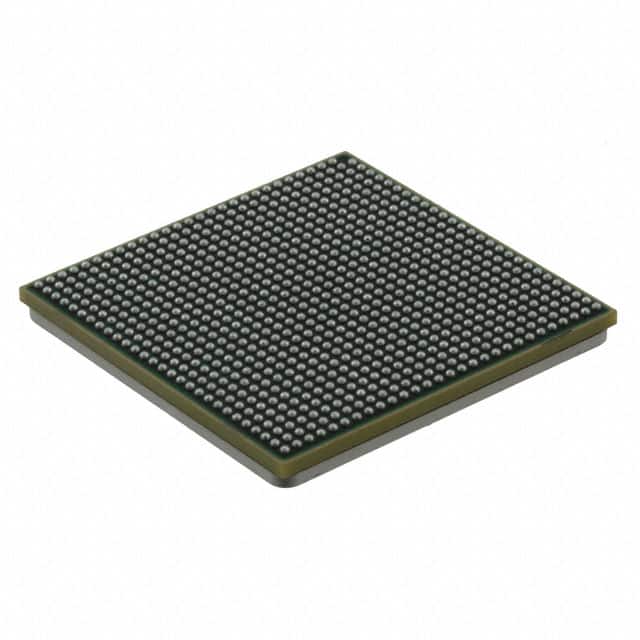
- Part No.:
- MSC8251TAG1000B
- Manufacturer:
- NXP Semiconductors
- Category:
- DSP (Digital Signal Processors)
- Package:
- 783-BBGA, FCBGA
- Datasheet:
-
 MSC8251TAG1000B.pdf
- Description:
- IC DSP 1X 1GHZ SC3850 783FCBGA
- Quantity:
- Payment:

- Shipping:

Inventory:4,996
Please send an inquiry. Send us your inquiry, and we will respond immediately.
Product details
Overview
The MSC8251TAG1000B from NXP Semiconductors (formerly Freescale) is a single-core programmable StarCore SC3850 DSP operating at 1 GHz, delivering 8000 MMACS peak performance. It integrates dual DDR2/DDR3 controllers (64/32-bit, 800 MHz data rate), two Serial RapidIO® interfaces (x1/x4, 3.125 Gbaud), PCI Express® (x1/x2/x4), two Gigabit Ethernet (RGMII/SGMII), and four multi-channel TDM interfaces - deployed in high-end medical imaging systems, radar signal processors, and defense electronic warfare platforms.
For engineers reviewing the MSC8251TAG1000B datasheet, MSC8251TAG1000B pinout, MSC8251TAG1000B application, or MSC8251TAG1000B equivalent, key selection criteria include its 1 GHz SC3850 core performance, CLASS fabric arbitration for concurrent memory access, QUICC Engine subsystem offloading packet processing, 783-ball FC-PBGA package compatibility, and boot support via Serial RapidIO, Ethernet, I²C, or SPI.
Technical Context
The MSC8251TAG1000B implements a fully programmable SC3850 DSP core with 32 KB L1 instruction and 32 KB L1 data caches, backed by 512 KB unified L2 cache (M2 memory) and 1056 KB on-chip SRAM (M3 memory). Its CLASS interconnect fabric arbitrates concurrent access between the DSP core, QUICC Engine, DDR controllers, and configuration registers.
It features a dual-RISC QUICC Engine subsystem running at up to 500 MHz, independently handling two Gigabit Ethernet MACs, SPI, and protocol stacks while offloading the DSP core. High-speed serial connectivity is managed through two HSSI SerDes ports supporting multiplexed Serial RapidIO, PCI Express, and SGMII signaling at 3.125 Gbaud per lane.
Key Specifications
| Parameter | Value and Actual Design Meaning |
|---|---|
| Core Architecture | StarCore SC3850 single-core DSP, 1 GHz clock, 8000 MMACS peak |
| Memory Subsystem | 32 KB L1 I-cache + 32 KB L1 D-cache; 512 KB L2 cache (M2); 1056 KB on-chip SRAM (M3) |
| DDR Interface | Dual 64/32-bit DDR2/DDR3 controllers, 800 MHz data rate, supports SODIMMs up to 2 GB per controller |
| High-Speed Serial | Two Serial RapidIO® (x1/x4, 3.125 Gbaud); PCI Express® (x1/x2/x4); two SGMII/RGMII Gigabit Ethernet |
| TDM & Control | Four TDM interfaces (each supports 8 E1 lines); UART, I²C, SPI, JTAG IEEE 1149.1 compliant |
| Package & Process | 783-ball FC-PBGA, 29 mm × 29 mm; 45 nm SOI CMOS technology |
| Power Management | Wait, stop, and power-down low-power standby modes; optimized on-die power circuitry |
Pinout & Package
MSC8251TAG1000B is housed in a 29 mm × 29 mm, 783-ball Fine-Pitch Column Grid Array (FC-PBGA) package with 1.0 mm ball pitch, designed for high-density PCB layouts and thermal management in conduction-cooled embedded systems.
| Pin/Terminal | Circuit Role | Design Meaning |
|---|---|---|
| DDR_A[0:15], DDR_BA[0:2], DDR_CAS#, DDR_RAS#, DDR_WE# | DDR2/DDR3 Address & Control | Direct interface to two independent DDR2/DDR3 memory channels; supports 32/64-bit bus width and 800 MHz data rate |
| SRIO_TX[0:7]/RX[0:7], PCIE_TX[0:3]/RX[0:3], SGMII_TX/RX | HSSI SerDes Lanes | Multiplexed high-speed serial I/O: configurable per lane as Serial RapidIO, PCI Express, or SGMII physical layer |
| QUICC_CLK, QE_RST#, QE_INT[0:3] | QUICC Engine Subsystem | Dedicated clock, reset, and interrupt signals enabling autonomous packet processing independent of DSP core execution |
| TDM0_CLK, TDM0_FS, TDM0_DIN/DOUT[0:31] | TDM Interface Group 0 | Full-duplex time-division multiplexed interface supporting up to 8 E1 streams (2.048 Mbps each) with frame sync and bit clock |
| JTAG_TCK, JTAG_TMS, JTAG_TDI, JTAG_TDO | IEEE 1149.1 Test Access Port | Boundary-scan test, real-time profiling, and debug visibility across all internal modules including DSP core and QUICC Engine |
Key Features
| Feature | Design Value |
|---|---|
| SC3850 Core Performance | 1 GHz operation with 40% higher MMACS/MHz than competing DSPs, validated by independent assessment |
| CLASS Interconnect Fabric | Arbitrates concurrent memory access among DSP core, QUICC Engine, DDR controllers, and M2/M3 memories - eliminating bus contention bottlenecks |
| QUICC Engine Offload | Dual RISC cores at 500 MHz handle full-stack Ethernet and protocol processing without consuming DSP cycles |
| Flexible HSSI Multiplexing | Two SerDes ports dynamically allocate lanes across Serial RapidIO, PCI Express, and SGMII - enabling hardware reuse across multiple interface requirements |
| Boot Flexibility | Supports boot from Serial RapidIO, Ethernet, I²C, or SPI - critical for field-upgradable secure systems in defense and medical applications |
Applications
| Medical Ultrasound Beamforming | Aerospace Radar Signal Processing |
|---|---|
Use Scenario: Real-time digital beamforming and synthetic aperture processing in portable and cart-based ultrasound systems requiring low-latency, high-precision filtering and FFT computation. IC Role / Device Role / Timing Role: Primary DSP engine executing time-critical beam steering algorithms, managing DDR3 memory for echo data buffering, and synchronizing TDM interfaces to ADC/DAC arrays. Use Value: 1 GHz SC3850 core delivers deterministic sub-microsecond latency for 128-channel beam synthesis; dual DDR controllers sustain >6.4 GB/s memory bandwidth for raw RF data streaming. | Use Scenario: Pulse-Doppler and SAR processing in airborne early-warning radar systems where SWaP-C constraints demand high compute density and deterministic I/O timing. IC Role / Device Role / Timing Role: Host processor for radar waveform generation, matched filtering, and CFAR detection; coordinates Serial RapidIO links to sensor front-ends and PCI Express to host mission computers. Use Value: CLASS fabric enables simultaneous access to M3 SRAM (for coefficient tables) and DDR3 (for range-Doppler maps), avoiding pipeline stalls during burst-mode processing. |
| Defense Electronic Warfare (EW) | Advanced Test & Measurement Equipment |
Use Scenario: Wideband signal intelligence (SIGINT) receivers performing real-time spectrum analysis, demodulation, and threat identification across 2–18 GHz bands using digital downconversion chains. IC Role / Device Role / Timing Role: Baseband processor interfacing with high-speed ADCs via TDM and managing rapid reconfiguration of filter banks and modulation schemes via QUICC Engine. Use Value: Four TDM interfaces support parallel 8-E1 channelization for multi-band IF digitization; QUICC Engine handles TCP/IP stack and metadata tagging without DSP core interruption. | Use Scenario: Modular PXIe-based vector signal analyzers requiring synchronized multi-channel acquisition, real-time FFT, and protocol-aware decoding (e.g., PCIe Gen3, SATA). IC Role / Device Role / Timing Role: Embedded controller orchestrating high-throughput data capture from FPGA-accelerated front-ends, performing spectral analysis, and exporting results over Gigabit Ethernet or Serial RapidIO. Use Value: Dual SGMII interfaces enable deterministic timestamping and low-jitter packet transmission to host PCs; 1056 KB M3 SRAM buffers 16k-point FFT windows without DDR latency penalties. |
Equivalent & Alternatives
The following parts are listed as comparable options for similar high-performance DSP applications.
| Alternative Part | Technical Difference | Application Difference | Selection Advice |
|---|---|---|---|
| MSC8156TAG1000B | Hex-core SC3400 DSP (1 GHz/core), no QUICC Engine, single DDR controller, no PCI Express | Targeted at massively parallel baseband processing (e.g., LTE eNodeB), lacks integrated networking offload | Select when algorithmic parallelism outweighs need for autonomous packet handling or PCIe host connectivity |
| TMS320C6678ACYPA | OCTO-core C66x DSP (1.25 GHz/core), no integrated SerDes, requires external PHYs for RapidIO/Ethernet, no CLASS fabric | Optimized for floating-point intensive tasks (e.g., beamforming with complex math libraries), relies on EMIF and SRIO accelerators | Select when floating-point precision and multicore scalability are primary; accept added board complexity for external interface ICs |
Compared with MSC8156TAG1000B and TMS320C6678ACYPA, the MSC8251TAG1000B uniquely combines single-core deterministic latency, integrated QUICC Engine offload, and multiplexed SerDes - making it optimal for systems requiring tight coupling between signal processing and packetized I/O without external glue logic.
Availability
MSC8251TAG1000B is available at Aetrix Electronics and suitable for medical imaging equipment, aerospace radar subsystems, and defense EW receivers requiring stable component supply, long-term lifecycle assurance, and traceable sourcing.
Supply support for MSC8251TAG1000B includes scheduled delivery planning, volume procurement assistance, BOM continuity management, traceable sourcing, and lifecycle availability coordination for OEM customers, industrial embedded developers, connected-device designers, and electronics production programs.
Manufacturer
NXP Semiconductors is a global semiconductor leader focused on secure connectivity solutions for automotive, industrial, and IoT applications, with deep heritage in high-performance signal processing from its Freescale acquisition.
The MSC8251TAG1000B belongs to NXP's StarCore DSP family, engineered specifically for deterministic, high-throughput digital signal processing in safety-critical and latency-sensitive domains such as medical diagnostics and electronic warfare.
FAQ
What is the maximum DDR3 memory capacity supported by the MSC8251TAG1000B?
The MSC8251TAG1000B supports up to 2 GB per DDR controller, with two independent DDR2/DDR3 controllers. Each controller interfaces with a 32/64-bit DDR2/DDR3 SDRAM bus operating at 800 MHz data rate. When using SODIMMs, the total addressable memory is 4 GB across both channels. This configuration is validated for use with industry-standard DDR3-1600 modules in medical and defense applications requiring large frame buffers.
Does the MSC8251TAG1000B support PCI Express Gen2?
No, the MSC8251TAG1000B supports PCI Express Gen1 only, with x1/x2/x4 link widths and 2.5 Gbps per lane. Its PCI Express interface is implemented within the HSSI SerDes block alongside Serial RapidIO and SGMII, and does not meet Gen2 (5.0 Gbps) electrical or protocol specifications. Designers requiring Gen2 must add an external PCIe switch or bridge IC.
How many TDM channels can the MSC8251TAG1000B manage simultaneously?
The MSC8251TAG1000B provides four independent TDM interfaces, each capable of supporting eight E1 lines (2.048 Mbps per line). This enables concurrent management of up to 32 TDM channels - sufficient for full-rate voice/data aggregation in SIGINT receivers or multi-probe ultrasound transducer arrays. Frame synchronization and bit clock are generated per interface with programmable polarity and phase alignment.
Is the QUICC Engine in the MSC8251TAG1000B compatible with legacy Freescale QUICC software?
Yes, the QUICC Engine subsystem in the MSC8251TAG1000B maintains binary compatibility with software developed for earlier Freescale QUICC Engine implementations, including drivers and protocol stacks for Gigabit Ethernet (IEEE 802.3), HDLC, and PPP. NXP provides updated BSPs and CodeWarrior toolchain support to ensure seamless migration from MSC81xx and MPC83xx platforms.
What boot sources are supported by the MSC8251TAG1000B during cold start?
The MSC8251TAG1000B supports cold-start boot from four sources: Serial RapidIO (via configured master port), 10/100/1000 Mbps Ethernet (using TFTP or BOOTP), I²C-connected EEPROM, and SPI flash. Boot mode is selected via dedicated strap pins (BOOT_SEL[2:0]) and verified by internal ROM bootloader before transferring control to user code in DDR or M3 memory.
MSC8251TAG1000B Specifications
- Product attributes
- Attribute value
- Manufacturer:
- NXP Semiconductors
- Series:
- StarCore
- Package/Case:
- 783-BBGA, FCBGA
- Packaging:
- Tray
- Product Status:
- Obsolete
- Type:
- SC3850 Single Core
- Interface:
- Ethernet, I2C, PCI, RGMII, Serial RapidIO, SGMII, SPI, UART/USART
- Clock Rate:
- 1GHz
- Non-Volatile Memory:
- ROM (96kB)
- On-Chip RAM:
- 576kB
- Voltage - I/O:
- 2.50V
- Voltage - Core:
- 1.00V
- Operating Temperature:
- -40°C ~ 105°C (TJ)
- Grade:
- -
- Qualification:
- -
- Mounting Type:
- Surface Mount
- Supplier Device Package:
- 783-FCPBGA (29x29)
MSC8251TAG1000B FAQ
1.How can I place an order for MSC8251TAG1000B through Aetrix?
Please submit a Request for Quotation (RFQ) for MSC8251TAG1000B on Aetrix. Our sales agent will provide a competitive quotation and guide you through the order confirmation once you accept the terms.
2.Are the price and stock information for MSC8251TAG1000B reliable?
The price and inventory of MSC8251TAG1000B are updated periodically and may fluctuate due to market conditions. Stock and pricing data are typically refreshed every 24 hours. Quotation validity for MSC8251TAG1000B is usually 5 days.
3.What payment methods are accepted for MSC8251TAG1000B?
We accept Wire Transfer, PayPal, Credit Card, Western Union, MoneyGram, and Escrow for MSC8251TAG1000B transactions.
Note: Certain payment methods may incur a processing fee.
4.How is shipping managed for MSC8251TAG1000B?
MSC8251TAG1000B orders can be shipped via leading logistics carriers, including DHL, UPS, FedEx, TNT, or Registered Mail.
Once your MSC8251TAG1000B order is processed, you will receive an email with the shipment details and tracking number.
Note: Tracking information may take up to 24 hours to appear. Express delivery typically takes 3–5 business days.
5.How can I obtain technical support or documentation for MSC8251TAG1000B?
For technical support, including MSC8251TAG1000B datasheets, pinout diagrams, or application guidance, please contact our engineering support team. They can provide detailed documentation and assistance for your MSC8251TAG1000B requirements.
6.How does Aetrix verify that MSC8251TAG1000B is sourced from the original manufacturer or authorized distributors?
All MSC8251TAG1000B products on Aetrix are procured from qualified distributors and authorized channels. Our dedicated quality assurance team conducts strict verification, including traceability checks and, if necessary, third-party testing. This ensures that MSC8251TAG1000B meets industry standards.
7.What is the process for return or replacement of MSC8251TAG1000B?
All MSC8251TAG1000B units undergo pre-shipment inspection (PSI). If there is an issue with MSC8251TAG1000B, returns or replacements are accepted under the following conditions:
1.Quantity discrepancies, incorrect items, or visible external defects (such as breakage or corrosion), acknowledged by Aetrix.
2.The issue is reported within 90 days of delivery.
3.The MSC8251TAG1000B part is unused and in its original packaging.
Return procedure for MSC8251TAG1000B:
1.Submit a request within 90 days.
2.Obtain a Return Material Authorization (RMA) from Aetrix.
MSC8251TAG1000B Tags
-
TMS320C5535AZAY10
Texas Instruments
-
TMS320VC5501PGF300
Texas Instruments
-
ADSP-BF592KCPZ
Analog Devices Inc.
-
ADAU1463WBCPZ150
Analog Devices Inc.
-
TMS320VC5402PGE100
Texas Instruments
-
ADAU1701JSTZ-RL
Analog Devices Inc.
-
ADAU1701JSTZ
Analog Devices Inc.
-
TMS320VC5502PGF300
Texas Instruments
-
ADAU1462WBCPZ300RL
Analog Devices Inc.
-
ADAU1452KCPZRL
Analog Devices Inc.
-
ADAU1452WBCPZ-RL
Analog Devices Inc.
-
TMS320C6747DZKB3
Texas Instruments
Tech Hub

A practical engineering guide to 3.3V and 5V logic compatibility, input thresholds, resistor dividers, translator ICs, MOSFET level shifting, I2C pull-ups, timing limits and power-sequencing risks.

The 74HC595 uses push-pull logic outputs, while the TPIC6B595 uses 50 V open-drain DMOS sinks for higher-power loads. This guide compares timing, current limits, 3.3 V interfacing, load wiring, thermal…

The 74HC595 converts serial data into eight stable parallel outputs. This guide covers pin functions, shift and storage timing, OE and MR behavior, drive-current limits, cascading, voltage compatibilit…

A technical comparison of level-sensitive latches and edge-triggered flip-flops, covering timing windows, setup and hold limits, master–slave operation, time borrowing, race-through, HDL inference and…

A D latch stores one bit while Enable controls when data can pass. This reference covers gate-level operation, truth tables, transparency, setup and hold timing, LE versus OE, common ICs and practical …

An SR latch stores one bit through cross-coupled feedback. This engineering reference covers NOR and NAND implementations, truth tables, forbidden-state recovery, gated operation, switch debouncing, fa…

Latch circuits retain one bit through feedback. This technical reference covers SR and D latches, truth tables, transparency, timing limits, latch-versus-flip-flop behavior, applications and common log…

An engineering guide to LED driver operation, constant-current and constant-voltage outputs, linear and switching topologies, dimming, IC selection, calculations, replacement compatibility, and fault c…

Operational amplifier guide covering op amp basics, feedback, ideal vs real op amps, common configurations, buffer circuits, offset, bias current, gain-bandwidth, slew rate, rail-to-rail limits and sel…

Jumper cables guide covering safe connection order, red and black clamp placement, final ground connection, cable gauge, length, clamp quality, copper vs CCA cables, jump starter comparison and battery…


