
 My Inquiry
 My Account


Texas Instruments MSP430F6734AIPN
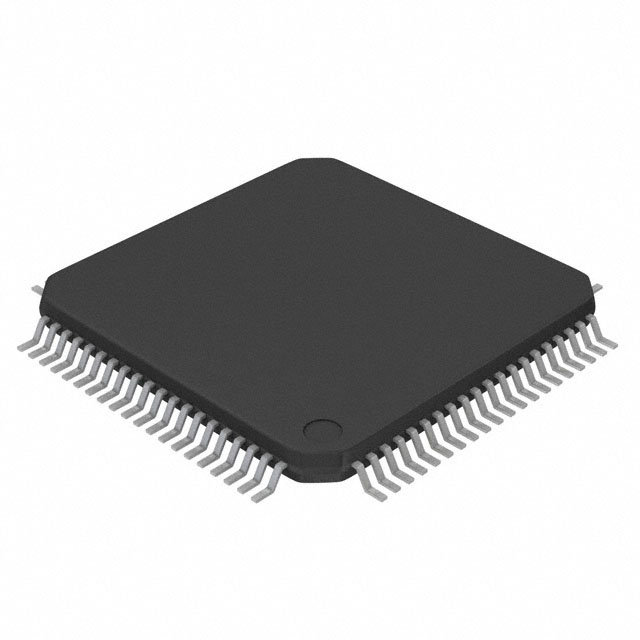
- Part No.:
- MSP430F6734AIPN
- Manufacturer:
- Texas Instruments
- Category:
- Microcontrollers
- Package:
- 80-LQFP
- Datasheet:
-
 MSP430F6734AIPN.pdf
- Description:
- IC MCU 16BIT 96KB FLASH 80LQFP
- Quantity:
- Payment:

- Shipping:

Inventory:3,637
Please send an inquiry. Send us your inquiry, and we will respond immediately.
Product details
Overview
MSP430F6734AIPN from Texas Instruments is an ultra-low-power mixed-signal microcontroller designed for precision energy metering applications. It integrates three 24-bit sigma-delta ADCs, a 10-bit 200-ksps ADC, LCD driver supporting up to 320 segments, real-time clock with crystal offset calibration, and eUSCI modules (3 UART/IrDA/SPI + 1 I²C). It operates from 1.8 V to 3.6 V and delivers 265 µA/MHz active current at 8 MHz, 3.0 V.
For engineers reviewing the MSP430F6734AIPN datasheet, MSP430F6734AIPN pinout, MSP430F6734AIPN application, or MSP430F6734AIPN equivalent, key selection criteria include its 96 KB Flash / 4 KB RAM configuration, 80-pin LQFP package, three SD24_B ADC channels, 3 external + 2 internal ADC10_A inputs, and support for single-phase watt-hour metering with integrated RTC and LCD.
Technical Context
The MSP430F6734AIPN implements a 16-bit RISC CPU with extended memory addressing and constant generators for optimized code efficiency. Its unified clock system includes FLL stabilization, low-frequency VLO and trimmed REFO sources, and 32-kHz XT1 crystal support - enabling precise timing for metrology-grade sampling and RTC operation.
Power management features include a fully integrated LDO with programmable core voltage, supply supervision with brownout detection, and dual auxiliary power domains (AUXVCC1/2/3) for isolated analog subsystems. The device supports fast wake-up (3 µs typical) from LPM3 standby mode while retaining full RAM and RTC functionality.
Key Specifications
| Parameter | Value and Actual Design Meaning |
|---|---|
| Flash Memory | 96 KB - sufficient for complex metering firmware including harmonic analysis, tariff switching, and communication stacks |
| RAM | 4 KB - supports real-time data buffering for multiple ADC channels and LCD refresh without external memory |
| ADC Resolution | Three 24-bit sigma-delta ADCs - enables high-accuracy current/voltage measurement with >100 dB SNR for Class 0.2 metering compliance |
| ADC Inputs | 3 external + 2 internal (including temperature sensor) - allows simultaneous phase current, neutral current, and voltage sensing with on-chip reference monitoring |
| Package | 80-pin LQFP (12 mm × 12 mm) - provides 52 GPIOs and dedicated analog input pins (SD0P0–SD2N0, A0–A5) for clean signal routing in meter PCB layouts |
| Operating Voltage | 1.8 V to 3.6 V - supports direct connection to 3.3-V systems and battery-backed operation during mains failure |
| RTC Accuracy | Crystal-based with temperature compensation and offset calibration - maintains ±2 ppm accuracy over –40°C to 85°C for time-of-use billing |
Pinout & Package
Package: 80-pin LQFP (PN), 12 mm × 12 mm body size, standard JEDEC footprint compatible with automated assembly.
| Pin/Terminal | Circuit Role | Design Meaning |
|---|---|---|
| SD0P0 / SD0N0 SD1P0 / SD1N0 SD2P0 / SD2N0 | Differential analog inputs for SD24_B ADCs | Enable simultaneous high-resolution measurement of up to three current transformers or shunt-based signals with inherent noise rejection |
| P1.0 / P1.1 (VeREF− / VeREF+) | External reference voltage terminals | Support precise 2.5-V or 1.5-V reference sourcing for ADCs, decoupling metrology accuracy from AVCC variation |
| XIN / XOUT | 32-kHz crystal oscillator connections | Drive low-power RTC with crystal; requires external 32.768-kHz tuning fork crystal for ±20 ppm stability |
| AUXVCC1 / AUXVCC2 / AUXVCC3 | Auxiliary analog supply rails | Isolate ADC, RTC, and backup memory domains from digital noise, critical for sub-millivolt measurement integrity |
| LCDCAP / COM0–COM7 | LCD driver capacitor and common outputs | Enable 8-mux segment driving for up to 320-segment displays; LCDCAP stabilizes internal charge pump for consistent contrast |
Key Features
| Feature | Design Value |
|---|---|
| Password-protected RTC | Prevents unauthorized time tampering in revenue-grade meters; supports alarm-triggered wake-up for scheduled events |
| Integrated LCD driver | Eliminates external display controller; reduces BOM cost and board space while supporting segmented displays for utility UIs |
| Three-channel DMA | Enables zero-CPU-overhead ADC data transfer to RAM, freeing CPU for metrology calculations and communication tasks |
| Hardware multiplier (MPY32) | Accelerates 32-bit arithmetic for RMS, THD, and fundamental power calculations required by IEC 62053-21/22 |
| eUSCI_A0/A1/A2 + eUSCI_B0 | Supports dual UART (for optical port + RS-485), IrDA (handheld reader), SPI (external flash), and I²C (sensor interface) concurrently |
Applications
| Single-Phase Watt-Hour Meter | Energy Monitoring Gateway |
|---|---|
Use Scenario: Residential electricity meter measuring active/reactive energy, demand, and power quality parameters. IC Role / Device Role / Timing Role: Primary metrology MCU performing synchronized sampling, harmonic analysis, and time-stamped event logging via integrated RTC. Use Value: Achieves IEC 62053-21 Class 0.2 accuracy using on-chip 24-bit SD24_B ADCs and temperature-compensated RTC, eliminating need for external precision references. | Use Scenario: DIN-rail mounted gateway aggregating consumption data from multiple submeters and transmitting via NB-IoT or LoRaWAN. IC Role / Device Role / Timing Role: Central processing unit managing multi-protocol communication (UART, I²C), local data storage, and secure firmware updates. Use Value: Low-power LPM3 mode (1.7 µA) enables battery backup for 5+ years; hardware AES acceleration (via MPY32-assisted routines) secures OTA updates. |
| Utility Grid Sensor Node | Smart Plug with Energy Analytics |
Use Scenario: Transformer monitoring node measuring voltage sag/swell, frequency deviation, and neutral current imbalance. IC Role / Device Role / Timing Role: Real-time signal processor capturing 16k samples/sec across 3 SD24_B channels with timestamp alignment to GPS-synced RTC. Use Value: Simultaneous 24-bit sampling on three independent ADCs enables true RMS and sequence component calculation without multiplexing delay errors. | Use Scenario: Consumer smart plug providing per-appliance energy breakdown, cost estimation, and load profiling. IC Role / Device Role / Timing Role: Embedded controller executing real-time power calculation, LCD display update, and Bluetooth LE communication stack. Use Value: Integrated LCD driver drives 128-segment display directly; 10-bit ADC monitors internal temperature for thermal derating of current measurements. |
Equivalent & Alternatives
The following parts are listed as comparable options for similar metrology microcontroller applications.
| Alternative Part | Technical Difference | Application Difference | Selection Advice |
|---|---|---|---|
| MSP430F6735AIPN | 128 KB Flash / 4 KB RAM vs. 96 KB / 4 KB; identical peripherals and pinout | Supports larger firmware images (e.g., DLMS/COSEM stack + OTA update handler) | Select when firmware size exceeds 96 KB or future-proofing for feature expansion is required |
| MSP430F6733AIPN | 64 KB Flash / 4 KB RAM; same ADC count, fewer timer resources (no TA0 with 3 CC registers) | Suitable for cost-sensitive meters with simplified tariff schemes and no harmonic analysis | Choose for entry-level meters where Flash headroom and advanced timing features are non-critical |
Compared with MSP430F6735AIPN and MSP430F6733AIPN, the MSP430F6734AIPN offers optimal balance of Flash capacity (96 KB), metrology-grade ADC performance, and 80-pin LQFP packaging - making it ideal for mid-tier single-phase meters requiring robust firmware and certified accuracy without over-provisioning resources.
Availability
MSP430F6734AIPN is available at Aetrix Electronics and suitable for single-phase watt-hour meters, energy monitoring gateways, and utility grid sensor nodes requiring stable component supply, long-term lifecycle support, and traceable sourcing for regulatory compliance.
Supply support for MSP430F6734AIPN includes scheduled delivery planning, volume procurement assistance, BOM continuity management, traceable sourcing, and lifecycle availability coordination for OEM customers, industrial embedded developers, connected-device designers, and electronics production programs.
Manufacturer
Texas Instruments is a global semiconductor leader delivering analog, embedded processing, and connectivity solutions for industrial, automotive, and consumer markets.
The MSP430F6734AIPN belongs to TI's ultra-low-power metrology MCU product line, engineered specifically for revenue-grade energy measurement with integrated high-resolution ADCs, RTC, and LCD driver - targeting IEC 62053 and ANSI C12 compliance.
FAQ
What is the maximum system clock frequency supported by the MSP430F6734AIPN?
The MSP430F6734AIPN supports a maximum system clock (MCLK) frequency of 25 MHz, enabled by its integrated FLL control loop and DCO oscillator. This speed allows real-time execution of metrology algorithms such as RMS calculation, harmonic analysis, and communication protocol handling while maintaining ultra-low power consumption in active mode (265 µA/MHz at 8 MHz, 3.0 V). The device achieves this performance without external clock components beyond the 32-kHz crystal for RTC.
Does the MSP430F6734AIPN support crystal-less operation for the RTC?
No, the MSP430F6734AIPN requires an external 32.768-kHz crystal connected to XIN/XOUT for RTC operation with specified accuracy. Its RTC_C module is designed for crystal-based timekeeping with temperature compensation and offset calibration - features unavailable with internal VLO or REFO sources. Using VLO alone would result in ±250 ppm drift, insufficient for time-of-use billing compliance per IEC 62053-22.
How many independent analog input channels does the MSP430F6734AIPN provide for metrology use?
The MSP430F6734AIPN provides six dedicated analog input channels for metrology: three differential pairs (SD0P0/SD0N0, SD1P0/SD1N0, SD2P0/SD2N0) for the 24-bit SD24_B ADCs, plus three single-ended inputs (A0, A1, A2) routed to the 10-bit ADC10_A. Two additional internal channels (temperature sensor and VCC/2) are also accessible, enabling comprehensive voltage, current, and environmental monitoring within a single chip.
Can the MSP430F6734AIPN drive a 4-mux LCD display?
Yes, the MSP430F6734AIPN's integrated LCD_C module supports both 4-mux and 8-mux configurations, driving up to 320 segments in 8-mux mode or up to 160 segments in 4-mux mode. It includes programmable contrast control, internal charge pump, and dedicated COM0–COM7 outputs - allowing direct interface to standard utility meter LCD glass without external bias circuitry or driver ICs.
What debug interface does the MSP430F6734AIPN support?
The MSP430F6734AIPN supports the Spy-Bi-Wire (SBW) interface using TEST/SBWTCK (pin 75) and RST/NMI/SBWTDIO (pin 80) for programming and debugging. It does not require JTAG; SBW provides full emulation capability with minimal pin count. TI's MSP-FET and compatible debuggers enable flash programming, real-time variable watch, and low-power mode transition analysis - essential for validating meter firmware behavior under battery-backup conditions.
MSP430F6734AIPN Specifications
- Product attributes
- Attribute value
- Manufacturer:
- Texas Instruments
- Package/Case:
- 80-LQFP
- Series:
- MSP430F6xx
- Packaging:
- Tray
- Product Status:
- Active
- Programmable:
- Not Verified
- Core Processor:
- MSP430 CPUXV2
- Core Size:
- 16-Bit
- Speed:
- 25MHz
- Connectivity:
- I2C, IrDA, LINbus, SCI, SPI, UART/USART
- Peripherals:
- Brown-out Detect/Reset, DMA, LCD, POR, PWM, WDT
- Number of I/O:
- 52
- Program Memory Size:
- 96KB (96K x 8)
- Program Memory Type:
- FLASH
- EEPROM Size:
- -
- RAM Size:
- 4K x 8
- Voltage - Supply (Vcc/Vdd):
- 1.8V ~ 3.6V
- Data Converters:
- A/D 5x10b, 3x24b
- Oscillator Type:
- Internal
- Operating Temperature:
- -40°C ~ 85°C (TA)
- Grade:
- -
- Qualification:
- -
- Mounting Type:
- Surface Mount
- Supplier Device Package:
MSP430F6734AIPN FAQ
1.How can I place an order for MSP430F6734AIPN through Aetrix?
Please submit a Request for Quotation (RFQ) for MSP430F6734AIPN on Aetrix. Our sales agent will provide a competitive quotation and guide you through the order confirmation once you accept the terms.
2.Are the price and stock information for MSP430F6734AIPN reliable?
The price and inventory of MSP430F6734AIPN are updated periodically and may fluctuate due to market conditions. Stock and pricing data are typically refreshed every 24 hours. Quotation validity for MSP430F6734AIPN is usually 5 days.
3.What payment methods are accepted for MSP430F6734AIPN?
We accept Wire Transfer, PayPal, Credit Card, Western Union, MoneyGram, and Escrow for MSP430F6734AIPN transactions.
Note: Certain payment methods may incur a processing fee.
4.How is shipping managed for MSP430F6734AIPN?
MSP430F6734AIPN orders can be shipped via leading logistics carriers, including DHL, UPS, FedEx, TNT, or Registered Mail.
Once your MSP430F6734AIPN order is processed, you will receive an email with the shipment details and tracking number.
Note: Tracking information may take up to 24 hours to appear. Express delivery typically takes 3–5 business days.
5.How can I obtain technical support or documentation for MSP430F6734AIPN?
For technical support, including MSP430F6734AIPN datasheets, pinout diagrams, or application guidance, please contact our engineering support team. They can provide detailed documentation and assistance for your MSP430F6734AIPN requirements.
6.How does Aetrix verify that MSP430F6734AIPN is sourced from the original manufacturer or authorized distributors?
All MSP430F6734AIPN products on Aetrix are procured from qualified distributors and authorized channels. Our dedicated quality assurance team conducts strict verification, including traceability checks and, if necessary, third-party testing. This ensures that MSP430F6734AIPN meets industry standards.
7.What is the process for return or replacement of MSP430F6734AIPN?
All MSP430F6734AIPN units undergo pre-shipment inspection (PSI). If there is an issue with MSP430F6734AIPN, returns or replacements are accepted under the following conditions:
1.Quantity discrepancies, incorrect items, or visible external defects (such as breakage or corrosion), acknowledged by Aetrix.
2.The issue is reported within 90 days of delivery.
3.The MSP430F6734AIPN part is unused and in its original packaging.
Return procedure for MSP430F6734AIPN:
1.Submit a request within 90 days.
2.Obtain a Return Material Authorization (RMA) from Aetrix.
MSP430F6734AIPN Tags

-
ATTINY4-TSHR
Microchip Technology
-
ATTINY10-TSHR
Microchip Technology
-
ATTINY10-TS8R
Microchip Technology

-
ATTINY202-SSNR
Microchip Technology
-
ATTINY202-SSFR
Microchip Technology
-
ATTINY402-SSNR
Microchip Technology

-
PIC16F15213T-I/MF
Microchip Technology
-
PIC16F15213-E/MF
Microchip Technology

-
PIC10F200T-I/OT
Microchip Technology
-
ATTINY412-SSNR
Microchip Technology
-
PIC10F202T-I/OT
Microchip Technology

-
ATTINY404-SSNR
Microchip Technology
Tech Hub

A practical engineering guide to 3.3V and 5V logic compatibility, input thresholds, resistor dividers, translator ICs, MOSFET level shifting, I2C pull-ups, timing limits and power-sequencing risks.

The 74HC595 uses push-pull logic outputs, while the TPIC6B595 uses 50 V open-drain DMOS sinks for higher-power loads. This guide compares timing, current limits, 3.3 V interfacing, load wiring, thermal…

The 74HC595 converts serial data into eight stable parallel outputs. This guide covers pin functions, shift and storage timing, OE and MR behavior, drive-current limits, cascading, voltage compatibilit…

A technical comparison of level-sensitive latches and edge-triggered flip-flops, covering timing windows, setup and hold limits, master–slave operation, time borrowing, race-through, HDL inference and…

A D latch stores one bit while Enable controls when data can pass. This reference covers gate-level operation, truth tables, transparency, setup and hold timing, LE versus OE, common ICs and practical …

An SR latch stores one bit through cross-coupled feedback. This engineering reference covers NOR and NAND implementations, truth tables, forbidden-state recovery, gated operation, switch debouncing, fa…

Latch circuits retain one bit through feedback. This technical reference covers SR and D latches, truth tables, transparency, timing limits, latch-versus-flip-flop behavior, applications and common log…

An engineering guide to LED driver operation, constant-current and constant-voltage outputs, linear and switching topologies, dimming, IC selection, calculations, replacement compatibility, and fault c…

Operational amplifier guide covering op amp basics, feedback, ideal vs real op amps, common configurations, buffer circuits, offset, bias current, gain-bandwidth, slew rate, rail-to-rail limits and sel…

Jumper cables guide covering safe connection order, red and black clamp placement, final ground connection, cable gauge, length, clamp quality, copper vs CCA cables, jump starter comparison and battery…


