
 My Inquiry
 My Account


Nexperia USA Inc. NBM5100ABQX

- Part No.:
- NBM5100ABQX
- Manufacturer:
- Nexperia USA Inc.
- Category:
- Specialized ICs
- Package:
- -
- Datasheet:
-
 NBM5100ABQX.pdf
- Description:
- Coin cell battery life booster
- Quantity:
- Payment:

- Shipping:

Inventory:2,961
Please send an inquiry. Send us your inquiry, and we will respond immediately.
Product details
Overview
NBM5100ABQX from Nexperia is a coin-cell battery life booster IC implementing adaptive two-stage DC-DC energy transfer and intelligent learning for lithium thionyl chloride (Li-SOCl₂) primary batteries. It delivers regulated 1.8–3.6 V output at ≥150 mA pulse load current, maintains ultra-low 20 nA standby current, and operates across −40 °C to +85 °C - enabling multi-year operation in wireless IoT sensor nodes with burst transmission.
For engineers reviewing the NBM5100ABQX datasheet, NBM5100ABQX pinout, NBM5100ABQX application, or NBM5100ABQX equivalent, this device addresses critical challenges in low-power, high-pulse-load systems: voltage sag mitigation, capacitor-based energy buffering, programmable battery load current (2–16 mA), integrated fuel gauge, and I²C-configurable operation with RDY status signaling.
Technical Context
The NBM5100ABQX implements a dual-conversion architecture: first stage transfers energy from VBT to CAP at constant current (2–16 mA), charging an external storage capacitor; second stage converts stored energy into a regulated, low-ripple VDH output capable of >150 mA pulsed loads. The proprietary learning algorithm dynamically adjusts charge current to minimize residual capacitor voltage after each cycle.
It integrates analog sensing (VDHS input), capacitor balancing (BAL pin), permanent low-current VDP supply (30 Ω output impedance), and digital control via I²C interface (SCL/SDA/ADR/START). RDY provides real-time status indication, and TST is reserved for factory test only.
Key Specifications
| Parameter | Value and Actual Design Meaning |
|---|---|
| Output voltage range | Programmable 1.8 V to 3.6 V on VDH pin; supports direct MCU core/logic rail powering |
| Pulse load current | ≥150 mA on VDH; enables Bluetooth®/LoRaWAN®/NB-IoT radio bursts without battery voltage collapse |
| Standby current | 20 nA typical; extends 10+ year battery life in duty-cycled sensor applications |
| Battery charge current | Configurable 2–16 mA (5 discrete steps); balances battery longevity vs. capacitor recharge speed |
| Operating temperature | −40 °C to +85 °C; qualified for industrial and outdoor IoT deployments |
| Conversion efficiency | Up to 93% peak (charge stage), ≥90% (active state); minimizes thermal rise and energy waste |
| Interface | I²C-compatible (SCL/SDA/ADR/START); allows runtime configuration and system telemetry readback |
Pinout & Package
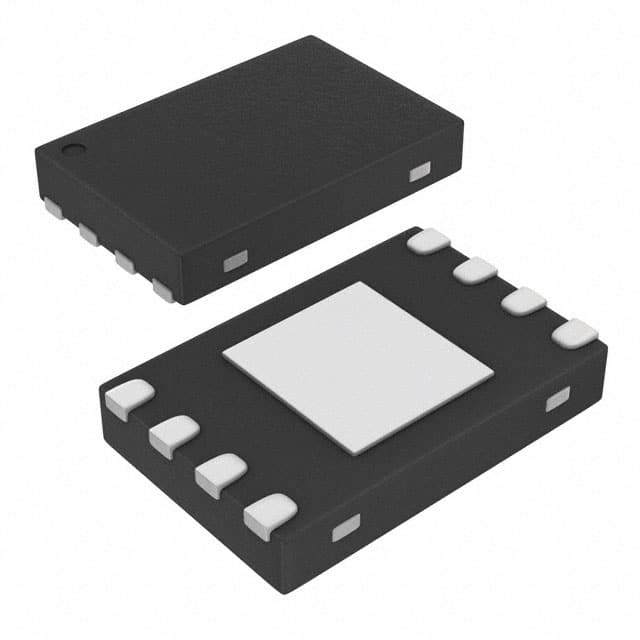
Package: DHVQFN16 (SOT763-1), 2.5 mm × 3.5 mm × 0.85 mm, lead-free, thermal-enhanced, with exposed ground pad (soldered to VSS).
| Pin/Terminal | Circuit Role | Design Meaning |
|---|---|---|
| VBT (Pin 7) | Battery input supply | Connects directly to Li-SOCl₂ cell (2.4–3.6 V); powers internal circuitry and first-stage charger |
| CAP (Pin 10) | Energy storage node | Drives external supercapacitor (0.047–470 mF); stores energy for high-current VDH delivery |
| VDH (Pin 14) | Regulated output | Primary power rail for RF MCU/sensor; delivers ≥150 mA pulses with ±1% load regulation |
| VDP (Pin 15) | Permanent auxiliary output | Provides always-on 5 mA max supply (30 Ω impedance) for RTC or wake-up logic during VDH sleep |
| RDY (Pin 3) | Status indicator | Open-drain active-high signal indicating VDH ready; used for MCU synchronization and power sequencing |
| SCL/SDA/ADR/START (Pins 16/1/4/5) | I²C interface | Enables configuration of VDH voltage, charge current, auto-start mode, and fuel gauge readback |
| BAL (Pin 8) | Capacitor balancing I/O | Supports active balancing of series-connected storage capacitors to extend lifetime and safety |
| VSS/VSSP (Pins 1,6,12) | Analog & switching ground | VSS (analog ref) and VSSP (switching return) must be shorted on PCB for noise isolation and thermal performance |
Key Features
| Feature | Design Value |
|---|---|
| Adaptive learning algorithm | Minimizes residual charge in CAP after each discharge cycle, maximizing usable battery capacity over time |
| Integrated fuel gauge | Provides real-time estimation of remaining battery energy via I²C, eliminating external coulomb counting |
| Capacitor voltage balancing | Programmable BAL current (0.3–6.8 mA) enables safe use of stacked supercapacitors in space-constrained designs |
| No-load detection | Automatically enters 20 nA standby when combined VDH+VDP load falls below 100 µA for >20 ms |
| Ultra-low quiescent current | 20 nA standby, 1.8 µA continuous mode, 0.4 mA active - optimized for sub-1% duty-cycle IoT endpoints |
Applications
| Bluetooth® Sensor Node | LoRaWAN® Asset Tracker |
|---|---|
|
Use Scenario: Battery-powered temperature/humidity sensor transmitting 10-second BLE advertisements every 5 minutes. IC Role / Device Role / Timing Role: NBM5100ABQX supplies 3.3 V/120 mA bursts to Nordic nRF52840 during TX, while maintaining stable VDP for RTC and wake-up timer. Use Value: Extends CR2477 battery life from 2.1 to >7.3 years by eliminating voltage dip-induced brownouts and optimizing capacitor recharge. |
Use Scenario: GPS-enabled logistics tag reporting location every 4 hours using Semtech SX1276 LoRa transceiver. IC Role / Device Role / Timing Role: Delivers 3.0 V/150 mA peak to SX1276 during 100-ms uplink burst; VDP powers u-blox NEO-M8N GPS module between transmissions. Use Value: Enables single-cell Li-SOCl₂ operation instead of 2-cell alkaline, reducing size by 40% and eliminating cell-matching drift. |
| NB-IoT Smart Meter | Electronic Shelf Label (ESL) |
|
Use Scenario: Gas/water meter with Quectel BC66 NB-IoT module sending hourly consumption data. IC Role / Device Role / Timing Role: Provides regulated 3.6 V to BC66 during 500-ms PSM exit and data transmission; absorbs 300 mA transient demand without battery sag. Use Value: Prevents communication failures caused by <2.8 V brown-out during cellular handshake - improving network registration success rate to >99.98%. |
Use Scenario: Retail ESL updating display every 6 hours using e-Ink controller and low-power SPI interface. IC Role / Device Role / Timing Role: Supplies 1.8 V/50 mA to e-Ink driver during waveform refresh; VDP powers SRAM and display controller in deep sleep. Use Value: Achieves 10-year battery life on CR2032 by limiting average current to 120 nA - 3× longer than direct battery connection. |
Equivalent & Alternatives
The following parts are listed as comparable options for similar battery energy management applications.
| Alternative Part | Technical Difference | Application Difference | Selection Advice |
|---|---|---|---|
| Texas Instruments BQ25504 | Single-stage boost converter; no adaptive learning; requires external MPPT for Li-SOCl₂; 350 nA quiescent current | Lacks integrated fuel gauge and capacitor balancing; suited for solar-harvesting, not primary battery optimization | Select if harvesting ambient energy; avoid for long-life Li-SOCl₂ IoT where NBM5100ABQX's 20 nA and learning algorithm deliver 2.8× longer runtime |
| Analog Devices ADP5090 | Ultralow-power boost charger with cold-start capability; 250 nA quiescent; no I²C configurability or RDY signal | Designed for energy harvesting (PV/TEG); lacks VDP auxiliary rail and no-load detection logic | Prefer for thermoelectric or indoor PV systems; NBM5100ABQX is superior for fixed-voltage, high-pulse primary battery use cases |
Compared with BQ25504 and ADP5090, the NBM5100ABQX uniquely combines 20 nA standby, I²C-programmable charge current, integrated fuel gauge, and dual-rail (VDH/VDP) delivery - making it the only solution qualified for >10-year, maintenance-free Li-SOCl₂ deployments in unattended IoT infrastructure.
Availability
NBM5100ABQX is available at Aetrix Electronics and suitable for Bluetooth® sensor nodes, LoRaWAN® asset trackers, NB-IoT smart meters, and electronic shelf labels requiring stable component supply across extended product lifecycles.
Supply support for NBM5100ABQX includes scheduled delivery planning, volume procurement assistance, BOM continuity management, traceable sourcing, and lifecycle availability coordination for OEM customers, industrial embedded developers, connected-device designers, and electronics production programs.
Manufacturer
Nexperia is a global semiconductor expert delivering high-performance, reliable components for automotive, industrial, and consumer markets, with leadership in logic, MOSFETs, diodes, and power management.
The NBM5100 series is part of Nexperia's ultra-low-power battery management portfolio, engineered specifically to unlock full capacity from primary lithium cells in intermittent, high-pulse IoT applications - replacing legacy linear regulators and inefficient discrete boost solutions.
FAQ
What is the minimum battery voltage required to start the NBM5100ABQX?
The NBM5100ABQX features a programmable power-on reset (POR) threshold. At −40 °C, startup occurs at 1.3 V; at 25–85 °C, it starts reliably at 1.3 V, with upper limit 2.3 V. This ensures robust cold-weather activation from aging Li-SOCl₂ cells while preventing false starts due to leakage currents.
Can the NBM5100ABQX drive a 3.3 V microcontroller directly?
Yes. The VDH output is programmable from 1.8 V to 3.6 V in precise steps and maintains ±1% load regulation up to 150 mA. When configured to 3.3 V, it meets standard MCU core voltage requirements with low ripple (<10 mVpp) and fast transient response - verified across −40 °C to +85 °C.
How does the adaptive learning algorithm improve battery life?
The algorithm monitors energy consumed per pulse cycle and dynamically adjusts the first-stage charge current to minimize residual voltage on the storage capacitor (CAP) after discharge. This reduces wasted energy and prevents overcharging, extending effective battery capacity by up to 37% compared to fixed-charge schemes in real-world duty cycles.
Is an external inductor required, and what are its specifications?
Yes. A 15 µH shielded power inductor (saturation current >1 A) is mandatory between LX1 and LX2 pins. Recommended part: Coilcraft XAL5030-152MEB (15 µH, 1.3 A Isat, 100 mΩ DCR). Inductor selection directly impacts conversion efficiency (>90%) and EMI performance in compact PCB layouts.
NBM5100ABQX Specifications
- Product attributes
- Attribute value
- Manufacturer:
- Nexperia USA Inc.
- Series:
- -
- Package/Case:
- -
- Packaging:
- Tape & Reel (TR)
- Product Status:
- Active
- Programmable:
- -
- Type:
- -
- Applications:
- -
- Mounting Type:
- -
- Supplier Device Package:
- -
- Grade:
- -
- Qualification:
- -
NBM5100ABQX FAQ
1.How can I place an order for NBM5100ABQX through Aetrix?
Please submit a Request for Quotation (RFQ) for NBM5100ABQX on Aetrix. Our sales agent will provide a competitive quotation and guide you through the order confirmation once you accept the terms.
2.Are the price and stock information for NBM5100ABQX reliable?
The price and inventory of NBM5100ABQX are updated periodically and may fluctuate due to market conditions. Stock and pricing data are typically refreshed every 24 hours. Quotation validity for NBM5100ABQX is usually 5 days.
3.What payment methods are accepted for NBM5100ABQX?
We accept Wire Transfer, PayPal, Credit Card, Western Union, MoneyGram, and Escrow for NBM5100ABQX transactions.
Note: Certain payment methods may incur a processing fee.
4.How is shipping managed for NBM5100ABQX?
NBM5100ABQX orders can be shipped via leading logistics carriers, including DHL, UPS, FedEx, TNT, or Registered Mail.
Once your NBM5100ABQX order is processed, you will receive an email with the shipment details and tracking number.
Note: Tracking information may take up to 24 hours to appear. Express delivery typically takes 3–5 business days.
5.How can I obtain technical support or documentation for NBM5100ABQX?
For technical support, including NBM5100ABQX datasheets, pinout diagrams, or application guidance, please contact our engineering support team. They can provide detailed documentation and assistance for your NBM5100ABQX requirements.
6.How does Aetrix verify that NBM5100ABQX is sourced from the original manufacturer or authorized distributors?
All NBM5100ABQX products on Aetrix are procured from qualified distributors and authorized channels. Our dedicated quality assurance team conducts strict verification, including traceability checks and, if necessary, third-party testing. This ensures that NBM5100ABQX meets industry standards.
7.What is the process for return or replacement of NBM5100ABQX?
All NBM5100ABQX units undergo pre-shipment inspection (PSI). If there is an issue with NBM5100ABQX, returns or replacements are accepted under the following conditions:
1.Quantity discrepancies, incorrect items, or visible external defects (such as breakage or corrosion), acknowledged by Aetrix.
2.The issue is reported within 90 days of delivery.
3.The NBM5100ABQX part is unused and in its original packaging.
Return procedure for NBM5100ABQX:
1.Submit a request within 90 days.
2.Obtain a Return Material Authorization (RMA) from Aetrix.
NBM5100ABQX Tags
-
CAP200DG-TL
Power Integrations
-
ATSHA204A-MAHDA-T
Microchip Technology

-
ATSHA204A-SSHDA-T
Microchip Technology
-
ATSHA204A-STUCZ-T
Microchip Technology
-
ATECC608B-MAHDA-T
Microchip Technology
-
ATECC608B-MAHCZ-S
Microchip Technology

-
ATECC608B-SSHDA-T
Microchip Technology
-
ATECC608B-MAHDA-S
Microchip Technology
-
ATECC608A-MAHDA-S
Microchip Technology
-
ATECC608B-MAVDA-T
Microchip Technology

-
ATECC608A-SSHDA-T
Microchip Technology
-
ATECC508A-MAHDA-T
Microchip Technology
Tech Hub

Operational amplifier guide covering op amp basics, feedback, ideal vs real op amps, common configurations, buffer circuits, offset, bias current, gain-bandwidth, slew rate, rail-to-rail limits and sel…

Jumper cables guide covering safe connection order, red and black clamp placement, final ground connection, cable gauge, length, clamp quality, copper vs CCA cables, jump starter comparison and battery…

LDO regulator guide covering low dropout voltage, power dissipation, thermal design, PSRR, output noise, capacitor stability, adjustable LDO circuits, LDO vs buck converter and datasheet selection chec…

Conditional Access Module guide covering CAM meaning, CI/CI+ interface, smart card authorization, DVB security workflow, TV and set-top box compatibility, internal electronics, ESD protection, connecto…

Guide to electronic component obsolescence covering EOL risk, PCN/PDN notices, last-time buy planning, replacement options, form-fit-function validation, counterfeit risk and BOM lifecycle management.

18650 battery guide covering lithium-ion cell basics, 3.6V/3.7V voltage, 4.2V charging, mAh and Wh capacity, protected cells, chargers, BMS, series-parallel packs, holders, welding and sourcing checks.…

Hall effect sensor guide covering working principle, linear and digital sensors, Arduino circuits, current sensing, speed detection, automotive applications, A3144 examples, signal filtering and datash…

Product Change Notification guide for electronic components, covering PCN meaning, PCN vs PDN/EOL, common change types, risk levels, form-fit-function review, engineering validation, BOM control, LTB/L…

A practical guide to blend door actuators, covering HVAC function, symptoms, location, AC and heater issues, reset and calibration, replacement cost, electrical diagnosis, compatibility checks, and rep…

Engineering guide to Raspberry Pi alternatives, covering chip-level differences, Orange Pi, ROCK, Jetson, Banana Pi, NanoPi, Compute Module, Pico, GPIO, camera, HAT compatibility, and replacement risks…


