
 My Inquiry
 My Account


onsemi NC7SZ14P5X-L22057

- Part No.:
- NC7SZ14P5X-L22057
- Manufacturer:
- onsemi
- Category:
- Gates and Inverters
- Package:
- 5-TSSOP, SC-70-5, SOT-353
- Datasheet:
-
 NC7SZ14P5X-L22057.pdf
- Description:
- IC INVERT SCHMITT 1CH 1IN SC88A
- Quantity:
- Payment:

- Shipping:

Inventory:3,867
Please send an inquiry. Send us your inquiry, and we will respond immediately.
Product details
Overview
NC7SZ14P5X-L22057 from onsemi is a single-channel Schmitt-trigger inverter in the TinyLogic UHS family, designed for noise-immune signal conditioning and level translation in low-voltage digital systems. It operates across 1.65 V to 5.5 V VCC, delivers ±24 mA output drive at 3 V, and achieves 3.7 ns typical propagation delay into 50 pF at 5 V - enabling robust edge detection in sensor interface and power-on reset circuits.
For engineers reviewing the NC7SZ14P5X-L22057 datasheet, pinout, applications, or equivalent options, key selection criteria include its hysteresis voltage (0.70–1.70 V), overvoltage-tolerant inputs (up to 5.5 V independent of VCC), power-down high-impedance behavior, and SC-88A package compatibility with space-constrained PCB layouts.
Technical Context
The NC7SZ14P5X-L22057 implements a CMOS-based Schmitt-trigger inverter with asymmetric input thresholds (VP = 1.00–3.60 V, VN = 0.20–1.70 V) and hysteresis (0.10–1.70 V) to reject noise on slow-rising or noisy signals. Its input structure tolerates 5.5 V regardless of VCC, supporting mixed-voltage translation between 5 V and 3.3 V/1.8 V domains without external components.
It features rail-to-rail output swing, power-off high-impedance I/Os when VCC = 0 V, and ultra-low quiescent current (≤10 µA). The device is specified for −40 °C to +85 °C operation and supports dynamic loading up to 32 mA sink/source at 3 V, with propagation delay tightly controlled across supply and temperature.
Key Specifications
| Parameter | Value and Actual Design Meaning |
|---|---|
| VCC Range | 1.65 V to 5.5 V - enables single-supply operation across 1.8 V, 2.5 V, 3.3 V, and 5 V logic families. |
| tPD (Typ.) | 3.7 ns into 50 pF at 5 V - ensures fast signal inversion for timing-critical clock clean-up or debounce functions. |
| IOH/IOL | ±24 mA at 3 V - provides sufficient drive strength to directly interface with multiple LS-TTL or CMOS loads. |
| Hysteresis (VH) | 0.70 V (min) to 1.70 V (max) at 5.5 V VCC - rejects >700 mV of input noise without false triggering. |
| VIN Tolerance | Up to 5.5 V independent of VCC - allows safe 5 V input interfacing even when powered from 1.8 V or 2.5 V. |
| IIN Leakage | ±1.0 µA max at −40 °C to +85 °C - minimizes loading on high-impedance sources like RC oscillators or sensor outputs. |
Pinout & Package
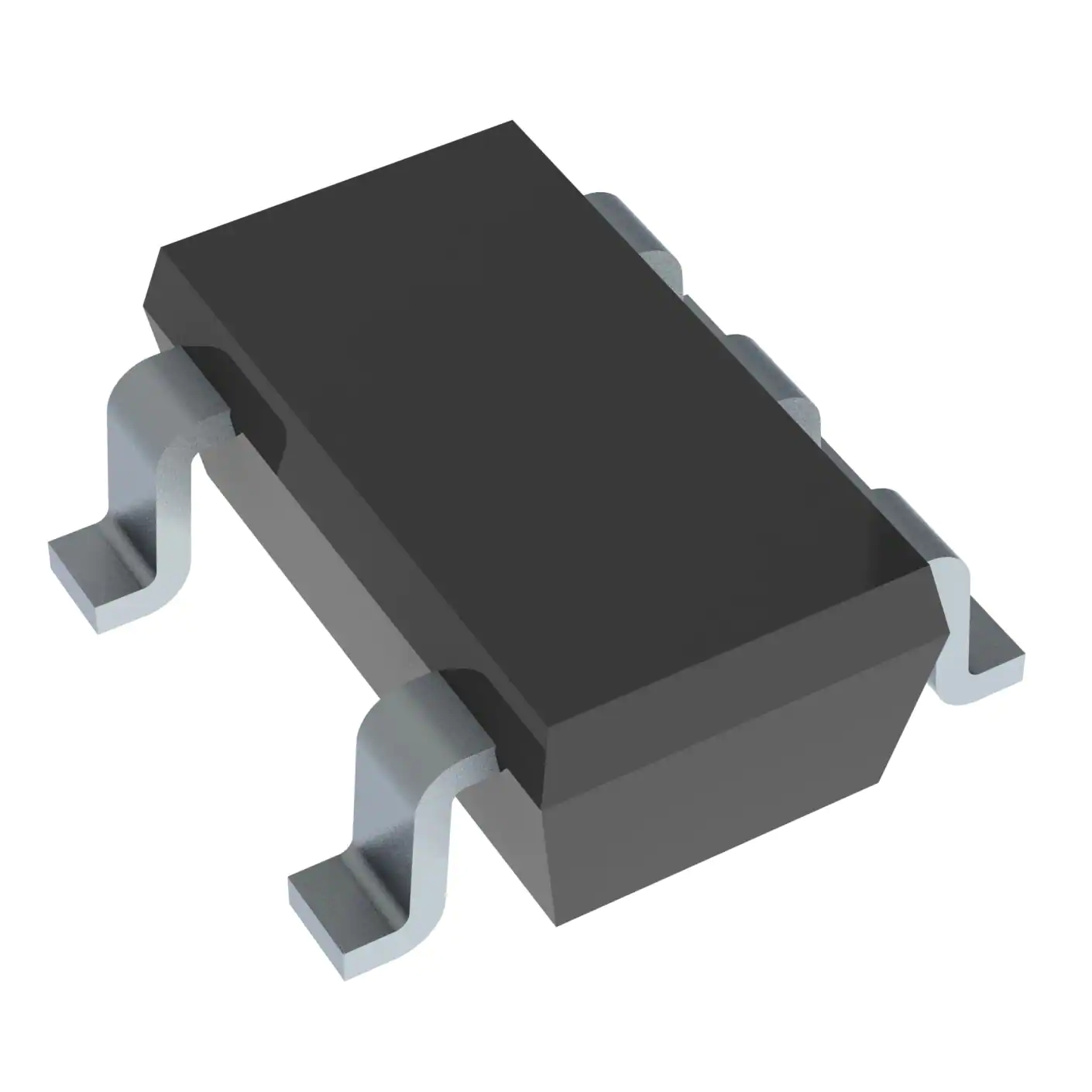
NC7SZ14P5X-L22057 is packaged in SC-88A (Case 419A-02), a 5-pin, 1.25 mm × 2.0 mm surface-mount package with 0.65 mm pitch. Pin 1 is marked by a dot or bevelled corner; the package is Pb-free, halogen-free, and RoHS compliant.
| Pin | Circuit Role | Design Meaning |
|---|---|---|
| 1 | NC | No-connect - electrically isolated; must not be soldered or tied to any net. |
| 2 | A | Inverting input - accepts Schmitt-trigger thresholds; tolerant to 5.5 V regardless of VCC. |
| 3 | GND | Ground reference - return path for all internal currents; requires low-inductance connection to system ground plane. |
| 4 | Y | Inverted output - rail-to-rail CMOS output capable of ±24 mA drive at 3 V. |
| 5 | VCC | Supply voltage - powers internal logic; decoupling capacitor (0.1 µF) recommended within 2 mm of this pin. |
Key Features
| Feature | Design Value |
|---|---|
| Schmitt-trigger input with programmable hysteresis | Enables reliable switching on slow or noisy signals (e.g., mechanical switch bounce, analog sensor outputs). |
| Overvoltage-tolerant inputs (5.5 V) | Eliminates need for external level-shifting resistors when interfacing 5 V sensors or legacy peripherals to 1.8 V/3.3 V MCUs. |
| Power-down high-impedance I/Os | Prevents back-powering and leakage paths during system sleep modes or hot-swap events. |
| Ultra-high speed (3.7 ns tPD) | Supports clean inversion of clock edges or fast control signals without introducing timing skew in feedback loops. |
| Micro-size SC-88A package (1.25 × 2.0 mm) | Reduces board area by >50% vs. SOIC-5; compatible with fine-pitch automated assembly and compact wearable designs. |
Applications
| Industrial Sensor Interface | Power-On Reset Generation |
|---|---|
|
Use Scenario: Converting slow-rising thermistor or potentiometer output into a clean digital signal for MCU ADC trigger or comparator enable. IC Role / Device Role / Timing Role: Schmitt-trigger inverter acting as noise-immune signal conditioner and threshold detector. Use Value: Hysteresis (≥0.7 V) rejects EMI-induced glitches on long sensor traces; 1.65–5.5 V VCC range matches industrial supply rails. |
Use Scenario: Generating a clean, debounced reset pulse upon power rail stabilization in microcontroller-based PLC modules. IC Role / Device Role / Timing Role: Inverter with RC network forming a monostable edge detector for POR sequencing. Use Value: Input overvoltage tolerance allows direct connection to unregulated 5 V supply; power-down high-Z prevents current leakage during brown-out. |
| USB-C Power Delivery Handshake | IoT Button Debounce Circuit |
|
Use Scenario: Conditioning CC line voltage transitions during USB-C port negotiation in embedded host controllers. IC Role / Device Role / Timing Role: Signal inverter with precise threshold control for detecting plug orientation and source/sink role. Use Value: Matched performance to LCX at 3.3 V ensures compatibility with USB PD PHY timing budgets; SC-88A footprint saves space near connector. |
Use Scenario: Eliminating contact bounce in battery-powered smart home buttons before wake-up interrupt assertion. IC Role / Device Role / Timing Role: Single-gate Schmitt inverter used in RC-based hardware debounce filter. Use Value: Ultra-low ICC (≤10 µA) extends coin-cell battery life; 1.65 V minimum VCC supports operation down to depleted battery voltage. |
Equivalent & Alternatives
The following parts are listed as comparable options for similar Schmitt-trigger inverter applications.
| Alternative Part | Technical Difference | Application Difference | Selection Advice |
|---|---|---|---|
| SN74LVC1G14DBVR | Wider VCC range (1.65–5.5 V), but lower output drive (±24 mA only at 4.5–5.5 V); no overvoltage-tolerant inputs. | Requires external clamping for 5 V inputs when VCC < 4.5 V; less suitable for mixed-voltage translation. | Select when cost sensitivity outweighs overvoltage tolerance and full-range drive capability. |
| MC74VHC1G14DTT1G | Higher propagation delay (5.5 ns typ. at 5 V); identical SC-88A package and pinout; same VCC range. | Marginally slower response limits use in sub-100 MHz clock clean-up; otherwise functionally interchangeable. | Choose if legacy VHC family qualification is required or when slightly relaxed timing is acceptable. |
Compared with SN74LVC1G14DBVR and MC74VHC1G14DTT1G, NC7SZ14P5X-L22057 uniquely combines 5.5 V input tolerance with ±24 mA drive across its entire 1.65–5.5 V supply range and fastest propagation delay (3.7 ns), making it optimal for compact, mixed-voltage, noise-prone interfaces.
Availability
NC7SZ14P5X-L22057 is available at Aetrix Electronics and suitable for industrial sensor interfaces, power-on reset generation, USB-C PD handshaking, IoT button debounce circuits, and other applications requiring stable component supply with guaranteed long-term sourcing.
Supply support for NC7SZ14P5X-L22057 includes scheduled delivery planning, volume procurement assistance, BOM continuity management, traceable sourcing, and lifecycle availability coordination for OEM customers, industrial embedded developers, connected-device designers, and electronics production programs.
Manufacturer
onsemi (formerly ON Semiconductor) is a global semiconductor supplier focused on energy-efficient innovation for automotive, industrial, cloud, medical, and IoT applications.
The TinyLogic UHS series - including NC7SZ14P5X-L22057 - was engineered for ultra-small-footprint, high-speed logic in battery-powered and space-constrained systems requiring robust noise immunity and wide supply flexibility.
FAQ
What is the maximum input voltage rating for NC7SZ14P5X-L22057?
The NC7SZ14P5X-L22057 supports DC input voltages up to 5.5 V regardless of VCC level - a key feature enabling safe interfacing with 5 V signals while operating from 1.65 V to 3.3 V supplies. This eliminates external level shifters in mixed-voltage designs and is confirmed in the Absolute Maximum Ratings table (VIN = −0.5 V to +6.5 V, with functional tolerance to 5.5 V).
Does NC7SZ14P5X-L22057 support power-down mode?
Yes, NC7SZ14P5X-L22057 enters a true power-down state when VCC = 0 V: both inputs and outputs become high-impedance, preventing back-driving or leakage current. This behavior is explicitly documented in the datasheet description and DC Electrical Characteristics (IOFF ≤ 10 µA), making it suitable for hot-swap and low-power sleep applications.
What is the hysteresis voltage of NC7SZ14P5X-L22057 at 3.3 V VCC?
At 3.3 V VCC, the NC7SZ14P5X-L22057 exhibits a typical hysteresis voltage (VH) of 0.77 V, with a guaranteed minimum of 0.40 V and maximum of 1.20 V over temperature. This value is derived from the difference between positive (VP = 1.75–2.20 V) and negative (VN = 0.60–1.00 V) input thresholds specified in the DC Electrical Characteristics table.
Is NC7SZ14P5X-L22057 pin-compatible with other TinyLogic inverters in SC-88A?
NC7SZ14P5X-L22057 uses the standard SC-88A 5-pin pinout (Pin 1: NC, Pin 2: A, Pin 3: GND, Pin 4: Y, Pin 5: VCC) shared across onsemi's NC7SZxx SC-88A variants. However, pin compatibility does not imply functional interchangeability - e.g., NC7SZ04 (non-Schmitt) lacks hysteresis and cannot replace NC7SZ14P5X-L22057 in noise-sensitive applications.
What package type is used for NC7SZ14P5X-L22057?
NC7SZ14P5X-L22057 is supplied in the SC-88A package (also known as SC-70-5 or SOT-353), a 5-terminal, 1.25 mm × 2.0 mm surface-mount outline with 0.65 mm lead pitch. This is confirmed in the Ordering Information table and Mechanical Case Outline (Case 419A-02) in the datasheet.
NC7SZ14P5X-L22057 Specifications
- Product attributes
- Attribute value
- Manufacturer:
- onsemi
- Series:
- 7SZ
- Package/Case:
- 5-TSSOP, SC-70-5, SOT-353
- Packaging:
- Tape & Reel (TR)
- Product Status:
- Obsolete
- Logic Type:
- Inverter
- Number of Circuits:
- 1
- Number of Inputs:
- 1
- Features:
- Schmitt Trigger Input
- Voltage - Supply:
- 1.65V ~ 5.5V
- Current - Quiescent (Max):
- 2 µA
- Current - Output High, Low:
- 32mA, 32mA
- Input Logic Level - Low:
- 0.5V ~ 1.7V
- Input Logic Level - High:
- 1.4V ~ 3.6V
- Max Propagation Delay @ V, Max CL:
- 5.9ns @ 5V, 50pF
- Operating Temperature:
- -40°C ~ 85°C
- Grade:
- -
- Qualification:
- -
- Mounting Type:
- Surface Mount
- Supplier Device Package:
- SC-88A (SC-70-5/SOT-353)
NC7SZ14P5X-L22057 FAQ
1.How can I place an order for NC7SZ14P5X-L22057 through Aetrix?
Please submit a Request for Quotation (RFQ) for NC7SZ14P5X-L22057 on Aetrix. Our sales agent will provide a competitive quotation and guide you through the order confirmation once you accept the terms.
2.Are the price and stock information for NC7SZ14P5X-L22057 reliable?
The price and inventory of NC7SZ14P5X-L22057 are updated periodically and may fluctuate due to market conditions. Stock and pricing data are typically refreshed every 24 hours. Quotation validity for NC7SZ14P5X-L22057 is usually 5 days.
3.What payment methods are accepted for NC7SZ14P5X-L22057?
We accept Wire Transfer, PayPal, Credit Card, Western Union, MoneyGram, and Escrow for NC7SZ14P5X-L22057 transactions.
Note: Certain payment methods may incur a processing fee.
4.How is shipping managed for NC7SZ14P5X-L22057?
NC7SZ14P5X-L22057 orders can be shipped via leading logistics carriers, including DHL, UPS, FedEx, TNT, or Registered Mail.
Once your NC7SZ14P5X-L22057 order is processed, you will receive an email with the shipment details and tracking number.
Note: Tracking information may take up to 24 hours to appear. Express delivery typically takes 3–5 business days.
5.How can I obtain technical support or documentation for NC7SZ14P5X-L22057?
For technical support, including NC7SZ14P5X-L22057 datasheets, pinout diagrams, or application guidance, please contact our engineering support team. They can provide detailed documentation and assistance for your NC7SZ14P5X-L22057 requirements.
6.How does Aetrix verify that NC7SZ14P5X-L22057 is sourced from the original manufacturer or authorized distributors?
All NC7SZ14P5X-L22057 products on Aetrix are procured from qualified distributors and authorized channels. Our dedicated quality assurance team conducts strict verification, including traceability checks and, if necessary, third-party testing. This ensures that NC7SZ14P5X-L22057 meets industry standards.
7.What is the process for return or replacement of NC7SZ14P5X-L22057?
All NC7SZ14P5X-L22057 units undergo pre-shipment inspection (PSI). If there is an issue with NC7SZ14P5X-L22057, returns or replacements are accepted under the following conditions:
1.Quantity discrepancies, incorrect items, or visible external defects (such as breakage or corrosion), acknowledged by Aetrix.
2.The issue is reported within 90 days of delivery.
3.The NC7SZ14P5X-L22057 part is unused and in its original packaging.
Return procedure for NC7SZ14P5X-L22057:
1.Submit a request within 90 days.
2.Obtain a Return Material Authorization (RMA) from Aetrix.
NC7SZ14P5X-L22057 Tags
-
SN74LVC1G14DBVR
Texas Instruments
-
SN74LVC1G14DCKR
Texas Instruments
-
SN74AHC1G14DBVR
Texas Instruments
-
SN74LVC1G08DBVR
Texas Instruments
-
SN74LVC1G08DCKR
Texas Instruments
-
SN74LVC1G32DCKR
Texas Instruments
-
SN74LVC1G04DBVR
Texas Instruments
.jpg)
-
74LVC1G08GW,125
Nexperia USA Inc.
-
SN74LVC1G04DCKR
Texas Instruments
-
SN74AHC1G08DBVR
Texas Instruments
-
SN74LVC1G32DBVR
Texas Instruments
-
SN74AHCT1G08DBVR
Texas Instruments
Tech Hub
Counterfeit components can hide behind convincing markings and passing basic function tests. This engineering reference covers source traceability, external inspection, X-ray, XRF, electrical testing, …

A practical engineering and sourcing framework covering lifecycle verification, lifetime-buy calculations, replacement qualification, supplier checks and counterfeit-risk controls.

TTL and CMOS logic families differ in thresholds, loading, output drive, power and timing. This engineering guide compares 74HC and 74HCT, calculates noise margins and checks 3.3 V/5 V compatibility.

A practical engineering guide to 3.3V and 5V logic compatibility, input thresholds, resistor dividers, translator ICs, MOSFET level shifting, I2C pull-ups, timing limits and power-sequencing risks.

The 74HC595 uses push-pull logic outputs, while the TPIC6B595 uses 50 V open-drain DMOS sinks for higher-power loads. This guide compares timing, current limits, 3.3 V interfacing, load wiring, thermal…

The 74HC595 converts serial data into eight stable parallel outputs. This guide covers pin functions, shift and storage timing, OE and MR behavior, drive-current limits, cascading, voltage compatibilit…

A technical comparison of level-sensitive latches and edge-triggered flip-flops, covering timing windows, setup and hold limits, master–slave operation, time borrowing, race-through, HDL inference and…

A D latch stores one bit while Enable controls when data can pass. This reference covers gate-level operation, truth tables, transparency, setup and hold timing, LE versus OE, common ICs and practical …

An SR latch stores one bit through cross-coupled feedback. This engineering reference covers NOR and NAND implementations, truth tables, forbidden-state recovery, gated operation, switch debouncing, fa…

Latch circuits retain one bit through feedback. This technical reference covers SR and D latches, truth tables, transparency, timing limits, latch-versus-flip-flop behavior, applications and common log…


