
 My Inquiry
 My Account


Nexperia USA Inc. NHDTA123JUX
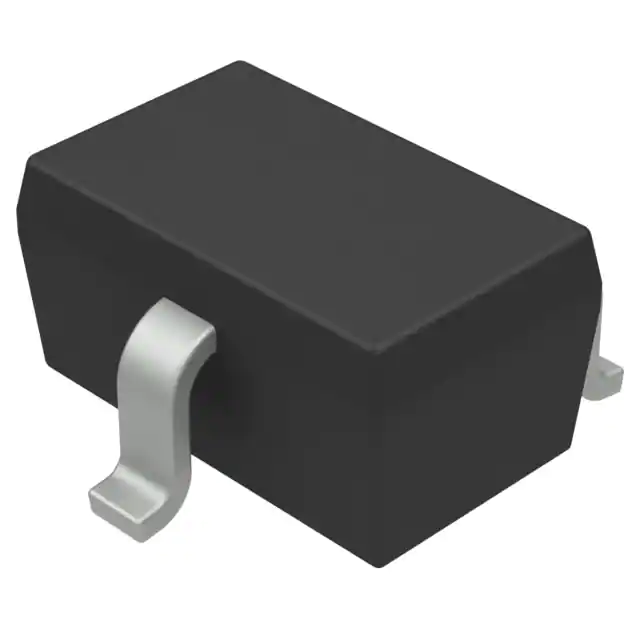
- Part No.:
- NHDTA123JUX
- Manufacturer:
- Nexperia USA Inc.
- Category:
- Single, Pre-Biased Bipolar Transistors
- Package:
- SC-70, SOT-323
- Datasheet:
-
 NHDTA123JUX.pdf
- Description:
- TRANS PREBIAS PNP 80V SOT323
- Quantity:
- Payment:

- Shipping:

Inventory:2,801
Please send an inquiry. Send us your inquiry, and we will respond immediately.
Product details
Overview
NHDTA123JUX from Nexperia is a PNP resistor-equipped transistor (RET) in SOT323 (SC-70) package, designed for digital switching and IC input control. It delivers −100 mA output current, −80 V collector-emitter breakdown voltage, and integrates 2.2 kΩ input bias resistor (R1) and 47 kΩ feedback resistor (R2), enabling direct logic-level drive in compact automotive and industrial control circuits.
For engineers reviewing the NHDTA123JUX datasheet, NHDTA123JUX pinout, NHDTA123JUX application, or NHDTA123JUX equivalent, this device serves as a space- and BOM-optimized replacement for discrete base-resistor transistor configurations-particularly where AEC-Q101 qualification, low saturation voltage (−100 mV at IC = −10 mA/IB = −0.5 mA), and −595 mV off-state input voltage are critical selection criteria.
Technical Context
This RET integrates a PNP bipolar transistor with two monolithically embedded resistors: R1 (2.2 kΩ) connects base to input, and R2 (47 kΩ) ties base to emitter, forming a built-in voltage divider that ensures reliable turn-off and reduces external component count. Its −80 V VCEO rating supports operation in 24 V and 48 V industrial bus environments.
The device exhibits −100 mV VCEsat at IC = −10 mA and IB = −0.5 mA, with DC current gain (hFE) ≥100 at VCE = −5 V and IC = −10 mA. Thermal resistance is 532 K/W (junction-to-ambient, single-sided FR4 PCB), and it is qualified to AEC-Q101 for automotive underhood applications.
Key Specifications
| Parameter | Value and Actual Design Meaning |
|---|---|
| VCEO | −80 V: Enables safe operation in 24 V/48 V supply rails with margin against transients. |
| IO | −100 mA: Supports driving moderate loads such as LED indicators, small relays, or logic inputs. |
| R1 | 2.2 kΩ: Sets base current for predictable turn-on with standard CMOS/TTL logic outputs. |
| R2/R1 | 21: Ensures strong base pull-down for fast, reliable turn-off and noise immunity. |
| VCEsat | −100 mV @ IC = −10 mA / IB = −0.5 mA: Minimizes conduction loss and self-heating in switching mode. |
| VI(off) | −595 mV: Guarantees cutoff when input is near ground, preventing leakage-induced false triggering. |
| hFE | ≥100 @ VCE = −5 V, IC = −10 mA: Provides sufficient current amplification for robust digital interface behavior. |
| AEC-Q101 | Qualified: Validated for automotive temperature range (−40 °C to +150 °C) and reliability stress testing. |
Pinout & Package
SOT323 (SC-70) plastic surface-mounted package: 1.35 mm × 1.15 mm × 0.45 mm body, 3-lead, gull-wing terminals, optimized for high-density PCB layouts and reflow soldering.
| Pin/Terminal | Circuit Role | Design Meaning |
|---|---|---|
| 1 | Input (base) | Accepts logic-level control signal; internally connected to R1 (2.2 kΩ) and R2 (47 kΩ). |
| 2 | GND (emitter) | Common reference node and current return path; tied to system ground in typical switching configuration. |
| 3 | Output (collector) | Switched high-side load connection; sinks current when active, compatible with open-collector logic interfaces. |
Key Features
| Feature | Design Value |
|---|---|
| Integrated bias network | Monolithic R1 (2.2 kΩ) and R2 (47 kΩ) eliminate two external resistors and reduce layout area by >30% vs discrete solution. |
| Low VCEsat | −100 mV at rated current ensures <1 mW conduction loss, critical for thermally constrained modules. |
| AEC-Q101 qualification | Validated for automotive underhood use including temperature cycling, HTRB, and ESD (HBM ±8 kV). |
| Small footprint | SOT323 (SC-70) occupies only 1.55 mm² PCB area-ideal for space-constrained IoT sensors and ECUs. |
| Digital interface optimization | VI(on) = −0.81 V and VI(off) = −595 mV align with standard 3.3 V/5 V logic thresholds without level-shifting. |
Applications
| Automotive Door Module Control | Industrial PLC Input Conditioning |
|---|---|
Use Scenario: Switching window motor enable signals and mirror fold/unfold commands in door control units. IC Role / Device Role / Timing Role: PNP RET acts as a high-side driver for 12 V loads, interfacing microcontroller GPIOs to relay coils and motor drivers. Use Value: AEC-Q101 qualification and −80 V VCEO ensure robustness against battery dump transients; integrated resistors reduce BOM count and improve assembly yield. |
Use Scenario: Converting 24 V field sensor signals to clean 3.3 V logic levels for PLC microcontrollers. IC Role / Device Role / Timing Role: Digital switch isolates and conditions dry-contact or NAMUR inputs before feeding into FPGA or ARM-based I/O processors. Use Value: −595 mV VI(off) guarantees solid cutoff under noisy factory floor conditions; SOT323 footprint enables dense I/O module designs. |
| Smart Lighting Driver Interface | Consumer Appliance Power Sequencing |
Use Scenario: Enabling LED backlight power rails and status indicator drivers in automotive infotainment displays. IC Role / Device Role / Timing Role: High-side switch controlling 5 V/3.3 V auxiliary supplies, synchronized with MCU boot sequence. Use Value: −100 mV VCEsat minimizes heat generation in sealed display enclosures; 150 °C Tj rating supports operation near LCD thermal zones. |
Use Scenario: Managing power-up sequencing of MCU, memory, and sensor subsystems in washing machine control boards. IC Role / Device Role / Timing Role: Discrete logic-level translator and enable gate for LDOs and DC-DC converters during cold start. Use Value: Integrated R1/R2 eliminates timing skew from external RC networks; SOT323 allows placement directly adjacent to power ICs. |
Equivalent & Alternatives
The following parts are listed as comparable options for similar PNP resistor-equipped transistor applications.
| Alternative Part | Technical Difference | Application Difference | Selection Advice |
|---|---|---|---|
| NHDTC123JU | NPN complement with identical R1/R2 values (2.2 kΩ/47 kΩ), same SOT323 package, but opposite polarity. | Used where low-side switching or sink configuration is preferred over high-side sourcing. | Select when interfacing with open-drain outputs or requiring inverted logic behavior. |
| BC856B,115 | Discrete PNP transistor (no built-in resistors); requires two external bias resistors; larger SOT23 package. | Offers higher hFE (220–475) and lower VCEsat (−65 mV), but increases component count and layout area. | Choose when maximum current gain or minimal saturation loss outweighs BOM simplification goals. |
Compared with NHDTC123JU, NHDTA123JUX provides complementary sourcing capability and matches pinout compatibility in shared PCB footprints; versus BC856B, it trades marginal VCEsat improvement for guaranteed bias stability, reduced test points, and AEC-Q101 assurance-making it preferable for volume automotive and industrial production.
Availability
NHDTA123JUX is available at Aetrix Electronics and suitable for automotive door modules, industrial PLC input stages, smart lighting interfaces, and consumer appliance power sequencing requiring stable component supply across extended temperature ranges and long production lifecycles.
Supply support for NHDTA123JUX includes scheduled delivery planning, volume procurement assistance, BOM continuity management, traceable sourcing, and lifecycle availability coordination for OEM customers, industrial embedded developers, connected-device designers, and electronics production programs.
Manufacturer
Nexperia is a global semiconductor expert focused on high-volume, high-reliability discrete and logic devices, with leadership in automotive-qualified components and advanced packaging.
NHDTA123JUX belongs to Nexperia's resistor-equipped transistor (RET) product line, engineered specifically to replace discrete transistor-resistor combinations in cost-sensitive, space-constrained digital interface applications across automotive and industrial markets.
FAQ
What is the maximum continuous collector current for NHDTA123JUX?
The absolute maximum continuous collector current is −100 mA at Tamb ≤ 25 °C on a standard FR4 PCB with single-sided copper. Derating applies above 25 °C per Figure 1: at 100 °C ambient, maximum allowable current drops to approximately −65 mA to maintain junction temperature below 150 °C.
Can NHDTA123JUX be used as a direct replacement for BC856B in existing designs?
Yes-with circuit-level validation. NHDTA123JUX offers identical pinout (SOT323 vs BC856B's SOT23), same PNP polarity, and −80 V VCEO, but integrates R1 and R2. To substitute, remove external base resistors and verify VI(on)/VI(off) thresholds match your controller's logic levels; layout may require minor pad adjustment due to smaller SC-70 footprint.
Is NHDTA123JUX suitable for 5 V logic interfacing?
Yes. Its VI(on) of −0.81 V (typical) and VI(off) of −595 mV (typical) are fully compatible with 5 V TTL and CMOS outputs. When driven by a 5 V microcontroller GPIO, the internal R1/R2 network ensures reliable turn-on with ~1.8 mA base current and solid turn-off even with noise up to ±200 mV on the input line.
Does NHDTA123JUX support wave soldering?
Yes. The SOT323 package is qualified for both reflow and wave soldering. Figure 26 provides the recommended wave soldering footprint: 3.65 mm × 2.1 mm land pattern with 1.425 mm × 0.9 mm solder pads per lead, aligned to industry-standard IPC-7351B Class B density guidelines.
NHDTA123JUX Specifications
- Product attributes
- Attribute value
- Manufacturer:
- Nexperia USA Inc.
- Series:
- -
- Package/Case:
- SC-70, SOT-323
- Packaging:
- Tape & Reel (TR)
- Product Status:
- Active
- Transistor Type:
- PNP - Pre-Biased
- Current - Collector (Ic) (Max):
- 100 mA
- Voltage - Collector Emitter Breakdown (Max):
- 80 V
- Resistor - Base (R1):
- 2.2 kOhms
- Resistor - Emitter Base (R2):
- 47 kOhms
- DC Current Gain (hFE) (Min) @ Ic, Vce:
- 100 @ 10mA, 5V
- Vce Saturation (Max) @ Ib, Ic:
- 100mV @ 500µA, 10mA
- Current - Collector Cutoff (Max):
- 100nA
- Frequency - Transition:
- 150 MHz
- Power - Max:
- 235 mW
- Grade:
- Automotive
- Qualification:
- AEC-Q101
- Mounting Type:
- Surface Mount
- Supplier Device Package:
- SOT-323
NHDTA123JUX FAQ
1.How can I place an order for NHDTA123JUX through Aetrix?
Please submit a Request for Quotation (RFQ) for NHDTA123JUX on Aetrix. Our sales agent will provide a competitive quotation and guide you through the order confirmation once you accept the terms.
2.Are the price and stock information for NHDTA123JUX reliable?
The price and inventory of NHDTA123JUX are updated periodically and may fluctuate due to market conditions. Stock and pricing data are typically refreshed every 24 hours. Quotation validity for NHDTA123JUX is usually 5 days.
3.What payment methods are accepted for NHDTA123JUX?
We accept Wire Transfer, PayPal, Credit Card, Western Union, MoneyGram, and Escrow for NHDTA123JUX transactions.
Note: Certain payment methods may incur a processing fee.
4.How is shipping managed for NHDTA123JUX?
NHDTA123JUX orders can be shipped via leading logistics carriers, including DHL, UPS, FedEx, TNT, or Registered Mail.
Once your NHDTA123JUX order is processed, you will receive an email with the shipment details and tracking number.
Note: Tracking information may take up to 24 hours to appear. Express delivery typically takes 3–5 business days.
5.How can I obtain technical support or documentation for NHDTA123JUX?
For technical support, including NHDTA123JUX datasheets, pinout diagrams, or application guidance, please contact our engineering support team. They can provide detailed documentation and assistance for your NHDTA123JUX requirements.
6.How does Aetrix verify that NHDTA123JUX is sourced from the original manufacturer or authorized distributors?
All NHDTA123JUX products on Aetrix are procured from qualified distributors and authorized channels. Our dedicated quality assurance team conducts strict verification, including traceability checks and, if necessary, third-party testing. This ensures that NHDTA123JUX meets industry standards.
7.What is the process for return or replacement of NHDTA123JUX?
All NHDTA123JUX units undergo pre-shipment inspection (PSI). If there is an issue with NHDTA123JUX, returns or replacements are accepted under the following conditions:
1.Quantity discrepancies, incorrect items, or visible external defects (such as breakage or corrosion), acknowledged by Aetrix.
2.The issue is reported within 90 days of delivery.
3.The NHDTA123JUX part is unused and in its original packaging.
Return procedure for NHDTA123JUX:
1.Submit a request within 90 days.
2.Obtain a Return Material Authorization (RMA) from Aetrix.
NHDTA123JUX Tags
-
MUN5211T1G
onsemi
-
DTC043ZEBTL
Rohm Semiconductor
-
DTC114EKAT146
Rohm Semiconductor
-
DDTD113ZC-7-F
Diodes Incorporated
-
DRDNB16W-7
Diodes Incorporated
-
PDTC114ET,215
Nexperia USA Inc.
-
PDTC143ZT,215
Nexperia USA Inc.
-
PDTC143ET,215
Nexperia USA Inc.
-
PDTC143XT,215
Nexperia USA Inc.
-
MMUN2211LT1G
onsemi
-
PDTC144ET,215
Nexperia USA Inc.
-
PDTC124ET,215
Nexperia USA Inc.
Tech Hub

Operational amplifier guide covering op amp basics, feedback, ideal vs real op amps, common configurations, buffer circuits, offset, bias current, gain-bandwidth, slew rate, rail-to-rail limits and sel…

Jumper cables guide covering safe connection order, red and black clamp placement, final ground connection, cable gauge, length, clamp quality, copper vs CCA cables, jump starter comparison and battery…

LDO regulator guide covering low dropout voltage, power dissipation, thermal design, PSRR, output noise, capacitor stability, adjustable LDO circuits, LDO vs buck converter and datasheet selection chec…

Conditional Access Module guide covering CAM meaning, CI/CI+ interface, smart card authorization, DVB security workflow, TV and set-top box compatibility, internal electronics, ESD protection, connecto…

Guide to electronic component obsolescence covering EOL risk, PCN/PDN notices, last-time buy planning, replacement options, form-fit-function validation, counterfeit risk and BOM lifecycle management.

18650 battery guide covering lithium-ion cell basics, 3.6V/3.7V voltage, 4.2V charging, mAh and Wh capacity, protected cells, chargers, BMS, series-parallel packs, holders, welding and sourcing checks.…

Hall effect sensor guide covering working principle, linear and digital sensors, Arduino circuits, current sensing, speed detection, automotive applications, A3144 examples, signal filtering and datash…

Product Change Notification guide for electronic components, covering PCN meaning, PCN vs PDN/EOL, common change types, risk levels, form-fit-function review, engineering validation, BOM control, LTB/L…

A practical guide to blend door actuators, covering HVAC function, symptoms, location, AC and heater issues, reset and calibration, replacement cost, electrical diagnosis, compatibility checks, and rep…

Engineering guide to Raspberry Pi alternatives, covering chip-level differences, Orange Pi, ROCK, Jetson, Banana Pi, NanoPi, Compute Module, Pico, GPIO, camera, HAT compatibility, and replacement risks…


