
 My Inquiry
 My Account


Nexperia USA Inc. NPIC6C595BQ-Q100,1
- Part No.:
- NPIC6C595BQ-Q100,1
- Manufacturer:
- Nexperia USA Inc.
- Category:
- Shift Registers
- Package:
- 16-VFQFN Exposed Pad
- Datasheet:
-
 NPIC6C595BQ-Q100,1.pdf
- Description:
- IC SHIFT REGISTER 8BIT 16DHVQFN
- Quantity:
- Payment:

- Shipping:

Inventory:3,638
Please send an inquiry. Send us your inquiry, and we will respond immediately.
Product details
Overview
NPIC6C595BQ-Q100 from Nexperia is an AEC-Q100 Grade 1 qualified 8-bit serial-in/parallel-out shift register with open-drain extended-drain NMOS outputs, separate shift/storage clocks (SHCP/STCP), asynchronous master reset (MR), and active-low output enable (OE). It delivers 100 mA continuous current per channel at 33 V drain-source rating and integrates avalanche energy protection (30 mJ) for driving LEDs, relays, and solenoids in automotive power interface applications.
For engineers reviewing the NPIC6C595BQ-Q100 datasheet, NPIC6C595BQ-Q100 pinout, NPIC6C595BQ-Q100 application, or NPIC6C595BQ-Q100 equivalent, key selection criteria include its DHVQFN16 package with side-wettable flanks for AOI, -40 °C to +125 °C operation, 250 mA pulsed output capability, RDS(on) ≤ 10 Ω at 100 mA, and integrated voltage clamping for inductive load transients.
Technical Context
The device implements dual-register architecture: an 8-stage shift register clocked by SHCP and an independent 8-bit storage register clocked by STCP, enabling synchronous latching of serially shifted data. Both registers are cleared simultaneously by a single active-low MR input, decoupling reset control from clock timing.
Each of the eight Q0–Q7 outputs uses an extended-drain NMOS transistor with internal source-to-GND connection, rated for 33 V VDS, 100 mA continuous, and 250 mA pulsed current. Output clamping and 30 mJ non-repetitive avalanche energy handling allow direct drive of inductive loads without external flyback diodes in many automotive implementations.
Key Specifications
| Parameter | Value and Actual Design Meaning |
|---|---|
| Supply Voltage | 4.5 V to 5.5 V - Ensures compatibility with standard automotive 5 V rail and stable logic-level operation across temperature. |
| Output Current | 100 mA continuous per channel - Supports direct LED string or small relay coil drive without external buffering. |
| VDS Rating | 33 V - Enables safe switching of 24 V automotive systems with margin for load transients. |
| RDS(on) | ≤ 10 Ω at 100 mA, 85 °C - Limits power dissipation to ≤ 100 mW per channel under full load, reducing thermal stress. |
| Avalanche Energy | 30 mJ (single pulse) - Absorbs inductive kickback from solenoids/relays without external protection components. |
| Propagation Delay | tPLH/tPHL ≤ 97 ns / 9 ns (OE to Qn) - Enables fast output enable/disable sequencing for dynamic load control. |
| Max Clock Frequency | 10 MHz SHCP - Supports high-speed serial loading in real-time dashboard or lighting control systems. |
Pinout & Package
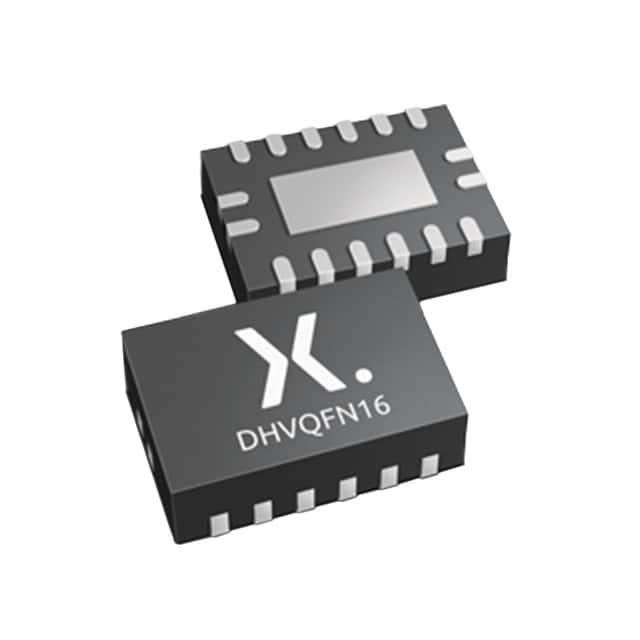
DHVQFN16 (SOT763-1), 2.5 × 3.5 × 0.85 mm body, no leads, side-wettable flanks for automated optical inspection (AOI) of solder joints.
| Pin/Terminal | Circuit Role | Design Meaning |
|---|---|---|
| VCC (Pin 1) | Power supply input | 5 V logic and gate drive supply; must be decoupled locally to suppress switching noise. |
| DS (Pin 2) | Serial data input | Accepts CMOS-level serial data; synchronized to rising edge of SHCP for shift register advancement. |
| MR (Pin 7) | Master reset | Asynchronous active-low reset clears both shift and storage registers-critical for fail-safe initialization. |
| OE (Pin 8) | Output enable | Active-low control; high-impedance state isolates outputs without affecting register contents-enables time-multiplexed load sharing. |
| Q7S (Pin 9) | Serial output | Provides cascaded data path to next device; enables daisy-chaining multiple NPIC6C595BQ-Q100 for expanded I/O. |
| STCP (Pin 10) | Storage register clock | Rising-edge-triggered latch transfers shift register contents to output drivers-decouples data shifting from output update. |
| SHCP (Pin 15) | Shift register clock | Rising-edge-triggered clock advances serial data through all 8 stages; may be tied to STCP only if one-clock-ahead behavior is acceptable. |
| GND (Pin 16) | Ground reference | 0 V return for logic and power paths; thermal pad underneath package must be connected to PCB ground plane for thermal performance. |
Key Features
| Feature | Design Value |
|---|---|
| AEC-Q100 Grade 1 qualification | Validated for automotive use from -40 °C to +125 °C ambient, meeting stringent reliability and lifetime requirements. |
| Open-drain EDNMOS outputs | Eight 33 V/100 mA channels with integrated clamping-eliminates need for external flyback diodes in relay/solenoid drive. |
| Separate shift and storage clocks | Enables precise timing control: data can be shifted while previous state remains active on outputs until STCP triggers update. |
| Side-wettable flanks (DHVQFN) | Facilitates automated optical inspection of solder joints-improves manufacturing yield and field reliability in automotive production. |
| Single-pin master reset | MR input clears both registers simultaneously-simplifies system-level fault recovery and power-up initialization sequences. |
Applications
| Automotive LED Signage | Dashboard Fault Indicator Panel |
|---|---|
Use Scenario: Driving multi-segment LED arrays in vehicle infotainment displays or exterior signage requiring brightness control and fault tolerance. IC Role / Device Role: Serial-to-parallel power driver translating microcontroller GPIO signals into high-current LED sink paths. Use Value: 100 mA per channel supports common-anode LED strings; 33 V rating accommodates forward voltage stacking and transient suppression without external components. | Use Scenario: Real-time status indication of ABS, airbag, or engine management faults using discrete red/green/yellow LEDs on instrument clusters. IC Role / Device Role: High-reliability output expander providing isolated, current-limited LED drive with fail-safe reset capability. Use Value: AEC-Q100 qualification ensures operation over full automotive temperature range; MR pin enables deterministic fault-clearing during ECU reboot sequences. |
| Body Control Module Relay Driver | Electric Power Steering (EPS) Solenoid Interface |
Use Scenario: Controlling door lock actuators, window lift motors, or HVAC dampers via 12 V/24 V relays in body control units. IC Role / Device Role: Inductive load switch with integrated avalanche energy absorption and voltage clamping. Use Value: 30 mJ avalanche rating handles typical relay coil energy; open-drain topology allows flexible pull-up configuration and shared power rail design. | Use Scenario: Driving torque-assist solenoids or valve actuators in EPS systems where rapid, precise current control and fault resilience are critical. IC Role / Device Role: Robust power interface between MCU and high-side solenoid drivers, managing inductive turn-off transients. Use Value: 250 mA pulsed current supports peak solenoid engagement; DHVQFN thermal performance sustains duty-cycled operation without derating. |
Equivalent & Alternatives
The following parts are listed as comparable options for similar 8-bit power shift register applications.
| Alternative Part | Technical Difference | Application Difference | Selection Advice |
|---|---|---|---|
| TPIC6B595QPWRQ1 | Higher 150 mA continuous output; 50 V VDS; larger TSSOP-16 package; no side-wettable flanks | Better suited for 48 V mild-hybrid systems; less compatible with AOI-based automotive SMT lines | Select when higher voltage margin or current headroom is required and DHVQFN assembly is not mandated. |
| ULN2803AQDRQ1 | 8-channel Darlington array; 500 mA per channel; no shift register logic; TTL-compatible inputs | Requires external shift logic; better for simple on/off drive where serial control is handled upstream | Choose when discrete logic control is preferred over integrated serial interface, or when higher current per channel is needed without clock management. |
Compared with TPIC6B595QPWRQ1 and ULN2803AQDRQ1, the NPIC6C595BQ-Q100 uniquely balances compact DHVQFN packaging with AEC-Q100-compliant power drive, integrated avalanche protection, and dual-clock architecture-making it optimal for space-constrained, serially controlled automotive power interfaces where board area and AOI traceability are critical.
Availability
NPIC6C595BQ-Q100 is available at Aetrix Electronics and suitable for automotive LED signage, dashboard fault indicators, body control module relay drivers, and electric power steering solenoid interfaces requiring stable component supply across extended temperature ranges and long production lifecycles.
Supply support for NPIC6C595BQ-Q100 includes scheduled delivery planning, volume procurement assistance, BOM continuity management, traceable sourcing, and lifecycle availability coordination for OEM customers, industrial embedded developers, connected-device designers, and electronics production programs.
Manufacturer
Nexperia is a global semiconductor expert focused on high-volume, high-reliability logic, discrete, and MOSFET solutions, with deep expertise in automotive-grade component qualification and manufacturing.
The NPIC6C595BQ-Q100 belongs to Nexperia's automotive power logic family, engineered specifically for robust serial-to-parallel power interfacing in harsh environments-emphasizing AEC-Q100 compliance, thermal efficiency, and integrated protection for electromechanical actuation.
FAQ
Can NPIC6C595BQ-Q100 drive 24 V incandescent lamps directly?
Yes-it supports up to 33 V VDS and 100 mA continuous per channel, sufficient for low-power 24 V indicator lamps. However, inrush current must be limited externally if lamp cold resistance causes >250 mA peak surge, as the device's pulsed rating is 250 mA with ≤2% duty cycle and ≤100 μs pulse width.
What is the function of the thermal pad on the DHVQFN package?
The exposed thermal pad (Pin 1 index area) must be soldered to a PCB ground plane to dissipate heat from the eight power outputs. Nexperia specifies it as electrically connected to GND internally; floating or unconnected pads cause thermal derating and potential reliability failure above 85 °C ambient.
How does the MR pin interact with OE and clock signals?
MR is asynchronous and overrides all other inputs: a LOW on MR immediately clears both shift and storage registers to zero, regardless of SHCP/STCP state or OE level. Outputs remain in high-impedance OFF-state if OE is HIGH, or go LOW if OE is LOW-ensuring predictable startup and fault-clearing behavior.
Is cascading multiple NPIC6C595BQ-Q100 devices supported in hardware?
Yes-Q7S (Pin 9) provides buffered serial output synchronized to SHCP, allowing direct connection to DS (Pin 2) of the next device. The datasheet confirms this topology in Fig. 1 and specifies timing margins (e.g., tpd = 5 ns SHCP→Q7S) to ensure reliable daisy-chaining at up to 10 MHz clock rates.
NPIC6C595BQ-Q100,1 Specifications
- Product attributes
- Attribute value
- Manufacturer:
- Nexperia USA Inc.
- Series:
- -
- Package/Case:
- 16-VFQFN Exposed Pad
- Packaging:
- Tape & Reel (TR)
- Product Status:
- Obsolete
- Logic Type:
- Shift Register
- Output Type:
- Open Drain
- Number of Elements:
- 1
- Number of Bits per Element:
- 8
- Function:
- Serial to Parallel, Serial
- Voltage - Supply:
- 4.5V ~ 5.5V
- Operating Temperature:
- -40°C ~ 125°C
- Grade:
- Automotive
- Qualification:
- AEC-Q100
- Mounting Type:
- Surface Mount
- Supplier Device Package:
- 16-DHVQFN (2.5x3.5)
NPIC6C595BQ-Q100,1 FAQ
1.How can I place an order for NPIC6C595BQ-Q100,1 through Aetrix?
Please submit a Request for Quotation (RFQ) for NPIC6C595BQ-Q100,1 on Aetrix. Our sales agent will provide a competitive quotation and guide you through the order confirmation once you accept the terms.
2.Are the price and stock information for NPIC6C595BQ-Q100,1 reliable?
The price and inventory of NPIC6C595BQ-Q100,1 are updated periodically and may fluctuate due to market conditions. Stock and pricing data are typically refreshed every 24 hours. Quotation validity for NPIC6C595BQ-Q100,1 is usually 5 days.
3.What payment methods are accepted for NPIC6C595BQ-Q100,1?
We accept Wire Transfer, PayPal, Credit Card, Western Union, MoneyGram, and Escrow for NPIC6C595BQ-Q100,1 transactions.
Note: Certain payment methods may incur a processing fee.
4.How is shipping managed for NPIC6C595BQ-Q100,1?
NPIC6C595BQ-Q100,1 orders can be shipped via leading logistics carriers, including DHL, UPS, FedEx, TNT, or Registered Mail.
Once your NPIC6C595BQ-Q100,1 order is processed, you will receive an email with the shipment details and tracking number.
Note: Tracking information may take up to 24 hours to appear. Express delivery typically takes 3–5 business days.
5.How can I obtain technical support or documentation for NPIC6C595BQ-Q100,1?
For technical support, including NPIC6C595BQ-Q100,1 datasheets, pinout diagrams, or application guidance, please contact our engineering support team. They can provide detailed documentation and assistance for your NPIC6C595BQ-Q100,1 requirements.
6.How does Aetrix verify that NPIC6C595BQ-Q100,1 is sourced from the original manufacturer or authorized distributors?
All NPIC6C595BQ-Q100,1 products on Aetrix are procured from qualified distributors and authorized channels. Our dedicated quality assurance team conducts strict verification, including traceability checks and, if necessary, third-party testing. This ensures that NPIC6C595BQ-Q100,1 meets industry standards.
7.What is the process for return or replacement of NPIC6C595BQ-Q100,1?
All NPIC6C595BQ-Q100,1 units undergo pre-shipment inspection (PSI). If there is an issue with NPIC6C595BQ-Q100,1, returns or replacements are accepted under the following conditions:
1.Quantity discrepancies, incorrect items, or visible external defects (such as breakage or corrosion), acknowledged by Aetrix.
2.The issue is reported within 90 days of delivery.
3.The NPIC6C595BQ-Q100,1 part is unused and in its original packaging.
Return procedure for NPIC6C595BQ-Q100,1:
1.Submit a request within 90 days.
2.Obtain a Return Material Authorization (RMA) from Aetrix.
NPIC6C595BQ-Q100,1 Tags
-
SN74HC164DR
Texas Instruments
-
SN74HC595DR
Texas Instruments
-
74HC595PW,118
Nexperia USA Inc.
-
SN74HC165PWR
Texas Instruments
-
HEF4094BT,653
Nexperia USA Inc.
-
74HC595D,118
Nexperia USA Inc.
-
SN74HC595PWR
Texas Instruments
-
74HC165D,653
Nexperia USA Inc.
-
SN74LV165APWR
Texas Instruments
-
74HC595BQ,115
Nexperia USA Inc.
-
74HC165BQ,115
Nexperia USA Inc.
-
CD4094BPWR
Texas Instruments
Tech Hub

An engineering guide to LED driver operation, constant-current and constant-voltage outputs, linear and switching topologies, dimming, IC selection, calculations, replacement compatibility, and fault c…

Operational amplifier guide covering op amp basics, feedback, ideal vs real op amps, common configurations, buffer circuits, offset, bias current, gain-bandwidth, slew rate, rail-to-rail limits and sel…

Jumper cables guide covering safe connection order, red and black clamp placement, final ground connection, cable gauge, length, clamp quality, copper vs CCA cables, jump starter comparison and battery…

LDO regulator guide covering low dropout voltage, power dissipation, thermal design, PSRR, output noise, capacitor stability, adjustable LDO circuits, LDO vs buck converter and datasheet selection chec…

Conditional Access Module guide covering CAM meaning, CI/CI+ interface, smart card authorization, DVB security workflow, TV and set-top box compatibility, internal electronics, ESD protection, connecto…

Guide to electronic component obsolescence covering EOL risk, PCN/PDN notices, last-time buy planning, replacement options, form-fit-function validation, counterfeit risk and BOM lifecycle management.

18650 battery guide covering lithium-ion cell basics, 3.6V/3.7V voltage, 4.2V charging, mAh and Wh capacity, protected cells, chargers, BMS, series-parallel packs, holders, welding and sourcing checks.…

Hall effect sensor guide covering working principle, linear and digital sensors, Arduino circuits, current sensing, speed detection, automotive applications, A3144 examples, signal filtering and datash…

Product Change Notification guide for electronic components, covering PCN meaning, PCN vs PDN/EOL, common change types, risk levels, form-fit-function review, engineering validation, BOM control, LTB/L…

A practical guide to blend door actuators, covering HVAC function, symptoms, location, AC and heater issues, reset and calibration, replacement cost, electrical diagnosis, compatibility checks, and rep…


