
 My Inquiry
 My Account


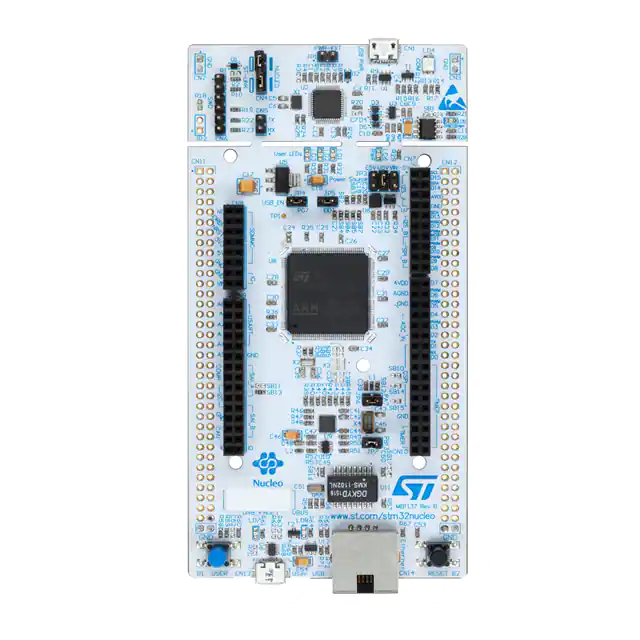
STMicroelectronics NUCLEO-H743ZI2
- Part No.:
- NUCLEO-H743ZI2
- Manufacturer:
- STMicroelectronics
- Category:
- Embedded MCU, DSP Evaluation Boards
- Package:
- Datasheet:
-
 NUCLEO-H743ZI2.pdf
- Description:
- NUCLEO-144 STM32H743ZI EVAL BRD
- Quantity:
- Payment:

- Shipping:

Inventory:4,905
Please send an inquiry. Send us your inquiry, and we will respond immediately.
Product details
Overview
NUCLEO-H743ZI2 from STMicroelectronics is an STM32 Nucleo-144 development board built around the STM32H743ZIT6 microcontroller (Arm Cortex-M7 @ 480 MHz, 2 MB Flash, 1 MB RAM), featuring Ethernet connectivity, USB OTG Full-Speed via Micro-AB connector, ST Zio expansion interface with ARDUINO® Uno V3 compatibility, and on-board STLINK-V3E debugger/programmer. It supports rapid prototyping for high-performance embedded applications requiring real-time processing and peripheral integration.
For engineers reviewing the NUCLEO-H743ZI2 datasheet, NUCLEO-H743ZI2 pinout, NUCLEO-H743ZI2 application, or NUCLEO-H743ZI2 equivalent, this board serves as a production-ready evaluation platform for STM32H7 dual-core (M7/M4) firmware development, Ethernet-enabled edge node validation, USB device stack testing, and hardware abstraction layer (HAL) integration with STM32CubeIDE.
Technical Context
The NUCLEO-H743ZI2 implements the STM32H743ZIT6 in LQFP144 package, delivering dual-core Arm Cortex-M7/M4 execution with tightly coupled memory, hardware floating-point units, and advanced peripheral routing through the STM32Cube ecosystem. It integrates a 32.768 kHz crystal oscillator for RTC accuracy and supports flexible power sourcing via USB VBUS, external supply, or ST-LINK debug port.
Board-level features include three user LEDs (LD1–LD3), two push-buttons (user and reset), SWD debugging interface, ST morpho headers for full MCU I/O access, and dual expansion connectors: ST Zio (with ARDUINO® Uno V3 pinout) and ST morpho. The on-board STLINK-V3E provides mass storage, Virtual COM port, and debug capabilities without external tools.
Key Specifications
| Parameter | Value and Actual Design Meaning |
|---|---|
| Target MCU | STM32H743ZIT6: Arm Cortex-M7 @ 480 MHz, 2 MB Flash, 1 MB RAM, LQFP144 package |
| Debug Interface | STLINK-V3E: Integrated debugger/programmer supporting mass storage, Virtual COM port, and SWD/JTAG |
| Expansion Connectors | ST Zio (ARDUINO® Uno V3 compatible) + ST morpho (full MCU I/O access) |
| Communication Interfaces | Ethernet (IEEE-802.3-2002 compliant), USB OTG Full-Speed via Micro-AB connector |
| Power Options | Flexible sourcing: ST-LINK USB VBUS, USB connector, or external 5–12 V supply |
| On-board Peripherals | 3 user LEDs, 2 push-buttons (user + reset), 32.768 kHz crystal oscillator |
Availability
NUCLEO-H743ZI2 is available at Aetrix Electronics and suitable for industrial IoT gateway validation, motor control algorithm prototyping, and secure firmware development requiring stable component supply and long-term toolchain support.
Supply support for NUCLEO-H743ZI2 includes scheduled delivery planning, volume procurement assistance, BOM continuity management, traceable sourcing, and lifecycle availability coordination for OEM customers, industrial embedded developers, connected-device designers, and electronics production programs.
Manufacturer
STMicroelectronics is a global semiconductor leader headquartered in Geneva, Switzerland, specializing in microcontrollers, analog ICs, power management, and sensors for automotive, industrial, and consumer markets.
The STM32 Nucleo series is designed to accelerate embedded software development with standardized form factors, open-source HAL libraries, and seamless IDE integration-targeting rapid proof-of-concept and scalable production firmware deployment.
FAQ
Does NUCLEO-H743ZI2 support dual-core debugging of M7 and M4 simultaneously?
Yes. The board's STM32H743ZIT6 MCU supports independent debugging of both Cortex-M7 and Cortex-M4 cores using STM32CubeIDE with STLINK-V3E. Debug sessions can be launched separately or synchronized via shared memory and inter-processor communication (IPC) mechanisms defined in the HAL and CMSIS layers.
What is the difference between NUCLEO-H743ZI and NUCLEO-H743ZI2?
The NUCLEO-H743ZI2 replaces the original NUCLEO-H743ZI and upgrades the on-board debugger from ST-LINK/V2-1 to STLINK-V3E, enabling faster programming speeds, enhanced Virtual COM port reliability, and improved USB enumeration stability across Windows, Linux, and macOS host systems.
Can the Ethernet interface operate without external magnetics?
No. The board includes an Ethernet PHY (DP83848C or equivalent) but requires an external RJ45 connector with integrated magnetics (e.g., HR911105A) for physical-layer compliance. The schematic confirms unpopulated magnetics circuitry; users must provide a compliant magjack or add discrete magnetics per IEEE 802.3 standards.
Is the USB Micro-AB connector configured for Device-only or OTG operation?
It is configured for USB OTG Full-Speed operation, supporting both device and host roles via the USB OTG HS/FS controller in the STM32H743ZIT6. The board routes VBUS sensing and ID pin, enabling dynamic role switching in firmware using the STM32Cube USB Device and Host libraries.
NUCLEO-H743ZI2 Specifications
- Product attributes
- Attribute value
- Manufacturer:
- STMicroelectronics
- Series:
- STM32H7
- Packaging:
- Box
- Product Status:
- Obsolete
- Type:
- MCU 32-Bit
- Core Processor:
- ARM® Cortex®-M7
- Platform:
- Nucleo-144
- Utilized IC / Part:
- STM32H743
- Mounting Type:
- Fixed
- Contents:
- Board(s)
NUCLEO-H743ZI2 FAQ
1.How can I place an order for NUCLEO-H743ZI2 through Aetrix?
Please submit a Request for Quotation (RFQ) for NUCLEO-H743ZI2 on Aetrix. Our sales agent will provide a competitive quotation and guide you through the order confirmation once you accept the terms.
2.Are the price and stock information for NUCLEO-H743ZI2 reliable?
The price and inventory of NUCLEO-H743ZI2 are updated periodically and may fluctuate due to market conditions. Stock and pricing data are typically refreshed every 24 hours. Quotation validity for NUCLEO-H743ZI2 is usually 5 days.
3.What payment methods are accepted for NUCLEO-H743ZI2?
We accept Wire Transfer, PayPal, Credit Card, Western Union, MoneyGram, and Escrow for NUCLEO-H743ZI2 transactions.
Note: Certain payment methods may incur a processing fee.
4.How is shipping managed for NUCLEO-H743ZI2?
NUCLEO-H743ZI2 orders can be shipped via leading logistics carriers, including DHL, UPS, FedEx, TNT, or Registered Mail.
Once your NUCLEO-H743ZI2 order is processed, you will receive an email with the shipment details and tracking number.
Note: Tracking information may take up to 24 hours to appear. Express delivery typically takes 3–5 business days.
5.How can I obtain technical support or documentation for NUCLEO-H743ZI2?
For technical support, including NUCLEO-H743ZI2 datasheets, pinout diagrams, or application guidance, please contact our engineering support team. They can provide detailed documentation and assistance for your NUCLEO-H743ZI2 requirements.
6.How does Aetrix verify that NUCLEO-H743ZI2 is sourced from the original manufacturer or authorized distributors?
All NUCLEO-H743ZI2 products on Aetrix are procured from qualified distributors and authorized channels. Our dedicated quality assurance team conducts strict verification, including traceability checks and, if necessary, third-party testing. This ensures that NUCLEO-H743ZI2 meets industry standards.
7.What is the process for return or replacement of NUCLEO-H743ZI2?
All NUCLEO-H743ZI2 units undergo pre-shipment inspection (PSI). If there is an issue with NUCLEO-H743ZI2, returns or replacements are accepted under the following conditions:
1.Quantity discrepancies, incorrect items, or visible external defects (such as breakage or corrosion), acknowledged by Aetrix.
2.The issue is reported within 90 days of delivery.
3.The NUCLEO-H743ZI2 part is unused and in its original packaging.
Return procedure for NUCLEO-H743ZI2:
1.Submit a request within 90 days.
2.Obtain a Return Material Authorization (RMA) from Aetrix.
NUCLEO-H743ZI2 Tags
-
SC0915
Raspberry Pi
-
102010428
Seeed Technology Co., Ltd
-
SC0917
Raspberry Pi

-
SC1631
Raspberry Pi
-
102010328
Seeed Technology Co., Ltd
-
102010388
Seeed Technology Co., Ltd
-
4600
Adafruit Industries LLC
-
102010268
Seeed Technology Co., Ltd
-
C124
M5Stack Technology Co., Ltd.
-
3500
Adafruit Industries LLC
-
5302
Adafruit Industries LLC
-
DFR0282
DFRobot
Tech Hub

Operational amplifier guide covering op amp basics, feedback, ideal vs real op amps, common configurations, buffer circuits, offset, bias current, gain-bandwidth, slew rate, rail-to-rail limits and sel…

Jumper cables guide covering safe connection order, red and black clamp placement, final ground connection, cable gauge, length, clamp quality, copper vs CCA cables, jump starter comparison and battery…

LDO regulator guide covering low dropout voltage, power dissipation, thermal design, PSRR, output noise, capacitor stability, adjustable LDO circuits, LDO vs buck converter and datasheet selection chec…

Conditional Access Module guide covering CAM meaning, CI/CI+ interface, smart card authorization, DVB security workflow, TV and set-top box compatibility, internal electronics, ESD protection, connecto…

Guide to electronic component obsolescence covering EOL risk, PCN/PDN notices, last-time buy planning, replacement options, form-fit-function validation, counterfeit risk and BOM lifecycle management.

18650 battery guide covering lithium-ion cell basics, 3.6V/3.7V voltage, 4.2V charging, mAh and Wh capacity, protected cells, chargers, BMS, series-parallel packs, holders, welding and sourcing checks.…

Hall effect sensor guide covering working principle, linear and digital sensors, Arduino circuits, current sensing, speed detection, automotive applications, A3144 examples, signal filtering and datash…

Product Change Notification guide for electronic components, covering PCN meaning, PCN vs PDN/EOL, common change types, risk levels, form-fit-function review, engineering validation, BOM control, LTB/L…

A practical guide to blend door actuators, covering HVAC function, symptoms, location, AC and heater issues, reset and calibration, replacement cost, electrical diagnosis, compatibility checks, and rep…

Engineering guide to Raspberry Pi alternatives, covering chip-level differences, Orange Pi, ROCK, Jetson, Banana Pi, NanoPi, Compute Module, Pico, GPIO, camera, HAT compatibility, and replacement risks…


