
 My Inquiry
 My Account


NXP Semiconductors OM7609/BGA2748
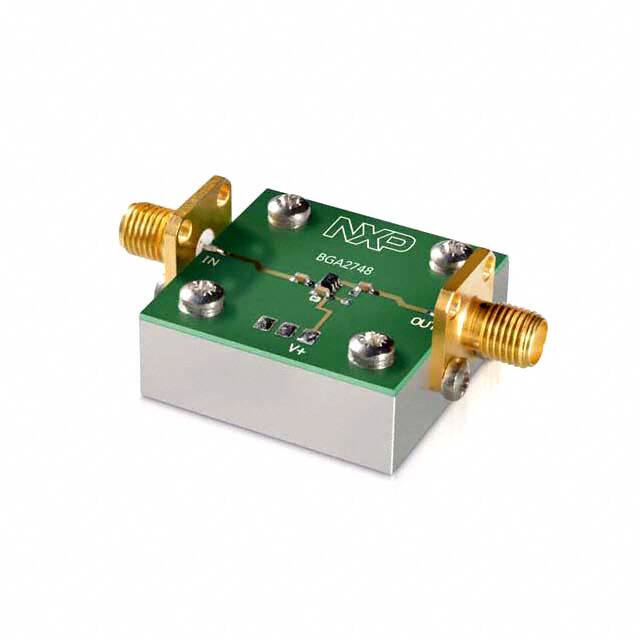
- Part No.:
- OM7609/BGA2748
- Manufacturer:
- NXP Semiconductors
- Category:
- RF, RFID, Wireless Evaluation Boards
- Package:
- Datasheet:
-
 OM7609/BGA2748.pdf
- Description:
- EVAL BOARD FOR BGA2748
- Quantity:
- Payment:

- Shipping:

Inventory:4,778
Please send an inquiry. Send us your inquiry, and we will respond immediately.
Product details
Overview
BGA2748 from NXP Semiconductors is a silicon monolithic microwave integrated circuit (MMIC) wideband amplifier internally matched to 50 Ω, operating from 100 MHz to 3 GHz with 21.8 dB typical gain at 1 GHz, 1.9 dB noise figure, and −2.3 dBm saturated output power. It serves as an IF amplifier in LNBs, RF buffer between LNA and mixer, and driver stage before power amplifiers in cable systems and ISM-band transceivers.
For engineers reviewing the BGA2748 datasheet, BGA2748 pinout, BGA2748 application, or BGA2748 equivalent, key selection criteria include its unconditionally stable operation up to 3 GHz, internal 50 Ω matching eliminating external components, low-noise performance at 1–2 GHz, and SOT363 package compatibility with high-density RF PCB layouts.
Technical Context
The BGA2748 employs a single-stage GaAs-based MMIC architecture optimized for broadband small-signal amplification. Its unconditional stability (K > 1 across 100 MHz–3 GHz) and excellent isolation (|s12|² ≤ −40 dB up to 2 GHz) enable cascaded configurations without oscillation risk.
Internally matched input/output impedances eliminate external tuning networks, while separate GND1 and GND2 terminals reduce ground loop inductance-critical for maintaining 18 dB input return loss at 1 GHz and preserving linearity under 5.7 mA supply current at 3 V.
Key Specifications
| Parameter | Value and Actual Design Meaning |
|---|---|
| Frequency Range | 100 MHz to 3 GHz - supports full ISM band (902–928 MHz, 2.4–2.5 GHz) and cable TV IF bands without retuning |
| Gain @ 1 GHz | 21.8 dB typical - provides sufficient signal boost before mixer or ADC with minimal added noise |
| Noise Figure | 1.9 dB @ 1 GHz - enables high SNR in LNB IF stages where weak satellite signals dominate |
| Supply Current | 5.7 mA @ 3 V - allows low-power operation in battery-backed or thermally constrained modules |
| Input Return Loss | 18 dB @ 1 GHz - ensures <5% reflected power into preceding LNA or filter without external matching |
| Output IP3 | −1.9 dBm @ 1 GHz - defines third-order intermodulation distortion limit in multi-carrier cable headend applications |
| Thermal Resistance | 300 K/W junction-to-solder - requires thermal pad or multiple vias under exposed die pad for sustained 200 mW dissipation |
Pinout & Package
Package: SOT363 (SC-88), 6-pin plastic surface-mount package with exposed thermal pad; dimensions 2.2 mm × 1.35 mm × 1.15 mm (L × W × H); JEDEC-compliant footprint.
| Pin/Terminal | Circuit Role | Design Meaning |
|---|---|---|
| 1 | VS | DC supply input - must be decoupled with 22 nF capacitor placed within 2 mm of pin |
| 2, 5 | GND2 | Dedicated RF ground path - routed separately from GND1 to minimize coupling into output stage |
| 3 | RF out | 50 Ω matched output - connects directly to mixer LO port or next-stage amplifier without series inductor |
| 4 | GND1 | Input-stage ground - isolated from GND2 to prevent feedback through shared ground impedance |
| 6 | RF in | 50 Ω matched input - accepts AC-coupled signal from LNA or filter; no DC bias required |
Key Features
| Feature | Design Value |
|---|---|
| Unconditional Stability | K > 1 across 100 MHz–3 GHz - eliminates need for external stabilization networks in production designs |
| Internal 50 Ω Matching | No external matching components required - reduces BOM count and layout area by ~30% vs discrete alternatives |
| Low Noise Figure | 1.9 dB @ 1 GHz - preserves EVM in QAM-256 cable modems where NF directly impacts error floor |
| High Isolation | |s12|² ≤ −40 dB up to 2 GHz - prevents oscillator pulling in transmitter IF chains with shared supply rails |
| Thermal Management | Exposed die pad with Rth j-s = 300 K/W - enables 100% duty-cycle operation at 3 V/5.7 mA with standard 2-layer FR4 |
Applications
| Cable TV Headend IF Amplifier | LNB Downconverter IF Stage |
|---|---|
Use Scenario: Amplifying 45–862 MHz downstream signals after channel filtering in CATV optical nodes. IC Role / Device Role / Timing Role: Wideband IF amplifier between bandpass filter and QAM demodulator ASIC. Use Value: 21.8 dB gain and 18 dB input return loss maintain flat group delay across entire DOCSIS spectrum without tuning. | Use Scenario: Boosting 950–2150 MHz satellite IF signals after LNB downconversion. IC Role / Device Role / Timing Role: Low-noise buffer between LNB output and tuner IC's RF input. Use Value: 1.9 dB noise figure minimizes system noise temperature, preserving C/N ratio for DVB-S2 reception. |
| ISM-Band Transmitter Driver | Multi-Carrier Receiver Front-End |
Use Scenario: Driving power amplifier input in 2.4 GHz Wi-Fi or Bluetooth access point radios. IC Role / Device Role / Timing Role: Linear driver amplifier between upconverter and PA, handling multi-tone signals. Use Value: −1.9 dBm output IP3 ensures <−45 dBc ACLR in 20 MHz OFDM transmission at +5 dBm output. | Use Scenario: First active stage after antenna switch in dual-band cellular IoT receivers. IC Role / Device Role / Timing Role: Broadband pre-amplifier supporting simultaneous LTE Band 12/13 and NB-IoT operation. Use Value: 1.9 GHz bandwidth (−3 dB) covers both bands with single device, reducing component count vs switched filters. |
Equivalent & Alternatives
The following parts are listed as comparable options for similar wideband MMIC amplifier applications.
| Alternative Part | Technical Difference | Application Difference | Selection Advice |
|---|---|---|---|
| QPL9547 | Higher gain (24 dB @ 1 GHz), wider bandwidth (DC–6 GHz), but 2.5 dB NF and requires external matching | Suitable for higher-frequency 5G FR1 front-ends where BGA2748's 3 GHz limit is insufficient | Select QPL9547 when >4 GHz operation or lower gain flatness tolerance (<±0.5 dB) is required |
| ERA-5SM+ | Similar 21 dB gain and 2 dB NF, but 5-pin SOT-23 package, no dedicated GND1/GND2 separation | Better suited for space-constrained portable receivers where SOT363 footprint is prohibitive | Choose ERA-5SM+ when board area is critical and ground inductance sensitivity is lower than in cable infrastructure |
Compared with QPL9547 and ERA-5SM+, the BGA2748 delivers optimal balance of noise, stability, and integration for cost-sensitive broadband IF amplification-its internal matching and dual-ground architecture simplify layout in fixed infrastructure equipment where thermal management and isolation are prioritized over minimal footprint.
Availability
BGA2748 is available at Aetrix Electronics and suitable for cable systems, LNB IF amplifiers, and ISM-band transceiver designs requiring stable component supply, consistent RF performance across production lots, and long-term lifecycle support.
Supply support for BGA2748 includes scheduled delivery planning, volume procurement assistance, BOM continuity management, traceable sourcing, and lifecycle availability coordination for OEM customers, industrial embedded developers, connected-device designers, and electronics production programs.
Manufacturer
NXP Semiconductors is a global semiconductor company specializing in high-performance RF, analog, and mixed-signal solutions for automotive, industrial, and communications markets.
The BGA2748 belongs to NXP's legacy MMIC amplifier product line designed specifically for broadband infrastructure applications-including cable TV, satellite reception, and industrial wireless-where low noise, unconditional stability, and internal matching reduce design cycle time.
FAQ
What is the recommended supply decoupling for BGA2748?
Use a 22 nF ceramic capacitor placed within 2 mm of pin 1 (VS) and connected to GND2 (pins 2 and 5) using a short, low-inductance trace. Additional 100 pF capacitors may be added in parallel for frequencies above 1 GHz to suppress high-frequency supply noise that could modulate the BGA2748's gain.
Can BGA2748 operate at 5 V supply voltage?
No. The absolute maximum DC supply voltage for BGA2748 is 4 V per the limiting values table. Operating at 5 V exceeds this rating and risks permanent damage. The device is characterized and optimized for 3 V operation, delivering 5.7 mA supply current and 21.8 dB gain at that voltage-using higher voltage is not supported.
Is BGA2748 pin-compatible with BGA2747?
No. BGA2747 uses a different pinout (RF in on pin 1, VS on pin 6) and has distinct scattering parameters-its s11 and s22 phase responses differ significantly from BGA2748. Substituting BGA2747 for BGA2748 requires PCB redesign due to reversed RF path and incompatible grounding scheme.
Does BGA2748 require external DC blocking capacitors?
Yes. The BGA2748 RF ports are DC-coupled internally, so external 100 pF DC blocking capacitors (C2, C3 in Fig.2) are mandatory on both RF in (pin 6) and RF out (pin 3) to prevent DC bias disruption in cascaded stages. Values >100 pF degrade high-frequency response above 100 MHz.
What is the thermal pad connection requirement for BGA2748?
The SOT363 package includes an exposed thermal pad (pin 4 is GND1, but the pad itself is electrically isolated and thermally conductive). It must be soldered to a dedicated copper pour connected to GND2 via ≥4 thermal vias (0.3 mm diameter) to achieve the specified 300 K/W thermal resistance and prevent junction temperature exceedance at full 200 mW dissipation.
OM7609/BGA2748 Specifications
- Product attributes
- Attribute value
- Manufacturer:
- NXP Semiconductors
- Series:
- -
- Packaging:
- Bulk
- Product Status:
- Obsolete
- Type:
- Amplifier
- Frequency:
- 100MHz ~ 2.2GHz
- Contents:
- Board(s)
- Utilized IC / Part:
- BGA2748
OM7609/BGA2748 FAQ
1.How can I place an order for OM7609/BGA2748 through Aetrix?
Please submit a Request for Quotation (RFQ) for OM7609/BGA2748 on Aetrix. Our sales agent will provide a competitive quotation and guide you through the order confirmation once you accept the terms.
2.Are the price and stock information for OM7609/BGA2748 reliable?
The price and inventory of OM7609/BGA2748 are updated periodically and may fluctuate due to market conditions. Stock and pricing data are typically refreshed every 24 hours. Quotation validity for OM7609/BGA2748 is usually 5 days.
3.What payment methods are accepted for OM7609/BGA2748?
We accept Wire Transfer, PayPal, Credit Card, Western Union, MoneyGram, and Escrow for OM7609/BGA2748 transactions.
Note: Certain payment methods may incur a processing fee.
4.How is shipping managed for OM7609/BGA2748?
OM7609/BGA2748 orders can be shipped via leading logistics carriers, including DHL, UPS, FedEx, TNT, or Registered Mail.
Once your OM7609/BGA2748 order is processed, you will receive an email with the shipment details and tracking number.
Note: Tracking information may take up to 24 hours to appear. Express delivery typically takes 3–5 business days.
5.How can I obtain technical support or documentation for OM7609/BGA2748?
For technical support, including OM7609/BGA2748 datasheets, pinout diagrams, or application guidance, please contact our engineering support team. They can provide detailed documentation and assistance for your OM7609/BGA2748 requirements.
6.How does Aetrix verify that OM7609/BGA2748 is sourced from the original manufacturer or authorized distributors?
All OM7609/BGA2748 products on Aetrix are procured from qualified distributors and authorized channels. Our dedicated quality assurance team conducts strict verification, including traceability checks and, if necessary, third-party testing. This ensures that OM7609/BGA2748 meets industry standards.
7.What is the process for return or replacement of OM7609/BGA2748?
All OM7609/BGA2748 units undergo pre-shipment inspection (PSI). If there is an issue with OM7609/BGA2748, returns or replacements are accepted under the following conditions:
1.Quantity discrepancies, incorrect items, or visible external defects (such as breakage or corrosion), acknowledged by Aetrix.
2.The issue is reported within 90 days of delivery.
3.The OM7609/BGA2748 part is unused and in its original packaging.
Return procedure for OM7609/BGA2748:
1.Submit a request within 90 days.
2.Obtain a Return Material Authorization (RMA) from Aetrix.
OM7609/BGA2748 Tags
-
113991054
Seeed Technology Co., Ltd
-
SC0918
Raspberry Pi

-
113991114
Seeed Technology Co., Ltd
-
ESP32-C6-DEVKITM-1-N4
Espressif Systems
-
ESP32-DEVKITM-1
Espressif Systems
-
C008
M5Stack Technology Co., Ltd.
-
ESP32-C3-DEVKITC-02
Espressif Systems
-
ESP32-C6-DEVKITC-1-N8
Espressif Systems
-
DFR0478
DFRobot
-
102010448
Seeed Technology Co., Ltd
-
ESP32-DEVKITC-32E
Espressif Systems
-
ESP32-DEVKITC-32UE
Espressif Systems
Tech Hub

A practical engineering guide to 3.3V and 5V logic compatibility, input thresholds, resistor dividers, translator ICs, MOSFET level shifting, I2C pull-ups, timing limits and power-sequencing risks.

The 74HC595 uses push-pull logic outputs, while the TPIC6B595 uses 50 V open-drain DMOS sinks for higher-power loads. This guide compares timing, current limits, 3.3 V interfacing, load wiring, thermal…

The 74HC595 converts serial data into eight stable parallel outputs. This guide covers pin functions, shift and storage timing, OE and MR behavior, drive-current limits, cascading, voltage compatibilit…

A technical comparison of level-sensitive latches and edge-triggered flip-flops, covering timing windows, setup and hold limits, master–slave operation, time borrowing, race-through, HDL inference and…

A D latch stores one bit while Enable controls when data can pass. This reference covers gate-level operation, truth tables, transparency, setup and hold timing, LE versus OE, common ICs and practical …

An SR latch stores one bit through cross-coupled feedback. This engineering reference covers NOR and NAND implementations, truth tables, forbidden-state recovery, gated operation, switch debouncing, fa…

Latch circuits retain one bit through feedback. This technical reference covers SR and D latches, truth tables, transparency, timing limits, latch-versus-flip-flop behavior, applications and common log…

An engineering guide to LED driver operation, constant-current and constant-voltage outputs, linear and switching topologies, dimming, IC selection, calculations, replacement compatibility, and fault c…

Operational amplifier guide covering op amp basics, feedback, ideal vs real op amps, common configurations, buffer circuits, offset, bias current, gain-bandwidth, slew rate, rail-to-rail limits and sel…

Jumper cables guide covering safe connection order, red and black clamp placement, final ground connection, cable gauge, length, clamp quality, copper vs CCA cables, jump starter comparison and battery…


