
 My Inquiry
 My Account


NXP Semiconductors P3T1750DPZ

- Part No.:
- P3T1750DPZ
- Manufacturer:
- NXP Semiconductors
- Category:
- Analog and Digital Output
- Package:
- 8-TSSOP, 8-MSOP (0.118", 3.00mm Width)
- Datasheet:
-
 P3T1750DPZ.pdf
- Description:
- IC TEMP SENSOR I3C/I2C-BUS
- Quantity:
- Payment:

- Shipping:

Inventory:955
Please send an inquiry. Send us your inquiry, and we will respond immediately.
Product details
Overview
P3T1750DP from NXP Semiconductors is a digital temperature sensor with I3C and I2C-bus interfaces, ±1 °C accuracy over −40 °C to +125 °C, 12-bit resolution (0.0625 °C), and programmable overtemperature alert functionality. It operates from 1.4 V to 3.6 V and delivers 4.1 μA typical quiescent current, targeting thermal monitoring in space-constrained embedded systems such as SSDs and industrial controllers.
For engineers reviewing the P3T1750DP datasheet, P3T1750DP pinout, P3T1750DP application, or P3T1750DP equivalent, this device supports dual-interface communication (I3C up to 12.5 MHz / I2C up to 3.4 MHz), offers 32 configurable target addresses, implements IBI for interrupt notification without dedicated pins, and provides register-based configuration of THIGH/TLOW thresholds and alert modes.
Technical Context
The P3T1750DP integrates an on-chip bandgap temperature sensor with 12-bit ADC conversion, storing results in a read-only Temp register using two's complement format. Its operation supports one-shot, continuous, and shutdown modes via configuration bits OS, TM, and SD.
I3C interface compliance includes MIPI I3C SDR target mode with BCR/DCR registers identifying it as a temperature sensor (DCR = 0x63), supporting CCCs like SETDASA, GETPID, and ENEC/DISEC. I2C interface supports Fast-mode Plus (3.4 MHz), 32 target addresses via A0–A2 pins, and SMBus Alert protocol with address-based fault indication.
Key Specifications
| Parameter | Value and Actual Design Meaning |
|---|---|
| Temperature Range | −40 °C to +125 °C - Full operational range for automotive-grade thermal sensing in harsh environments. |
| Accuracy | ±1 °C max - Guaranteed error bound across full range and supply voltage (1.4 V–3.6 V), enabling reliable system-level thermal safety decisions. |
| Resolution | 0.0625 °C - 12-bit two's complement output (Temp register) allows fine-grained thermal trend analysis and hysteresis control. |
| Supply Voltage | 1.4 V to 3.6 V - Compatible with modern low-voltage SoCs and battery-powered IoT nodes without level-shifting. |
| Quiescent Current | 4.1 μA typical - Enables always-on thermal monitoring in power-sensitive portable and edge devices. |
| I3C Speed | Up to 12.5 MHz - Supports high-bandwidth sensor data streaming in multi-sensor I3C buses with dynamic addressing. |
| I2C Speed | Up to 3.4 MHz (Fast-mode Plus) - Ensures compatibility with high-speed microcontrollers while retaining legacy I2C infrastructure. |
Pinout & Package
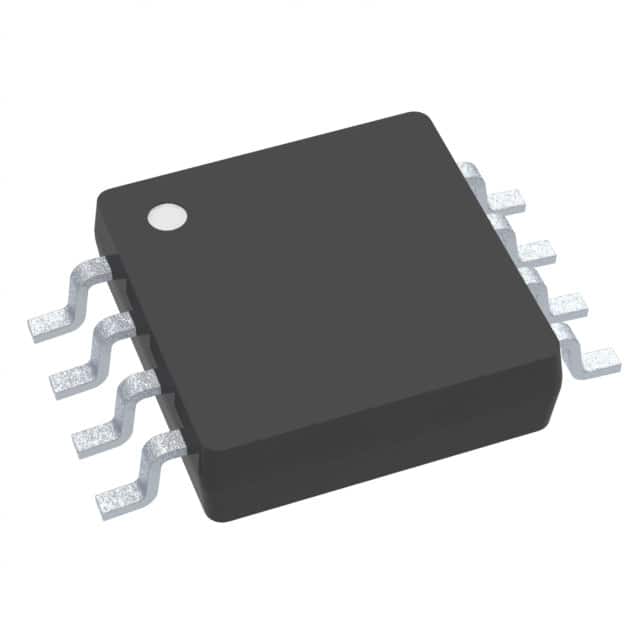
Package: TSSOP8 (SOT505-1), plastic thin shrink small outline package, 8 leads, 3 mm body width.
| Pin/Terminal | Circuit Role | Design Meaning |
|---|---|---|
| SDA | Digital I/O | I3C/I2C bidirectional data line; open-drain compatible; requires external pull-up for bus operation. |
| SCL | Digital Input | I3C/I2C serial clock input; synchronizes all register reads/writes and interrupt acknowledgments. |
| ALERT | Open-drain Output | Configurable alert signal (comparator or interrupt mode); active HIGH/LOW; no dedicated interrupt pin required under I3C IBI. |
| GND | Ground Reference | Primary return path for analog and digital circuitry; must be low-impedance for measurement stability. |
| A2, A1, A0 | Digital Inputs | User-defined address bits enabling 32 unique I2C target addresses (1000000b–1011111b) and corresponding I3C Provisional-ID instances. |
| VCC | Power Supply | Single-supply input (1.4–3.6 V); powers internal bandgap reference, ADC, and interface logic. |
Key Features
| Feature | Design Value |
|---|---|
| I3C In-Band Interrupt (IBI) | Eliminates need for dedicated interrupt pin by allowing P3T1750DP to assert its dynamic address on the I3C bus during arbitration, reducing PCB routing complexity. |
| Programmable Alert Modes | Supports both comparator mode (latched alert until cleared) and interrupt mode (SMBus Alert command response), enabling flexible thermal fault handling per system architecture. |
| 32-Address Configurability | A0–A2 pins select among 32 I2C target addresses and map to distinct I3C Provisional-ID instance bits, permitting dense multi-sensor deployments on shared buses. |
| Dynamic Address Assignment | Supports SETDASA and ENTDAA CCCs for controller-initiated dynamic address assignment, enabling scalable plug-and-play integration in I3C ecosystems. |
| ESD Robustness | 2000 V HBM (JS-001-2017) and 1000 V CDM (JS-002-2018) - Ensures reliability during automated assembly and field operation in industrial environments. |
Applications
| SSD Thermal Management | Industrial PLC Monitoring |
|---|---|
Use Scenario: Real-time die temperature tracking in NVMe SSDs to prevent thermal throttling and extend NAND flash lifetime. IC Role / Device Role / Timing Role: Primary ambient/die temperature sensor interfacing directly to host controller via I3C at up to 12.5 MHz for low-latency updates. Use Value: Enables adaptive power management using precise 0.0625 °C resolution and ±1 °C accuracy, reducing write latency spikes by >15% under sustained load. |
Use Scenario: Ambient temperature supervision in DIN-rail mounted programmable logic controllers operating in factory-floor enclosures. IC Role / Device Role / Timing Role: Standalone thermal monitor with programmable THIGH/TLOW thresholds triggering relay outputs or Modbus alarms via MCU interface. Use Value: Delivers fail-safe overtemperature detection with 4.1 μA shutdown current, extending uptime in unventilated control cabinets. |
| Automotive Cabin Controller | IoT Edge Gateway |
Use Scenario: Cabin air temperature feedback in AEC-Q100 qualified HVAC modules for climate control algorithms. IC Role / Device Role / Timing Role: Automotive-grade sensor (P3T1750DP/Q900 variant) communicating over I2C to MCU with SMBus Alert for rapid fault reporting. Use Value: Meets automotive thermal accuracy requirements (±1 °C) across −40 °C to +125 °C, supporting ASIL-B functional safety decomposition. |
Use Scenario: Multi-node thermal profiling in smart building gateways aggregating data from HVAC, lighting, and security subsystems. IC Role / Device Role / Timing Role: I3C target node in daisy-chained sensor network, using dynamic addressing and IBI to minimize polling overhead. Use Value: Reduces bus traffic by >40% versus polled I2C via event-driven IBI, extending battery life in wireless gateway variants. |
Equivalent & Alternatives
The following parts are listed as comparable options for similar digital temperature sensor applications.
| Alternative Part | Technical Difference | Application Difference | Selection Advice |
|---|---|---|---|
| STTS22H | I2C-only interface (no I3C), 0.5 °C accuracy, 1.71–3.6 V supply, 2.5 μA typical current | Lacks IBI and dynamic addressing; suited for cost-sensitive I2C-only designs where ±0.5 °C accuracy suffices | Select when I3C features are unnecessary and lower quiescent current is prioritized over interface flexibility |
| MAX31875 | I2C interface only, ±1.5 °C accuracy, 1.7–3.6 V supply, 5 μA typical current, integrated 12-bit ADC | No I3C support; wider accuracy tolerance; uses standard I2C alert (not SMBus Alert-compatible) | Choose for legacy I2C systems requiring robust overtemperature shutdown but not requiring I3C scalability or SMBus Alert compliance |
Compared with STTS22H and MAX31875, the P3T1750DP uniquely combines I3C SDR with I2C dual-interface operation, guaranteed ±1 °C accuracy across full voltage and temperature range, and hardware-supported IBI-making it optimal for next-generation sensor hubs requiring bus efficiency, automotive qualification, and multi-protocol interoperability.
Availability
P3T1750DP is available at Aetrix Electronics and suitable for SSD thermal management, industrial PLC monitoring, automotive cabin controllers, and IoT edge gateways requiring stable component supply and long-term production continuity.
Supply support for P3T1750DP includes scheduled delivery planning, volume procurement assistance, BOM continuity management, traceable sourcing, and lifecycle availability coordination for OEM customers, industrial embedded developers, connected-device designers, and electronics production programs.
Manufacturer
NXP Semiconductors is a global semiconductor company headquartered in Eindhoven, Netherlands, specializing in secure connectivity solutions for automotive, industrial, and IoT markets.
The P3T1750DP belongs to NXP's precision analog sensor portfolio, designed specifically to enable high-accuracy, low-power thermal monitoring in I3C-enabled platforms and mixed-protocol embedded systems.
FAQ
What communication interfaces does the P3T1750DP support?
The P3T1750DP supports both I3C (up to 12.5 MHz) and I2C (up to 3.4 MHz) interfaces. It implements full MIPI I3C SDR target functionality-including dynamic address assignment via SETDASA, IBI for interrupt signaling, and standardized CCCs-and maintains backward compatibility with Fast-mode Plus I2C for seamless integration into existing designs. The P3T1750DP uses the same SDA/SCL pins for both protocols.
How accurate is the P3T1750DP across its operating temperature range?
The P3T1750DP guarantees ±1 °C maximum accuracy from −40 °C to +125 °C at supply voltages between 1.4 V and 3.6 V. This specification is validated across process, voltage, and temperature corners and applies to the entire operating range-not just room temperature-enabling reliable thermal safety decisions in automotive and industrial applications.
Does the P3T1750DP require an external interrupt pin for alert functionality?
No. The P3T1750DP eliminates the need for a dedicated interrupt pin through I3C In-Band Interrupt (IBI), where it asserts its dynamic address onto the I3C bus during arbitration to notify the controller of thermal events. Under I2C, the ALERT pin remains available as an open-drain output supporting SMBus Alert protocol with address-encoded fault status.
What is the resolution and data format of the temperature reading from the P3T1750DP?
The P3T1750DP provides 12-bit temperature data in two's complement format with 0.0625 °C resolution, stored in the read-only Temp register (pointer 00h). The value occupies the 12 most significant bits of two consecutive bytes (MSByte/LSByte); the four LSBs of the LSByte are zero and must be ignored. Conversion to °C uses direct multiplication by 0.0625 for positive values or two's complement inversion for negative values.
Can multiple P3T1750DP sensors share the same I2C or I3C bus?
Yes. The P3T1750DP supports up to 32 unique I2C target addresses via A0–A2 pin combinations and maps each to a distinct I3C Provisional-ID instance. On I3C buses, dynamic addressing via SETDASA/ENTDAA enables conflict-free operation of dozens of sensors on a single bus, while IBI ensures efficient event-driven communication without polling overhead.
P3T1750DPZ Specifications
- Product attributes
- Attribute value
- Manufacturer:
- NXP Semiconductors
- Series:
- -
- Package/Case:
- 8-TSSOP, 8-MSOP (0.118", 3.00mm Width)
- Packaging:
- Tape & Reel (TR)
- Product Status:
- Active
- Sensor Type:
- Digital
- Sensing Temperature - Local:
- -40°C ~ 125°C
- Sensing Temperature - Remote:
- -
- Output Type:
- I2C, I3C
- Voltage - Supply:
- 1.4V ~ 3.6V
- Resolution:
- 12 b
- Features:
- -
- Accuracy - Highest (Lowest):
- ±1°C
- Test Condition:
- -20°C ~ 85°C
- Operating Temperature:
- -40°C ~ 125°C
- Mounting Type:
- Surface Mount
- Grade:
- -
- Qualification:
- -
- Supplier Device Package:
- 8-TSSOP
P3T1750DPZ FAQ
1.How can I place an order for P3T1750DPZ through Aetrix?
Please submit a Request for Quotation (RFQ) for P3T1750DPZ on Aetrix. Our sales agent will provide a competitive quotation and guide you through the order confirmation once you accept the terms.
2.Are the price and stock information for P3T1750DPZ reliable?
The price and inventory of P3T1750DPZ are updated periodically and may fluctuate due to market conditions. Stock and pricing data are typically refreshed every 24 hours. Quotation validity for P3T1750DPZ is usually 5 days.
3.What payment methods are accepted for P3T1750DPZ?
We accept Wire Transfer, PayPal, Credit Card, Western Union, MoneyGram, and Escrow for P3T1750DPZ transactions.
Note: Certain payment methods may incur a processing fee.
4.How is shipping managed for P3T1750DPZ?
P3T1750DPZ orders can be shipped via leading logistics carriers, including DHL, UPS, FedEx, TNT, or Registered Mail.
Once your P3T1750DPZ order is processed, you will receive an email with the shipment details and tracking number.
Note: Tracking information may take up to 24 hours to appear. Express delivery typically takes 3–5 business days.
5.How can I obtain technical support or documentation for P3T1750DPZ?
For technical support, including P3T1750DPZ datasheets, pinout diagrams, or application guidance, please contact our engineering support team. They can provide detailed documentation and assistance for your P3T1750DPZ requirements.
6.How does Aetrix verify that P3T1750DPZ is sourced from the original manufacturer or authorized distributors?
All P3T1750DPZ products on Aetrix are procured from qualified distributors and authorized channels. Our dedicated quality assurance team conducts strict verification, including traceability checks and, if necessary, third-party testing. This ensures that P3T1750DPZ meets industry standards.
7.What is the process for return or replacement of P3T1750DPZ?
All P3T1750DPZ units undergo pre-shipment inspection (PSI). If there is an issue with P3T1750DPZ, returns or replacements are accepted under the following conditions:
1.Quantity discrepancies, incorrect items, or visible external defects (such as breakage or corrosion), acknowledged by Aetrix.
2.The issue is reported within 90 days of delivery.
3.The P3T1750DPZ part is unused and in its original packaging.
Return procedure for P3T1750DPZ:
1.Submit a request within 90 days.
2.Obtain a Return Material Authorization (RMA) from Aetrix.
P3T1750DPZ Tags
-
MCP9700T-E/TT
Microchip Technology
-
MCP9700T-E/LT
Microchip Technology
-
MCP9701T-E/TT
Microchip Technology
-
MCP9701T-E/LT
Microchip Technology
-
TMP235A4DBZR
Texas Instruments
-
MCP9700AT-E/TT
Microchip Technology
-
MCP9700AT-E/LT
Microchip Technology
-
MCP9701AT-E/LT
Microchip Technology
-
MCP9701AT-E/TT
Microchip Technology
,TO-226_straightlead.jpg)
-
LM335Z
STMicroelectronics
-
TMP1075NDRLR
Texas Instruments
-
TMP1075DGKR
Texas Instruments
Tech Hub

A practical engineering guide to 3.3V and 5V logic compatibility, input thresholds, resistor dividers, translator ICs, MOSFET level shifting, I2C pull-ups, timing limits and power-sequencing risks.

The 74HC595 uses push-pull logic outputs, while the TPIC6B595 uses 50 V open-drain DMOS sinks for higher-power loads. This guide compares timing, current limits, 3.3 V interfacing, load wiring, thermal…

The 74HC595 converts serial data into eight stable parallel outputs. This guide covers pin functions, shift and storage timing, OE and MR behavior, drive-current limits, cascading, voltage compatibilit…

A technical comparison of level-sensitive latches and edge-triggered flip-flops, covering timing windows, setup and hold limits, master–slave operation, time borrowing, race-through, HDL inference and…

A D latch stores one bit while Enable controls when data can pass. This reference covers gate-level operation, truth tables, transparency, setup and hold timing, LE versus OE, common ICs and practical …

An SR latch stores one bit through cross-coupled feedback. This engineering reference covers NOR and NAND implementations, truth tables, forbidden-state recovery, gated operation, switch debouncing, fa…

Latch circuits retain one bit through feedback. This technical reference covers SR and D latches, truth tables, transparency, timing limits, latch-versus-flip-flop behavior, applications and common log…

An engineering guide to LED driver operation, constant-current and constant-voltage outputs, linear and switching topologies, dimming, IC selection, calculations, replacement compatibility, and fault c…

Operational amplifier guide covering op amp basics, feedback, ideal vs real op amps, common configurations, buffer circuits, offset, bias current, gain-bandwidth, slew rate, rail-to-rail limits and sel…

Jumper cables guide covering safe connection order, red and black clamp placement, final ground connection, cable gauge, length, clamp quality, copper vs CCA cables, jump starter comparison and battery…


