
 My Inquiry
 My Account


NXP Semiconductors PCF7936AA/3851/C/6

- Part No.:
- PCF7936AA/3851/C/6
- Manufacturer:
- NXP Semiconductors
- Category:
- RFID Transponders, Tags
- Package:
- Datasheet:
-
 PCF7936AA/3851/C/6.pdf
- Description:
- RFID TAG R/W 125KHZ PLLMC
- Quantity:
- Payment:

- Shipping:

Inventory:3,710
Please send an inquiry. Send us your inquiry, and we will respond immediately.
Product details
Overview
PCF7936AA/3851/C/6 from NXP is an automotive immobilizer transponder IC with 96-bit secret key encryption, 448-byte EEPROM, and ISO/IEC 15693-compliant RF interface operating at 134.2 kHz. It serves as the secure authentication token in vehicle key fobs, enabling challenge-response handshaking with basestation ICs like ABIC2 (PJF7992) in engine control units.
For engineers reviewing the PCF7936AA/3851/C/6 datasheet, PCF7936AA/3851/C/6 pinout, PCF7936AA/3851/C/6 application, or PCF7936AA/3851/C/6 equivalent, key selection criteria include 96-bit cryptographic strength, EEPROM access configuration flexibility, 134.2 kHz carrier frequency compliance, and migration compatibility with PCF7938-based systems.
Technical Context
The PCF7936AA/3851/C/6 implements a passive RFID transponder architecture compliant with ISO/IEC 15693-2 and -3, using load modulation for bidirectional communication. Its internal oscillator derives timing from the 134.2 kHz magnetic field, eliminating need for on-board crystal or battery.
It executes a proprietary NXP Crypto-Authentication protocol with 96-bit secret key stored in tamper-resistant memory. The 448-byte EEPROM supports configurable read/write protection zones, including lockable sectors and password-protected access modes defined via configuration bits.
Key Specifications
| Parameter | Value and Actual Design Meaning |
|---|---|
| Operating Frequency | 134.2 kHz carrier - enables interoperability with standard automotive basestation antennas and coil geometries |
| Cryptographic Key Length | 96-bit secret key - provides higher entropy than legacy 48-bit keys, resisting brute-force attacks |
| EEPROM Capacity | 448 bytes - stores vehicle-specific identifiers, rolling code counters, and user-configurable data blocks |
| Communication Protocol | ISO/IEC 15693-2/-3 compliant - ensures physical layer and command set compatibility with NXP basestations |
| Power Source | Passive (field-powered) - draws energy solely from basestation's magnetic field, no onboard battery required |
| Authentication Time | < 10 ms per challenge-response cycle - meets real-time engine start latency requirements |
Pinout & Package
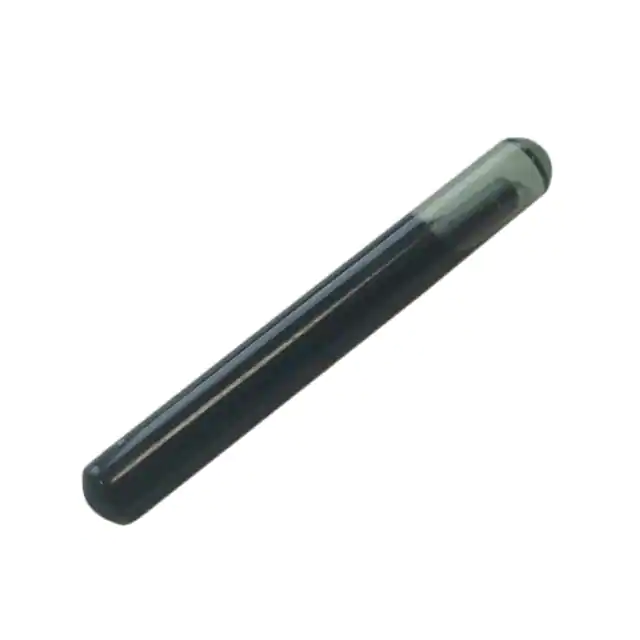
PCF7936AA/3851/C/6 is housed in NXP's proprietary "stick" package - a hermetically sealed, cylindrical glass capsule (Ø3.85 mm × 12.5 mm) optimized for embedding into plastic key housings. No external pins; RF coupling occurs via integrated coil antenna.
Key Features
| Feature | Design Value |
|---|---|
| 96-bit Secret Key Storage | Hardware-secured non-volatile memory prevents extraction via side-channel or probing attacks |
| Configurable EEPROM Access | Per-sector lock bits and password-controlled write enable allow differentiated data security policies |
| ISO/IEC 15693 Compliance | Guarantees interoperability with certified basestations without custom firmware adaptation |
| Field-Powered Operation | Eliminates battery replacement, leakage, and temperature-related failure modes in key fobs |
| Fast Authentication Cycle | Sub-10 ms response time enables seamless ignition sequence integration without perceptible delay |
Applications
| Automotive Immobilizer System | Keyless Entry Transponder |
|---|---|
Use Scenario: Embedded in OEM vehicle key fob to authenticate driver identity before enabling engine start. IC Role / Device Role / Timing Role: Passive RF transponder providing cryptographically signed response to basestation challenge. Use Value: Prevents unauthorized vehicle operation by enforcing hardware-bound secret key validation. | Use Scenario: Integrated into smart key housing for proximity-based door unlock and trunk release. IC Role / Device Role / Timing Role: Secure identification token responding to low-power 134.2 kHz polling bursts. Use Value: Enables reliable short-range authentication without battery dependency or manual button press. |
| Aftermarket Anti-Theft Module | Vehicle Diagnostic Security Token |
Use Scenario: Used in third-party immobilizer kits installed in older vehicles lacking factory systems. IC Role / Device Role / Timing Role: Standalone authentication element interfacing with aftermarket ECU controllers. Use Value: Provides NXP-grade cryptographic security without requiring full OEM basestation redesign. | Use Scenario: Embedded in service tool keys to authorize access to diagnostic functions like ECU reprogramming. IC Role / Device Role / Timing Role: Tamper-resistant credential verifying technician authorization prior to critical operations. Use Value: Enforces role-based access control using hardware-stored secrets, preventing unauthorized firmware modification. |
Equivalent & Alternatives
The following parts are listed as comparable options for similar immobilizer transponder applications.
| Alternative Part | Technical Difference | Application Difference | Selection Advice |
|---|---|---|---|
| PCF7938A/3851/C/6 | Same 96-bit key, 448-byte EEPROM, but adds enhanced anti-cloning features and extended configuration registers | Required for new designs targeting latest OEM security mandates (e.g., UNECE R110) | Select when migrating to higher-security baseline; retains same stick package and RF interface |
| PCF7937AA/3851/C/6 | 48-bit secret key, 256-byte EEPROM, identical 134.2 kHz interface and stick package | Suitable for legacy systems where cost sensitivity outweighs cryptographic upgrade needs | Choose for backward-compatible replacement where existing basestation firmware lacks 96-bit support |
Compared with PCF7936AA/3851/C/6, PCF7938A/3851/C/6 extends security posture with additional countermeasures against replay and emulation attacks, while PCF7937AA/3851/C/6 reduces memory and key size to lower unit cost - both maintain mechanical and RF interoperability.
Availability
PCF7936AA/3851/C/6 is available at Aetrix Electronics and suitable for automotive immobilizer systems, keyless entry modules, and aftermarket anti-theft solutions requiring stable component supply and long-term lifecycle support.
Supply support for PCF7936AA/3851/C/6 includes scheduled delivery planning, volume procurement assistance, BOM continuity management, traceable sourcing, and lifecycle availability coordination for OEM customers, industrial embedded developers, connected-device designers, and electronics production programs.
Manufacturer
NXP Semiconductors is a global semiconductor company headquartered in Eindhoven, Netherlands, specializing in secure connectivity solutions for automotive, industrial, and IoT applications.
The PCF7936AA/3851/C/6 belongs to NXP's Immobilizer Transponder product line, designed specifically to meet stringent automotive OEM security and reliability requirements for electronic key authentication.
FAQ
What is the operating frequency of the PCF7936AA/3851/C/6?
The PCF7936AA/3851/C/6 operates at 134.2 kHz, conforming to ISO/IEC 15693-2 for magnetic field coupling. This frequency enables reliable communication with automotive basestations over typical coil distances (up to 5 cm) and ensures compatibility with standardized antenna designs used in ECU modules and key fobs. The device derives all power and clocking from this field, eliminating need for internal oscillators or batteries.
Does the PCF7936AA/3851/C/6 require an external power source?
No, the PCF7936AA/3851/C/6 is fully passive and draws all operating power from the 134.2 kHz magnetic field generated by the basestation. It contains no battery or external power connections. Energy harvesting from the RF field powers the internal logic, EEPROM access, and modulation circuitry - a core design requirement for long-life, maintenance-free key fob applications.
How does the PCF7936AA/3851/C/6 differ from the PCF7938 in terms of security?
The PCF7936AA/3851/C/6 uses a 96-bit secret key and supports the same core authentication protocol as the PCF7938, but lacks certain advanced anti-cloning enhancements present in the PCF7938 such as extended challenge-response randomness and additional configuration lock bits. Both share identical 448-byte EEPROM layout and ISO/IEC 15693 compliance, making PCF7936AA/3851/C/6 suitable for systems where baseline 96-bit security suffices.
Is the PCF7936AA/3851/C/6 pin-compatible with other NXP stick-package transponders?
Yes - the PCF7936AA/3851/C/6 shares the identical cylindrical glass "stick" package (Ø3.85 mm × 12.5 mm) and RF interface characteristics with PCF7937AA/3851/C/6 and PCF7938A/3851/C/6. Mechanical fit, coil coupling behavior, and field-powered operation are fully interchangeable; only cryptographic capability and EEPROM configuration options differ between these variants.
Can the PCF7936AA/3851/C/6 be used with ABIC2 (PJF7992) basestation ICs?
Yes, the PCF7936AA/3851/C/6 is fully compatible with NXP ABIC2 basestation ICs like PJF7992. The ABIC2's ISO/IEC 15693-compliant demodulator, adaptive sampling, and Manchester codec support the exact modulation scheme and command set used by PCF7936AA/3851/C/6. NXP documentation explicitly confirms interoperability across the PCF7936/37/38 transponder family with ABIC2.
PCF7936AA/3851/C/6 Specifications
- Product attributes
- Attribute value
- Manufacturer:
- NXP Semiconductors
- Series:
- HITAG® 2
- Packaging:
- Bulk
- Product Status:
- Active
- Style:
- -
- Technology:
- -
- Frequency:
- 125kHz
- Memory Type:
- Read/Write
- Writable Memory:
- -
- Standards:
- -
- Operating Temperature:
- -
- Size / Dimension:
- -
PCF7936AA/3851/C/6 FAQ
1.How can I place an order for PCF7936AA/3851/C/6 through Aetrix?
Please submit a Request for Quotation (RFQ) for PCF7936AA/3851/C/6 on Aetrix. Our sales agent will provide a competitive quotation and guide you through the order confirmation once you accept the terms.
2.Are the price and stock information for PCF7936AA/3851/C/6 reliable?
The price and inventory of PCF7936AA/3851/C/6 are updated periodically and may fluctuate due to market conditions. Stock and pricing data are typically refreshed every 24 hours. Quotation validity for PCF7936AA/3851/C/6 is usually 5 days.
3.What payment methods are accepted for PCF7936AA/3851/C/6?
We accept Wire Transfer, PayPal, Credit Card, Western Union, MoneyGram, and Escrow for PCF7936AA/3851/C/6 transactions.
Note: Certain payment methods may incur a processing fee.
4.How is shipping managed for PCF7936AA/3851/C/6?
PCF7936AA/3851/C/6 orders can be shipped via leading logistics carriers, including DHL, UPS, FedEx, TNT, or Registered Mail.
Once your PCF7936AA/3851/C/6 order is processed, you will receive an email with the shipment details and tracking number.
Note: Tracking information may take up to 24 hours to appear. Express delivery typically takes 3–5 business days.
5.How can I obtain technical support or documentation for PCF7936AA/3851/C/6?
For technical support, including PCF7936AA/3851/C/6 datasheets, pinout diagrams, or application guidance, please contact our engineering support team. They can provide detailed documentation and assistance for your PCF7936AA/3851/C/6 requirements.
6.How does Aetrix verify that PCF7936AA/3851/C/6 is sourced from the original manufacturer or authorized distributors?
All PCF7936AA/3851/C/6 products on Aetrix are procured from qualified distributors and authorized channels. Our dedicated quality assurance team conducts strict verification, including traceability checks and, if necessary, third-party testing. This ensures that PCF7936AA/3851/C/6 meets industry standards.
7.What is the process for return or replacement of PCF7936AA/3851/C/6?
All PCF7936AA/3851/C/6 units undergo pre-shipment inspection (PSI). If there is an issue with PCF7936AA/3851/C/6, returns or replacements are accepted under the following conditions:
1.Quantity discrepancies, incorrect items, or visible external defects (such as breakage or corrosion), acknowledged by Aetrix.
2.The issue is reported within 90 days of delivery.
3.The PCF7936AA/3851/C/6 part is unused and in its original packaging.
Return procedure for PCF7936AA/3851/C/6:
1.Submit a request within 90 days.
2.Obtain a Return Material Authorization (RMA) from Aetrix.
PCF7936AA/3851/C/6 Tags
-
SL3S1013FTB0,115
NXP Semiconductors
-
NTP53321G0JHKZ
NXP Semiconductors
-
HTSH4801ETK,118
NXP Semiconductors
-
NTA53321G0FHKZ
NXP Semiconductors
-
RF-HDT-DVBE-N2
Texas Instruments
-
RF-HDT-DVBB-N2
Texas Instruments
-
HT2DC20S20/F/RSP
NXP Semiconductors
-
TRPGR30ATGA
Texas Instruments
-
TRPGR30ATGC
Texas Instruments
-
RI-TRP-DR2B-40
Texas Instruments
-
V680-D1KP52MT
Omron Automation and Safety
-
HTMS8001FTB/AF,115
NXP USA Inc.
Tech Hub

A practical engineering guide to 3.3V and 5V logic compatibility, input thresholds, resistor dividers, translator ICs, MOSFET level shifting, I2C pull-ups, timing limits and power-sequencing risks.

The 74HC595 uses push-pull logic outputs, while the TPIC6B595 uses 50 V open-drain DMOS sinks for higher-power loads. This guide compares timing, current limits, 3.3 V interfacing, load wiring, thermal…

The 74HC595 converts serial data into eight stable parallel outputs. This guide covers pin functions, shift and storage timing, OE and MR behavior, drive-current limits, cascading, voltage compatibilit…

A technical comparison of level-sensitive latches and edge-triggered flip-flops, covering timing windows, setup and hold limits, master–slave operation, time borrowing, race-through, HDL inference and…

A D latch stores one bit while Enable controls when data can pass. This reference covers gate-level operation, truth tables, transparency, setup and hold timing, LE versus OE, common ICs and practical …

An SR latch stores one bit through cross-coupled feedback. This engineering reference covers NOR and NAND implementations, truth tables, forbidden-state recovery, gated operation, switch debouncing, fa…

Latch circuits retain one bit through feedback. This technical reference covers SR and D latches, truth tables, transparency, timing limits, latch-versus-flip-flop behavior, applications and common log…

An engineering guide to LED driver operation, constant-current and constant-voltage outputs, linear and switching topologies, dimming, IC selection, calculations, replacement compatibility, and fault c…

Operational amplifier guide covering op amp basics, feedback, ideal vs real op amps, common configurations, buffer circuits, offset, bias current, gain-bandwidth, slew rate, rail-to-rail limits and sel…

Jumper cables guide covering safe connection order, red and black clamp placement, final ground connection, cable gauge, length, clamp quality, copper vs CCA cables, jump starter comparison and battery…


