
 My Inquiry
 My Account


NXP Semiconductors PCF8576T/1,112
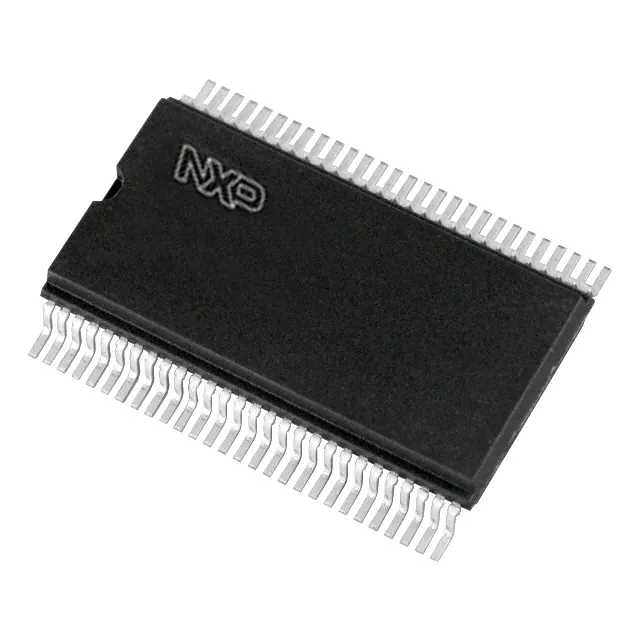
- Part No.:
- PCF8576T/1,112
- Manufacturer:
- NXP Semiconductors
- Category:
- Display Drivers
- Package:
- 56-BSOP (0.435", 11.05mm Width)
- Datasheet:
-
 PCF8576T/1,112.pdf
- Description:
- IC DRVR 8 SEGMENT 56VSOP
- Quantity:
- Payment:

- Shipping:

Inventory:2,760
Please send an inquiry. Send us your inquiry, and we will respond immediately.
Product details
Overview
PCF8576T/1,112 from NXP Semiconductors (formerly Philips) is a single-chip I²C-bus LCD controller/driver supporting static or 2/3/4-backplane multiplexing, 40 segment outputs (S0–S39), internal LCD bias generation, and 40 × 4-bit display RAM. It operates from 2 V to 9 V logic/LCD supplies and targets low-power embedded displays in consumer electronics and instrumentation.
For engineers reviewing the PCF8576T/1,112 datasheet, PCF8576T/1,112 pinout, PCF8576T/1,112 application, or PCF8576T/1,112 equivalent, key selection criteria include its VSO56 package compatibility, I²C-bus address configuration via A0–A2/SA0, selectable 1/2 or 1/3 LCD bias, power-saving mode for battery operation, and cascading capability with PCF8566 for large-panel systems.
Technical Context
The PCF8576T/1,112 integrates an I²C-bus controller with command decoder, display RAM auto-increment addressing, hardware subaddressing, and display memory bank switching for static and duplex drive modes. Its oscillator supports internal (ROSC-based) or external clock input at pin CLK, with frame frequency derived as fCLK/2880 (normal) or fCLK/480 (power-saving).
It implements LCD drive waveforms for static, 1:2, 1:3, and 1:4 multiplex modes using internal voltage divider biasing (1/2 or 1/3), with backplane outputs BP0–BP3 and segment outputs S0–S39 directly driving the LCD panel. Blinking is supported via dedicated BLINK command with configurable frequencies tied to fCLK.
Key Specifications
| Parameter | Value and Actual Design Meaning |
|---|---|
| Display Drive Capability | Up to 160 LCD elements (e.g., 20×8-segment digits or 10×15-segment alphanumerics) using 4 backplanes and 40 segments. |
| I²C-Bus Interface | Standard-mode (100 kHz max) bidirectional interface with slave address set by A0–A2 and SA0 pins; supports cascaded multi-device systems. |
| Supply Voltage Range | VDD = 2 V to 9 V; VLCD independently configurable - enables use with low-threshold (2 V) or high-threshold (automotive TN) LCDs. |
| Display Memory | 40 × 4-bit static RAM with auto-incremented addressing and subaddress boundary wraparound for seamless cascading. |
| Power-Saving Mode | Reduces internal clock division ratio by 6×, lowering supply current significantly while increasing I²C data transfer latency. |
| Oscillator Options | Internal RC oscillator (ROSC to VSS) or external clock applied to CLK pin; minimum fCLK = 125 kHz required for full 100 kHz I²C throughput. |
Pinout & Package
PCF8576T/1,112 is housed in a space-saving 56-lead plastic Very Small Outline (VSO56) package per SOT190-1 outline, optimized for plane wiring in single- and multi-device LCD applications.
| Pin/Terminal | Circuit Role | Design Meaning |
|---|---|---|
| SDA (1) | I²C serial data I/O | Open-drain bidirectional bus line requiring external pull-up; handles command/data transfers and ACK/NACK signaling. |
| SCL (2) | I²C serial clock input | Master-generated clock synchronizing all I²C transactions; device samples SDA on rising edge. |
| SYNC (3) | Cascade synchronization I/O | Propagates timing alignment signal between multiple PCF8576 devices in daisy-chained configurations. |
| CLK (4) | External clock input/output | Accepts external clock when OSC = VDD; outputs internal oscillator signal when OSC = VSS for driving PCF8566 slaves. |
| VDD (5) | Logic supply voltage | Primary power for digital core and I²C interface; range 2–9 V supports wide LCD threshold compatibility. |
| OSC (6) | Oscillator control | Connect to VSS for internal RC oscillator; connect to VDD to enable external clock mode. |
| A0–A2 (7–9) | I²C subaddress inputs | Hardware-configured 3-bit subaddress enabling up to 8 devices on same I²C bus without address conflict. |
| SA0 (10) | I²C slave address bit 0 | LSB of 7-bit slave address; combined with fixed prefix 0x70–0x77 depending on A0–A2 state. |
| VSS (11) | Logic ground | Reference for digital circuitry and internal oscillator; must be low-impedance connection to minimize noise coupling. |
| VLCD (12) | LCD supply voltage | Independent bias source for LCD panel; sets Vop = VDD − VLCD and enables temperature compensation via external circuitry. |
| BP0–BP3 (13–16) | LCD backplane outputs | Drive up to four LCD backplanes; support pairing (e.g., BP0/BP2 in 1:2 mode) for enhanced current delivery. |
| S0–S39 (17–56) | LCD segment outputs | 40 CMOS-compatible outputs directly connected to LCD segments; unused pins may be left open. |
Key Features
| Feature | Design Value |
|---|---|
| Configurable LCD drive modes | Supports static, 1:2, 1:3, and 1:4 multiplexing with selectable 1/2 or 1/3 bias - matches diverse LCD panel architectures without external components. |
| Low external component count | Requires at most one external resistor (ROSC) even in multi-device systems - reduces BOM cost and PCB area. |
| Bank-switchable display RAM | Enables dual-bank display preparation in static and 1:2 modes - allows flicker-free content updates by switching active RAM banks via BANK SELECT command. |
| Versatile blinking control | Full-display or arbitrary segment blinking via hardware-controlled bank exchange or RAM update - eliminates MCU intervention for common UI feedback patterns. |
| Chip-on-glass compatibility | Optimized pinout and bonding pad layout support direct integration with COG LCD modules - simplifies mechanical design and improves signal integrity. |
Applications
| Consumer Electronics Display | Industrial Instrumentation Panel |
|---|---|
Use Scenario: Driving 16-character alphanumeric LCD in portable multimeter or thermostat. IC Role / Device Role / Timing Role: Primary LCD controller/driver handling I²C commands, RAM management, and multiplexed segment/backplane waveform generation. Use Value: Eliminates need for discrete timing ICs or microcontroller GPIO expansion; 40×4-bit RAM stores full display state with auto-increment writes reducing firmware overhead. | Use Scenario: Controlling segmented bar-graph and numeric readout in programmable logic controller (PLC) HMI. IC Role / Device Role / Timing Role: Standalone display engine interfacing to host MCU via I²C, managing static + 1:2 multiplexed segments simultaneously via bank switching. Use Value: Enables dual-display zones (e.g., status indicators + measurement digits) with independent update timing and zero-latency visual transitions. |
| Automotive Dashboard Indicator | Telecom Handset Display |
Use Scenario: Driving high-threshold twisted-nematic LCD in vehicle instrument cluster under 9 V battery supply. IC Role / Device Role / Timing Role: LCD bias generator and driver delivering stable Vop across temperature via VLCD compensation, operating in 1:4 multiplex mode. Use Value: Wide 2–9 V supply range and internal 1/3-bias generation ensure reliable contrast at cold start (-40°C) and hot idle (85°C) without external voltage dividers. | Use Scenario: Power-constrained monochrome display in cordless phone base station with intermittent backlight usage. IC Role / Device Role / Timing Role: Low-power LCD driver activating power-saving mode during standby, reducing quiescent current while maintaining display retention. Use Value: Achieves sub-10 µA typical supply current in power-save mode - extends battery life in always-on telecom applications without display blanking. |
Equivalent & Alternatives
The following parts are listed as comparable options for similar LCD controller/driver applications.
| Alternative Part | Technical Difference | Application Difference | Selection Advice |
|---|---|---|---|
| PCF8566T/1,112 | 24-segment, 3-backplane driver; smaller RAM (24×4-bit); shares identical I²C protocol and cascade architecture. | Targeted for smaller displays (e.g., 6-digit numeric); requires fewer PCB pads but lacks PCF8576T/1,112's 40-segment capacity and 4-backplane support. | Select when display size is ≤120 elements and board space is constrained; not suitable for 4-backplane panels. |
| PCF8576AT/1,112 | Enhanced version with improved ESD rating (±4 kV HBM) and extended temperature range (−40°C to +105°C) versus standard PCF8576T/1,112 (−40°C to +85°C). | Required for automotive under-hood or industrial environments exceeding 85°C ambient; otherwise functionally identical in electrical behavior and pinout. | Choose for extended thermal reliability where qualification to AEC-Q100 or industrial-grade operation is mandatory. |
Compared with PCF8576T/1,112, PCF8566T/1,112 offers reduced segment count and lower pin count for compact designs, while PCF8576AT/1,112 provides higher thermal and ESD robustness without altering functionality - both retain full software compatibility and cascade interoperability.
Availability
PCF8576T/1,112 is available at Aetrix Electronics and suitable for consumer electronics, industrial instrumentation, and telecom handset applications requiring stable component supply, long-term lifecycle support, and guaranteed traceable sourcing.
Supply support for PCF8576T/1,112 includes scheduled delivery planning, volume procurement assistance, BOM continuity management, traceable sourcing, and lifecycle availability coordination for OEM customers, industrial embedded developers, connected-device designers, and electronics production programs.
Manufacturer
NXP Semiconductors is a global semiconductor leader specializing in secure connectivity solutions for automotive, industrial, and IoT markets, with legacy roots in Philips' analog and mixed-signal product lines.
The PCF8576T/1,112 belongs to NXP's universal LCD driver family designed specifically for low-multiplex-rate character and segment-based displays in cost-sensitive, low-power embedded systems.
FAQ
What is the maximum number of LCD segments the PCF8576T/1,112 can drive?
The PCF8576T/1,112 supports up to 40 segment outputs (S0–S39) and up to 4 backplane outputs (BP0–BP3), enabling a maximum of 160 LCD elements (e.g., 20 eight-segment digits or 10 fifteen-segment alphanumeric characters). This capacity is fixed per device and scalable via cascading with additional PCF8576T/1,112 or PCF8566T/1,112 units.
Does the PCF8576T/1,112 require external resistors for LCD bias generation?
No, the PCF8576T/1,112 includes an internal three-resistor voltage divider between VDD and VLCD to generate 1/2 or 1/3 LCD bias levels. Only one external resistor (ROSC) is needed if using the internal oscillator; no bias-setting resistors are required for standard operation.
Can the PCF8576T/1,112 operate with separate logic and LCD supply voltages?
Yes, the PCF8576T/1,112 supports independent VDD (2–9 V) and VLCD supplies, allowing optimization of logic-level compatibility and LCD contrast requirements. This separation enables use with low-threshold (2 V) or high-threshold (9 V) LCD panels without compromising digital interface integrity.
How does the PCF8576T/1,112 handle I²C-bus address conflicts in multi-device systems?
The PCF8576T/1,112 uses hardware-configurable address bits A0–A2 and SA0 to set a unique 7-bit slave address within the 0x70–0x77 range. Up to eight devices can share one I²C bus without address collision, and subaddressing ensures correct data routing across cascaded units via automatic boundary wraparound.
Is the PCF8576T/1,112 compatible with chip-on-glass (COG) LCD modules?
Yes, the PCF8576T/1,112 is explicitly designed for chip-on-glass compatibility, with optimized pinout, bonding pad layout, and drive strength matching COG module requirements. Its VSO56 package and direct segment/backplane output structure simplify integration into COG-based displays.
PCF8576T/1,112 Specifications
- Product attributes
- Attribute value
- Manufacturer:
- NXP Semiconductors
- Series:
- -
- Package/Case:
- 56-BSOP (0.435", 11.05mm Width)
- Packaging:
- Tube
- Product Status:
- Obsolete
- Display Type:
- LCD
- Configuration:
- 8 Segment, 15 Segment, 160 Element
- Interface:
- I2C
- Digits or Characters:
- 10 Characters, 20 Characters, 160 Elements
- Current - Supply:
- 180 µA
- Voltage - Supply:
- 2V ~ 9V
- Operating Temperature:
- -40°C ~ 85°C
- Grade:
- -
- Qualification:
- -
- Mounting Type:
- Surface Mount
- Supplier Device Package:
- 56-VSO
PCF8576T/1,112 FAQ
1.How can I place an order for PCF8576T/1,112 through Aetrix?
Please submit a Request for Quotation (RFQ) for PCF8576T/1,112 on Aetrix. Our sales agent will provide a competitive quotation and guide you through the order confirmation once you accept the terms.
2.Are the price and stock information for PCF8576T/1,112 reliable?
The price and inventory of PCF8576T/1,112 are updated periodically and may fluctuate due to market conditions. Stock and pricing data are typically refreshed every 24 hours. Quotation validity for PCF8576T/1,112 is usually 5 days.
3.What payment methods are accepted for PCF8576T/1,112?
We accept Wire Transfer, PayPal, Credit Card, Western Union, MoneyGram, and Escrow for PCF8576T/1,112 transactions.
Note: Certain payment methods may incur a processing fee.
4.How is shipping managed for PCF8576T/1,112?
PCF8576T/1,112 orders can be shipped via leading logistics carriers, including DHL, UPS, FedEx, TNT, or Registered Mail.
Once your PCF8576T/1,112 order is processed, you will receive an email with the shipment details and tracking number.
Note: Tracking information may take up to 24 hours to appear. Express delivery typically takes 3–5 business days.
5.How can I obtain technical support or documentation for PCF8576T/1,112?
For technical support, including PCF8576T/1,112 datasheets, pinout diagrams, or application guidance, please contact our engineering support team. They can provide detailed documentation and assistance for your PCF8576T/1,112 requirements.
6.How does Aetrix verify that PCF8576T/1,112 is sourced from the original manufacturer or authorized distributors?
All PCF8576T/1,112 products on Aetrix are procured from qualified distributors and authorized channels. Our dedicated quality assurance team conducts strict verification, including traceability checks and, if necessary, third-party testing. This ensures that PCF8576T/1,112 meets industry standards.
7.What is the process for return or replacement of PCF8576T/1,112?
All PCF8576T/1,112 units undergo pre-shipment inspection (PSI). If there is an issue with PCF8576T/1,112, returns or replacements are accepted under the following conditions:
1.Quantity discrepancies, incorrect items, or visible external defects (such as breakage or corrosion), acknowledged by Aetrix.
2.The issue is reported within 90 days of delivery.
3.The PCF8576T/1,112 part is unused and in its original packaging.
Return procedure for PCF8576T/1,112:
1.Submit a request within 90 days.
2.Obtain a Return Material Authorization (RMA) from Aetrix.
PCF8576T/1,112 Tags
-
PCA8561AHN/AY
NXP Semiconductors
-
SN74LS47N
Texas Instruments

-
PCF85176T/1Y
NXP Semiconductors
-
PCF85176H/1,518
NXP Semiconductors
-
BU9796AMUV-E2
Rohm Semiconductor
-
PCA85176H/Q900/1,5
NXP Semiconductors
-
PCF8537AH/1,518
NXP Semiconductors
-
LM3914VX/NOPB
Texas Instruments
-
PCF85134HL/1,118
NXP Semiconductors
-
AS1115-BSST
ams-OSRAM USA INC.
-
PCA8534AH/Q900/1,5
NXP Semiconductors
-
LM3914V/NOPB
Texas Instruments
Tech Hub

A practical engineering guide to 3.3V and 5V logic compatibility, input thresholds, resistor dividers, translator ICs, MOSFET level shifting, I2C pull-ups, timing limits and power-sequencing risks.

The 74HC595 uses push-pull logic outputs, while the TPIC6B595 uses 50 V open-drain DMOS sinks for higher-power loads. This guide compares timing, current limits, 3.3 V interfacing, load wiring, thermal…

The 74HC595 converts serial data into eight stable parallel outputs. This guide covers pin functions, shift and storage timing, OE and MR behavior, drive-current limits, cascading, voltage compatibilit…

A technical comparison of level-sensitive latches and edge-triggered flip-flops, covering timing windows, setup and hold limits, master–slave operation, time borrowing, race-through, HDL inference and…

A D latch stores one bit while Enable controls when data can pass. This reference covers gate-level operation, truth tables, transparency, setup and hold timing, LE versus OE, common ICs and practical …

An SR latch stores one bit through cross-coupled feedback. This engineering reference covers NOR and NAND implementations, truth tables, forbidden-state recovery, gated operation, switch debouncing, fa…

Latch circuits retain one bit through feedback. This technical reference covers SR and D latches, truth tables, transparency, timing limits, latch-versus-flip-flop behavior, applications and common log…

An engineering guide to LED driver operation, constant-current and constant-voltage outputs, linear and switching topologies, dimming, IC selection, calculations, replacement compatibility, and fault c…

Operational amplifier guide covering op amp basics, feedback, ideal vs real op amps, common configurations, buffer circuits, offset, bias current, gain-bandwidth, slew rate, rail-to-rail limits and sel…

Jumper cables guide covering safe connection order, red and black clamp placement, final ground connection, cable gauge, length, clamp quality, copper vs CCA cables, jump starter comparison and battery…


