
 My Inquiry
 My Account


Texas Instruments PCI1410AZGU
- Part No.:
- PCI1410AZGU
- Manufacturer:
- Texas Instruments
- Category:
- Controllers
- Package:
- -
- Datasheet:
-
 PCI1410AZGU.pdf
- Description:
- MOS LOG MULTIPURP&OTH
- Quantity:
- Payment:

- Shipping:

Inventory:913
Please send an inquiry. Send us your inquiry, and we will respond immediately.
Product details
Overview
PCI1410AZGU from Texas Instruments is a PCI-to-PC Card controller supporting single-slot 16-bit PC Card and 32-bit CardBus interfaces with 3.3-V core logic, 5-V/3.3-V mixed-voltage card compatibility, five PCI memory windows, two I/O windows for PC Card, and pipelined architecture enabling >130 Mbit/s sustained throughput between CardBus and PCI buses in notebook/desktop host systems.
For engineers reviewing the PCI1410AZGU datasheet, PCI1410AZGU pinout, PCI1410AZGU application, or PCI1410AZGU equivalent, key selection considerations include ExCA register compatibility with Intel 82365SL, support for D3hot/D3cold wake, programmable CLKRUN output, socket-activity LED control, and distributed DMA (DDMA) capability for embedded PC Card bridge designs.
Technical Context
The PCI1410AZGU implements a register-compatible ExCA interface mapped in both memory and I/O space, supports parallel PCI/ISA IRQ and serialized ISA/PCI interrupts, and provides independent buffering for hot insertion/removal without external circuitry. Its pipelined data-path logic enables full 32-bit PCI cycles to access 8-/16-/32-bit cards while accepting fast-posted writes to improve bus utilization.
It operates as either PCI master or slave, initiates bus mastering during 16-bit PC Card DMA or CardBus bridging, and complies with PCI Bus Power Management Interface Specification for PCI-to-CardBus bridges. Internal ring oscillator and advanced submicron CMOS process enable low-power operation at up to 33 MHz PCI clock rate.
Key Specifications
| Parameter | Value and Actual Design Meaning |
|---|---|
| PCI Interface | 3.3-V universal, compatible with 3.3-V and 5-V PCI signaling environments |
| Card Support | 16-bit PC Card and 32-bit CardBus, mix-and-match 5-V/3.3-V powered cards |
| Memory Windows | Five PCI memory windows allocated to PC Card socket |
| I/O Windows | Two I/O windows for PC Card socket; two additional for CardBus socket |
| Data Throughput | >130 Mbit/s sustained burst transfer between CardBus and PCI buses |
| Power States | Supports wake from D3hot and D3cold device power states |
| General-Purpose I/O | Up to five programmable GPIOs for sideband functions |
Pinout & Package
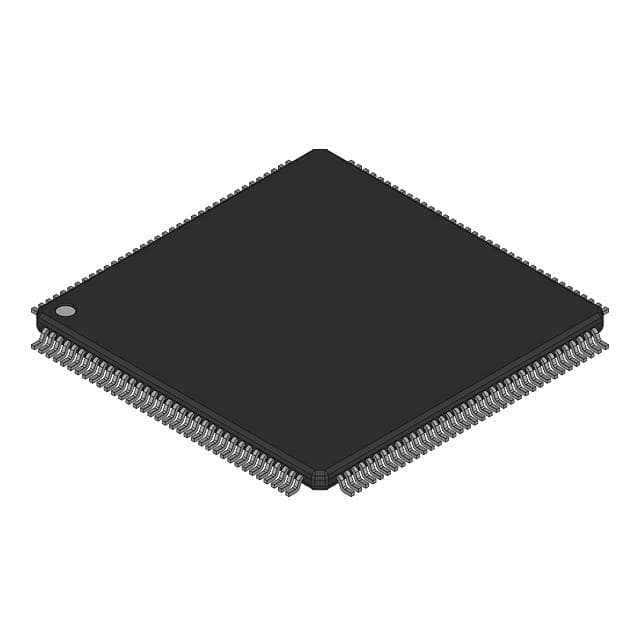
The PCI1410AZGU is packaged in a 144-terminal MicroStar BGA™ (GGU) package with 0.8-mm ball pitch, 12.0 mm × 12.0 mm body size, and JEDEC MO-220 compliant footprint.
| Pin/Terminal | Circuit Role | Design Meaning |
|---|---|---|
| CLKIN | PCI Clock Input | Accepts 33-MHz PCI system clock; drives internal timing for PCI interface and bridge logic |
| FRAME# | PCI Frame Signal | Indicates start/end of PCI transaction cycle; used for arbitration and bus ownership handoff |
| AD[31:0] | PCI Address/Data Multiplex | Time-multiplexed 32-bit address/data bus; latched on rising edge of IRDY# and TRDY# handshake |
| C/BE#[3:0]# | PCI Command/Byte Enable | Defines transaction type (memory/I/O/config) and active byte lanes during data phase |
| PCICLKRUN# | PCI CLKRUN Control | Programmable output to request PCI clock resumption after low-power state; supports power management coordination |
| LED1#, LED2# | Socket-Activity Indicators | Open-drain outputs driving external LEDs to signal card insertion, activity, or suspend status |
| EXCA_A[9:0] | ExCA Register Address Bus | 10-bit address bus mapping ExCA registers into memory or I/O space per PC Card Standard |
| CD1#, CD2# | Card Detect Inputs | Active-low inputs monitoring mechanical switch state to detect card insertion/removal events |
Key Features
| Feature | Design Value |
|---|---|
| ExCA Register Compatibility | Fully maps Intel 82365SL-DF/82365SL registers in memory and I/O space for seamless driver reuse |
| Distributed DMA (DDMA) | Enables concurrent data movement across PCI and CardBus domains without CPU intervention |
| Hot Insertion Support | All card signals internally buffered-no external buffer ICs required for safe live card swap |
| Low-Power Architecture | Multiple sleep modes plus internal ring oscillator reduce host system power draw during idle periods |
| Interrupt Flexibility | Parallel PCI/ISA IRQ and serialized ISA/PCI interrupt options simplify legacy and modern platform integration |
Applications
| Mobile Notebook Expansion | Industrial PC Card Host |
|---|---|
Use Scenario: Adding modular peripherals (modems, LAN, flash storage) to thin-client notebooks via PCMCIA slot. IC Role / Device Role / Timing Role: PCI-to-CardBus bridge controller managing protocol translation, voltage translation, and power sequencing. Use Value: Enables hot-pluggable 32-bit CardBus devices with >130 Mbit/s throughput while maintaining D3cold wake capability for battery-sensitive designs. | Use Scenario: Retrofitting legacy industrial PCs with field-upgradable I/O modules using standardized PC Card form factor. IC Role / Device Role / Timing Role: ExCA-compliant controller providing register-level compatibility with existing 82365SL-based drivers and BIOS. Use Value: Eliminates driver rework and reduces qualification time by preserving software stack while upgrading to higher-bandwidth CardBus support. |
| Embedded Medical Data Logger | Test Equipment Peripheral Interface |
Use Scenario: Connecting removable flash memory or GPS receivers to portable diagnostic equipment via ruggedized PC Card slot. IC Role / Device Role / Timing Role: Dual-voltage (5-V/3.3-V) PC Card interface controller with integrated card-detect and LED signaling. Use Value: Supports mixed-voltage card fleets and provides visual socket-status feedback via dedicated LED1#/LED2# pins without added logic. | Use Scenario: Integrating calibrated sensor modules or waveform generators into automated test systems using PC Card expansion. IC Role / Device Role / Timing Role: High-throughput bridge with fast-posted write support and pipelined data path for real-time data streaming. Use Value: Sustains burst transfers at >130 Mbit/s to minimize test cycle latency when moving large calibration datasets between host and peripheral. |
Equivalent & Alternatives
The following parts are listed as comparable options for similar PCI-to-PC Card bridge applications.
| Alternative Part | Technical Difference | Application Difference | Selection Advice |
|---|---|---|---|
| PCI1420AGGU | Enhanced version with additional GPIOs (7 vs. 5), improved thermal performance, and extended temperature range support | Preferred for extended-temperature industrial deployments requiring higher reliability margin | Select PCI1420AGGU when operating beyond 0°C–70°C ambient or needing extra sideband I/O for custom board control |
| PLX Technology PCI9050 | PCI-to-local bus bridge (not ExCA-compliant); requires custom firmware for PC Card interface layer | Suitable only when full ExCA register mapping is not required and driver development resources are available | Choose PCI9050 only if designing a non-standard PC Card interface where TI's ExCA compliance is unnecessary |
Compared with PCI1410AZGU, PCI1420AGGU offers higher thermal robustness and GPIO count for demanding environments, while PCI9050 lacks native ExCA support-requiring significant firmware investment to replicate PCI1410AZGU's plug-and-play PC Card functionality.
Availability
PCI1410AZGU is available at Aetrix Electronics and suitable for mobile notebook expansion, industrial PC Card host systems, embedded medical data loggers, and test equipment peripheral interfaces requiring stable component supply and long-term design continuity.
Supply support for PCI1410AZGU includes scheduled delivery planning, volume procurement assistance, BOM continuity management, traceable sourcing, and lifecycle availability coordination for OEM customers, industrial embedded developers, connected-device designers, and electronics production programs.
Manufacturer
Texas Instruments is a global semiconductor company delivering analog and embedded processing solutions, with leadership in interface, power management, and connectivity technologies for industrial, automotive, and computing markets.
The PCI1410A product line delivers high-performance, register-compatible PCI-to-PC Card bridge controllers targeting cost-sensitive, high-volume CE and embedded computing platforms requiring hot-swap-ready expansion capabilities.
FAQ
What is the primary function of the PCI1410AZGU in a host system?
The PCI1410AZGU serves as a PCI-to-PC Card bridge controller, enabling communication between a PCI host bus and a single-slot 16-bit PC Card or 32-bit CardBus socket. It handles protocol translation, voltage level adaptation, ExCA register mapping, and DMA coordination. The PCI1410AZGU integrates all necessary logic to support hot insertion/removal, power management states (including D3hot/D3cold wake), and mixed-voltage card operation-eliminating need for external buffer or interface ICs in compliant designs.
Does the PCI1410AZGU support both 16-bit PC Cards and 32-bit CardBus cards?
Yes, the PCI1410AZGU natively supports both 16-bit PC Cards and 32-bit CardBus cards. It provides five PCI memory windows and two I/O windows for the 16-bit PC Card socket, plus two additional I/O and two memory windows dedicated to the CardBus socket. The device maintains full compatibility with the PC Card Standard and enables mix-and-match operation of 5-V and 3.3-V cards, with internal buffering ensuring safe hot insertion and removal for both types without external components.
Is the PCI1410AZGU pin-compatible with Intel 82365SL controllers?
The PCI1410AZGU is register-compatible-not pin-compatible-with the Intel 82365SL-DF and 82365SL ExCA controllers. Its ExCA registers are mapped identically in memory and I/O space, allowing reuse of existing drivers and BIOS code. However, physical pinout differs due to distinct packaging (144-ball GGU BGA vs. Intel's PLCC/QFP packages) and enhanced feature set (e.g., CLKRUN#, LED control, additional GPIOs). Board redesign is required, but software migration is simplified.
What power management features does the PCI1410AZGU support?
The PCI1410AZGU supports PCI Bus Power Management Interface Specification for PCI-to-CardBus bridges, including full compliance with D3hot and D3cold device power states. It enables wake events from both states via card-detect or system interrupts. Additional low-power capabilities include programmable CLKRUN# output to gate PCI clock during idle, internal ring oscillator for autonomous timing, and multiple sleep modes coordinated with host power management firmware-reducing overall system power consumption in portable and embedded applications using PCI1410AZGU.
What package type is used for the PCI1410AZGU, and what are its key mechanical dimensions?
The PCI1410AZGU uses a 144-terminal MicroStar BGA™ (GGU) package with 0.8-mm ball pitch, 12.0 mm × 12.0 mm body size, and JEDEC MO-220 compliance. Ball grid layout is 12 × 12, with corner balls designated A1 and P12. The package features a coplanarity of ≤0.10 mm and moisture sensitivity level (MSL) rating of Level-3 (220°C peak reflow, 168-hour floor life). This GGU package is distinct from the PGE QFP variant and requires BGA-specific PCB layout and assembly practices for reliable deployment of PCI1410AZGU.
PCI1410AZGU Specifications
- Product attributes
- Attribute value
- Manufacturer:
- Texas Instruments
- Package/Case:
- -
- Programmable:
- Not Verified
- Protocol:
- -
- Function:
- -
- Interface:
- -
- Standards:
- -
- Voltage - Supply:
- -
- Current - Supply:
- -
- Operating Temperature:
- -
- Supplier Device Package:
- -
- Grade:
- -
- Qualification:
- -
PCI1410AZGU FAQ
1.How can I place an order for PCI1410AZGU through Aetrix?
Please submit a Request for Quotation (RFQ) for PCI1410AZGU on Aetrix. Our sales agent will provide a competitive quotation and guide you through the order confirmation once you accept the terms.
2.Are the price and stock information for PCI1410AZGU reliable?
The price and inventory of PCI1410AZGU are updated periodically and may fluctuate due to market conditions. Stock and pricing data are typically refreshed every 24 hours. Quotation validity for PCI1410AZGU is usually 5 days.
3.What payment methods are accepted for PCI1410AZGU?
We accept Wire Transfer, PayPal, Credit Card, Western Union, MoneyGram, and Escrow for PCI1410AZGU transactions.
Note: Certain payment methods may incur a processing fee.
4.How is shipping managed for PCI1410AZGU?
PCI1410AZGU orders can be shipped via leading logistics carriers, including DHL, UPS, FedEx, TNT, or Registered Mail.
Once your PCI1410AZGU order is processed, you will receive an email with the shipment details and tracking number.
Note: Tracking information may take up to 24 hours to appear. Express delivery typically takes 3–5 business days.
5.How can I obtain technical support or documentation for PCI1410AZGU?
For technical support, including PCI1410AZGU datasheets, pinout diagrams, or application guidance, please contact our engineering support team. They can provide detailed documentation and assistance for your PCI1410AZGU requirements.
6.How does Aetrix verify that PCI1410AZGU is sourced from the original manufacturer or authorized distributors?
All PCI1410AZGU products on Aetrix are procured from qualified distributors and authorized channels. Our dedicated quality assurance team conducts strict verification, including traceability checks and, if necessary, third-party testing. This ensures that PCI1410AZGU meets industry standards.
7.What is the process for return or replacement of PCI1410AZGU?
All PCI1410AZGU units undergo pre-shipment inspection (PSI). If there is an issue with PCI1410AZGU, returns or replacements are accepted under the following conditions:
1.Quantity discrepancies, incorrect items, or visible external defects (such as breakage or corrosion), acknowledged by Aetrix.
2.The issue is reported within 90 days of delivery.
3.The PCI1410AZGU part is unused and in its original packaging.
Return procedure for PCI1410AZGU:
1.Submit a request within 90 days.
2.Obtain a Return Material Authorization (RMA) from Aetrix.
PCI1410AZGU Tags
-
PTN5150AHXMP
NXP Semiconductors
-
USB3740B-AI9-TR
Microchip Technology
-
USB3740B-AI2-TR
Microchip Technology
-
USB3300-EZK-TR
Microchip Technology
-
USB3300-EZK
Microchip Technology
-
FUSB340TMX
onsemi
-
FUSB302BMPX
onsemi
-
DP83826IRHBR
Texas Instruments
-
MCP2518FDT-E/QBB
Microchip Technology
-
FUSB302MPX
onsemi
-
MCP2518FDT-E/SL
Microchip Technology
-
FT260Q-R
FTDI, Future Technology Devices International Ltd
Tech Hub

A practical engineering guide to 3.3V and 5V logic compatibility, input thresholds, resistor dividers, translator ICs, MOSFET level shifting, I2C pull-ups, timing limits and power-sequencing risks.

The 74HC595 uses push-pull logic outputs, while the TPIC6B595 uses 50 V open-drain DMOS sinks for higher-power loads. This guide compares timing, current limits, 3.3 V interfacing, load wiring, thermal…

The 74HC595 converts serial data into eight stable parallel outputs. This guide covers pin functions, shift and storage timing, OE and MR behavior, drive-current limits, cascading, voltage compatibilit…

A technical comparison of level-sensitive latches and edge-triggered flip-flops, covering timing windows, setup and hold limits, master–slave operation, time borrowing, race-through, HDL inference and…

A D latch stores one bit while Enable controls when data can pass. This reference covers gate-level operation, truth tables, transparency, setup and hold timing, LE versus OE, common ICs and practical …

An SR latch stores one bit through cross-coupled feedback. This engineering reference covers NOR and NAND implementations, truth tables, forbidden-state recovery, gated operation, switch debouncing, fa…

Latch circuits retain one bit through feedback. This technical reference covers SR and D latches, truth tables, transparency, timing limits, latch-versus-flip-flop behavior, applications and common log…

An engineering guide to LED driver operation, constant-current and constant-voltage outputs, linear and switching topologies, dimming, IC selection, calculations, replacement compatibility, and fault c…

Operational amplifier guide covering op amp basics, feedback, ideal vs real op amps, common configurations, buffer circuits, offset, bias current, gain-bandwidth, slew rate, rail-to-rail limits and sel…

Jumper cables guide covering safe connection order, red and black clamp placement, final ground connection, cable gauge, length, clamp quality, copper vs CCA cables, jump starter comparison and battery…


