
 My Inquiry
 My Account


Diodes Incorporated PI4ULS3V304AQ1ZMAEX
- Part No.:
- PI4ULS3V304AQ1ZMAEX
- Manufacturer:
- Diodes Incorporated
- Category:
- Translators, Level Shifters
- Package:
- Datasheet:
-
 PI4ULS3V304AQ1ZMAEX.pdf
- Description:
- IC TRANSLATOR BIDIR 12UQFN T&R
- Quantity:
- Payment:

- Shipping:

Inventory:4,395
Please send an inquiry. Send us your inquiry, and we will respond immediately.
Product details
Overview
PI4ULS3V304AQ1ZMAEX from Diodes Incorporated is an automotive-qualified 4-bit bidirectional level translator IC for push-pull logic interfaces, supporting independent dual-supply operation (0.9–2.0 V on A port, 1.65–3.6 V on B port), 140 Mb/s data rate, 100 pF capacitive drive, and AEC-Q100 Grade 1 qualification (−40 °C to +125 °C). It enables voltage translation between low-voltage microcontrollers and higher-voltage peripherals in automotive infotainment and ADAS sensor interfaces.
For engineers reviewing the PI4ULS3V304AQ1ZMAEX datasheet, PI4ULS3V304AQ1ZMAEX pinout, PI4ULS3V304AQ1ZMAEX application, or PI4ULS3V304AQ1ZMAEX equivalent, this device delivers autosensing bidirectional translation without direction control pins, overvoltage-tolerant I/Os, non-preferential power-up sequencing, and 3-state enable control - critical for robust mixed-voltage automotive subsystem design.
Technical Context
The PI4ULS3V304AQ1ZMAEX implements a dual-rail autosensing architecture with independent A- and B-port supply domains (VCCA and VCCB), enabling translation regardless of relative rail voltage magnitude. Each of its four bidirectional channels uses one-shot edge-detection circuitry to auto-determine signal direction and accelerate output transitions.
It features overvoltage-tolerant EN and I/O pins referenced to VCCA, supports power-off protection with high-impedance I/O states when either supply is absent, and achieves ≤0.15 ns channel-to-channel skew at 15 pF load - ensuring timing integrity across all four channels in high-speed serial links like SPI and I²C derivatives.
Key Specifications
| Parameter | Value and Actual Design Meaning |
|---|---|
| Supply Range (A port) | 0.9 V to 2.0 V - supports ultra-low-voltage logic (e.g., 1.2 V/1.8 V MCUs) while maintaining full functionality |
| Supply Range (B port) | 1.65 V to 3.6 V - interfaces directly with 1.8 V, 2.5 V, 3.3 V peripherals without external level-shifting components |
| Max Data Rate | 140 Mb/s - validated at 2.25–3.6 V VCCB and 1.65–2.0 V VCCA with 15 pF load, enabling high-speed sensor or display interface use |
| Capacitive Drive | 100 pF - drives EMI filters and long PCB traces common in automotive cabin modules without signal degradation |
| Operating Temp | −40 °C to +125 °C ambient - meets AEC-Q100 Grade 1 requirements for under-hood and dashboard electronics |
| ESD Rating | 2 kV system-level HBM - provides robustness against electrostatic discharge in assembly and field environments |
| Enable Function | Active-high EN referenced to VCCA - places all I/Os in 3-state to reduce quiescent current to ≤6 µA (VCCA) / ≤6 µA (VCCB) |
Pinout & Package
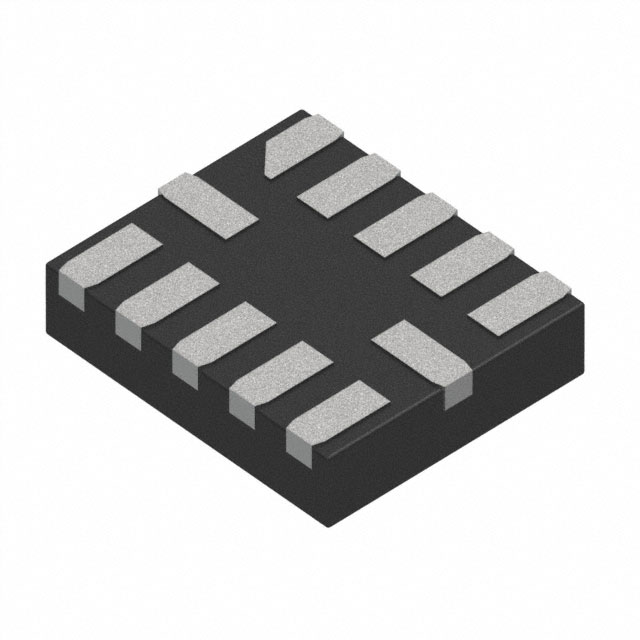
Supplied in a 12-pin UQFN package (ZMA footprint, 2.0 mm × 1.6 mm, 0.4 mm pitch) with wettable flanks for automated optical inspection. Thermal pad exposed on bottom for enhanced heat dissipation in compact automotive modules.
| Pin/Terminal | Circuit Role | Design Meaning |
|---|---|---|
| 1 | VccA | A-port supply rail (0.9–2.0 V); powers internal A-side logic and I/O buffers |
| 2–5 | A1–A4 | Bidirectional I/Os referenced to VccA; auto-sense direction per channel without control lines |
| 6 | GND | Common ground reference for both supply domains and signal integrity |
| 7–10 | B4–B1 | Bidirectional I/Os referenced to VccB; electrically isolated from A-side but logically paired with A1–A4 |
| 11 | VccB | B-port supply rail (1.65–3.6 V); powers B-side logic and high-drive output stages |
| 12 | EN | Active-high enable input referenced to VccA; asserts 3-state on all I/Os when low, reducing total supply current |
Key Features
| Feature | Design Value |
|---|---|
| Autosensing bidirectional translation | Eliminates need for direction-control signals and simplifies PCB routing in SPI, UART, and GPIO expansion applications |
| Non-preferential power-up sequencing | Allows VCCA and VCCB to power up in any order without latch-up or damage - critical for modular automotive ECUs |
| Overvoltage-tolerant I/O and EN pins | Withstands up to 2.6 V (A-side) and 4.0 V (B-side) inputs even when respective supplies are off - enhances system resilience |
| Power-off protection | I/Os enter high-impedance state if either VCCA or VCCB = 0 V - prevents back-powering and signal contention |
| Low bit-to-bit skew | ≤0.15 ns max skew across all four channels at 15 pF ensures deterministic timing in parallel data paths |
Applications
| Automotive Infotainment Display Interface | ADAS Camera Sensor Hub |
|---|---|
Use Scenario: Interfacing a 1.2 V SoC processor to a 3.3 V LVDS display timing controller in a head-unit display module. IC Role / Device Role / Timing Role: Bidirectional level translator managing clock, data, and control signals between mismatched voltage domains with no added latency or direction logic. Use Value: Enables direct connection without discrete MOSFET translators or complex glue logic, reducing BOM count and layout area by >40%. |
Use Scenario: Connecting a 1.8 V image signal processor to multiple 2.8 V/3.3 V camera sensors in a surround-view system. IC Role / Device Role / Timing Role: Four-channel autosensing translator handling parallel pixel data and I²C configuration traffic across independent supply rails. Use Value: Maintains <10 ns propagation delay variation across channels, preserving pixel alignment and frame sync integrity at 60 fps. |
| Body Control Module GPIO Expansion | Automotive Telematics CAN Subsystem |
Use Scenario: Extending low-voltage MCU GPIOs to drive 3.3 V LED drivers, LIN transceivers, and sensor bias circuits in door modules. IC Role / Device Role / Timing Role: Configurable I/O translator operating as uni-directional driver or bi-directional bus extender depending on EN state and signal flow. Use Value: Reduces need for separate input and output buffers; single device replaces two discrete level shifters per channel pair. |
Use Scenario: Isolating 1.8 V CAN FD controller logic from 3.3 V CAN transceiver and diagnostic interface circuitry in telematics gateways. IC Role / Device Role / Timing Role: Voltage-level bridge for CAN TX/RX, STBY, and ERR signals - not CAN protocol handling, but physical-layer voltage adaptation. Use Value: Supports 140 Mb/s burst-mode diagnostics signaling while maintaining AEC-Q100 compliance and thermal stability at 125 °C ambient. |
Equivalent & Alternatives
The following parts are listed as comparable options for similar bidirectional level translation applications.
| Alternative Part | Technical Difference | Application Difference | Selection Advice |
|---|---|---|---|
| NXP PCA9306DCUR | 2-channel, max 100 Mb/s, VREF-based architecture requiring external reference; no AEC-Q100 qualification | Limited to industrial/commercial temp range (−40 °C to +85 °C); lacks automotive change control and PPAP support | Use only where AEC-Q100 is not required and channel count is ≤2; lower cost but higher design overhead due to VREF dependency |
| Texas Instruments TXS0104EPRJR | 4-channel, 60 Mb/s max, auto-bidirectional with 3.6 V max VCCB; AEC-Q100 Grade 2 (−40 °C to +105 °C), not Grade 1 | Insufficient for under-hood applications requiring full −40 °C to +125 °C operation; lower speed limits use in high-bandwidth camera links | Select when Grade 2 qualification suffices and data rates ≤60 Mb/s; avoid for ADAS or infotainment display timing-critical paths |
Compared with PCA9306DCUR and TXS0104EPRJR, the PI4ULS3V304AQ1ZMAEX uniquely combines AEC-Q100 Grade 1, 140 Mb/s performance, true dual-supply independence (no VREF), and 4-channel integration - making it the only drop-in solution for automotive-grade high-speed mixed-voltage interconnects demanding full temperature coverage and production traceability.
Availability
PI4ULS3V304AQ1ZMAEX is available at Aetrix Electronics and suitable for automotive infotainment systems, ADAS sensor hubs, and body control modules requiring stable component supply, long-term lifecycle assurance, and AEC-Q100-compliant sourcing.
Supply support for PI4ULS3V304AQ1ZMAEX includes scheduled delivery planning, volume procurement assistance, BOM continuity management, traceable sourcing, and lifecycle availability coordination for OEM customers, industrial embedded developers, connected-device designers, and electronics production programs.
Manufacturer
Diodes Incorporated is a global manufacturer of discrete semiconductors and integrated circuits, specializing in high-reliability solutions for automotive, industrial, and computing markets with IATF 16949-certified manufacturing.
The PI4ULS3V304AQ1ZMAEX belongs to Diodes' automotive-qualified level translation product line, designed specifically to replace discrete MOSFET-based translators in safety-critical vehicle subsystems while meeting stringent AEC-Q100, PPAP, and thermal reliability requirements.
FAQ
Is PI4ULS3V304AQ1ZMAEX pin-compatible with PI4ULS3V304AQ?
Yes - the "1ZMAEX" suffix denotes tape-and-reel packaging (X) and Pb-free/Green compliance (E), with identical UQFN-12 (ZMA) footprint, pinout, and electrical behavior as the base PI4ULS3V304AQ. No layout or schematic changes are needed when upgrading to the automotive-qualified variant.
Can VCCA be higher than VCCB in PI4ULS3V304AQ1ZMAEX?
Yes - the device explicitly supports VCCA > VCCB (e.g., 1.8 V on A port, 1.65 V on B port), unlike many competitive translators that require VCCA ≤ VCCB − 0.4 V. This flexibility enables use cases such as translating from a 1.8 V MCU to a 1.65 V memory interface or low-power sensor.
What is the maximum capacitive load supported at 140 Mb/s?
The 140 Mb/s rating is guaranteed with ≤15 pF load per I/O, as specified in the timing table for VCCB = 2.25–3.6 V and VCCA = 1.65–2.0 V. At 100 pF, the maximum data rate drops to 60 Mb/s - confirmed by the MIDR specification table. For 100 pF loads, derate speed accordingly or add series termination.
Does the EN pin require a pull-up resistor?
No - the EN pin is internally biased and functions as a standard CMOS input referenced to VCCA. A pull-down is recommended only if default-disabled operation is required at power-up; otherwise, tie EN directly to VCCA for always-enabled operation. No external pull-up is necessary or specified in the datasheet.
PI4ULS3V304AQ1ZMAEX Specifications
- Product attributes
- Attribute value
- Manufacturer:
- Diodes Incorporated
- Series:
- ULS
- Package/Case:
- Packaging:
- Tape & Reel (TR)
- Product Status:
- Active
- Translator Type:
- Voltage Level
- Channel Type:
- Bidirectional
- Number of Circuits:
- 1
- Channels per Circuit:
- 2
- Voltage - VCCA:
- 0.9 V ~ 2 V
- Voltage - VCCB:
- 1.65 V ~ 3.6 V
- Input Signal:
- -
- Output Signal:
- -
- Output Type:
- Non-Inverted
- Data Rate:
- 140Mbps
- Operating Temperature:
- -40°C ~ 125°C (TA)
- Grade:
- -
- Qualification:
- -
- Features:
- -
- Mounting Type:
- Surface Mount
- Supplier Device Package:
- 12-UFQFN
PI4ULS3V304AQ1ZMAEX FAQ
1.How can I place an order for PI4ULS3V304AQ1ZMAEX through Aetrix?
Please submit a Request for Quotation (RFQ) for PI4ULS3V304AQ1ZMAEX on Aetrix. Our sales agent will provide a competitive quotation and guide you through the order confirmation once you accept the terms.
2.Are the price and stock information for PI4ULS3V304AQ1ZMAEX reliable?
The price and inventory of PI4ULS3V304AQ1ZMAEX are updated periodically and may fluctuate due to market conditions. Stock and pricing data are typically refreshed every 24 hours. Quotation validity for PI4ULS3V304AQ1ZMAEX is usually 5 days.
3.What payment methods are accepted for PI4ULS3V304AQ1ZMAEX?
We accept Wire Transfer, PayPal, Credit Card, Western Union, MoneyGram, and Escrow for PI4ULS3V304AQ1ZMAEX transactions.
Note: Certain payment methods may incur a processing fee.
4.How is shipping managed for PI4ULS3V304AQ1ZMAEX?
PI4ULS3V304AQ1ZMAEX orders can be shipped via leading logistics carriers, including DHL, UPS, FedEx, TNT, or Registered Mail.
Once your PI4ULS3V304AQ1ZMAEX order is processed, you will receive an email with the shipment details and tracking number.
Note: Tracking information may take up to 24 hours to appear. Express delivery typically takes 3–5 business days.
5.How can I obtain technical support or documentation for PI4ULS3V304AQ1ZMAEX?
For technical support, including PI4ULS3V304AQ1ZMAEX datasheets, pinout diagrams, or application guidance, please contact our engineering support team. They can provide detailed documentation and assistance for your PI4ULS3V304AQ1ZMAEX requirements.
6.How does Aetrix verify that PI4ULS3V304AQ1ZMAEX is sourced from the original manufacturer or authorized distributors?
All PI4ULS3V304AQ1ZMAEX products on Aetrix are procured from qualified distributors and authorized channels. Our dedicated quality assurance team conducts strict verification, including traceability checks and, if necessary, third-party testing. This ensures that PI4ULS3V304AQ1ZMAEX meets industry standards.
7.What is the process for return or replacement of PI4ULS3V304AQ1ZMAEX?
All PI4ULS3V304AQ1ZMAEX units undergo pre-shipment inspection (PSI). If there is an issue with PI4ULS3V304AQ1ZMAEX, returns or replacements are accepted under the following conditions:
1.Quantity discrepancies, incorrect items, or visible external defects (such as breakage or corrosion), acknowledged by Aetrix.
2.The issue is reported within 90 days of delivery.
3.The PI4ULS3V304AQ1ZMAEX part is unused and in its original packaging.
Return procedure for PI4ULS3V304AQ1ZMAEX:
1.Submit a request within 90 days.
2.Obtain a Return Material Authorization (RMA) from Aetrix.
PI4ULS3V304AQ1ZMAEX Tags
-
74LVC1T45GW,125
Nexperia USA Inc.
-
74LVCH2T45DC,125
Nexperia USA Inc.

-
SN74LVC1T45DBVR
Texas Instruments
-
SN74LVC1T45DRLR
Texas Instruments
-
SN74LVC1T45DPKR
Texas Instruments
-
SN74LVC2T45DCTR
Texas Instruments
-
74LVC2T45GT,115
Nexperia USA Inc.
-
SN74LVC1T45YZPR
Texas Instruments
-
LSF0102DCUR
Texas Instruments
-
SN74LVC1T45DCKR
Texas Instruments
-
TXS0102DCTR
Texas Instruments
-
FXLP34P5X
onsemi
Tech Hub

An engineering guide to LED driver operation, constant-current and constant-voltage outputs, linear and switching topologies, dimming, IC selection, calculations, replacement compatibility, and fault c…

Operational amplifier guide covering op amp basics, feedback, ideal vs real op amps, common configurations, buffer circuits, offset, bias current, gain-bandwidth, slew rate, rail-to-rail limits and sel…

Jumper cables guide covering safe connection order, red and black clamp placement, final ground connection, cable gauge, length, clamp quality, copper vs CCA cables, jump starter comparison and battery…

LDO regulator guide covering low dropout voltage, power dissipation, thermal design, PSRR, output noise, capacitor stability, adjustable LDO circuits, LDO vs buck converter and datasheet selection chec…

Conditional Access Module guide covering CAM meaning, CI/CI+ interface, smart card authorization, DVB security workflow, TV and set-top box compatibility, internal electronics, ESD protection, connecto…

Guide to electronic component obsolescence covering EOL risk, PCN/PDN notices, last-time buy planning, replacement options, form-fit-function validation, counterfeit risk and BOM lifecycle management.

18650 battery guide covering lithium-ion cell basics, 3.6V/3.7V voltage, 4.2V charging, mAh and Wh capacity, protected cells, chargers, BMS, series-parallel packs, holders, welding and sourcing checks.…

Hall effect sensor guide covering working principle, linear and digital sensors, Arduino circuits, current sensing, speed detection, automotive applications, A3144 examples, signal filtering and datash…

Product Change Notification guide for electronic components, covering PCN meaning, PCN vs PDN/EOL, common change types, risk levels, form-fit-function review, engineering validation, BOM control, LTB/L…

A practical guide to blend door actuators, covering HVAC function, symptoms, location, AC and heater issues, reset and calibration, replacement cost, electrical diagnosis, compatibility checks, and rep…


