
 My Inquiry
 My Account


NXP Semiconductors PTN38003AEWY
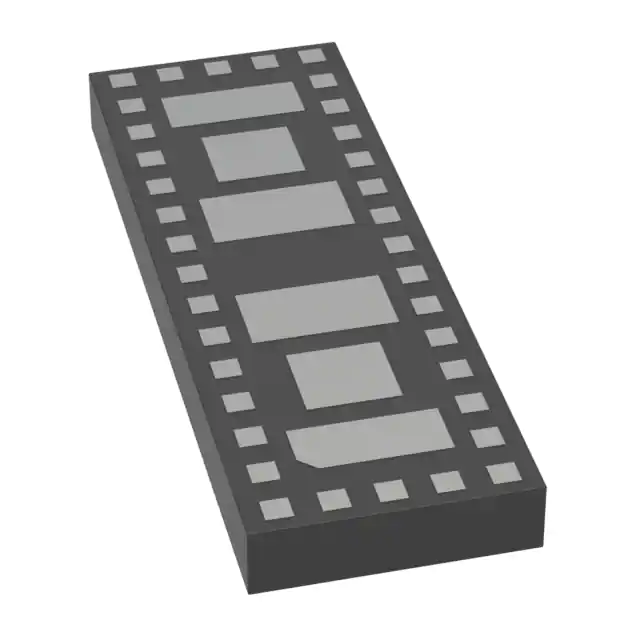
- Part No.:
- PTN38003AEWY
- Manufacturer:
- NXP Semiconductors
- Category:
- Signal Buffers, Repeaters, Splitters
- Package:
- 36-WFLGA Exposed Pad
- Datasheet:
-
 PTN38003AEWY.pdf
- Description:
- IC USB-C 3.2 / DP1.4 REDRIVER
- Quantity:
- Payment:

- Shipping:

Inventory:2,052
Please send an inquiry. Send us your inquiry, and we will respond immediately.
Product details
Overview
PTN38003AEWY from NXP Semiconductors is a multi-protocol linear redriver IC optimized for USB3.2 Gen1/Gen2 (5/10 Gbps) and DisplayPort 1.4/2.0 (up to 20 Gbps) signal integrity enhancement in USB Type-C DFP/UFP applications. It delivers programmable equalization, AUX snooping for DP link training, autonomous orientation detection, and supports four operational modes including deep power saving. It is deployed in notebook host ports and docking station sink interfaces.
For engineers reviewing the PTN38003AEWY datasheet, PTN38003AEWY pinout, PTN38003AEWY application, or PTN38003AEWY equivalent, this page provides verified technical context on USB3.2/DP coexistence, I2C- and pin-strapped configuration, lane-count-aware power management, and HWFLGA36 layout considerations - all critical for Type-C system integration.
Technical Context
The PTN38003AEWY implements dual-path linear redriving with independent upstream/downstream channel control: USB3.2 paths support Gen1x1/Gen1x2/Gen2x1/Gen2x2 operation with LFPS/LBPM detection and U2/U3 state awareness; DP paths support 1–4 lanes at RBR/HBR/HBR2/HBR3/UHBR10/UHBR13.5/UHBR20 rates with real-time AUX snooping of DPCD LANE_COUNT_SET and SET_POWER registers.
Its architecture integrates self-biasing differential I/Os, integrated termination resistors, and ternary gain-control pins (LCTL[3:1], RCTL[3:1]) enabling per-lane peaking gain tuning (+12.1 dB @ 5 GHz for USB, +10.2 dB @ 4.05 GHz / +20 dB @ 10 GHz for DP) and output swing linearity (500–950 mVppd). Mode selection is determined at POR via AUTO_ORIENT_EN and register 0x04 bit [2:0].
Key Specifications
| Parameter | Value and Actual Design Meaning |
|---|---|
| Protocol Support | USB3.2 Gen1/Gen2 (5/10 Gbps) and DisplayPort 1.4/2.0 (1.62–20 Gbps) with AUX snooping |
| Operating Voltage | 1.7–1.9 V supply; 1.8 V nominal for digital, I2C, and AUX blocks |
| Peaking Gain | +12.1 dB @ 5 GHz (USB path); +10.2 dB @ 4.05 GHz / +20 dB @ 10 GHz (DP path) |
| Output Swing Range | 500–950 mVppd, configurable via LCTL3/RCTL3 pin strapping or I2C |
| Active Current (Typ) | 250 mA (USB Gen2x2), 125 mA (USB Gen2x1), 125 mA (2-lane DP HBR3+), 250 mA (4-lane DP only) |
| Power-Saving Current (Typ) | 10 µA (deep power saving), 0.11–0.22 mA (USB U2/U3), 3.2 mA (DP D3 sleep) |
| Package | HWFLGA36 (3.0 × 3.0 mm, 0.4 mm pitch, thermal-enhanced land grid array) |
Pinout & Package
PTN38003AEWY is housed in a 36-pin HWFLGA36 package with flow-through pinout optimized for minimal crosstalk (< −50 dB DDNEXT up to 10.3 GHz) and simplified PCB routing. Six center GND pads provide electrical grounding and thermal relief.
| Pin/Terminal | Circuit Role | Design Meaning |
|---|---|---|
| B_IOP / B_ION | Differential I/O pair | Upstream USB/DP lane; paired with DRX2P/DRX2N; mode-configurable direction |
| A_INP / A_INN | Differential input | Upstream RX path feeding DTX2P/DTX2N; used for SSTX/ML signals in DFP/UFP |
| C_INP / C_INN | Differential input | Upstream RX path feeding DTX1P/DTX1N; supports USB/DP signal routing |
| D_IOP / D_ION | Differential I/O pair | Downstream USB/DP lane; paired with DRX1P/DRX1N; connects to Type-C receptacle |
| DRX1P / DRX1N | Differential I/O pair | Downstream RX path; feeds D_IOP/D_ION; routed to Type-C RX1+/RX1− in DFP |
| DTX1P / DTX1N | Differential output | Downstream TX path; driven by C_INP/C_INN; routed to Type-C TX1+/TX1− in DFP |
| AUXP / AUXN | DP AUX monitor input | Passive snooping of DP sideband channel; enables DPCD-based lane count/power config |
| LCTL1–LCTL3 | Ternary gain control | Set upstream EQ peaking gain (LCTL1/LCTL2) and output linearity (LCTL3) via pin strapping |
| RCTL1–RCTL3 | Ternary gain control | Set downstream EQ peaking gain (RCTL1/RCTL2) and output linearity (RCTL3) |
| AUTO_ORIENT_EN | Binary enable input | Activates autonomous USB-C plug orientation detection at POR; weak internal pulldown |
| SCL / SDA / ADDR | I2C interface | Configurable slave address (ADDR), supports register-level fine-tuning of all redriver parameters |
Key Features
| Feature | Design Value |
|---|---|
| Multi-mode protocol agility | Four hardware-selectable modes: deep power saving, USB-only, USB+2-lane DP, or 4-lane DP - no firmware reconfiguration needed |
| AUX snooping intelligence | Real-time monitoring of DPCD LANE_COUNT_SET and SET_POWER commands to auto-configure lane count and enter D3 sleep without host intervention |
| Autonomous orientation detection | Determines USB-C plug orientation at power-on using SuperSpeed signal characteristics; reports result in register 0x04 bit 4 |
| Dynamic low-power management | Sub-µA deep-sleep (10 µA), USB U2/U3-aware current scaling (0.11–0.22 mA), and DP D3 mode (3.2 mA) reduce system-level power budget |
| Flow-through layout optimization | Signal path alignment minimizes trace length mismatch and inter-pair crosstalk; supports high-density Type-C PCB designs |
Applications
| USB Type-C Host Port | USB Type-C Docking Station |
|---|---|
Use Scenario: Notebook or AIO implementing USB Type-C DFP with simultaneous USB3.2 data and DisplayPort Alt Mode video output. IC Role / Device Role / Timing Role: Linear redriver placed between host SoC and Type-C connector to restore signal integrity across FR4 traces and flex cables. Use Value: Enables reliable 10 Gbps USB3.2 Gen2x1 and 20 Gbps DP UHBR20 over 15 cm PCB + 30 cm cable with <−16 dB return loss up to 10.3 GHz. |
Use Scenario: Multi-function dock supporting USB3.2 peripherals and 4K@120Hz DP display via single Type-C uplink. IC Role / Device Role / Timing Role: Redriver on upstream port handling both USB host-to-peripheral traffic and DP source-to-sink video stream. Use Value: Eliminates need for separate USB and DP redrivers; reduces BOM count and layout area while maintaining compliance with USB Type-C Safe State requirements. |
| Smartphone/Tablet Hub Adapter | Desktop Graphics Expansion |
Use Scenario: Compact adapter converting smartphone USB-C output to HDMI/USB-A/SD card slots. IC Role / Device Role / Timing Role: UFP-side redriver enhancing signal fidelity from mobile SoC to external interfaces under tight thermal constraints. Use Value: Achieves full USB3.2 Gen1x2 bandwidth and DP HBR3 (8.1 Gbps) with 62 mA active current per lane - critical for battery-powered devices. |
Use Scenario: PCIe-based graphics expansion chassis using USB-C for host connection and DP Alt Mode for display output. IC Role / Device Role / Timing Role: Downstream redriver on host-facing port ensuring robust 4-lane DP UHBR10 (10 Gbps) link establishment during hot-plug events. Use Value: Supports AUX-triggered lane activation and automatic D3→D0 wake on DP link request - reducing latency and improving user experience. |
Equivalent & Alternatives
The following parts are listed as comparable options for similar multi-protocol redriver applications.
| Alternative Part | Technical Difference | Application Difference | Selection Advice |
|---|---|---|---|
| TI TUSB1044 | Supports USB3.2 Gen2x2 and DP1.4 (up to HBR3); lacks UHBR20 support and AUX snooping logic | Targeted at cost-sensitive USB/DP hubs without UHBR20 or autonomous orientation needs | Choose when UHBR20 and DPCD-aware lane management are not required |
| Diodes AP1332 | USB3.2 Gen2x2 + DP1.4 redriver with I2C control; no AUX snooping, no orientation detection, lower max gain (+9.5 dB @ 5 GHz) | Suitable for fixed-orientation embedded systems where software-managed configuration suffices | Prefer for simpler, non-Type-C-receptacle applications with static lane assignment |
Compared with TI TUSB1044 and Diodes AP1332, PTN38003AEWY uniquely delivers UHBR20 readiness, real-time AUX snooping for dynamic lane power gating, and hardware-accelerated orientation detection - making it the only option for next-generation USB-C hosts requiring seamless DP Alt Mode scalability and zero-firmware plug-and-play.
Availability
PTN38003AEWY is available at Aetrix Electronics and suitable for notebook host ports, docking stations, smartphone adapters, and desktop expansion chassis requiring stable component supply, long-term lifecycle assurance, and full USB Type-C/DP Alt Mode interoperability validation.
Supply support for PTN38003AEWY includes scheduled delivery planning, volume procurement assistance, BOM continuity management, traceable sourcing, and lifecycle availability coordination for OEM customers, industrial embedded developers, connected-device designers, and electronics production programs.
Manufacturer
NXP Semiconductors is a global semiconductor leader focused on secure connectivity solutions for automotive, industrial, and consumer applications, with deep expertise in high-speed interface IP and USB/PCIe/DP ecosystem integration.
The PTN38003AEWY belongs to NXP's USB Type-C signal integrity product line, designed specifically to solve signal degradation challenges in compact, thermally constrained USB-C endpoints supporting concurrent USB3.2 and DisplayPort Alt Mode operation.
FAQ
What is the primary function of the PTN38003AEWY in a USB Type-C system?
The PTN38003AEWY functions as a multi-protocol linear redriver that restores high-speed signal integrity for both USB3.2 (5/10 Gbps) and DisplayPort (up to 20 Gbps) traffic across PCB traces and cables. It actively compensates for inter-symbol interference using programmable equalization and adapts its configuration based on detected protocol, lane count, and link state - all without host software involvement. The PTN38003AEWY ensures reliable operation in both DFP and UFP roles within USB Type-C architectures.
How does PTN38003AEWY handle USB Type-C plug orientation detection?
The PTN38003AEWY performs autonomous orientation detection at power-on reset when the AUTO_ORIENT_EN pin is asserted high. It analyzes SuperSpeed USB signal characteristics to determine plug orientation and reports the result in register 0x04 bit 4. This hardware-based method eliminates firmware dependency and enables correct upstream/downstream signal routing before any USB or DP traffic begins. The PTN38003AEWY retains the orientation result until explicitly reset or reconfigured via I2C.
Does PTN38003AEWY support DisplayPort 2.0 UHBR20 (20 Gbps) operation?
Yes, the PTN38003AEWY fully supports DisplayPort 2.0 UHBR20 (20 Gbps) operation with measured peaking gain of +20 dB at 10 GHz and output linearity control spanning 500–950 mVppd. Its AUX snooping capability monitors DPCD transactions to dynamically configure lane count and power states during UHBR20 link training. The PTN38003AEWY maintains <−16 dB differential return loss up to 10.3 GHz, meeting signal integrity requirements for UHBR20 channel extension.
What power-saving features distinguish PTN38003AEWY from basic redrivers?
The PTN38003AEWY implements three-tiered power management: deep power saving (10 µA), USB U2/U3-aware states (0.11–0.22 mA), and DP D3 sleep mode (3.2 mA). Unlike basic redrivers, it detects LFPS signaling and AUX commands to autonomously disable unused lanes and circuitry - e.g., disabling LOS detectors in U2/U3 or powering down high-speed paths in DP D3 while keeping AUX snooping active. This granular control is embedded in hardware and requires no host driver intervention. The PTN38003AEWY achieves these states without compromising safe-state compliance on connector-facing pins.
Can PTN38003AEWY be configured exclusively via pin strapping, or is I2C required?
The PTN38003AEWY supports full functionality via pin strapping alone - including mode selection (via AUTO_ORIENT_EN and register 0x04 bit [2:0] emulation), EQ peaking gain (LCTL1/LCTL2/RCTL1/RCTL2), and output swing linearity (LCTL3/RCTL3). I2C is optional and used only for advanced runtime adjustments such as per-lane configuration, orientation override, or AUX snooping enable/disable. The PTN38003AEWY operates immediately after POR with pin-strapped settings, making it suitable for systems lacking I2C infrastructure or requiring deterministic boot behavior.
PTN38003AEWY Specifications
- Product attributes
- Attribute value
- Manufacturer:
- NXP Semiconductors
- Series:
- -
- Package/Case:
- 36-WFLGA Exposed Pad
- Packaging:
- Tape & Reel (TR)
- Product Status:
- Obsolete
- Type:
- ReDriver
- Applications:
- DisplayPort, USB Type C
- Input:
- Differential
- Output:
- Differential
- Data Rate (Max):
- 10Gbps
- Number of Channels:
- 4
- Delay Time:
- 70ps
- Signal Conditioning:
- Input Equalization, Output Pre-Emphasis
- Capacitance - Input:
- 10 pF
- Voltage - Supply:
- 1.7V ~ 1.9V
- Current - Supply:
- 250mA
- Operating Temperature:
- -20°C ~ 85°C (TA)
- Grade:
- -
- Qualification:
- -
- Mounting Type:
- Surface Mount
- Supplier Device Package:
- 36-HWFLGA (2.1x6)
PTN38003AEWY FAQ
1.How can I place an order for PTN38003AEWY through Aetrix?
Please submit a Request for Quotation (RFQ) for PTN38003AEWY on Aetrix. Our sales agent will provide a competitive quotation and guide you through the order confirmation once you accept the terms.
2.Are the price and stock information for PTN38003AEWY reliable?
The price and inventory of PTN38003AEWY are updated periodically and may fluctuate due to market conditions. Stock and pricing data are typically refreshed every 24 hours. Quotation validity for PTN38003AEWY is usually 5 days.
3.What payment methods are accepted for PTN38003AEWY?
We accept Wire Transfer, PayPal, Credit Card, Western Union, MoneyGram, and Escrow for PTN38003AEWY transactions.
Note: Certain payment methods may incur a processing fee.
4.How is shipping managed for PTN38003AEWY?
PTN38003AEWY orders can be shipped via leading logistics carriers, including DHL, UPS, FedEx, TNT, or Registered Mail.
Once your PTN38003AEWY order is processed, you will receive an email with the shipment details and tracking number.
Note: Tracking information may take up to 24 hours to appear. Express delivery typically takes 3–5 business days.
5.How can I obtain technical support or documentation for PTN38003AEWY?
For technical support, including PTN38003AEWY datasheets, pinout diagrams, or application guidance, please contact our engineering support team. They can provide detailed documentation and assistance for your PTN38003AEWY requirements.
6.How does Aetrix verify that PTN38003AEWY is sourced from the original manufacturer or authorized distributors?
All PTN38003AEWY products on Aetrix are procured from qualified distributors and authorized channels. Our dedicated quality assurance team conducts strict verification, including traceability checks and, if necessary, third-party testing. This ensures that PTN38003AEWY meets industry standards.
7.What is the process for return or replacement of PTN38003AEWY?
All PTN38003AEWY units undergo pre-shipment inspection (PSI). If there is an issue with PTN38003AEWY, returns or replacements are accepted under the following conditions:
1.Quantity discrepancies, incorrect items, or visible external defects (such as breakage or corrosion), acknowledged by Aetrix.
2.The issue is reported within 90 days of delivery.
3.The PTN38003AEWY part is unused and in its original packaging.
Return procedure for PTN38003AEWY:
1.Submit a request within 90 days.
2.Obtain a Return Material Authorization (RMA) from Aetrix.
PTN38003AEWY Tags
-
PCA9509GM,125
NXP Semiconductors
-
PCA9617ADPJ
NXP Semiconductors
-
TCA9509DGKR
Texas Instruments
-
PCA9617ATPZ
NXP Semiconductors
-
PCA9517ADP,118
NXP Semiconductors
-
PCA9515ADP,118
NXP Semiconductors
-
PCA9515AD,118
NXP Semiconductors
-
PCA9517DP,118
NXP Semiconductors

-
TUSB211ARWBR
Texas Instruments
-
PCA9517AD,118
NXP Semiconductors
-
PCA9517ATP,147
NXP Semiconductors
-
P82B96PWR
Texas Instruments
Tech Hub

A practical engineering guide to 3.3V and 5V logic compatibility, input thresholds, resistor dividers, translator ICs, MOSFET level shifting, I2C pull-ups, timing limits and power-sequencing risks.

The 74HC595 uses push-pull logic outputs, while the TPIC6B595 uses 50 V open-drain DMOS sinks for higher-power loads. This guide compares timing, current limits, 3.3 V interfacing, load wiring, thermal…

The 74HC595 converts serial data into eight stable parallel outputs. This guide covers pin functions, shift and storage timing, OE and MR behavior, drive-current limits, cascading, voltage compatibilit…

A technical comparison of level-sensitive latches and edge-triggered flip-flops, covering timing windows, setup and hold limits, master–slave operation, time borrowing, race-through, HDL inference and…

A D latch stores one bit while Enable controls when data can pass. This reference covers gate-level operation, truth tables, transparency, setup and hold timing, LE versus OE, common ICs and practical …

An SR latch stores one bit through cross-coupled feedback. This engineering reference covers NOR and NAND implementations, truth tables, forbidden-state recovery, gated operation, switch debouncing, fa…

Latch circuits retain one bit through feedback. This technical reference covers SR and D latches, truth tables, transparency, timing limits, latch-versus-flip-flop behavior, applications and common log…

An engineering guide to LED driver operation, constant-current and constant-voltage outputs, linear and switching topologies, dimming, IC selection, calculations, replacement compatibility, and fault c…

Operational amplifier guide covering op amp basics, feedback, ideal vs real op amps, common configurations, buffer circuits, offset, bias current, gain-bandwidth, slew rate, rail-to-rail limits and sel…

Jumper cables guide covering safe connection order, red and black clamp placement, final ground connection, cable gauge, length, clamp quality, copper vs CCA cables, jump starter comparison and battery…


