
 My Inquiry
 My Account


Renesas R9A07G075M26GBG#AC0

- Part No.:
- R9A07G075M26GBG#AC0
- Manufacturer:
- Renesas
- Category:
- Microprocessors
- Package:
- 320-LFBGA
- Datasheet:
-
 R9A07G075M26GBG#AC0.pdf
- Description:
- IC MPU RZ/T2M 600/800MHZ 320FBGA
- Quantity:
- Payment:

- Shipping:

Inventory:1,814
Please send an inquiry. Send us your inquiry, and we will respond immediately.
Product details
Overview
R9A07G075M26GBG#AC0 from Renesas Electronics is a dual-core Arm® Cortex®-R52 microprocessor operating at 200/400/800 MHz, featuring 2.0 MB on-chip SRAM with ECC, dual-channel Classical CAN (ISO 11898-1), EtherCAT slave controller (3 ports), Ethernet MAC, USB 2.0 HS, and hardware accelerators for ΔΣ, trigonometric functions, and industrial encoders - deployed in real-time motion control systems for servo drives and robotics.
For engineers reviewing the R9A07G075M26GBG#AC0 datasheet, R9A07G075M26GBG#AC0 pinout, R9A07G075M26GBG#AC0 application, or R9A07G075M26GBG#AC0 equivalent, this page delivers verified specifications, package mapping, safety-certified peripheral integration, and direct alternatives for industrial real-time embedded designs requiring deterministic latency, functional safety support, and multi-protocol industrial networking.
Technical Context
The R9A07G075M26GBG#AC0 implements two Arm Cortex-R52 cores (r1p2) in lock-step–independent configuration - no DCLS - with separate instruction/data caches (16 KB/32 KB per core, ECC-protected) and TCM (512 KB ATCM + 64 KB BTCM on CPU0). It integrates a dedicated safety subsystem including EL2/EL1 MPU, CRC calculators, clock monitor (CLMA), and isolated peripherals (GPT, SCI, IIC, SPI, RTC).
Its industrial interface stack includes EtherCAT slave controller (Beckhoff IP core), 3-port Ethernet switch, GMAC, dual Classical CAN (1 Mbps), xSPI (JESD251-compliant), EnDat 2.2/BiSS-C encoder interfaces, and DSMIF supporting up to six external ΔΣ modulators - all synchronized via Event Link Controller (ELC) for CPU-standby operation.
Key Specifications
| Parameter | Value and Actual Design Meaning |
|---|---|
| CPU Core | Dual Arm Cortex-R52 (r1p2), no DCLS; enables independent real-time task partitioning with hardware-enforced isolation. |
| Clock Frequency | 200/400/800 MHz CPU clock (200 MHz system clock); supports deterministic timing-critical control loops. |
| On-chip SRAM | 2.0 MB with SEC-DED ECC; eliminates external RAM dependency for safety-critical firmware and data buffers. |
| Industrial Interfaces | 2× Classical CAN (1 Mbps), EtherCAT slave (3 ports), EnDat 2.2/BiSS-C encoder support; targets servo motor feedback and fieldbus integration. |
| Safety Features | EL2/EL1 MPU, CLMA clock monitor, CRC-32/16/8, DOC unit, isolated GPT/SCI/IIC/SPI/RTC; meets IEC 61508 SIL3 readiness requirements. |
| Power & Temp | VDD = 1.1 V, VCC18 = 1.8 V, VCC33 = 3.3 V; operating junction temperature −40°C to +125°C; qualified for under-hood and drive-train environments. |
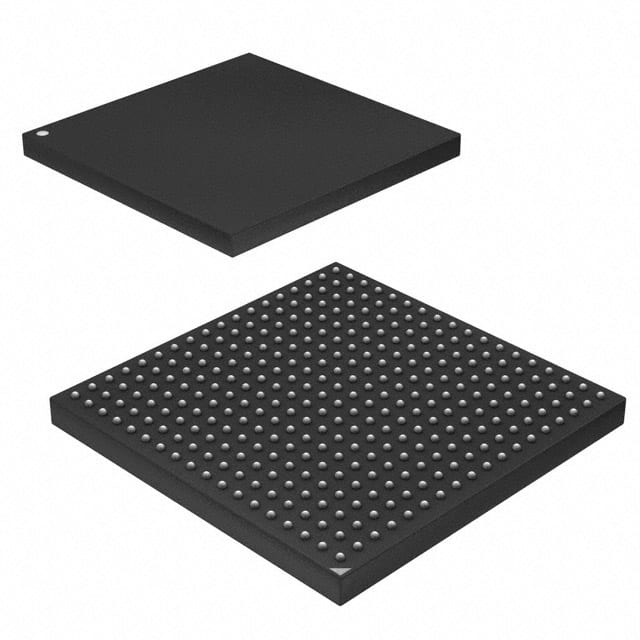
| Package | 320-pin FBGA, 17 mm × 17 mm, 0.8 mm pitch; supports high-density PCB layout with thermal pad for industrial conduction cooling. |
Pinout & Package
320-pin Fine-Pitch Ball Grid Array (FBGA), 17 mm × 17 mm, 0.8 mm pitch, with exposed thermal pad. Pinout conforms to RZ/T2M Group standard layout (R01DS0383EJ0130 Rev.1.30, Pages 112–127); ball map includes dedicated differential pairs for EtherCAT, CAN, RMII/RGMII, xSPI, and encoder interfaces.
| Pin/Terminal | Circuit Role | Design Meaning |
|---|---|---|
| VDD (Balls A1–A4, C1–C4, etc.) | Core power supply | 1.1 V supply for Cortex-R52 cores and internal logic; requires low-noise regulation and local decoupling. |
| VCC18 (Balls D1–D4, E1–E4) | Analog/PLL/USB/ADC supply | 1.8 V rail powering USB PHY, ADC12, TSU, and PLL; must be isolated from digital noise sources. |
| VCC33 (Balls F1–F4, G1–G4) | I/O and USB 3.3 V supply | 3.3 V for GPIO, RMII/MII, SCI, SPI, and USB VBUS sensing; supports 3.3 V tolerant I/Os. |
| CLKIN (Ball K1) | External clock input | 25 MHz crystal/resonator input for system clock generation; connects to on-chip oscillator circuit with stop-detection. |
| RES# (Ball L2) | Active-low reset input | Asynchronous hardware reset pin; initiates full chip reset including CPU, peripherals, and memory controllers. |
| MD[2:0] (Balls M1–M3) | Boot mode selection | Configures boot source (xSPI0/xSPI1/NOR Flash/SCI/USB); latched at power-on reset for secure boot path selection. |
Key Features
| Feature | Design Value |
|---|---|
| Dual Cortex-R52 with TCM and ECC caches | Enables time-deterministic dual-core execution with zero-wait TCM access for critical ISR and control code. |
| EtherCAT Slave Controller (ESC) | Integrated Beckhoff IP core with 3-port MII interface; eliminates external ESC ASIC and reduces BOM cost in servo drives. |
| Encoder interface support (EnDat 2.2, BiSS-C) | Hardware-accelerated position feedback decoding with sub-microsecond latency; supports 2-channel synchronous readout. |
| ΔΣ Interface (DSMIF) × 2 units | Direct connection to 6 external ΔΣ modulators for high-resolution current/voltage sensing without FPGA or external DSP. |
| Trigonometric Function Unit (TFU) | Simultaneous sine/cosine and arctangent/hypotk computation in single cycle; accelerates field-oriented control (FOC) math. |
| Event Link Controller (ELC) | Links 213 event signals across modules; enables timer-triggered ADC sampling and PWM updates while CPU remains in standby. |
Applications
| Industrial Servo Drives | Programmable Logic Controllers (PLCs) |
|---|---|
|
Use Scenario: High-bandwidth current loop control in 3-phase PMSM servo drives with real-time FOC and safety shutdown. IC Role / Device Role / Timing Role: Main real-time controller executing FOC algorithm, PWM generation, encoder position capture, and EtherCAT slave communication with <1 µs jitter. Use Value: On-chip TFU and MTU3/GPT timers eliminate external math coprocessor and reduce PWM update latency to 125 ns resolution. |
Use Scenario: Modular PLC backplane with distributed I/O, motion control, and safety logic execution in a single SoC. IC Role / Device Role / Timing Role: Central processing unit managing cyclic EtherCAT I/O exchange, ladder logic scan, and safety monitoring via isolated peripherals. Use Value: Dual Cortex-R52 cores allow separation of standard control (EL1) and safety-critical tasks (EL2), meeting IEC 61508 Part 3 requirements. |
| Robot Joint Controllers | Industrial Ethernet Gateways |
|
Use Scenario: Compact joint controller integrating motor control, torque sensing (via DSMIF), and real-time network synchronization. IC Role / Device Role / Timing Role: Real-time motion controller with hardware encoder decode, ΔΣ current sensing, and IEEE 1588 timestamping for multi-axis coordination. Use Value: Integrated GMAC + ETHSW + ESC provides deterministic network stack with hardware timestamping and TDMA scheduling for synchronized robot joints. |
Use Scenario: Protocol translation gateway bridging EtherCAT, CAN, and Modbus TCP networks in factory automation. IC Role / Device Role / Timing Role: Protocol-aware bridge processor handling concurrent EtherCAT slave, Classical CAN, and TCP/IP stack with hardware offload. Use Value: Dual CANFD/CAN channels and xSPI-bootable flash enable field-upgradable protocol firmware without external memory. |
Equivalent & Alternatives
The following parts are listed as comparable options for similar real-time industrial MPU applications.
| Alternative Part | Technical Difference | Application Difference | Selection Advice |
|---|---|---|---|
| R9A07G075M28GBG | Same package and dual-core R52, but supports CAN FD (8 Mbps data rate) instead of Classical CAN. | Required where higher bandwidth fieldbus communication (e.g., sensor fusion over CAN FD) is needed alongside EtherCAT. | Select R9A07G075M28GBG if CAN FD protocol compliance is mandatory; otherwise R9A07G075M26GBG#AC0 offers lower-cost Classical CAN implementation. |
| R9A07G075M24GBG | Same dual-core R52 and CAN FD support, but lacks security features (no cryptographic accelerator, TRNG, or JTAG authentication). | Suitable for cost-sensitive non-secure industrial nodes where secure boot and encrypted firmware updates are not required. | Choose R9A07G075M24GBG only when security certification (e.g., IEC 62443) is unnecessary; R9A07G075M26GBG#AC0 retains full security suite. |
Compared with R9A07G075M28GBG and R9A07G075M24GBG, the R9A07G075M26GBG#AC0 uniquely balances Classical CAN compatibility, full EtherCAT/Ethernet integration, and certified security - making it optimal for safety-rated servo drives where CAN FD bandwidth is unnecessary but secure firmware integrity is mandatory.
Availability
R9A07G075M26GBG#AC0 is available at Aetrix Electronics and suitable for industrial servo drives, programmable logic controllers, robotic joint controllers, and industrial Ethernet gateways requiring stable component supply across extended product lifecycles.
Supply support for R9A07G075M26GBG#AC0 includes scheduled delivery planning, volume procurement assistance, BOM continuity management, traceable sourcing, and lifecycle availability coordination for OEM customers, industrial embedded developers, connected-device designers, and electronics production programs.
Manufacturer
Renesas Electronics is a Japanese semiconductor manufacturer specializing in microcontrollers, MPUs, analog, and power devices for automotive, industrial, and IoT markets.
The RZ/T2M product line - including R9A07G075M26GBG#AC0 - was designed specifically for real-time industrial automation, integrating safety, security, and multi-protocol industrial networking into a single high-performance MPU for servo, motion, and PLC applications.
FAQ
What is the maximum operating frequency of the R9A07G075M26GBG#AC0 CPU cores?
The R9A07G075M26GBG#AC0 features dual Arm Cortex-R52 cores with configurable CPU clock frequencies of 200 MHz, 400 MHz, or 800 MHz - dependent on the selected system clock (200 MHz or 150 MHz). These frequencies are validated under full industrial temperature range (−40°C to +125°C) and supported by on-chip voltage regulation and thermal management. The R9A07G075M26GBG#AC0 achieves deterministic real-time performance at all three speeds without throttling.
Does the R9A07G075M26GBG#AC0 support EtherCAT slave functionality?
Yes, the R9A07G075M26GBG#AC0 integrates a licensed EtherCAT Slave Controller (ESC) IP core from Beckhoff Automation GmbH, supporting three physical ports via MII interface. This ESC is fully compliant with EtherCAT protocol specifications and operates alongside the integrated Ethernet MAC and switch - enabling seamless integration into EtherCAT-based motion control networks without external ASICs. The R9A07G075M26GBG#AC0's ESC is active in all 320-pin FBGA variants.
What industrial encoder protocols does the R9A07G075M26GBG#AC0 support?
The R9A07G075M26GBG#AC0 supports EnDat 2.2, BiSS-C, FA-CODER, A-format, and HIPERFACE DSL-compliant encoder interfaces through dedicated hardware blocks. These are implemented in the optional encoder interface module, confirmed available for the 320-pin FBGA package. The R9A07G075M26GBG#AC0 allows simultaneous dual-channel position capture with hardware-assisted decoding and error detection - critical for high-precision servo applications.
Is the R9A07G075M26GBG#AC0 pin-compatible with other RZ/T2M family members?
No - the R9A07G075M26GBG#AC0 is not pin-compatible with other RZ/T2M variants such as R9A07G075M28GBG or R9A07G075M24GBG. While all share the same 320-pin FBGA mechanical footprint and ball pitch, signal assignments differ across models due to variant-specific peripheral enablement (e.g., CAN FD vs. Classical CAN, security block presence). Board-level reuse requires verification against the specific R9A07G075M26GBG#AC0 pin map in R01DS0383EJ0130 Rev.1.30.
What safety certifications does the R9A07G075M26GBG#AC0 target?
The R9A07G075M26GBG#AC0 incorporates hardware safety mechanisms aligned with IEC 61508 SIL3 and ISO 13849 PL e requirements - including dual-stage MPU (EL2/EL1), clock monitor (CLMA), CRC calculators, DOC unit, and isolated safety peripherals. While Renesas provides safety documentation (FMEDA, safety manual), final certification is system-level and requires customer validation. The R9A07G075M26GBG#AC0's architecture enables certified functional safety design without external safety monitors.
R9A07G075M26GBG#AC0 Specifications
- Product attributes
- Attribute value
- Manufacturer:
- Renesas
- Package/Case:
- 320-LFBGA
- Series:
- RZ/T2M
- Packaging:
- Tray
- Product Status:
- Active
- Core Processor:
- ARM® Cortex®-R52
- Number of Cores/Bus Width:
- 2 Core, 32-Bit
- Speed:
- 600MHz, 800MHz
- Co-Processors/DSP:
- Multimedia; NEON™ SIMD
- RAM Controllers:
- -
- Graphics Acceleration:
- No
- Display & Interface Controllers:
- -
- Ethernet:
- 10/100/1000Mbps (2)
- SATA:
- -
- USB:
- USB 2.0 (1)
- Voltage - I/O:
- 1.8V, 3.3V
- Operating Temperature:
- -40°C ~ 125°C (TJ)
- Grade:
- -
- Qualification:
- -
- Security Features:
- Boot Security, Crypto Accelerator, JTAG, TRNG
- Mounting Type:
- Surface Mount
- Supplier Device Package:
- 320-FBGA (17x17)
- Additional Interfaces:
- CANbus, I2C, SCI, SPI, WDT
R9A07G075M26GBG#AC0 FAQ
1.How can I place an order for R9A07G075M26GBG#AC0 through Aetrix?
Please submit a Request for Quotation (RFQ) for R9A07G075M26GBG#AC0 on Aetrix. Our sales agent will provide a competitive quotation and guide you through the order confirmation once you accept the terms.
2.Are the price and stock information for R9A07G075M26GBG#AC0 reliable?
The price and inventory of R9A07G075M26GBG#AC0 are updated periodically and may fluctuate due to market conditions. Stock and pricing data are typically refreshed every 24 hours. Quotation validity for R9A07G075M26GBG#AC0 is usually 5 days.
3.What payment methods are accepted for R9A07G075M26GBG#AC0?
We accept Wire Transfer, PayPal, Credit Card, Western Union, MoneyGram, and Escrow for R9A07G075M26GBG#AC0 transactions.
Note: Certain payment methods may incur a processing fee.
4.How is shipping managed for R9A07G075M26GBG#AC0?
R9A07G075M26GBG#AC0 orders can be shipped via leading logistics carriers, including DHL, UPS, FedEx, TNT, or Registered Mail.
Once your R9A07G075M26GBG#AC0 order is processed, you will receive an email with the shipment details and tracking number.
Note: Tracking information may take up to 24 hours to appear. Express delivery typically takes 3–5 business days.
5.How can I obtain technical support or documentation for R9A07G075M26GBG#AC0?
For technical support, including R9A07G075M26GBG#AC0 datasheets, pinout diagrams, or application guidance, please contact our engineering support team. They can provide detailed documentation and assistance for your R9A07G075M26GBG#AC0 requirements.
6.How does Aetrix verify that R9A07G075M26GBG#AC0 is sourced from the original manufacturer or authorized distributors?
All R9A07G075M26GBG#AC0 products on Aetrix are procured from qualified distributors and authorized channels. Our dedicated quality assurance team conducts strict verification, including traceability checks and, if necessary, third-party testing. This ensures that R9A07G075M26GBG#AC0 meets industry standards.
7.What is the process for return or replacement of R9A07G075M26GBG#AC0?
All R9A07G075M26GBG#AC0 units undergo pre-shipment inspection (PSI). If there is an issue with R9A07G075M26GBG#AC0, returns or replacements are accepted under the following conditions:
1.Quantity discrepancies, incorrect items, or visible external defects (such as breakage or corrosion), acknowledged by Aetrix.
2.The issue is reported within 90 days of delivery.
3.The R9A07G075M26GBG#AC0 part is unused and in its original packaging.
Return procedure for R9A07G075M26GBG#AC0:
1.Submit a request within 90 days.
2.Obtain a Return Material Authorization (RMA) from Aetrix.
R9A07G075M26GBG#AC0 Tags
-
AT91SAM9260B-CU-999
Microchip Technology
-
AT91SAM9G25-CU
Microchip Technology
-
ATSAMA5D27C-CU
Microchip Technology
-
AT91SAM9X35-CU
Microchip Technology
-
AT91SAM9X25-CU
Microchip Technology
-
MCIMX6Y2CVM08AB
NXP Semiconductors
.JPG)
-
AM3352BZCZ100
Texas Instruments
-
AT91SAM9260B-CU
Microchip Technology
-
AT91SAM9260B-QU
Microchip Technology
-
ATSAMA5D31A-CU
Microchip Technology
-
AT91SAM9G20B-CU-999
Microchip Technology
-
MCIMX6Y2CVM05AB
NXP Semiconductors
Tech Hub

TTL and CMOS logic families differ in thresholds, loading, output drive, power and timing. This engineering guide compares 74HC and 74HCT, calculates noise margins and checks 3.3 V/5 V compatibility.

A practical engineering guide to 3.3V and 5V logic compatibility, input thresholds, resistor dividers, translator ICs, MOSFET level shifting, I2C pull-ups, timing limits and power-sequencing risks.

The 74HC595 uses push-pull logic outputs, while the TPIC6B595 uses 50 V open-drain DMOS sinks for higher-power loads. This guide compares timing, current limits, 3.3 V interfacing, load wiring, thermal…

The 74HC595 converts serial data into eight stable parallel outputs. This guide covers pin functions, shift and storage timing, OE and MR behavior, drive-current limits, cascading, voltage compatibilit…

A technical comparison of level-sensitive latches and edge-triggered flip-flops, covering timing windows, setup and hold limits, master–slave operation, time borrowing, race-through, HDL inference and…

A D latch stores one bit while Enable controls when data can pass. This reference covers gate-level operation, truth tables, transparency, setup and hold timing, LE versus OE, common ICs and practical …

An SR latch stores one bit through cross-coupled feedback. This engineering reference covers NOR and NAND implementations, truth tables, forbidden-state recovery, gated operation, switch debouncing, fa…

Latch circuits retain one bit through feedback. This technical reference covers SR and D latches, truth tables, transparency, timing limits, latch-versus-flip-flop behavior, applications and common log…

An engineering guide to LED driver operation, constant-current and constant-voltage outputs, linear and switching topologies, dimming, IC selection, calculations, replacement compatibility, and fault c…

Operational amplifier guide covering op amp basics, feedback, ideal vs real op amps, common configurations, buffer circuits, offset, bias current, gain-bandwidth, slew rate, rail-to-rail limits and sel…


