
 My Inquiry
 My Account


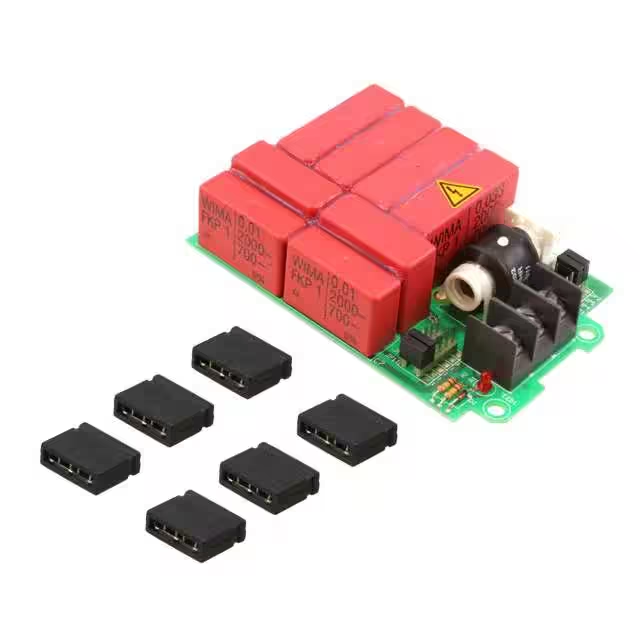
Texas Instruments RI-ACC-008B-30
- Part No.:
- RI-ACC-008B-30
- Manufacturer:
- Texas Instruments
- Category:
- RFID Accessories
- Package:
- Datasheet:
-
 RI-ACC-008B-30.pdf
- Description:
- RFID 2000 ANT TUNING BD 134.2K
- Quantity:
- Payment:

- Shipping:

Inventory:3,593
Please send an inquiry. Send us your inquiry, and we will respond immediately.
Product details
Overview
RI-ACC-008B-30 from Texas Instruments is an antenna tuning module for 134.2 kHz HDX/FSK RFID systems, forming the resonant circuit with external antennas and enabling up to 120 m reader-to-antenna distance via twinax cable. It supports 8–80 µH antenna inductance range, operates from –25°C to +70°C, and delivers up to 380 Vpeak resonance voltage for industrial access control and vehicle identification.
For engineers reviewing the RI-ACC-008B-30 datasheet, RI-ACC-008B-30 pinout, RI-ACC-008B-30 application, or RI-ACC-008B-30 equivalent, key selection factors include its 8–80 µH tunable inductance range, 380 Vpeak resonance voltage capability, twinax-cable interface compatibility with RI-RFM-008B, and operation in harsh industrial environments per IEC 68-2-30.
Technical Context
The RI-ACC-008B-30 functions as a passive LC tuning board that interfaces between the RI-RFM-008B RF power module and external LF antennas. It does not contain active circuitry but provides precise impedance matching across 8–80 µH inductance values to sustain 134.2 kHz resonance under variable cable length and environmental loading.
Its design enables extension of the antenna location up to 120 meters from the reader module using symmetrical twinax cabling, maintaining signal integrity and peak resonance voltage up to 380 Vpeak while operating within –25°C to +70°C ambient temperature and <97% non-condensing humidity.
Key Specifications
| Parameter | Value and Actual Design Meaning |
|---|---|
| RF Frequency | 134.2 kHz - precisely matches TI HDX/FSK transponder carrier for reliable energizing and data exchange. |
| Antenna Tuning Range | 8 µH to 80 µH - accommodates TI gate (RI-ANT-G01E/G02E/G04E) and stick (RI-ANT-S01C/S02C) antennas without redesign. |
| Resonance Voltage | Max. 380 Vpeak - sustains high-field strength at extended distances while staying within safe insulation limits. |
| Operating Temperature | –25°C to +70°C - validated for outdoor and industrial enclosures without thermal derating. |
| Humidity Rating | <97% non-condensing (IEC 68-2-30 Db, 21 cycles) - ensures long-term reliability in humid waste management or port environments. |
| Dimensions | 115 × 70 × 27 mm ±1 mm - mechanical fit verified for standard mounting in RI-series reader housings. |
| Weight | 162 g - lightweight yet rigid construction supports vibration-resistant installation in mobile vehicle ID systems. |
Pinout & Package
RI-ACC-008B-30 is a passive tuning board housed in a molded plastic enclosure (115 × 70 × 27 mm, 162 g) with two screw-terminal connections for twinax cable interface to the RI-RFM-008B RF module. No active IC or semiconductor die is present; it contains only precision capacitors and layout-optimized PCB traces for LC resonance.
| Pin/Terminal | Circuit Role | Design Meaning |
|---|---|---|
| TWINAX IN (+) | RF Input, Positive Leg | Accepts differential 134.2 kHz drive signal from RI-RFM-008B via symmetrical twinax; polarity must match RFM output. |
| TWINAX IN (–) | RF Input, Negative Leg | Completes differential RF path; maintains common-mode rejection and minimizes EMI over 120 m cable runs. |
| ANTENNA OUT (+) | Resonant Circuit Output, Positive | Drives one terminal of connected antenna coil; forms tuned LC tank with onboard capacitance and antenna inductance. |
| ANTENNA OUT (–) | Resonant Circuit Output, Negative | Provides return path for antenna current; completes resonant loop with controlled impedance trace geometry. |
Key Features
| Feature | Design Value |
|---|---|
| Extended Inductance Support | 8–80 µH range enables field replacement of diverse TI antennas without module change or recalibration. |
| High-Voltage Resonance | Rated for 380 Vpeak ensures sufficient magnetic field strength at 120 m distance even with cable loss and environmental detuning. |
| Twinax Interface | Differential input eliminates ground-loop noise and preserves signal fidelity over long industrial cable runs. |
| Harsh Environment Rating | Validated to IEC 68-2-30 Db (21 humidity cycles) confirms operational stability in outdoor, port, and waste-handling sites. |
Applications
| Access Control | Vehicle Identification |
|---|---|
Use Scenario: Gate-mounted RFID reader energizes transponders on employee badges or access fobs at entry points. IC Role / Device Role / Timing Role: RI-ACC-008B-30 serves as the antenna tuning interface, matching impedance between RI-RFM-008B and gate antenna (e.g., RI-ANT-G02E) to maximize read range. Use Value: Enables reliable 3–5 m read distance through metal doors or weatherproof enclosures without antenna retuning. | Use Scenario: Fixed-mount reader identifies transponders on truck chassis or trailers entering logistics yards. IC Role / Device Role / Timing Role: RI-ACC-008B-30 tunes the RI-ANT-G04E gate antenna to sustain 134.2 kHz resonance despite vibration, temperature swing, and EMI from diesel engines. Use Value: Delivers consistent 120 m maximum detection range using twinax extension-critical for automated yard management. |
| Container Tracking | Waste Management |
Use Scenario: Port-side readers scan ISO containers fitted with TI LF transponders during stacking/unloading operations. IC Role / Device Role / Timing Role: RI-ACC-008B-30 interfaces RI-RFM-008B with RI-ANT-S02C stick antenna mounted on crane booms or gantry arms. Use Value: Maintains stable resonance across wide inductance variation caused by container metal mass proximity and salt-air corrosion. | Use Scenario: Underground bin readers detect transponders embedded in municipal waste collection vehicles or smart bins. IC Role / Device Role / Timing Role: RI-ACC-008B-30 couples RI-RFM-008B to RI-ANT-S01C stick antenna installed in damp, buried enclosures. Use Value: Withstands 97% non-condensing humidity and thermal cycling per IEC 68-2-30, ensuring multi-year uptime in landfill environments. |
Equivalent & Alternatives
The following parts are listed as comparable options for similar antenna tuning applications.
| Alternative Part | Technical Difference | Application Difference | Selection Advice |
|---|---|---|---|
| RI-ACC-008B-00 | OBSOLETE variant with identical electrical specs and mechanical footprint; no RoHS compliance documentation available. | Not qualified for new designs per TI status; lacks eco-plan and MSL data required for modern production. | Select RI-ACC-008B-30 for new deployments requiring active supply chain support and documented environmental compliance. |
| RI-ACC-008B-31 | Identical tuning range and voltage rating; differs only in cable connector type (31 uses F-type coaxial vs. 30's twinax terminals). | Requires different cabling infrastructure; incompatible with RI-RFM-008B's twinax output without adapter. | Choose RI-ACC-008B-30 only when integrating with standard Series 2000 twinax-based reader systems. |
Compared with RI-ACC-008B-00 and RI-ACC-008B-31, RI-ACC-008B-30 is the sole ACTIVE variant with validated twinax interface, full environmental test data, and ongoing TI supply support-making it the only suitable choice for new industrial RFID installations requiring long-distance antenna extension.
Availability
RI-ACC-008B-30 is available at Aetrix Electronics and suitable for access control, vehicle identification, and container tracking applications requiring stable component supply, long-cable RF extension, and proven operation in harsh industrial environments.
Supply support for RI-ACC-008B-30 includes scheduled delivery planning, volume procurement assistance, BOM continuity management, traceable sourcing, and lifecycle availability coordination for OEM customers, industrial embedded developers, connected-device designers, and electronics production programs.
Manufacturer
Texas Instruments is a global semiconductor company delivering analog, embedded processing, and connectivity solutions for industrial, automotive, and communications markets.
The RI-ACC-008B-30 belongs to TI's Series 2000 Remote Antenna RFM product line, engineered specifically to decouple antenna placement from reader electronics in 134.2 kHz HDX/FSK RFID systems deployed in logistics, security, and asset visibility infrastructure.
FAQ
What is the primary function of the RI-ACC-008B-30 in a TI RFID system?
The RI-ACC-008B-30 is a passive antenna tuning module that forms the resonant LC circuit with external 134.2 kHz antennas. It interfaces between the RI-RFM-008B RF power module and the antenna via twinax cable, enabling extended read range up to 120 meters. The RI-ACC-008B-30 itself contains no active components-it relies on precision capacitor networks and optimized PCB layout to match antenna inductance (8–80 µH) and sustain 380 Vpeak resonance voltage.
Does the RI-ACC-008B-30 require a power supply or control signals?
No, the RI-ACC-008B-30 is a fully passive tuning board with no internal power requirements or digital interfaces. It receives differential 134.2 kHz RF energy from the RI-RFM-008B module via twinax cable and delivers it to the antenna while maintaining resonance. All control, modulation, and decoding functions reside in the RI-RFM-008B and associated control modules (e.g., RI-CTL-MB2A), not in the RI-ACC-008B-30.
Which antennas are compatible with the RI-ACC-008B-30?
The RI-ACC-008B-30 supports TI-certified antennas with inductance values from 8 µH to 80 µH, including RI-ANT-G01E, RI-ANT-G02E, and RI-ANT-G04E gate antennas, as well as RI-ANT-S01C and RI-ANT-S02C stick antennas. Compatibility is determined solely by measured inductance-not physical form factor-and requires no firmware or hardware modification to the RI-ACC-008B-30.
Can the RI-ACC-008B-30 be used with non-TI RFID transponders?
The RI-ACC-008B-30 is designed exclusively for use with Texas Instruments 134.2 kHz HDX and FSK transponders. Its tuning network, resonance voltage profile, and interface timing align with TI's proprietary protocol stack and field strength requirements. Using it with non-TI transponders-even at 134.2 kHz-may result in unreliable read performance or failure to energize due to mismatched modulation depth and backscatter timing.
What is the maximum recommended cable length between RI-RFM-008B and RI-ACC-008B-30?
Texas Instruments specifies a maximum distance of 120 meters between the RI-RFM-008B and RI-ACC-008B-30 when using symmetrical shielded twinax cable meeting specified impedance and attenuation characteristics. Exceeding this length degrades RF power transfer efficiency and may reduce resonance voltage below the 380 Vpeak threshold needed for reliable transponder activation at range. Cable type, shielding quality, and termination must strictly follow TI's SCBS850 design guidelines.
RI-ACC-008B-30 Specifications
- Product attributes
- Attribute value
- Manufacturer:
- Texas Instruments
- Series:
- -
- Packaging:
- Box
- Product Status:
- Obsolete
- Accessory Type:
- Antenna Tuning Board
- For Use With/Related Products:
- LF Antennas
RI-ACC-008B-30 FAQ
1.How can I place an order for RI-ACC-008B-30 through Aetrix?
Please submit a Request for Quotation (RFQ) for RI-ACC-008B-30 on Aetrix. Our sales agent will provide a competitive quotation and guide you through the order confirmation once you accept the terms.
2.Are the price and stock information for RI-ACC-008B-30 reliable?
The price and inventory of RI-ACC-008B-30 are updated periodically and may fluctuate due to market conditions. Stock and pricing data are typically refreshed every 24 hours. Quotation validity for RI-ACC-008B-30 is usually 5 days.
3.What payment methods are accepted for RI-ACC-008B-30?
We accept Wire Transfer, PayPal, Credit Card, Western Union, MoneyGram, and Escrow for RI-ACC-008B-30 transactions.
Note: Certain payment methods may incur a processing fee.
4.How is shipping managed for RI-ACC-008B-30?
RI-ACC-008B-30 orders can be shipped via leading logistics carriers, including DHL, UPS, FedEx, TNT, or Registered Mail.
Once your RI-ACC-008B-30 order is processed, you will receive an email with the shipment details and tracking number.
Note: Tracking information may take up to 24 hours to appear. Express delivery typically takes 3–5 business days.
5.How can I obtain technical support or documentation for RI-ACC-008B-30?
For technical support, including RI-ACC-008B-30 datasheets, pinout diagrams, or application guidance, please contact our engineering support team. They can provide detailed documentation and assistance for your RI-ACC-008B-30 requirements.
6.How does Aetrix verify that RI-ACC-008B-30 is sourced from the original manufacturer or authorized distributors?
All RI-ACC-008B-30 products on Aetrix are procured from qualified distributors and authorized channels. Our dedicated quality assurance team conducts strict verification, including traceability checks and, if necessary, third-party testing. This ensures that RI-ACC-008B-30 meets industry standards.
7.What is the process for return or replacement of RI-ACC-008B-30?
All RI-ACC-008B-30 units undergo pre-shipment inspection (PSI). If there is an issue with RI-ACC-008B-30, returns or replacements are accepted under the following conditions:
1.Quantity discrepancies, incorrect items, or visible external defects (such as breakage or corrosion), acknowledged by Aetrix.
2.The issue is reported within 90 days of delivery.
3.The RI-ACC-008B-30 part is unused and in its original packaging.
Return procedure for RI-ACC-008B-30:
1.Submit a request within 90 days.
2.Obtain a Return Material Authorization (RMA) from Aetrix.
RI-ACC-008B-30 Tags


Tech Hub

A practical engineering guide to 3.3V and 5V logic compatibility, input thresholds, resistor dividers, translator ICs, MOSFET level shifting, I2C pull-ups, timing limits and power-sequencing risks.

The 74HC595 uses push-pull logic outputs, while the TPIC6B595 uses 50 V open-drain DMOS sinks for higher-power loads. This guide compares timing, current limits, 3.3 V interfacing, load wiring, thermal…

The 74HC595 converts serial data into eight stable parallel outputs. This guide covers pin functions, shift and storage timing, OE and MR behavior, drive-current limits, cascading, voltage compatibilit…

A technical comparison of level-sensitive latches and edge-triggered flip-flops, covering timing windows, setup and hold limits, master–slave operation, time borrowing, race-through, HDL inference and…

A D latch stores one bit while Enable controls when data can pass. This reference covers gate-level operation, truth tables, transparency, setup and hold timing, LE versus OE, common ICs and practical …

An SR latch stores one bit through cross-coupled feedback. This engineering reference covers NOR and NAND implementations, truth tables, forbidden-state recovery, gated operation, switch debouncing, fa…

Latch circuits retain one bit through feedback. This technical reference covers SR and D latches, truth tables, transparency, timing limits, latch-versus-flip-flop behavior, applications and common log…

An engineering guide to LED driver operation, constant-current and constant-voltage outputs, linear and switching topologies, dimming, IC selection, calculations, replacement compatibility, and fault c…

Operational amplifier guide covering op amp basics, feedback, ideal vs real op amps, common configurations, buffer circuits, offset, bias current, gain-bandwidth, slew rate, rail-to-rail limits and sel…

Jumper cables guide covering safe connection order, red and black clamp placement, final ground connection, cable gauge, length, clamp quality, copper vs CCA cables, jump starter comparison and battery…


