
 My Inquiry
 My Account


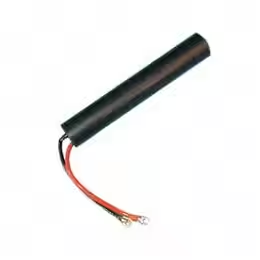
Texas Instruments RI-ANT-P02A-30
- Part No.:
- RI-ANT-P02A-30
- Manufacturer:
- Texas Instruments
- Category:
- RFID Antennas
- Package:
- Datasheet:
-
 RI-ANT-P02A-30.pdf
- Description:
- RFID ANTENNA 134.2KHZ W/1M CABLE
- Quantity:
- Payment:

- Shipping:

Inventory:3,909
Please send an inquiry. Send us your inquiry, and we will respond immediately.
Product details
Overview
RI-ANT-P02A-30 from Texas Instruments is a low-frequency (134.2 kHz) stick antenna designed for integration with RI-RFM-003B radio frequency modules in LF RFID systems. It delivers typically 27 µH inductance at 134.2 kHz, IP66 ingress protection, and operates from –30°C to +70°C. Its compact 140 ± 2 mm × 21 ± 2 mm (dia.) form factor with 1 m cable and ring lug terminals enables focused read-zone deployment in industrial asset tracking.
For engineers reviewing the RI-ANT-P02A-30 datasheet, RI-ANT-P02A-30 pinout, RI-ANT-P02A-30 application, or RI-ANT-P02A-30 equivalent, key selection criteria include its 134.2 kHz resonant inductance, IP66-rated enclosure, Mil-Std-810E vibration compliance, glass-reinforced epoxy construction, and compatibility with TI's HDX transponder technology in access control and vehicle ID systems.
Technical Context
The RI-ANT-P02A-30 functions as a tuned passive resonator in low-frequency RFID reader systems, forming the electromagnetic interface between the RI-RFM-003B module and TI HDX transponders. Its 27 µH inductance is optimized for 134.2 kHz carrier frequency operation and supports energy transfer and bidirectional signal coupling.
Designed specifically for the RI-RFM-003B, it provides a focused read zone-distinct from gate antennas' broad coverage-enabling spatial discrimination between closely spaced transponders in container or asset management deployments. Mounting uses non-metal clamps to avoid detuning, and its glass-reinforced epoxy housing ensures mechanical stability under Mil-Std-810E Category 1 transportation vibration.
Key Specifications
| Parameter | Value and Actual Design Meaning |
|---|---|
| Operating Frequency | 134.2 kHz - precisely matched to TI HDX transponder carrier standard |
| Inductance | Typically 27 µH @ 134.2 kHz - sets resonant tuning with external capacitor for optimal power transfer |
| Protection Class | IP66 - dust-tight and protected against powerful water jets, suitable for outdoor/industrial use |
| Operating Temperature | –30°C to +70°C - supports deployment in uncontrolled environments including vehicle under-hood or waste collection sites |
| Cable Length | 1 m - enables flexible placement of antenna relative to RFM while minimizing loss and EMI coupling |
| Connection Terminals | Ring lugs (3.5 mm ID / 7.5 mm OD) - secure, low-resistance interface compatible with standard mounting hardware |
| Mounting Method | Non-metallic clamps only - prevents eddy current losses and maintains specified inductance and read performance |
Availability
RI-ANT-P02A-30 is available at Aetrix Electronics and suitable for access control, vehicle identification, and container tracking applications requiring stable component supply, long-term industrial availability, and RoHS-compliant passive RF components.
Supply support for RI-ANT-P02A-30 includes scheduled delivery planning, volume procurement assistance, BOM continuity management, traceable sourcing, and lifecycle availability coordination for OEM customers, industrial embedded developers, connected-device designers, and electronics production programs.
Manufacturer
Texas Instruments is a global semiconductor company specializing in analog, embedded processing, and connectivity technologies, with leadership in industrial, automotive, and RFID solutions.
The RI-ANT-P02A-30 belongs to TI's Series 2000 Antennas product line, engineered specifically for reliable, high-performance coupling with TI's 134.2 kHz HDX transponder ecosystem in harsh industrial RFID applications.
FAQ
What is the operating frequency and inductance specification of the RI-ANT-P02A-30?
The RI-ANT-P02A-30 is designed for 134.2 kHz low-frequency RFID operation and exhibits a typical inductance of 27 µH at that frequency. This value is critical for resonant tuning with the matching capacitor in the RI-RFM-003B circuit, ensuring efficient energy transfer to HDX transponders. The inductance is measured under standard conditions and directly impacts read range and reliability in deployed systems using the RI-ANT-P02A-30.
Is the RI-ANT-P02A-30 compatible with other TI RF modules besides the RI-RFM-003B?
The RI-ANT-P02A-30 is explicitly specified for use with the RI-RFM-003B module in TI's documentation. While electrical compatibility with other 134.2 kHz modules cannot be ruled out, no functional validation or design support is provided for alternate modules. For guaranteed performance and system certification, the RI-ANT-P02A-30 must be used with the RI-RFM-003B as intended in TI's reference architecture.
What does IP66 protection mean for the RI-ANT-P02A-30 in real-world deployment?
IP66 certification means the RI-ANT-P02A-30 is fully dust-tight and protected against powerful water jets from any direction-making it suitable for outdoor, washdown, or high-humidity environments such as waste management facilities or vehicle inspection lanes. This rating is achieved via its sealed glass-reinforced epoxy housing and contributes directly to long-term reliability where the RI-ANT-P02A-30 is exposed to weather, cleaning agents, or industrial contaminants.
Why must non-metallic clamps be used when mounting the RI-ANT-P02A-30?
Non-metallic clamps are required to prevent magnetic field distortion and inductance shift caused by eddy currents induced in conductive materials near the ferrite-based antenna structure. Using metallic fasteners would detune the 27 µH resonance, degrade read zone shape and distance, and compromise system-level performance of the RI-ANT-P02A-30. TI specifies this mounting constraint to ensure repeatable, specification-compliant operation.
How does the RI-ANT-P02A-30 differ from gate antennas like the RI-ANT-G02E in application role?
The RI-ANT-P02A-30 is a stick antenna delivering a focused, directional read zone ideal for discriminating between adjacent transponders-e.g., scanning individual assets on a pallet. In contrast, gate antennas like the RI-ANT-G02E generate wide-area fields for portal-style detection. This functional distinction makes the RI-ANT-P02A-30 appropriate for handheld or targeted scanning roles, whereas the RI-ANT-G02E suits entry/exit point monitoring in vehicle ID or container tracking systems.
RI-ANT-P02A-30 Specifications
- Product attributes
- Attribute value
- Manufacturer:
- Texas Instruments
- Series:
- Stick Antenna
- Packaging:
- Bulk
- Product Status:
- Obsolete
- Frequency:
- 134.2kHz
- Features:
- 0.1m Cable
- Size / Dimension:
- -
- Grade:
- -
- Qualification:
- -
RI-ANT-P02A-30 FAQ
1.How can I place an order for RI-ANT-P02A-30 through Aetrix?
Please submit a Request for Quotation (RFQ) for RI-ANT-P02A-30 on Aetrix. Our sales agent will provide a competitive quotation and guide you through the order confirmation once you accept the terms.
2.Are the price and stock information for RI-ANT-P02A-30 reliable?
The price and inventory of RI-ANT-P02A-30 are updated periodically and may fluctuate due to market conditions. Stock and pricing data are typically refreshed every 24 hours. Quotation validity for RI-ANT-P02A-30 is usually 5 days.
3.What payment methods are accepted for RI-ANT-P02A-30?
We accept Wire Transfer, PayPal, Credit Card, Western Union, MoneyGram, and Escrow for RI-ANT-P02A-30 transactions.
Note: Certain payment methods may incur a processing fee.
4.How is shipping managed for RI-ANT-P02A-30?
RI-ANT-P02A-30 orders can be shipped via leading logistics carriers, including DHL, UPS, FedEx, TNT, or Registered Mail.
Once your RI-ANT-P02A-30 order is processed, you will receive an email with the shipment details and tracking number.
Note: Tracking information may take up to 24 hours to appear. Express delivery typically takes 3–5 business days.
5.How can I obtain technical support or documentation for RI-ANT-P02A-30?
For technical support, including RI-ANT-P02A-30 datasheets, pinout diagrams, or application guidance, please contact our engineering support team. They can provide detailed documentation and assistance for your RI-ANT-P02A-30 requirements.
6.How does Aetrix verify that RI-ANT-P02A-30 is sourced from the original manufacturer or authorized distributors?
All RI-ANT-P02A-30 products on Aetrix are procured from qualified distributors and authorized channels. Our dedicated quality assurance team conducts strict verification, including traceability checks and, if necessary, third-party testing. This ensures that RI-ANT-P02A-30 meets industry standards.
7.What is the process for return or replacement of RI-ANT-P02A-30?
All RI-ANT-P02A-30 units undergo pre-shipment inspection (PSI). If there is an issue with RI-ANT-P02A-30, returns or replacements are accepted under the following conditions:
1.Quantity discrepancies, incorrect items, or visible external defects (such as breakage or corrosion), acknowledged by Aetrix.
2.The issue is reported within 90 days of delivery.
3.The RI-ANT-P02A-30 part is unused and in its original packaging.
Return procedure for RI-ANT-P02A-30:
1.Submit a request within 90 days.
2.Obtain a Return Material Authorization (RMA) from Aetrix.
RI-ANT-P02A-30 Tags
-
TPLC553030-592H
TDK Corporation
-
B82451L2364E402
EPCOS - TDK Electronics
-
1462360101
Molex
-
W3102
Pulse Electronics
-
1462360021
Molex
-
1462362122
Molex
-
B82453C0275A000
EPCOS - TDK Electronics
-
AS705-125A-XH
Sumida America Components Inc.
-
1462362151
Molex
-
FXR.01.07.0100C.A
Taoglas Limited

-
FXR.1515.A
Taoglas Limited
-
B82450A1084C000
EPCOS - TDK Electronics
Tech Hub

A practical engineering guide to 3.3V and 5V logic compatibility, input thresholds, resistor dividers, translator ICs, MOSFET level shifting, I2C pull-ups, timing limits and power-sequencing risks.

The 74HC595 uses push-pull logic outputs, while the TPIC6B595 uses 50 V open-drain DMOS sinks for higher-power loads. This guide compares timing, current limits, 3.3 V interfacing, load wiring, thermal…

The 74HC595 converts serial data into eight stable parallel outputs. This guide covers pin functions, shift and storage timing, OE and MR behavior, drive-current limits, cascading, voltage compatibilit…

A technical comparison of level-sensitive latches and edge-triggered flip-flops, covering timing windows, setup and hold limits, master–slave operation, time borrowing, race-through, HDL inference and…

A D latch stores one bit while Enable controls when data can pass. This reference covers gate-level operation, truth tables, transparency, setup and hold timing, LE versus OE, common ICs and practical …

An SR latch stores one bit through cross-coupled feedback. This engineering reference covers NOR and NAND implementations, truth tables, forbidden-state recovery, gated operation, switch debouncing, fa…

Latch circuits retain one bit through feedback. This technical reference covers SR and D latches, truth tables, transparency, timing limits, latch-versus-flip-flop behavior, applications and common log…

An engineering guide to LED driver operation, constant-current and constant-voltage outputs, linear and switching topologies, dimming, IC selection, calculations, replacement compatibility, and fault c…

Operational amplifier guide covering op amp basics, feedback, ideal vs real op amps, common configurations, buffer circuits, offset, bias current, gain-bandwidth, slew rate, rail-to-rail limits and sel…

Jumper cables guide covering safe connection order, red and black clamp placement, final ground connection, cable gauge, length, clamp quality, copper vs CCA cables, jump starter comparison and battery…


