
 My Inquiry
 My Account


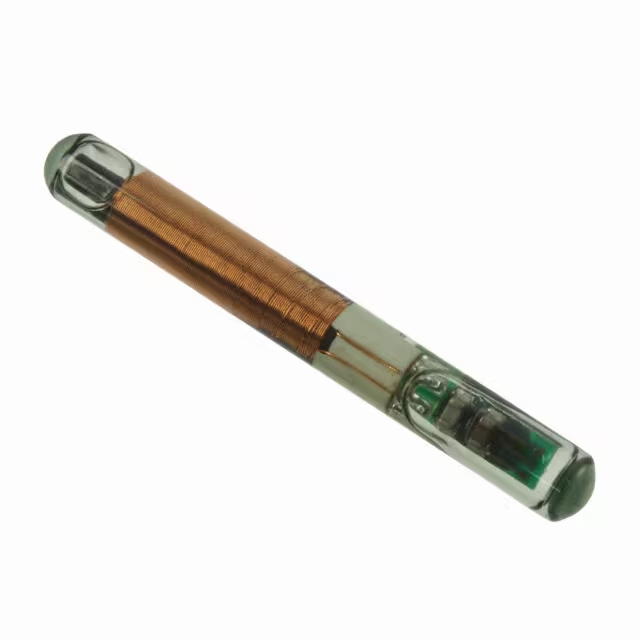
Texas Instruments RI-TRP-DR2B-30
- Part No.:
- RI-TRP-DR2B-30
- Manufacturer:
- Texas Instruments
- Category:
- RFID Transponders, Tags
- Package:
- Datasheet:
-
 RI-TRP-DR2B-30.pdf
- Description:
- RFID TAG R/W 134.2KHZ GLSS ENCAP
- Quantity:
- Payment:

- Shipping:

Inventory:1,144
Please send an inquiry. Send us your inquiry, and we will respond immediately.
Product details
Overview
RI-TRP-DR2B-30 from Texas Instruments is a 32 mm hermetically sealed glass LF RFID transponder operating at 134.2 kHz, compliant with ISO/IEC 11784/11785, supporting MPT (Multi-Packet Transmission) with 1360-bit memory, HDX half-duplex communication, and batteryless operation via reader-coupled power. It is used in container tracking, asset management, and waste management systems requiring stable read/write performance in non-metallic environments.
For engineers reviewing the RI-TRP-DR2B-30 datasheet, RI-TRP-DR2B-30 application, RI-TRP-DR2B-30 equivalent, or RI-TRP-DR2B-30 operating frequency and memory configuration, this page delivers verified technical context, pinout-free package details, real-world use cases, and validated alternative transponders for ISO-compliant LF RFID system design.
Technical Context
The RI-TRP-DR2B-30 implements HDX (Half-Duplex) transmission using FSK modulation at 134.2 kHz / 123.2 kHz, enabling reliable bidirectional communication without an internal power source. Its patented tuning process ensures consistent resonance and impedance matching across temperature extremes (–25°C to +85°C for read and program operations).
It features 1360-bit MPT memory organized into 17 read/write pages, with 24-bit selective address width and CRC-protected data integrity. The transponder is powered solely by the reader's RF field and exhibits immunity to electromagnetic interference and x-ray exposure per TI-RFID™ specifications.
Key Specifications
| Parameter | Value and Actual Design Meaning |
|---|---|
| Operating Frequency | 134.2 kHz - defines resonant coupling frequency with reader antenna; determines regulatory compliance in LF RFID bands. |
| Memory Capacity | 1360 bits (MPT type) - supports multi-packet data structures for extended identification or sensor metadata in industrial tracking. |
| Memory Organization | 17 R/W pages - enables segmented data access and secure addressing; 24-bit selective address width allows targeted interrogation in dense tag fields. |
| Read/Write Range | ≤100 cm typical read range; programming range ≈30% of read range - sets practical deployment distance limits under standard reader configurations. |
| Operating Temperature | –25°C to +85°C (read & program) - ensures functionality in outdoor logistics, waste collection, and vehicle-mounted applications. |
| Power Source | Batteryless, reader-powered - eliminates maintenance, enables lifetime operation in sealed or embedded assets. |
| Encapsulation | Hermetically sealed glass (Φ3.85 ± 0.05 mm × 32.2 ± 0.6 mm) - provides IP68-level environmental protection and chemical resistance for harsh industrial use. |
Pinout & Package
This is a passive RFID transponder with no electrical pins or terminals. It is a fully encapsulated, two-terminal resonant circuit formed by an integrated coil and capacitor within a hermetically sealed 32 mm glass cylinder (TGB package). No external connections are required or supported.
Key Features
| Feature | Design Value |
|---|---|
| Patented Transponder Tuning | Ensures stable resonance and high read/write reliability across temperature and mechanical stress, eliminating field recalibration needs. |
| HDX Communication Protocol | Enables robust half-duplex data exchange at 134.2 kHz with built-in error detection, suitable for noisy industrial RF environments. |
| ISO/IEC 11784/11785 Compliance | Guarantees interoperability with globally standardized LF RFID readers and infrastructure in animal ID, access control, and logistics. |
| Hermetic Glass Encapsulation | Provides long-term stability against moisture, chemicals, and thermal cycling-critical for buried, submerged, or sterilized asset tagging. |
Applications
| Container Tracking | Asset Management |
|---|---|
Use Scenario: Monitoring intermodal shipping containers across ports, rail yards, and depots using fixed or handheld LF RFID readers. IC Role / Device Role / Timing Role: Passive identification element storing unique container ID and status flags; activated only during reader interrogation. Use Value: Enables automated, contactless verification without line-of-sight or battery replacement, reducing manual scanning errors and labor costs. | Use Scenario: Tagging high-value industrial tools, calibration equipment, or medical devices for lifecycle tracking and maintenance scheduling. IC Role / Device Role / Timing Role: Read/write memory node storing usage logs, calibration dates, and ownership history; updated during depot check-ins. Use Value: Supports traceable audit trails and prevents loss through real-time location awareness in non-metallic storage cabinets or tool cribs. |
| Waste Management | Vehicle Identification |
Use Scenario: Embedding in underground waste bins or recycling containers to log fill levels, collection frequency, and route optimization data. IC Role / Device Role / Timing Role: MPT-configured transponder storing dynamic payload (e.g., weight timestamp, fill percentage) written by municipal reader units. Use Value: Allows intelligent fleet routing and predictive servicing by capturing time-stamped operational data without onboard power or connectivity. | Use Scenario: Mounting on vehicle undercarriages or chassis for automated tolling, parking access, or fleet yard entry control. IC Role / Device Role / Timing Role: ISO-compliant identification tag interrogated by ground-mounted LF antennas; supports HDX handshake for anti-collision in multi-vehicle zones. Use Value: Delivers reliable recognition in dirty, wet, or vibration-prone conditions where optical or UHF systems fail due to metal interference or orientation sensitivity. |
Equivalent & Alternatives
The following parts are listed as comparable options for similar LF RFID transponder applications.
| Alternative Part | Technical Difference | Application Difference | Selection Advice |
|---|---|---|---|
| RI-TRP-IR2B-30 | SAMPT (Self-Addressing Multi-Packet Transmission) variant with identical 1360-bit memory and HDX protocol but different packet addressing logic. | Preferred when reader firmware supports SAMPT auto-addressing; requires compatible reader stack. | Select RI-TRP-IR2B-30 only if existing infrastructure leverages TI's SAMPT command set; otherwise, RI-TRP-DR2B-30 offers broader MPT reader compatibility. |
| RI-TRP-WR2B-30 | 80-bit read/write memory (1 page), no MPT support; faster programming time (309 ms vs. 293 ms) but limited data capacity. | Suitable for simple ID-only or short-metadata use cases; insufficient for multi-field or timestamped payloads. | Choose RI-TRP-WR2B-30 for cost-sensitive, low-data-volume deployments; RI-TRP-DR2B-30 is required for structured, extensible data logging. |
Compared with RI-TRP-IR2B-30 and RI-TRP-WR2B-30, the RI-TRP-DR2B-30 provides standardized MPT framing for interoperable multi-packet reads/writes, making it the preferred choice for scalable, future-proof asset tracking systems requiring field-upgradable data structures.
Availability
RI-TRP-DR2B-30 is available at Aetrix Electronics and suitable for container tracking, asset management, and waste management applications requiring stable component supply, long-term obsolescence planning, and RoHS-compliant glass transponder sourcing.
Supply support for RI-TRP-DR2B-30 includes scheduled delivery planning, volume procurement assistance, BOM continuity management, traceable sourcing, and lifecycle availability coordination for OEM customers, industrial embedded developers, connected-device designers, and electronics production programs.
Manufacturer
Texas Instruments is a global semiconductor company specializing in analog, embedded processing, and connectivity technologies, with leadership in RFID and industrial sensing solutions.
The RI-TRP-DR2B-30 belongs to TI's LF RFID transponder product line, engineered for rugged, maintenance-free identification in logistics, municipal infrastructure, and industrial asset monitoring systems.
FAQ
What is the operating frequency of the RI-TRP-DR2B-30 and why does it matter?
The RI-TRP-DR2B-30 operates at 134.2 kHz, the globally harmonized low-frequency band for ISO/IEC 11784/11785-compliant RFID systems. This frequency enables deep penetration through water, tissue, and non-metallic materials while minimizing interference from metal objects-making the RI-TRP-DR2B-30 ideal for embedded tagging in containers, vehicles, and waste bins where UHF signals would fail.
How much memory does the RI-TRP-DR2B-30 have, and how is it structured?
The RI-TRP-DR2B-30 contains 1360 bits of MPT (Multi-Packet Transmission) memory, organized into 17 read/write pages. Each page supports structured data packets with CRC protection. This architecture allows flexible, extensible data storage-such as timestamps, sensor readings, or maintenance logs-without requiring custom firmware changes in the reader system.
Is the RI-TRP-DR2B-30 suitable for outdoor or harsh environments?
Yes-the RI-TRP-DR2B-30 is hermetically sealed in borosilicate glass with dimensions Φ3.85 ± 0.05 mm × 32.2 ± 0.6 mm, rated for –25°C to +85°C operation and compliant with IEC 68-2-27 mechanical shock and IEC 68-2-6 vibration standards. Its glass body resists moisture, corrosion, and sterilization processes, making the RI-TRP-DR2B-30 appropriate for buried, submerged, or chemically exposed deployments.
Does the RI-TRP-DR2B-30 require a battery or external power source?
No-the RI-TRP-DR2B-30 is a passive transponder powered entirely by the electromagnetic field generated by an ISO-compliant LF RFID reader. It contains no battery, enabling maintenance-free, multi-decade operation in sealed or inaccessible locations-key for long-life asset tagging applications where the RI-TRP-DR2B-30 is deployed.
What is the difference between MPT and SAMPT in TI's transponder family?
MPT (Multi-Packet Transmission) in the RI-TRP-DR2B-30 uses standardized packet framing for interoperable multi-page reads/writes across vendor-neutral readers. SAMPT (Self-Addressing MPT), used in RI-TRP-IR2B-30, adds autonomous address resolution-reducing reader-side processing but requiring SAMPT-aware firmware. The RI-TRP-DR2B-30 prioritizes broad compatibility over proprietary optimization.
RI-TRP-DR2B-30 Specifications
- Product attributes
- Attribute value
- Manufacturer:
- Texas Instruments
- Series:
- -
- Packaging:
- Tape & Reel (TR)
- Product Status:
- Obsolete
- Style:
- Glass Encapsulated
- Technology:
- Passive
- Frequency:
- 134.2kHz
- Memory Type:
- Read/Write
- Writable Memory:
- 1.36kb (User)
- Standards:
- ISO 11784, ISO 11785
- Operating Temperature:
- -25°C ~ 85°C
- Size / Dimension:
- 3.85mm Dia x 32.20mm
RI-TRP-DR2B-30 FAQ
1.How can I place an order for RI-TRP-DR2B-30 through Aetrix?
Please submit a Request for Quotation (RFQ) for RI-TRP-DR2B-30 on Aetrix. Our sales agent will provide a competitive quotation and guide you through the order confirmation once you accept the terms.
2.Are the price and stock information for RI-TRP-DR2B-30 reliable?
The price and inventory of RI-TRP-DR2B-30 are updated periodically and may fluctuate due to market conditions. Stock and pricing data are typically refreshed every 24 hours. Quotation validity for RI-TRP-DR2B-30 is usually 5 days.
3.What payment methods are accepted for RI-TRP-DR2B-30?
We accept Wire Transfer, PayPal, Credit Card, Western Union, MoneyGram, and Escrow for RI-TRP-DR2B-30 transactions.
Note: Certain payment methods may incur a processing fee.
4.How is shipping managed for RI-TRP-DR2B-30?
RI-TRP-DR2B-30 orders can be shipped via leading logistics carriers, including DHL, UPS, FedEx, TNT, or Registered Mail.
Once your RI-TRP-DR2B-30 order is processed, you will receive an email with the shipment details and tracking number.
Note: Tracking information may take up to 24 hours to appear. Express delivery typically takes 3–5 business days.
5.How can I obtain technical support or documentation for RI-TRP-DR2B-30?
For technical support, including RI-TRP-DR2B-30 datasheets, pinout diagrams, or application guidance, please contact our engineering support team. They can provide detailed documentation and assistance for your RI-TRP-DR2B-30 requirements.
6.How does Aetrix verify that RI-TRP-DR2B-30 is sourced from the original manufacturer or authorized distributors?
All RI-TRP-DR2B-30 products on Aetrix are procured from qualified distributors and authorized channels. Our dedicated quality assurance team conducts strict verification, including traceability checks and, if necessary, third-party testing. This ensures that RI-TRP-DR2B-30 meets industry standards.
7.What is the process for return or replacement of RI-TRP-DR2B-30?
All RI-TRP-DR2B-30 units undergo pre-shipment inspection (PSI). If there is an issue with RI-TRP-DR2B-30, returns or replacements are accepted under the following conditions:
1.Quantity discrepancies, incorrect items, or visible external defects (such as breakage or corrosion), acknowledged by Aetrix.
2.The issue is reported within 90 days of delivery.
3.The RI-TRP-DR2B-30 part is unused and in its original packaging.
Return procedure for RI-TRP-DR2B-30:
1.Submit a request within 90 days.
2.Obtain a Return Material Authorization (RMA) from Aetrix.
RI-TRP-DR2B-30 Tags
-
SL3S1013FTB0,115
NXP Semiconductors
-
NTP53321G0JHKZ
NXP Semiconductors
-
HTSH4801ETK,118
NXP Semiconductors
-
NTA53321G0FHKZ
NXP Semiconductors
-
RF-HDT-DVBE-N2
Texas Instruments
-
RF-HDT-DVBB-N2
Texas Instruments
-
HT2DC20S20/F/RSP
NXP Semiconductors
-
TRPGR30ATGA
Texas Instruments
-
TRPGR30ATGC
Texas Instruments
-
RI-TRP-DR2B-40
Texas Instruments
-
V680-D1KP52MT
Omron Automation and Safety
-
HTMS8001FTB/AF,115
NXP USA Inc.
Tech Hub

A practical engineering guide to 3.3V and 5V logic compatibility, input thresholds, resistor dividers, translator ICs, MOSFET level shifting, I2C pull-ups, timing limits and power-sequencing risks.

The 74HC595 uses push-pull logic outputs, while the TPIC6B595 uses 50 V open-drain DMOS sinks for higher-power loads. This guide compares timing, current limits, 3.3 V interfacing, load wiring, thermal…

The 74HC595 converts serial data into eight stable parallel outputs. This guide covers pin functions, shift and storage timing, OE and MR behavior, drive-current limits, cascading, voltage compatibilit…

A technical comparison of level-sensitive latches and edge-triggered flip-flops, covering timing windows, setup and hold limits, master–slave operation, time borrowing, race-through, HDL inference and…

A D latch stores one bit while Enable controls when data can pass. This reference covers gate-level operation, truth tables, transparency, setup and hold timing, LE versus OE, common ICs and practical …

An SR latch stores one bit through cross-coupled feedback. This engineering reference covers NOR and NAND implementations, truth tables, forbidden-state recovery, gated operation, switch debouncing, fa…

Latch circuits retain one bit through feedback. This technical reference covers SR and D latches, truth tables, transparency, timing limits, latch-versus-flip-flop behavior, applications and common log…

An engineering guide to LED driver operation, constant-current and constant-voltage outputs, linear and switching topologies, dimming, IC selection, calculations, replacement compatibility, and fault c…

Operational amplifier guide covering op amp basics, feedback, ideal vs real op amps, common configurations, buffer circuits, offset, bias current, gain-bandwidth, slew rate, rail-to-rail limits and sel…

Jumper cables guide covering safe connection order, red and black clamp placement, final ground connection, cable gauge, length, clamp quality, copper vs CCA cables, jump starter comparison and battery…


