
 My Inquiry
 My Account


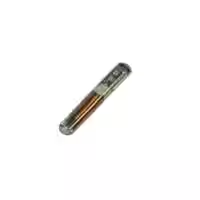
Texas Instruments RI-TRP-WEHP-01
- Part No.:
- RI-TRP-WEHP-01
- Manufacturer:
- Texas Instruments
- Category:
- RFID Transponders, Tags
- Package:
- Datasheet:
-
 RI-TRP-WEHP-01.pdf
- Description:
- RFID TAG R/W 134.2KHZ GLSS ENCAP
- Quantity:
- Payment:

- Shipping:

Inventory:2,668
Please send an inquiry. Send us your inquiry, and we will respond immediately.
Product details
Overview
RI-TRP-WEHP-01 from Texas Instruments is a 23 mm hermetically sealed glass RFID transponder operating at 134.2 kHz with read/write capability, 80-bit EEPROM memory (64-bit ID + 16-bit BCC), and FSK modulation using low/high bit frequencies of 131.5–139.0 kHz and 120.0–128.0 kHz respectively; used in animal identification, access control, and industrial asset tagging where field-programmable identity and tamper-resistant encapsulation are required.
For engineers reviewing the RI-TRP-WEHP-01 datasheet, RI-TRP-WEHP-01 pinout, RI-TRP-WEHP-01 application, or RI-TRP-WEHP-01 equivalent, this page delivers verified mechanical dimensions (Ø3.85 mm × 23.1 mm), absolute maximum ratings (2000 RAD X-ray, 200 g shock), programming cycle endurance (10k cycles), operating temperature range (–25°C to +70°C), and regulatory compliance context per IEC 68-2-6/27 and TI-RFid™ system integration requirements.
Technical Context
This transponder operates in an inductive near-field RFID system requiring sequential charge/read/write phases: a 15–50 ms 134.2 kHz electromagnetic field powers the device via resonant coupling, charging an internal capacitor that enables subsequent FSK data transmission or PWM-based write command reception. No external power source or battery is used.
The device implements a single-block 80-bit EEPROM with CRC-CCITT 16-bit error detection, supports full 64-bit ID reprogramming, and uses pulse-width-modulated field modulation for write commands-requiring precise reader-side timing control per Series 2000 RFM Sequence Control Reference Manual (11-06-21-049).
Key Specifications
| Parameter | Value and Actual Design Meaning |
|---|---|
| Operating Frequency | 134.2 kHz ±0.04 kHz - defines resonant coupling efficiency and regulatory alignment with ISO 11784/11785 LF RFID standards. |
| Memory Size | 80-bit EEPROM (64-bit ID + 16-bit BCC) - enables unique programmable identity with hardware-level cyclic redundancy check for read integrity. |
| Read Range Support | Up to 150 mm typical with 50 ms charge duration - decreases significantly below 15 ms charge time due to reduced capacitor energy storage. |
| Programming Endurance | 10,000 write cycles - specifies maximum field-programming operations before EEPROM degradation affects reliability. |
| Environmental Rating | Hermetically sealed glass housing (IP68 equivalent), 200 g mechanical shock, 10 g vibration - ensures survivability in implantation, livestock, and harsh industrial environments. |
| Field Strength (AFS) | 188–192 dBµV/m - minimum reader field amplitude required to reliably initiate transponder charge phase under worst-case coupling conditions. |
| X-ray Tolerance | 2000 RAD at 110 kV - certifies suitability for sterilization and medical logistics handling without data corruption. |
Pinout & Package
Glass cylindrical package: Ø3.85 mm ±0.05 mm × 23.1 mm ±0.5 mm, weight 0.6 g, hermetically sealed, no external terminals or pins - functions as a passive, two-terminal resonant circuit formed by internal coil and capacitor.
Key Features
| Feature | Design Value |
|---|---|
| Read/Write Capability | User-programmable 64-bit ID via PWM-modulated field - eliminates factory-only provisioning and enables on-site identity updates in deployed systems. |
| CRC-CCITT 16-bit BCC | Hardware-implemented block check character - detects bit errors during over-air transmission without host-side computation overhead. |
| Hermetic Glass Encapsulation | Zero-permeability barrier against moisture, chemicals, and biological fluids - validated for subcutaneous animal implantation and autoclave exposure. |
| 134.2 kHz FSK Modulation | Dual-frequency shift keying (131.5–139.0 kHz / 120.0–128.0 kHz) - provides noise-immune digital signaling compatible with legacy TI-RFid™ readers. |
| 10k Programming Cycles | Guaranteed EEPROM rewrite endurance - supports multi-lifecycle use cases such as reusable tool tracking or temporary access credential assignment. |
Applications
| Animal Identification | Access Control |
|---|---|
Use Scenario: Subcutaneous implantation in livestock for lifetime traceability across farms, slaughterhouses, and export documentation. IC Role / Device Role / Timing Role: Passive RFID transponder providing tamper-proof, battery-free identity broadcast upon reader interrogation. Use Value: Hermetic glass construction prevents tissue rejection and corrosion; 2000 RAD X-ray tolerance allows post-implant radiographic verification without data loss. |
Use Scenario: Embedding in employee ID badges or vehicle access tags for secure facility entry with audit trail capability. IC Role / Device Role / Timing Role: Read/write identity token enabling dynamic credential updates (e.g., role changes, expiration resets) without badge replacement. Use Value: 10,000-program cycle endurance supports multi-year credential lifecycle; FSK modulation ensures reliable read in electrically noisy gate environments. |
| Industrial Asset Tracking | Reusable Container Management |
Use Scenario: Mounting on high-value tools, molds, or calibration equipment subjected to cleaning, heat cycling, and mechanical impact. IC Role / Device Role / Timing Role: Ruggedized passive tag storing unique asset ID and maintenance history accessible via handheld reader. Use Value: 200 g shock rating and 125°C short-term storage tolerance enable survival in industrial washdown and oven-curing processes. |
Use Scenario: Sealing inside plastic or metal shipping containers used across supply chain loops with repeated sterilization and stacking loads. IC Role / Device Role / Timing Role: Field-reprogrammable identity marker supporting container reuse, route logging, and content verification. Use Value: Glass encapsulation resists chemical degradation from disinfectants; 0.6 g mass avoids interference with automated container weighing systems. |
Equivalent & Alternatives
The following parts are listed as comparable options for similar passive LF RFID transponder applications.
| Alternative Part | Technical Difference | Application Difference | Selection Advice |
|---|---|---|---|
| EM4102 (EM Microelectronic) | Read-only, 128-bit ROM, no EEPROM; fixed factory ID; lower memory density but higher read sensitivity at 125 kHz. | Limited to static ID use cases; unsuitable for credential updates or dynamic asset reassignment. | Select when cost-sensitive, high-volume, immutable ID deployment is required and reader infrastructure operates at 125 kHz. |
| TK4100 (Dongguan Temic) | Read/write, 512-bit EEPROM, 125 kHz operation; larger physical size (Ø4.5 mm × 30 mm); no published X-ray tolerance data. | Better memory capacity for extended metadata, but incompatible with strict 23 mm form factor constraints and medical sterilization workflows. | Choose only if additional user memory is critical and glass hermeticity/X-ray resistance are secondary to cost and memory size. |
Compared with EM4102 and TK4100, RI-TRP-WEHP-01 uniquely balances field-programmability, medical-grade encapsulation, and ISO 11785-compliant 134.2 kHz operation - making it the sole option among these three qualified for implantable animal ID and regulated industrial sterilization environments.
Availability
RI-TRP-WEHP-01 is available at Aetrix Electronics and suitable for animal identification, secure access control, and industrial asset tracking requiring stable component supply, long-term lifecycle continuity, and regulatory-aligned passive RFID performance.
Supply support for RI-TRP-WEHP-01 includes scheduled delivery planning, volume procurement assistance, BOM continuity management, traceable sourcing, and lifecycle availability coordination for OEM customers, industrial embedded developers, connected-device designers, and electronics production programs.
Manufacturer
Texas Instruments is a global semiconductor company specializing in analog, embedded processing, and wireless technologies, with leadership in industrial, automotive, and sensing solutions.
The RI-TRP-WEHP-01 belongs to TI's TI-RFid™ Eco-Line transponder family, engineered specifically for low-frequency (134.2 kHz) passive RFID applications demanding biocompatibility, environmental ruggedness, and field-programmable identity in compact glass form factors.
FAQ
What is the operating frequency and regulatory alignment of the RI-TRP-WEHP-01?
The RI-TRP-WEHP-01 operates at 134.2 kHz ±0.04 kHz and complies with ISO 11784/11785 for animal identification and related LF RFID applications. Its frequency stability and field strength characteristics meet IEC 68-2-6/27 mechanical test requirements and are certified for use under experimental or final approval licenses per regional radio regulations.
Does the RI-TRP-WEHP-01 require a battery or external power source?
No, the RI-TRP-WEHP-01 is a fully passive transponder. It derives all operating energy from the reader's 134.2 kHz electromagnetic field during the 15–50 ms charge phase, rectifying induced voltage to power its internal logic and EEPROM programming circuitry without any onboard battery or connection.
How many times can the RI-TRP-WEHP-01 be reprogrammed, and what memory structure does it use?
The RI-TRP-WEHP-01 supports 10,000 write cycles to its 80-bit EEPROM, organized as one block containing 64 bits of user-programmable identification data and a 16-bit CRC-CCITT block check character. Each full 64-bit ID update requires simultaneous programming of all bits during the reader-controlled programming time window.
What mechanical and environmental qualifications validate the RI-TRP-WEHP-01 for implantation or industrial use?
The RI-TRP-WEHP-01 features hermetic glass encapsulation (Ø3.85 mm × 23.1 mm), withstands 200 g half-sine mechanical shock (IEC 68-2-27), 10 g vibration (IEC 68-2-6), and 2000 RAD X-ray exposure at 110 kV - qualifications confirmed in TI's SCBU034 reference guide and supporting its use in animal implantation, autoclave sterilization, and heavy-equipment asset tagging.
Can the RI-TRP-WEHP-01 be used interchangeably with RI-TRP-REHP-01 in the same reader system?
Yes, both RI-TRP-WEHP-01 and RI-TRP-REHP-01 share identical mechanical dimensions, operating frequency, and read-phase FSK modulation, allowing coexistence in the same reader field. However, RI-TRP-WEHP-01 responds to write-mode field modulation while RI-TRP-REHP-01 ignores it - requiring reader firmware awareness to avoid unintended programming attempts.
RI-TRP-WEHP-01 Specifications
- Product attributes
- Attribute value
- Manufacturer:
- Texas Instruments
- Series:
- -
- Packaging:
- Tape & Reel (TR)
- Product Status:
- Obsolete
- Style:
- Glass Encapsulated
- Technology:
- Passive
- Frequency:
- 134.2kHz
- Memory Type:
- Read/Write
- Writable Memory:
- 80b (User)
- Standards:
- -
- Operating Temperature:
- -25°C ~ 70°C
- Size / Dimension:
- 3.85mm Dia x 23.10mm
RI-TRP-WEHP-01 FAQ
1.How can I place an order for RI-TRP-WEHP-01 through Aetrix?
Please submit a Request for Quotation (RFQ) for RI-TRP-WEHP-01 on Aetrix. Our sales agent will provide a competitive quotation and guide you through the order confirmation once you accept the terms.
2.Are the price and stock information for RI-TRP-WEHP-01 reliable?
The price and inventory of RI-TRP-WEHP-01 are updated periodically and may fluctuate due to market conditions. Stock and pricing data are typically refreshed every 24 hours. Quotation validity for RI-TRP-WEHP-01 is usually 5 days.
3.What payment methods are accepted for RI-TRP-WEHP-01?
We accept Wire Transfer, PayPal, Credit Card, Western Union, MoneyGram, and Escrow for RI-TRP-WEHP-01 transactions.
Note: Certain payment methods may incur a processing fee.
4.How is shipping managed for RI-TRP-WEHP-01?
RI-TRP-WEHP-01 orders can be shipped via leading logistics carriers, including DHL, UPS, FedEx, TNT, or Registered Mail.
Once your RI-TRP-WEHP-01 order is processed, you will receive an email with the shipment details and tracking number.
Note: Tracking information may take up to 24 hours to appear. Express delivery typically takes 3–5 business days.
5.How can I obtain technical support or documentation for RI-TRP-WEHP-01?
For technical support, including RI-TRP-WEHP-01 datasheets, pinout diagrams, or application guidance, please contact our engineering support team. They can provide detailed documentation and assistance for your RI-TRP-WEHP-01 requirements.
6.How does Aetrix verify that RI-TRP-WEHP-01 is sourced from the original manufacturer or authorized distributors?
All RI-TRP-WEHP-01 products on Aetrix are procured from qualified distributors and authorized channels. Our dedicated quality assurance team conducts strict verification, including traceability checks and, if necessary, third-party testing. This ensures that RI-TRP-WEHP-01 meets industry standards.
7.What is the process for return or replacement of RI-TRP-WEHP-01?
All RI-TRP-WEHP-01 units undergo pre-shipment inspection (PSI). If there is an issue with RI-TRP-WEHP-01, returns or replacements are accepted under the following conditions:
1.Quantity discrepancies, incorrect items, or visible external defects (such as breakage or corrosion), acknowledged by Aetrix.
2.The issue is reported within 90 days of delivery.
3.The RI-TRP-WEHP-01 part is unused and in its original packaging.
Return procedure for RI-TRP-WEHP-01:
1.Submit a request within 90 days.
2.Obtain a Return Material Authorization (RMA) from Aetrix.
RI-TRP-WEHP-01 Tags
-
SL3S1013FTB0,115
NXP Semiconductors
-
NTP53321G0JHKZ
NXP Semiconductors
-
HTSH4801ETK,118
NXP Semiconductors
-
NTA53321G0FHKZ
NXP Semiconductors
-
RF-HDT-DVBE-N2
Texas Instruments
-
RF-HDT-DVBB-N2
Texas Instruments
-
HT2DC20S20/F/RSP
NXP Semiconductors
-
TRPGR30ATGA
Texas Instruments
-
TRPGR30ATGC
Texas Instruments
-
RI-TRP-DR2B-40
Texas Instruments
-
V680-D1KP52MT
Omron Automation and Safety
-
HTMS8001FTB/AF,115
NXP USA Inc.
Tech Hub

A practical engineering guide to 3.3V and 5V logic compatibility, input thresholds, resistor dividers, translator ICs, MOSFET level shifting, I2C pull-ups, timing limits and power-sequencing risks.

The 74HC595 uses push-pull logic outputs, while the TPIC6B595 uses 50 V open-drain DMOS sinks for higher-power loads. This guide compares timing, current limits, 3.3 V interfacing, load wiring, thermal…

The 74HC595 converts serial data into eight stable parallel outputs. This guide covers pin functions, shift and storage timing, OE and MR behavior, drive-current limits, cascading, voltage compatibilit…

A technical comparison of level-sensitive latches and edge-triggered flip-flops, covering timing windows, setup and hold limits, master–slave operation, time borrowing, race-through, HDL inference and…

A D latch stores one bit while Enable controls when data can pass. This reference covers gate-level operation, truth tables, transparency, setup and hold timing, LE versus OE, common ICs and practical …

An SR latch stores one bit through cross-coupled feedback. This engineering reference covers NOR and NAND implementations, truth tables, forbidden-state recovery, gated operation, switch debouncing, fa…

Latch circuits retain one bit through feedback. This technical reference covers SR and D latches, truth tables, transparency, timing limits, latch-versus-flip-flop behavior, applications and common log…

An engineering guide to LED driver operation, constant-current and constant-voltage outputs, linear and switching topologies, dimming, IC selection, calculations, replacement compatibility, and fault c…

Operational amplifier guide covering op amp basics, feedback, ideal vs real op amps, common configurations, buffer circuits, offset, bias current, gain-bandwidth, slew rate, rail-to-rail limits and sel…

Jumper cables guide covering safe connection order, red and black clamp placement, final ground connection, cable gauge, length, clamp quality, copper vs CCA cables, jump starter comparison and battery…


