
 My Inquiry
 My Account


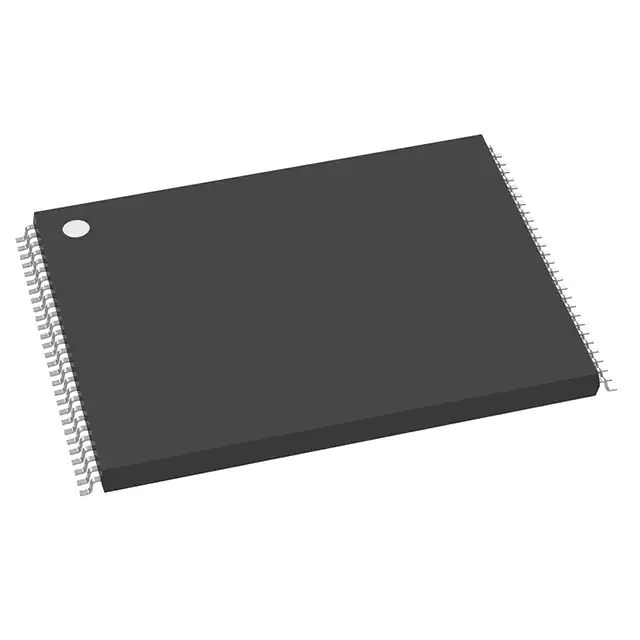
Infineon Technologies S29GL256S10TFV013
- Part No.:
- S29GL256S10TFV013
- Manufacturer:
- Infineon Technologies
- Category:
- Memory
- Package:
- 56-TFSOP (0.724", 18.40mm Width)
- Datasheet:
-
 S29GL256S10TFV013.pdf
- Description:
- IC FLASH 256MBIT PARALLEL 56TSOP
- Quantity:
- Payment:

- Shipping:

Inventory:4,011
Please send an inquiry. Send us your inquiry, and we will respond immediately.
Product details
Overview
S29GL256S10TFV013 from Infineon is a 256 Mb (32 MB) parallel NOR flash memory IC with 16-bit data bus, fabricated on 65 nm MIRRORBIT™ Eclipse technology. It operates from a single 2.7–3.6 V supply, delivers 90 ns random access time and 15 ns page access time, and integrates hardware ECC for single-bit error correction - deployed in automotive instrument clusters requiring fast XIP boot code execution and robust data retention.
For engineers reviewing the S29GL256S10TFV013 datasheet, S29GL256S10TFV013 pinout, S29GL256S10TFV013 application, or S29GL256S10TFV013 equivalent, key selection criteria include its 128 kB uniform sector erase granularity, 512-byte write buffer throughput (1.5 MBps), Versatile I/O support (1.65–3.6 V), AEC-Q100 Grade 2 qualification (–40°C to +105°C), and OTP array for secure firmware storage.
Technical Context
This device implements an asynchronous parallel interface with word-aligned addressing (A0–A23), supporting both standard and page-mode reads. Its embedded algorithm controller handles autonomous program/erase operations, status monitoring via RY/BY# pin or status register, and suspend/resume capability during active programming or erasing.
The internal architecture includes separate 1024-byte OTP array with dual lockable regions, advanced sector protection (volatile/non-volatile), and CFI-compliant parameter tables for host software identification. ECC logic operates transparently during read cycles without CPU intervention.
Key Specifications
| Parameter | Value and Actual Design Meaning |
|---|---|
| Density | 256 Mb (32 MB); supports full firmware image storage for mid-tier automotive ECUs |
| Random Access Time | 90 ns at VCC = VIO; enables real-time XIP execution from flash without external cache |
| Page Access Time | 15 ns; allows rapid sequential reads within 32-byte aligned pages |
| Write Buffer Size | 512 bytes; reduces effective programming time by batching up to 256 words per command |
| Erase Granularity | Uniform 128 kB sectors; simplifies firmware update partitioning and wear leveling |
| Data Retention | 20 years at 85°C; meets long-life requirements for automotive infotainment and ADAS modules |
| Endurance | 100,000 program/erase cycles per sector; supports field-upgradable calibration data logging |
Pinout & Package
Package: 56-ball VBU Fortified BGA (9 mm × 7 mm, 0.8 mm pitch), RoHS-compliant, moisture sensitivity level 3.
| Pin/Terminal | Circuit Role | Design Meaning |
|---|---|---|
| A0–A23 | Address Inputs | Word-aligned address bus; A23 is MSB for 256 Mb density (2²⁴ × 16-bit) |
| DQ0–DQ15 | Data I/O | 16-bit bidirectional data bus; supports Versatile I/O (1.65–3.6 V) |
| CE# | Chip Enable | Active-low chip select; controls device power state and bus contention |
| OE# | Output Enable | Active-low read strobe; gates output drivers during asynchronous reads |
| WE# | Write Enable | Active-low write strobe; initiates command latching and embedded operations |
| RY/BY# | Ready/Busy Output | Open-drain status indicator; low during program/erase, high when idle or ready |
| RESET# | Hardware Reset | Active-low asynchronous reset; forces device into reading ID mode or aborts ongoing operation |
| WP# | Write Protect | Active-low hardware sector protection enable; overrides software-based sector locks |
Key Features
| Feature | Design Value |
|---|---|
| Hardware ECC | Single-bit error correction with automatic detection and correction during read cycles - eliminates need for host-side ECC software overhead |
| Page Mode Read | 15 ns access within 32-byte pages - accelerates sequential instruction fetch in XIP applications |
| Suspend/Resume | Interruptible program/erase operations - enables responsive background firmware updates without blocking system interrupts |
| OTP Array | 1024-byte one-time-programmable region with two independent lock bits - secures cryptographic keys and calibration constants against overwrite |
| CFI Compliance | Standard Common Flash Interface table - enables plug-and-play driver compatibility across bootloader and OS environments |
Applications
| Automotive Instrument Cluster | Industrial HMI Controller |
|---|---|
Use Scenario: Real-time rendering of vehicle speed, RPM, and warning icons from flash-resident graphics assets and firmware. IC Role / Device Role / Timing Role: XIP-capable NOR flash providing deterministic 90 ns read latency for GUI code execution and 128 kB sector-erased firmware patches. Use Value: Eliminates external RAM buffering for display code; supports AEC-Q100 Grade 2 thermal range (–40°C to +105°C) for under-dash mounting. | Use Scenario: Localized control logic and configuration storage in panel-mounted HMIs used in factory automation systems. IC Role / Device Role / Timing Role: Non-volatile program storage with hardware write protection (WP#) and sector-level locking for certified safety firmware. Use Value: Enables field updates via RS-485 without risk of accidental sector corruption; 100,000-cycle endurance supports daily calibration log writes. |
| Medical Diagnostic Display | Avionics Boot ROM |
Use Scenario: Storing boot firmware and diagnostic UI assets in portable ultrasound devices requiring FDA-cleared reliability. IC Role / Device Role / Timing Role: Secure boot source with OTP-locked bootloader signature and ECC-protected runtime code. Use Value: Meets IEC 62304 Class C SW safety requirements via hardware ECC and 20-year data retention at 85°C. | Use Scenario: Cold-start initialization of flight management computers where deterministic boot timing is critical. IC Role / Device Role / Timing Role: Primary boot ROM delivering verified firmware images with CFI-based auto-configuration and RY/BY#-monitored status feedback. Use Value: Guarantees ≤90 ns first-instruction fetch latency and supports DO-254 compliance via traceable erase/program verification. |
Equivalent & Alternatives
The following parts are listed as comparable options for similar parallel NOR flash applications.
| Alternative Part | Technical Difference | Application Difference | Selection Advice |
|---|---|---|---|
| S29GL256P10TFV010 | Same density and package, but lacks Versatile I/O (VIO fixed to VCC); no 1.65 V I/O support | Not suitable for mixed-voltage SoC interfaces requiring 1.8 V I/O signaling | Select only if host interface operates strictly at 3.0 V and cost optimization is prioritized over voltage flexibility |
| MX29GL256FHT2I-90G | Macronix part with identical 256 Mb density, 90 ns access, and 512-byte buffer; no integrated ECC or OTP array | Requires external ECC implementation and lacks secure key storage capability | Choose when lower unit cost outweighs need for hardware ECC and secure OTP features |
Compared with S29GL256P10TFV010, the S29GL256S10TFV013 adds Versatile I/O for multi-voltage SoC compatibility; versus MX29GL256FHT2I-90G, it provides built-in ECC and OTP - reducing BOM count and enhancing security-critical boot integrity.
Availability
S29GL256S10TFV013 is available at Aetrix Electronics and suitable for automotive instrument clusters, industrial HMIs, medical diagnostic displays, and avionics boot ROMs requiring stable component supply, AEC-Q100 qualification, and long-term lifecycle support.
Supply support for S29GL256S10TFV013 includes scheduled delivery planning, volume procurement assistance, BOM continuity management, traceable sourcing, and lifecycle availability coordination for OEM customers, industrial embedded developers, connected-device designers, and electronics production programs.
Manufacturer
Infineon Technologies is a German semiconductor manufacturer specializing in power management, automotive microcontrollers, and non-volatile memory solutions for safety-critical applications.
The GL-S family targets high-reliability embedded systems needing fast XIP performance, robust data retention, and automotive-grade qualification - specifically designed for ECU boot code, firmware storage, and secure configuration in harsh environments.
FAQ
What temperature grades are supported by S29GL256S10TFV013?
S29GL256S10TFV013 is qualified to AEC-Q100 Grade 2, operating from –40°C to +105°C. This grade is validated for under-hood automotive applications such as engine control units and transmission controllers where extended thermal stability is required. The device also supports industrial grade (–40°C to +85°C) operation, but the specific part number suffix 'TFV' denotes the Grade 2 qualification.
Does S29GL256S10TFV013 support hardware write protection at the sector level?
Yes, S29GL256S10TFV013 implements Advanced Sector Protection (ASP) with both volatile and non-volatile locking modes per 128 kB sector. Hardware write protection is enabled via the WP# pin, which overrides software commands to prevent unintended sector erasure or programming - critical for safeguarding boot code and calibration data in safety-certified systems.
How does the 512-byte programming buffer improve effective write speed?
The 512-byte buffer allows up to 256 words to be loaded before initiating a single embedded program operation, achieving 1.5 MBps effective throughput. This eliminates per-word command overhead and reduces total programming time by ~70% compared to byte-by-byte writes - especially beneficial for firmware patching and field-upgrade scenarios where latency must be minimized.
Can S29GL256S10TFV013 be used in place of legacy S29GL256N devices?
No, S29GL256S10TFV013 is not a direct replacement for S29GL256N due to differences in command set timing, CFI parameter offsets, and absence of legacy toggle-bit polling support. While both are 256 Mb parallel NOR flashes, the S-series introduces new status register definitions and requires updated bootloader drivers to handle RY/BY#-based status monitoring and enhanced ECC reporting.
S29GL256S10TFV013 Specifications
- Product attributes
- Attribute value
- Manufacturer:
- Infineon Technologies
- Series:
- GL-S
- Package/Case:
- 56-TFSOP (0.724", 18.40mm Width)
- Packaging:
- Tape & Reel (TR)
- Product Status:
- Active
- Programmable:
- Not Verified
- Memory Type:
- Non-Volatile
- Memory Format:
- FLASH
- Technology:
- FLASH - NOR
- Memory Size:
- 256Mbit
- Memory Organization:
- 16M x 16
- Memory Interface:
- Parallel
- Clock Frequency:
- -
- Write Cycle Time - Word, Page:
- 60ns
- Access Time:
- 100 ns
- Voltage - Supply:
- 2.7V ~ 3.6V
- Operating Temperature:
- -40°C ~ 105°C (TA)
- Grade:
- -
- Qualification:
- -
- Mounting Type:
- Surface Mount
- Supplier Device Package:
- 56-TSOP
S29GL256S10TFV013 FAQ
1.How can I place an order for S29GL256S10TFV013 through Aetrix?
Please submit a Request for Quotation (RFQ) for S29GL256S10TFV013 on Aetrix. Our sales agent will provide a competitive quotation and guide you through the order confirmation once you accept the terms.
2.Are the price and stock information for S29GL256S10TFV013 reliable?
The price and inventory of S29GL256S10TFV013 are updated periodically and may fluctuate due to market conditions. Stock and pricing data are typically refreshed every 24 hours. Quotation validity for S29GL256S10TFV013 is usually 5 days.
3.What payment methods are accepted for S29GL256S10TFV013?
We accept Wire Transfer, PayPal, Credit Card, Western Union, MoneyGram, and Escrow for S29GL256S10TFV013 transactions.
Note: Certain payment methods may incur a processing fee.
4.How is shipping managed for S29GL256S10TFV013?
S29GL256S10TFV013 orders can be shipped via leading logistics carriers, including DHL, UPS, FedEx, TNT, or Registered Mail.
Once your S29GL256S10TFV013 order is processed, you will receive an email with the shipment details and tracking number.
Note: Tracking information may take up to 24 hours to appear. Express delivery typically takes 3–5 business days.
5.How can I obtain technical support or documentation for S29GL256S10TFV013?
For technical support, including S29GL256S10TFV013 datasheets, pinout diagrams, or application guidance, please contact our engineering support team. They can provide detailed documentation and assistance for your S29GL256S10TFV013 requirements.
6.How does Aetrix verify that S29GL256S10TFV013 is sourced from the original manufacturer or authorized distributors?
All S29GL256S10TFV013 products on Aetrix are procured from qualified distributors and authorized channels. Our dedicated quality assurance team conducts strict verification, including traceability checks and, if necessary, third-party testing. This ensures that S29GL256S10TFV013 meets industry standards.
7.What is the process for return or replacement of S29GL256S10TFV013?
All S29GL256S10TFV013 units undergo pre-shipment inspection (PSI). If there is an issue with S29GL256S10TFV013, returns or replacements are accepted under the following conditions:
1.Quantity discrepancies, incorrect items, or visible external defects (such as breakage or corrosion), acknowledged by Aetrix.
2.The issue is reported within 90 days of delivery.
3.The S29GL256S10TFV013 part is unused and in its original packaging.
Return procedure for S29GL256S10TFV013:
1.Submit a request within 90 days.
2.Obtain a Return Material Authorization (RMA) from Aetrix.
S29GL256S10TFV013 Tags
-
M24C02-WMN6TP
STMicroelectronics
-
AT24C02C-XHM-T
Microchip Technology
-
AT21CS01-STUM10-T
Microchip Technology

-
AT24C02C-SSHM-T
Microchip Technology
-
24LC01BT-I/OT
Microchip Technology
-
M24C02-FMC6TG
STMicroelectronics
-
AT24CS02-SSHM-T
Microchip Technology

-
93LC46BT-I/OT
Microchip Technology
-
AT24C04C-SSHM-T
Microchip Technology

-
24LC01BT-I/SN
Microchip Technology
-
24AA02UIDT-I/OT
Microchip Technology
-
AT24C08C-STUM-T
Microchip Technology
Tech Hub

A practical engineering guide to 3.3V and 5V logic compatibility, input thresholds, resistor dividers, translator ICs, MOSFET level shifting, I2C pull-ups, timing limits and power-sequencing risks.

The 74HC595 uses push-pull logic outputs, while the TPIC6B595 uses 50 V open-drain DMOS sinks for higher-power loads. This guide compares timing, current limits, 3.3 V interfacing, load wiring, thermal…

The 74HC595 converts serial data into eight stable parallel outputs. This guide covers pin functions, shift and storage timing, OE and MR behavior, drive-current limits, cascading, voltage compatibilit…

A technical comparison of level-sensitive latches and edge-triggered flip-flops, covering timing windows, setup and hold limits, master–slave operation, time borrowing, race-through, HDL inference and…

A D latch stores one bit while Enable controls when data can pass. This reference covers gate-level operation, truth tables, transparency, setup and hold timing, LE versus OE, common ICs and practical …

An SR latch stores one bit through cross-coupled feedback. This engineering reference covers NOR and NAND implementations, truth tables, forbidden-state recovery, gated operation, switch debouncing, fa…

Latch circuits retain one bit through feedback. This technical reference covers SR and D latches, truth tables, transparency, timing limits, latch-versus-flip-flop behavior, applications and common log…

An engineering guide to LED driver operation, constant-current and constant-voltage outputs, linear and switching topologies, dimming, IC selection, calculations, replacement compatibility, and fault c…

Operational amplifier guide covering op amp basics, feedback, ideal vs real op amps, common configurations, buffer circuits, offset, bias current, gain-bandwidth, slew rate, rail-to-rail limits and sel…

Jumper cables guide covering safe connection order, red and black clamp placement, final ground connection, cable gauge, length, clamp quality, copper vs CCA cables, jump starter comparison and battery…


