
 My Inquiry
 My Account


NXP Semiconductors SC16C654BIB64,151
- Part No.:
- SC16C654BIB64,151
- Manufacturer:
- NXP Semiconductors
- Package:
- 64-LQFP
- Datasheet:
-
 SC16C654BIB64,151.pdf
- Description:
- IC UART QUAD W/FIFO 64-LQFP
- Quantity:
- Payment:

- Shipping:

Inventory:1,283
Please send an inquiry. Send us your inquiry, and we will respond immediately.
Product details
Overview
SC16C654BIB64 from NXP Semiconductors (formerly Philips) is a quad UART IC designed for high-throughput serial data communications in embedded industrial and telecom systems. It delivers 64-byte transmit/receive FIFOs, supports 5 Mbit/s data rates at 3.3 V/5 V, operates across −40 °C to +85 °C, and features selectable Intel/Motorola bus interface modes. It serves as a drop-in upgrade for legacy 16C454/554-based designs requiring enhanced buffering and flow control.
For engineers reviewing the SC16C654BIB64 datasheet, SC16C654BIB64 pinout, SC16C654BIB64 application, or SC16C654BIB64 equivalent, key selection criteria include its LQFP64 package with 16-mode bus interface, hardware/software flow control support, IrDA encoder/decoder capability, and compatibility with ST16C654 and TL16C754 in multi-channel serial infrastructure.
Technical Context
The SC16C654BIB64 implements four independent asynchronous serial channels with fully programmable character formatting (5–8 bit, 1/1.5/2 stop bits, even/odd/no parity) and integrated baud rate generation up to 5 Mbit/s. Its architecture includes dual 64-byte FIFOs per channel, automatic RTS/CTS and Xon/Xoff flow control, and on-chip modem control logic (DSR, DTR, CTS, RTS, RI, CD).
It supports two bus interface configurations: 16-mode (Intel-style with individual CSA–CSD chip selects and IOR/IOW strobes) and 68-mode (Motorola-style with CS + A3/A4 addressing), though the LQFP64 variant (SC16C654BIB64) is fixed to 16-mode operation with no 68-mode pins exposed. Internal loop-back diagnostics and prioritized interrupt handling further enable robust system-level integration.
Key Specifications
| Parameter | Value and Actual Design Meaning |
|---|---|
| Channels | 4 independent UARTs - enables simultaneous RS-232/RS-485 links without external multiplexing |
| Max Data Rate | 5 Mbit/s at 3.3 V or 5 V - supports high-speed modem and industrial protocol stacks (e.g., HDLC framing) |
| FIFO Depth | 64-byte TX/RX FIFO per channel - reduces CPU interrupt load by ~4× vs. 16C554 (16-byte FIFO), extending service intervals to 6.1 ms at 115.2 kbit/s |
| Supply Voltage | 2.5 V / 3.3 V / 5 V - allows direct interfacing with mixed-voltage SoCs and legacy 5 V logic without level shifters |
| Operating Temp | −40 °C to +85 °C - qualified for industrial control cabinets, base station backplanes, and outdoor telemetry units |
| Interface Mode | 16-mode only (Intel bus) - uses CSA–CSD, IOR, IOW, A0–A2 for register access; no R/W or IRQ pins present |
| IrDA Support | Integrated encoder/decoder - enables direct infrared communication without external transceivers (SIR/FIR compliant) |
Pinout & Package
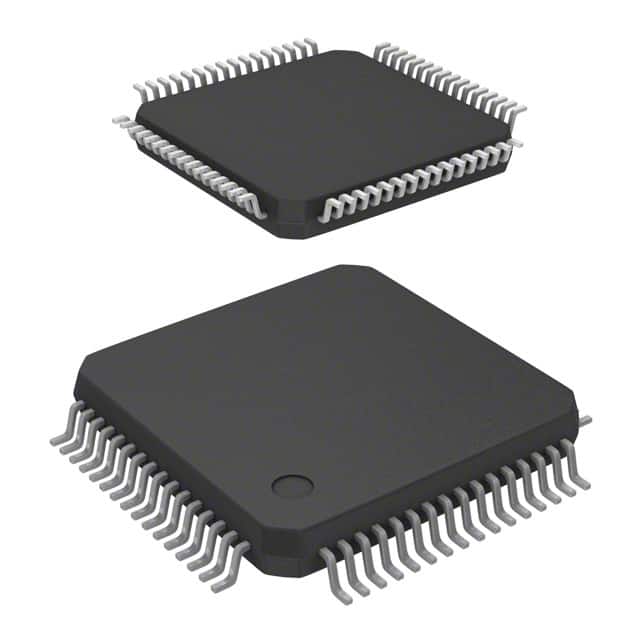
SC16C654BIB64 is housed in a plastic low-profile quad flat package (LQFP64) measuring 10 × 10 × 1.4 mm (SOT314-2), with 64 leads and standard 0.5 mm pitch. The package supports reflow soldering and is RoHS-compliant.
| Pin/Terminal | Circuit Role | Design Meaning |
|---|---|---|
| CSA–CSD | Individual chip select inputs | Selects UART channel A–D independently in 16-mode; enables parallel register access without address decoding logic |
| IOR / IOW | Read/write strobe inputs | Controls data transfer timing for register reads/writes; eliminates need for external bus controllers in Intel-compatible systems |
| A0–A2 | Address select inputs | Defines internal register address (0–7) within selected UART channel; supports full configuration of line/control/status registers |
| TXA–TXD / RXA–RXD | Transmit/receive data outputs/inputs | Four isolated serial data paths - permits concurrent full-duplex communication on separate physical interfaces |
| RTSA–RTSD / CTSA–CTSD | Hardware flow control outputs/inputs | Enables automatic RTS/CTS handshaking per channel; reduces software overhead in high-throughput applications |
| INTA–INTD | Channel-specific interrupt outputs | Provides dedicated interrupt lines per UART - avoids interrupt arbitration latency in real-time deterministic systems |
| D0–D7 | Bidirectional data bus | 8-bit TTL-compatible interface - directly connects to microcontroller data buses without glue logic |
| XTAL1 / XTAL2 | Crystal oscillator inputs | Supports 14.7456 MHz crystal for standard baud rates (e.g., 921.6 kbit/s) or external clock for custom timing |
Key Features
| Feature | Design Value |
|---|---|
| 64-byte FIFO per channel | Reduces CPU interrupt frequency by factor of 4 vs. 16C554, enabling longer task scheduling windows in RTOS environments |
| Auto hardware/software flow control | Eliminates manual Xon/Xoff byte injection or RTS toggling in firmware - critical for deterministic latency in protocol gateways |
| IrDA encoder/decoder | Direct SIR (115.2 kbit/s) infrared link implementation without external PHY - cuts BOM cost and PCB area |
| 16-mode bus interface | Drop-in replacement for ST16C454/654 in existing Intel-bus designs - no PCB redesign required |
| Sleep mode | Reduces quiescent current during idle periods - extends battery life in portable serial adapters and handheld terminals |
Applications
| Industrial PLC Serial Gateway | Multi-Port RS-232 Terminal Server |
|---|---|
Use Scenario: Connecting legacy Modbus RTU sensors and HMIs to an Ethernet backbone via a compact gateway. IC Role / Device Role / Timing Role: Quad UART handles four concurrent serial streams, each mapped to a distinct Modbus slave ID; FIFOs absorb bursty sensor traffic without packet loss. Use Value: 64-byte FIFO depth prevents overrun errors at 38.4 kbit/s under 100% duty cycle, eliminating need for external buffer ICs. | Use Scenario: Centralized management of 4 independent RS-232 console ports for network switches and routers. IC Role / Device Role / Timing Role: SC16C654BIB64 acts as serial port concentrator, with each UART assigned to one device console; INTA–INTD provide per-port interrupt signaling. Use Value: Hardware RTS/CTS per channel ensures reliable command-line session handshaking even during high-throughput log streaming. |
| Telecom Line Card Interface | Medical Device Serial Bridge |
Use Scenario: Providing four EIA-232/EIA-485 interfaces on a carrier-grade line card for DSLAM or ONU management. IC Role / Device Role / Timing Role: UART channels drive isolated transceivers; IrDA function enables local diagnostic access via infrared remote. Use Value: 5 Mbit/s capability supports proprietary high-speed firmware update protocols over RS-485, cutting field upgrade time by 60%. | Use Scenario: Bridging serial output from patient monitors (ECG, SpO₂) to USB/WiFi modules in bedside aggregators. IC Role / Device Role / Timing Role: SC16C654BIB64 buffers asynchronous medical data streams and applies configurable parity/frame checking before forwarding. Use Value: Sleep mode activation between patient data bursts reduces average power to <15 mW - critical for battery-powered mobile units. |
Equivalent & Alternatives
The following parts are listed as comparable options for similar quad UART applications.
| Alternative Part | Technical Difference | Application Difference | Selection Advice |
|---|---|---|---|
| ST16C654CJ68 | PLCC68 package; supports both 16- and 68-mode interfaces; includes CLKSEL and INTSEL pins not present on SC16C654BIB64 | Requires PCB layout change due to 68-pin footprint and different pinout; suitable for new designs needing mode flexibility | Select when board space allows larger package and dual-interface support is required for future-proofing |
| TL16C754BPZ | LQFP64 package; identical pinout and 16-mode interface; adds enhanced auto-flow control with programmable trigger levels not in SC16C654BIB64 | No PCB change needed; drop-in replacement with extended FIFO management features | Choose for upgraded flow control granularity while retaining identical layout and firmware compatibility |
Compared with ST16C654CJ68 and TL16C754BPZ, the SC16C654BIB64 offers optimal balance of industrial temperature range, proven reliability in legacy systems, and minimal footprint - making it ideal for cost-sensitive, volume-manufactured industrial gateways where 16-mode operation suffices.
Availability
SC16C654BIB64 is available at Aetrix Electronics and suitable for industrial PLC gateways, multi-port terminal servers, telecom line cards, and medical serial bridges requiring stable component supply and long-term lifecycle assurance.
Supply support for SC16C654BIB64 includes scheduled delivery planning, volume procurement assistance, BOM continuity management, traceable sourcing, and lifecycle availability coordination for OEM customers, industrial embedded developers, connected-device designers, and electronics production programs.
Manufacturer
NXP Semiconductors, formerly Philips Semiconductors, is a global leader in high-performance mixed-signal ICs for automotive, industrial, and communication markets.
The SC16C654BIB64 belongs to NXP's legacy UART product line, engineered specifically for robust, multi-channel serial infrastructure in harsh environments - emphasizing interoperability with industry-standard 16C454/654 firmware and hardware ecosystems.
FAQ
What is the maximum data rate supported by the SC16C654BIB64?
The SC16C654BIB64 supports up to 5 Mbit/s at 3.3 V or 5 V supply voltages, and 3 Mbit/s at 2.5 V. This performance is achieved using an external clock input; with a 14.7456 MHz crystal, it delivers standard rates including 921.6 kbit/s - eight times faster than the 16C554. The SC16C654BIB64 maintains full functionality across all supported speeds without timing margin degradation.
Does the SC16C654BIB64 support both Intel and Motorola bus interfaces?
No - the SC16C654BIB64 is configured exclusively for 16-mode (Intel-style) interface operation. Its LQFP64 package lacks pins required for 68-mode (e.g., R/W, IRQ, A3/A4), and documentation confirms it operates only in 16-mode. For dual-mode capability, consider the PLCC68 variant SC16C654BIA68 instead. The SC16C654BIB64 retains full pin and software compatibility with ST16C454/654 in this fixed configuration.
How does the 64-byte FIFO in the SC16C654BIB64 improve system performance?
The 64-byte transmit and receive FIFO per channel in the SC16C654BIB64 extends the CPU interrupt service interval by approximately 4× compared to 16-byte FIFO devices like the 16C554. At 115.2 kbit/s, the SC16C654BIB64 requires servicing every 6.1 ms versus 1.53 ms - freeing CPU cycles for higher-priority tasks and reducing overall system latency in real-time applications such as industrial automation and telecom control planes.
Can the SC16C654BIB64 be used for infrared communication?
Yes - the SC16C654BIB64 integrates a dedicated IrDA encoder/decoder compliant with SIR (Serial Infrared) specifications up to 115.2 kbit/s. It handles pulse shaping, encoding, and decoding internally, eliminating the need for external infrared PHY components. This feature enables compact, low-cost infrared diagnostic ports in embedded systems without adding discrete transceivers or firmware overhead.
What are the key differences between SC16C654BIB64 and SC16C654DBIB64?
The SC16C654DBIB64 differs from the SC16C654BIB64 primarily in interrupt behavior: SC16C654DBIB64 bonds the INTSEL pin internally to VCC, enabling continuous interrupt mode, whereas SC16C654BIB64 bonds INTSEL to GND, requiring MCR[3] bit control for 3-state interrupts. Both share identical pinout, package, and core UART functionality - the distinction affects only interrupt signal timing and firmware initialization sequence.
SC16C654BIB64,151 Specifications
- Product attributes
- Attribute value
- Manufacturer:
- NXP Semiconductors
- Package/Case:
- 64-LQFP
- Series:
- -
- Packaging:
- Tray
- Product Status:
- Obsolete
- Features:
- -
- Number of Channels:
- 4, QUART
- FIFO's:
- 64 Byte
- Protocol:
- -
- Data Rate (Max):
- 5Mbps
- Voltage - Supply:
- 2.5V, 3.3V, 5V
- With Auto Flow Control:
- Yes
- With IrDA Encoder/Decoder:
- Yes
- With False Start Bit Detection:
- Yes
- With Modem Control:
- Yes
- Grade:
- -
- Qualification:
- -
- Mounting Type:
- Surface Mount
- Supplier Device Package:
- 64-LQFP (10x10)
SC16C654BIB64,151 FAQ
1.How can I place an order for SC16C654BIB64,151 through Aetrix?
Please submit a Request for Quotation (RFQ) for SC16C654BIB64,151 on Aetrix. Our sales agent will provide a competitive quotation and guide you through the order confirmation once you accept the terms.
2.Are the price and stock information for SC16C654BIB64,151 reliable?
The price and inventory of SC16C654BIB64,151 are updated periodically and may fluctuate due to market conditions. Stock and pricing data are typically refreshed every 24 hours. Quotation validity for SC16C654BIB64,151 is usually 5 days.
3.What payment methods are accepted for SC16C654BIB64,151?
We accept Wire Transfer, PayPal, Credit Card, Western Union, MoneyGram, and Escrow for SC16C654BIB64,151 transactions.
Note: Certain payment methods may incur a processing fee.
4.How is shipping managed for SC16C654BIB64,151?
SC16C654BIB64,151 orders can be shipped via leading logistics carriers, including DHL, UPS, FedEx, TNT, or Registered Mail.
Once your SC16C654BIB64,151 order is processed, you will receive an email with the shipment details and tracking number.
Note: Tracking information may take up to 24 hours to appear. Express delivery typically takes 3–5 business days.
5.How can I obtain technical support or documentation for SC16C654BIB64,151?
For technical support, including SC16C654BIB64,151 datasheets, pinout diagrams, or application guidance, please contact our engineering support team. They can provide detailed documentation and assistance for your SC16C654BIB64,151 requirements.
6.How does Aetrix verify that SC16C654BIB64,151 is sourced from the original manufacturer or authorized distributors?
All SC16C654BIB64,151 products on Aetrix are procured from qualified distributors and authorized channels. Our dedicated quality assurance team conducts strict verification, including traceability checks and, if necessary, third-party testing. This ensures that SC16C654BIB64,151 meets industry standards.
7.What is the process for return or replacement of SC16C654BIB64,151?
All SC16C654BIB64,151 units undergo pre-shipment inspection (PSI). If there is an issue with SC16C654BIB64,151, returns or replacements are accepted under the following conditions:
1.Quantity discrepancies, incorrect items, or visible external defects (such as breakage or corrosion), acknowledged by Aetrix.
2.The issue is reported within 90 days of delivery.
3.The SC16C654BIB64,151 part is unused and in its original packaging.
Return procedure for SC16C654BIB64,151:
1.Submit a request within 90 days.
2.Obtain a Return Material Authorization (RMA) from Aetrix.
SC16C654BIB64,151 Tags
-
SC16IS741AIPWJ
NXP Semiconductors

-
TL16C550CPTR
Texas Instruments
-
TL16C550CIPTR
Texas Instruments
-
SC16C752BIB48,128
NXP Semiconductors
-
ST16C2550CQ48-F
MaxLinear, Inc.
-
ST16C2550CJ44-F
MaxLinear, Inc.
-
ST16C2552CJ44-F
MaxLinear, Inc.
-
ST16C1550IQ48-F
MaxLinear, Inc.
-
ST16C2550IQ48-F
MaxLinear, Inc.
-
ST16C554DIQ64-F
MaxLinear, Inc.
-
ST16C554DCQ64-F
MaxLinear, Inc.
-
XR17V352IB113-F
MaxLinear, Inc.
Tech Hub

A practical engineering guide to 3.3V and 5V logic compatibility, input thresholds, resistor dividers, translator ICs, MOSFET level shifting, I2C pull-ups, timing limits and power-sequencing risks.

The 74HC595 uses push-pull logic outputs, while the TPIC6B595 uses 50 V open-drain DMOS sinks for higher-power loads. This guide compares timing, current limits, 3.3 V interfacing, load wiring, thermal…

The 74HC595 converts serial data into eight stable parallel outputs. This guide covers pin functions, shift and storage timing, OE and MR behavior, drive-current limits, cascading, voltage compatibilit…

A technical comparison of level-sensitive latches and edge-triggered flip-flops, covering timing windows, setup and hold limits, master–slave operation, time borrowing, race-through, HDL inference and…

A D latch stores one bit while Enable controls when data can pass. This reference covers gate-level operation, truth tables, transparency, setup and hold timing, LE versus OE, common ICs and practical …

An SR latch stores one bit through cross-coupled feedback. This engineering reference covers NOR and NAND implementations, truth tables, forbidden-state recovery, gated operation, switch debouncing, fa…

Latch circuits retain one bit through feedback. This technical reference covers SR and D latches, truth tables, transparency, timing limits, latch-versus-flip-flop behavior, applications and common log…

An engineering guide to LED driver operation, constant-current and constant-voltage outputs, linear and switching topologies, dimming, IC selection, calculations, replacement compatibility, and fault c…

Operational amplifier guide covering op amp basics, feedback, ideal vs real op amps, common configurations, buffer circuits, offset, bias current, gain-bandwidth, slew rate, rail-to-rail limits and sel…

Jumper cables guide covering safe connection order, red and black clamp placement, final ground connection, cable gauge, length, clamp quality, copper vs CCA cables, jump starter comparison and battery…


