
 My Inquiry
 My Account


Skyworks Solutions Inc. SI5350A-B02378-GTR
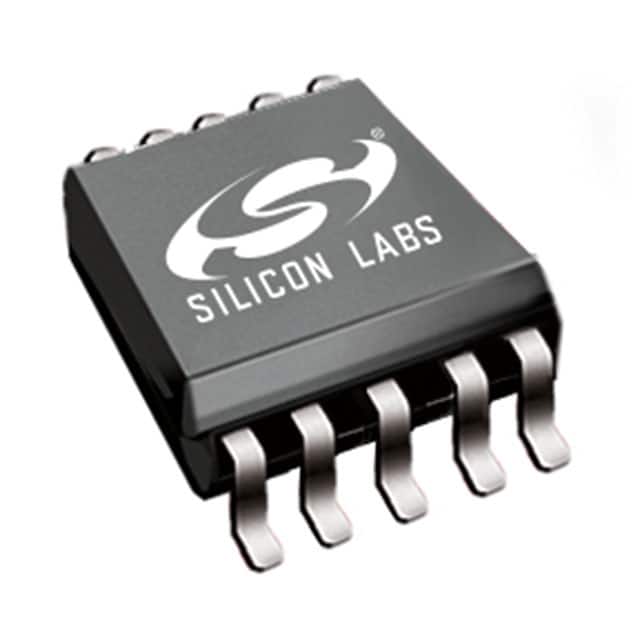
- Part No.:
- SI5350A-B02378-GTR
- Manufacturer:
- Skyworks Solutions Inc.
- Package:
- 10-TFSOP, 10-MSOP (0.118", 3.00mm Width)
- Datasheet:
-
 SI5350A-B02378-GTR.pdf
- Description:
- IC ANY FREQ ANY OUT XTAL 10MSOP
- Quantity:
- Payment:

- Shipping:

Inventory:2,967
Please send an inquiry. Send us your inquiry, and we will respond immediately.
Product details
Overview
SI5350A-B02378-GTR from Skyworks Solutions is a factory-programmed, pin-controlled CMOS clock generator delivering three independent output clocks (CLK0–CLK2) with 0 ppm frequency error across 2.5 kHz–200 MHz range. It uses a 25 or 27 MHz crystal reference, supports glitchless dual-frequency switching via FS_0/FS_1 pins, and targets cost-sensitive audio/video and embedded timing applications requiring XO replacement.
For engineers reviewing the SI5350A-B02378-GTR datasheet, SI5350A-B02378-GTR pinout, SI5350A-B02378-GTR application, or SI5350A-B02378-GTR equivalent, key selection criteria include its 3-output 10-MSOP package, 70 ps peak-to-peak period jitter (all outputs active), configurable spread spectrum per output, and support for HCSL-compatible swing at 2.5 V VDDO with external termination.
Technical Context
The SI5350A-B02378-GTR implements a dual-PLL + eight fractional MultiSynth architecture-two PLLs (PLLA/PLLB) feed dedicated MultiSynth dividers per output, enabling non-integer-related frequencies up to 200 MHz. Only PLLA-sourced outputs support spread spectrum modulation (±0.1% to ±1.5% center-spread, 30–33 kHz rate); PLLB-sourced outputs do not.
It operates from independent core (VDD = 1.8/2.5/3.3 V) and output (VDDO = 1.8/2.5/3.3 V) supplies, features user-configurable control pins (P0–P4) for OEB_0/1/2, PDN, FS_0/1, and SSEN, and supports static phase offset and rise/fall time control-critical for timing-critical video and networking interfaces.
Key Specifications
| Parameter | Value and Actual Design Meaning |
|---|---|
| Output count | 3 independent CMOS clock outputs (CLK0–CLK2) |
| Frequency range | 2.5 kHz to 200 MHz per output; only two unique frequencies >112.5 MHz simultaneously allowed |
| Period jitter | <70 ps pk-pk (typical, all outputs active, worst-case real-world frequency plan) |
| Core supply | 1.8 V / 2.5 V / 3.3 V (independent of VDDO; sequencing requires VDDO powered before or with VDD) |
| Output supply | VDDOA/VDDOB/VDDOC independently configurable at 1.8 V / 2.5 V / 3.3 V for level translation |
| Crystal reference | 25 MHz or 27 MHz AT-cut crystal; internal load capacitance selectable (0/6/8/10 pF) |
| Spread spectrum | Selectable per output (on/off); center-spread ±0.1% to ±1.5%, down-spread –0.1% to –2.5%, 30–33 kHz modulation rate |
Pinout & Package
SI5350A-B02378-GTR is packaged in a 10-pin MSOP (3.0 × 4.9 mm, 0.5 mm pitch) with exposed thermal pad. Pin functions are validated per Skyworks Rev. 1.2 datasheet Section 7.3 and Figure 4 (10-MSOP block diagram).
| Pin/Terminal | Circuit Role | Design Meaning |
|---|---|---|
| VDD | Core power supply | Supplies PLLs, logic, and MultiSynths; must be ≥ VDDO and sequenced first or concurrently |
| VDDOA, VDDOB, VDDOC | Output buffer supplies | Independent voltage rails per output pair; enable level translation (e.g., 1.8 V core + 2.5 V outputs for HCSL) |
| GND | Ground reference | Common return for core and outputs; thermal pad must be soldered for θJA = 150°C/W (2-layer board) |
| CLK0, CLK1, CLK2 | CMOS clock outputs | Configurable frequency, duty cycle (45–55%), rise/fall time (1 ns typ), and invert/non-invert per output |
| XA, XB | Crysal oscillator inputs | Differential crystal interface; accepts 25 or 27 MHz AT-cut crystal; internal load caps configurable |
| P0, P1, P2 | Programmable control pins | P0 = OEB_0 (output enable for CLK0), P1 = OEB_1 (CLK1), P2 = OEB_2 (CLK2); each configurable as active-low/high or high-Z disable state |
| P3 | Power-down control | PDN: device enters <50 µA shutdown when driven high; full restart required on low-to-high transition |
| P4 | Spread spectrum enable | SSEN: disables spread spectrum on all enabled PLLA-derived outputs when held low |
Key Features
| Feature | Design Value |
|---|---|
| Factory-programmed configuration | Delivers exact pre-defined frequencies without I²C programming-reduces BOM and firmware overhead in volume production |
| Glitchless frequency switching | FS_0/FS_1 pins select between two pre-programmed frequencies (F1_x/F2_x) on CLK0–CLK2 with zero-cycle phase discontinuity |
| HCSL-compatible output mode | When VDDOA = 2.5 V and CLK0/CLK1 are configured with complementary inversion + 511 Ω/240 Ω termination, meets HCSL jitter specs |
| Low-power operation | 20 mA typical core current (3 outputs enabled); <50 µA power-down current enables dynamic power gating in battery-sensitive systems |
| High PSRR | Eliminates need for external LDOs or ferrite beads-core and output supplies tolerate >60 dB ripple rejection up to 100 MHz |
Applications
| HDMI Audio/Video Timing | Residential Gateway Clocking |
|---|---|
Use Scenario: Generating synchronized 74.25 MHz (HDMI pixel clock), 24.576 MHz (audio sample rate), and 48 MHz (USB interface) from a single 27 MHz crystal in set-top boxes or Blu-ray players. IC Role / Device Role / Timing Role: Replaces three discrete XOs with one programmable clock generator, reducing PCB area and EMI coupling between clocks. Use Value: Eliminates inter-clock skew and jitter accumulation across domains; 0 ppm synthesis error ensures frame-accurate video timing and bit-perfect audio playback. | Use Scenario: Providing 33.333 MHz (CPU), 28.322 MHz (Ethernet PHY), and 22.5792 MHz (MoCA) clocks in broadband gateways using a single 25 MHz crystal. IC Role / Device Role / Timing Role: Centralized timing source for multi-protocol SoC subsystems, enabling deterministic latency and reduced component count. Use Value: Enables simultaneous operation of Ethernet, Wi-Fi, and MoCA PHYs without clock domain crossing buffers-lowers system-level jitter and simplifies layout. |
| Printers & Scanners | Handheld Instrumentation |
Use Scenario: Delivering 27 MHz (image sensor interface), 125 MHz (FPGA fabric), and 48 MHz (USB 2.0) in multifunction peripherals where space and cost are constrained. IC Role / Device Role / Timing Role: Single-chip clock solution replacing crystal oscillators and discrete buffers in compact mechanical enclosures. Use Value: Reduces bill-of-materials by 60% vs. discrete XO + fanout buffer approach; 70 ps jitter meets USB 2.0 eye diagram requirements. | Use Scenario: Supplying 33.333 MHz (microcontroller core), 74.25 MHz (video DAC), and 24.576 MHz (audio codec) in portable test equipment with battery life constraints. IC Role / Device Role / Timing Role: Low-power, factory-configured timing engine supporting multiple sampling rates and display resolutions. Use Value: Power-down unused outputs and disable spread spectrum during precision measurements-improves SNR by >3 dB versus always-on clock sources. |
Equivalent & Alternatives
The following parts are listed as comparable options for similar clock generator applications.
| Alternative Part | Technical Difference | Application Difference | Selection Advice |
|---|---|---|---|
| Si5350A-B-GT | Blank (unprogrammed) 10-MSOP variant requiring I²C configuration; no factory frequency definition | Requires external MCU and ClockBuilder Pro-generated firmware; unsuitable for turnkey production | Select SI5350A-B02378-GTR when fixed, verified frequencies are needed without runtime programming. |
| Si5351A-B-GT | I²C-programmable 3-output variant with identical 10-MSOP package but different PLL architecture (single PLL + MultiSynths); max 160 MHz output | Lacks dual-frequency switching (FS pins) and HCSL compatibility; higher jitter (110 ps pk-pk typical) | Choose Si5351A-B-GT only if field-upgradable frequency plans are mandatory and 200 MHz capability is not required. |
Compared with Si5350A-B-GT and Si5351A-B-GT, SI5350A-B02378-GTR delivers guaranteed factory-set frequencies, lower jitter, HCSL support, and pin-controlled dual-rate switching-making it optimal for cost-sensitive, high-volume consumer electronics where design lock-in and supply chain simplicity are critical.
Availability
SI5350A-B02378-GTR is available at Aetrix Electronics and suitable for HDMI timing, residential gateway clocking, printer/scanner synchronization, and handheld instrumentation requiring stable component supply and guaranteed factory-programmed performance.
Supply support for SI5350A-B02378-GTR includes scheduled delivery planning, volume procurement assistance, BOM continuity management, traceable sourcing, and lifecycle availability coordination for OEM customers, industrial embedded developers, connected-device designers, and electronics production programs.
Manufacturer
Skyworks Solutions is a global semiconductor company specializing in analog and mixed-signal connectivity solutions, with leadership in RF, timing, and power management ICs.
The Si5350A product line delivers factory-programmable, low-jitter clock generators targeting cost-sensitive consumer, computing, and communications applications where crystal oscillator replacement and multi-frequency flexibility are essential.
FAQ
What is the maximum output frequency supported by the SI5350A-B02378-GTR?
The SI5350A-B02378-GTR supports output frequencies from 2.5 kHz up to 200 MHz per channel. However, only two unique frequencies above 112.5 MHz may be generated simultaneously-e.g., 125 MHz and 130 MHz on separate outputs is permitted, but adding a third distinct frequency >112.5 MHz violates specification. This constraint arises from internal PLL bandwidth and MultiSynth divider resolution limits documented in Table 7 of the Skyworks datasheet.
Does the SI5350A-B02378-GTR require an external EEPROM or I²C controller to operate?
No. The SI5350A-B02378-GTR is factory-programmed with its specific frequency configuration and operates autonomously after power-up. Unlike blank variants (e.g., SI5350A-B-GT), it needs no I²C bus, external memory, or host processor initialization-making it ideal for simple, reliable, and secure timing in resource-constrained designs.
Can the SI5350A-B02378-GTR generate HCSL-compatible differential clocks?
Yes-but only in 10-MSOP and 20-QFN packages, and only when VDDOA is set to 2.5 V for CLK0/CLK1 pair. External 511 Ω and 240 Ω resistors plus inversion of one output (via ClockBuilder Pro configuration) are required to meet HCSL voltage swing and impedance specs. The SI5350A-B02378-GTR's 10-MSOP package supports this mode per Section 4.3 and Figure 3 of the datasheet.
What is the power consumption of the SI5350A-B02378-GTR under typical operating conditions?
With three outputs enabled, the SI5350A-B02378-GTR draws 20 mA typical core current (IDD) at 1.8 V VDD, per Table 4. Output buffer current is 2.2–5.6 mA per channel (IDDOx) depending on load. In power-down mode (PDN = high), total current drops to ≤50 µA. Total system current is therefore highly dependent on VDD, VDDO, and enabled outputs-designers should use the values in Tables 4 and 5 for accurate budgeting.
How does spread spectrum work on the SI5350A-B02378-GTR, and which outputs support it?
Spread spectrum modulation reduces EMI by dithering output frequency around its nominal value. On the SI5350A-B02378-GTR, only outputs sourced from PLLA support spread spectrum (configurable per output); PLLB-sourced outputs do not. Modulation is center-spread (±0.1% to ±1.5%) or down-spread (–0.1% to –2.5%) at 30–33 kHz, controlled globally via the SSEN pin or individually via register settings in programmable variants-though SI5350A-B02378-GTR uses factory-fixed enable/disable states.
SI5350A-B02378-GTR Specifications
- Product attributes
- Attribute value
- Manufacturer:
- Skyworks Solutions Inc.
- Series:
- -
- Package/Case:
- 10-TFSOP, 10-MSOP (0.118", 3.00mm Width)
- Packaging:
- Tape & Reel (TR)
- Product Status:
- Active
- Programmable:
- Not Verified
- Type:
- -
- PLL:
- -
- Input:
- -
- Output:
- -
- Number of Circuits:
- -
- Ratio - Input:Output:
- -
- Differential - Input:Output:
- -
- Frequency - Max:
- -
- Divider/Multiplier:
- -
- Voltage - Supply:
- -
- Operating Temperature:
- -
- Mounting Type:
- Surface Mount
- Grade:
- -
- Qualification:
- -
- Supplier Device Package:
- 10-MSOP
SI5350A-B02378-GTR FAQ
1.How can I place an order for SI5350A-B02378-GTR through Aetrix?
Please submit a Request for Quotation (RFQ) for SI5350A-B02378-GTR on Aetrix. Our sales agent will provide a competitive quotation and guide you through the order confirmation once you accept the terms.
2.Are the price and stock information for SI5350A-B02378-GTR reliable?
The price and inventory of SI5350A-B02378-GTR are updated periodically and may fluctuate due to market conditions. Stock and pricing data are typically refreshed every 24 hours. Quotation validity for SI5350A-B02378-GTR is usually 5 days.
3.What payment methods are accepted for SI5350A-B02378-GTR?
We accept Wire Transfer, PayPal, Credit Card, Western Union, MoneyGram, and Escrow for SI5350A-B02378-GTR transactions.
Note: Certain payment methods may incur a processing fee.
4.How is shipping managed for SI5350A-B02378-GTR?
SI5350A-B02378-GTR orders can be shipped via leading logistics carriers, including DHL, UPS, FedEx, TNT, or Registered Mail.
Once your SI5350A-B02378-GTR order is processed, you will receive an email with the shipment details and tracking number.
Note: Tracking information may take up to 24 hours to appear. Express delivery typically takes 3–5 business days.
5.How can I obtain technical support or documentation for SI5350A-B02378-GTR?
For technical support, including SI5350A-B02378-GTR datasheets, pinout diagrams, or application guidance, please contact our engineering support team. They can provide detailed documentation and assistance for your SI5350A-B02378-GTR requirements.
6.How does Aetrix verify that SI5350A-B02378-GTR is sourced from the original manufacturer or authorized distributors?
All SI5350A-B02378-GTR products on Aetrix are procured from qualified distributors and authorized channels. Our dedicated quality assurance team conducts strict verification, including traceability checks and, if necessary, third-party testing. This ensures that SI5350A-B02378-GTR meets industry standards.
7.What is the process for return or replacement of SI5350A-B02378-GTR?
All SI5350A-B02378-GTR units undergo pre-shipment inspection (PSI). If there is an issue with SI5350A-B02378-GTR, returns or replacements are accepted under the following conditions:
1.Quantity discrepancies, incorrect items, or visible external defects (such as breakage or corrosion), acknowledged by Aetrix.
2.The issue is reported within 90 days of delivery.
3.The SI5350A-B02378-GTR part is unused and in its original packaging.
Return procedure for SI5350A-B02378-GTR:
1.Submit a request within 90 days.
2.Obtain a Return Material Authorization (RMA) from Aetrix.
SI5350A-B02378-GTR Tags
-
CD74HCT4046AM96
Texas Instruments
-
MC14046BDWR2G
onsemi

-
501MILFT
Renesas
-
CD74HC7046AM
Texas Instruments
-
CDCVF2505PWR
Texas Instruments

-
RC19004A100GNL#KB0
Renesas
-
SI5351A-B-GTR
Skyworks Solutions Inc.
-
CY2305SXI-1T
Infineon Technologies
-
570BILFT
Renesas
-
CDCE913PWR
Texas Instruments
-
CY2305SXI-1HT
Infineon Technologies
-
DS1086LU+T
Analog Devices Inc./Maxim Integrated
Tech Hub
Counterfeit components can hide behind convincing markings and passing basic function tests. This engineering reference covers source traceability, external inspection, X-ray, XRF, electrical testing, …

A practical engineering and sourcing framework covering lifecycle verification, lifetime-buy calculations, replacement qualification, supplier checks and counterfeit-risk controls.

TTL and CMOS logic families differ in thresholds, loading, output drive, power and timing. This engineering guide compares 74HC and 74HCT, calculates noise margins and checks 3.3 V/5 V compatibility.

A practical engineering guide to 3.3V and 5V logic compatibility, input thresholds, resistor dividers, translator ICs, MOSFET level shifting, I2C pull-ups, timing limits and power-sequencing risks.

The 74HC595 uses push-pull logic outputs, while the TPIC6B595 uses 50 V open-drain DMOS sinks for higher-power loads. This guide compares timing, current limits, 3.3 V interfacing, load wiring, thermal…

The 74HC595 converts serial data into eight stable parallel outputs. This guide covers pin functions, shift and storage timing, OE and MR behavior, drive-current limits, cascading, voltage compatibilit…

A technical comparison of level-sensitive latches and edge-triggered flip-flops, covering timing windows, setup and hold limits, master–slave operation, time borrowing, race-through, HDL inference and…

A D latch stores one bit while Enable controls when data can pass. This reference covers gate-level operation, truth tables, transparency, setup and hold timing, LE versus OE, common ICs and practical …

An SR latch stores one bit through cross-coupled feedback. This engineering reference covers NOR and NAND implementations, truth tables, forbidden-state recovery, gated operation, switch debouncing, fa…

Latch circuits retain one bit through feedback. This technical reference covers SR and D latches, truth tables, transparency, timing limits, latch-versus-flip-flop behavior, applications and common log…


