
 My Inquiry
 My Account


Skyworks Solutions Inc. SI5394E-A-GMR
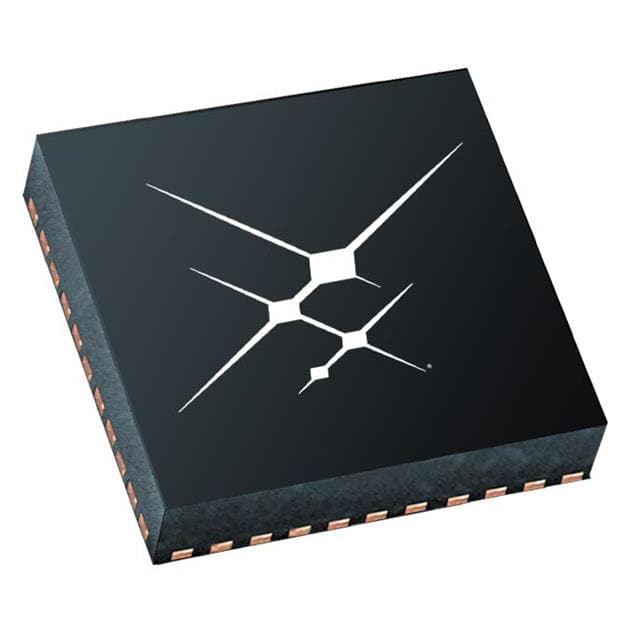
- Part No.:
- SI5394E-A-GMR
- Manufacturer:
- Skyworks Solutions Inc.
- Package:
- 44-TFLGA Exposed Pad
- Datasheet:
-
 SI5394E-A-GMR.pdf
- Description:
- IC CLOCK MULTIPLIER 44LGA
- Quantity:
- Payment:

- Shipping:

Inventory:2,292
Please send an inquiry. Send us your inquiry, and we will respond immediately.
Product details
Overview
SI5394E-A-GMR from Skyworks Solutions is a 4-input, 4-output ultra-low-jitter clock multiplier and jitter attenuator with integrated crystal reference, delivering 71 fs RMS phase jitter (Grade E), programmable DSPLL loop bandwidth (fixed at 100 Hz for Grade E), and support for hitless switching in 56G PAM4 SerDes clocking applications.
For engineers reviewing the SI5394E-A-GMR datasheet, SI5394E-A-GMR pinout, SI5394E-A-GMR application, or SI5394E-A-GMR equivalent, this device serves as a precision timing solution requiring deterministic jitter performance, holdover stability with integrated reference, and multi-domain frequency synthesis for high-speed networking line cards and SyncE-compliant systems.
Technical Context
The SI5394E-A-GMR implements fourth-generation DSPLL® architecture with Multi-Synth™ dividers to perform jitter attenuation and any-frequency multiplication. Its integrated crystal oscillator eliminates external XTAL components and reduces acoustic noise sensitivity during thermal ramping.
It supports free-run, locked, and holdover modes with programmable 120-second frequency history averaging for holdover, and enables frequency-on-the-fly updates per MultiSynth without disturbing other outputs - all configured via I²C/SPI with on-chip NVM for known-power-up state.
Key Specifications
| Parameter | Value and Actual Design Meaning |
|---|---|
| Phase Jitter (RMS) | 71 fs - meets stringent 56G SerDes sampling margin requirements |
| Input Frequency Range | Differential: 8 kHz–750 MHz; LVCMOS: 8 kHz–250 MHz - supports legacy and high-speed sync sources |
| Output Frequency Range | Differential: 100 Hz–1028 MHz; LVCMOS: 100 Hz–250 MHz - covers Ethernet, OTN, and test equipment clocks |
| DSPLL Loop Bandwidth | Fixed at 100 Hz - optimized for G.8262/G.8262.1 eEEC compliance and low wander |
| Output Count / Input Count | 4 outputs / 4 inputs - enables flexible clock domain isolation and redundancy |
| Reference Type | Integrated crystal - eliminates external XTAL BOM, improves board-level reliability and acoustic immunity |
| Supply Voltages | VDD = 1.8 V ±5%; VDDA = 3.3 V ±5%; independent output supply pins (1.8/2.5/3.3 V) - supports mixed-signal SoC interfacing |
Pinout & Package
SI5394E-A-GMR is housed in a 44-pin LGA package (7 × 7 mm), compatible with standard reflow profiles and offering improved thermal performance over QFN equivalents. Pin assignments follow Skyworks' standardized Si539x pinout for Grades J/K/L/M/E.
| Pin/Terminal | Circuit Role | Design Meaning |
|---|---|---|
| IN0–IN3 | Differential/LVCMOS clock inputs | Support automatic/manual selection; IN3 becomes FB_IN in zero-delay mode |
| OUT0–OUT3 | Programmable differential/LVCMOS outputs | Configurable for LVDS, LVPECL, CML, HCSL, or LVCMOS with amplitude control |
| XA/XB | Crystal oscillator terminals | Internally loaded - no external capacitors required; dedicated to integrated reference only |
| SCL/SDA | I²C serial interface | Two-wire bus for configuration and status monitoring; supports hot-plug programming |
| CLKIN_SEL[1:0] | Manual input selection control | Selects active input (IN0–IN2); IN3 reserved when zero-delay enabled |
| LOL/LOS/OOF | Status flag outputs | Open-drain indicators for loss-of-lock, loss-of-signal, and out-of-frequency conditions |
Key Features
| Feature | Design Value |
|---|---|
| Enhanced hitless switching | 0.2 ns typical output phase transient - preserves SerDes eye integrity during input failover |
| Integrated crystal reference (Grade E) | Eliminates external XTAL and load caps - reduces PCB area by ~12 mm² and improves system MTBF |
| Programmable holdover window | Up to 120 s of historical frequency data with user-defined averaging window - minimizes holdover drift in SyncE applications |
| Frequency-on-the-fly (FOTF) | Independent MultiSynth reconfiguration - enables dynamic clock rate changes without system reset |
| DCO mode (Grade E) | 0.001 ppb step size - supports fine-grained frequency tuning for calibration and test scenarios |
Applications
| 56G/112G PAM4 SerDes Clocking | OTN Muxponders & Transponders |
|---|---|
Use Scenario: Providing ultra-low-jitter reference clocks to multiple 56G/112G SerDes lanes in AI accelerators and optical modules. IC Role / Device Role / Timing Role: Jitter attenuator and frequency multiplier generating synchronized, sub-100-fs clocks from recovered or system references. Use Value: Enables >28 GBd PAM4 signaling with BER <1e-12 by meeting IEEE 802.3bs jitter budgets. | Use Scenario: Clocking OTN framers and digital signal processors in metro/core DWDM line cards. IC Role / Device Role / Timing Role: Multi-domain clock generator supporting OTU-4 (112 Gbps), OTU-3 (43 Gbps), and legacy SONET rates. Use Value: Maintains G.709 frame alignment across domains using independent MultiSynth outputs with integer/fractional synthesis. |
| 100/400G Synchronous Ethernet | Medical Imaging Systems |
Use Scenario: Delivering ITU-T G.8262-compliant EEC Option 1/2 and G.8262.1 eEEC clocks to packet processing ASICs in white-box switches. IC Role / Device Role / Timing Role: Primary timing IC providing traceable, holdover-stable clocks with integrated reference for pizza-box deployments. Use Value: Achieves <±4.6 ppm wander in holdover using 120 s averaged frequency history - exceeds SyncE Class C requirements. | Use Scenario: Synchronizing time-of-flight (ToF) sensors, ADCs, and FPGA-based beamformers in ultrasound and MRI subsystems. IC Role / Device Role / Timing Role: Low-phase-noise clock source for high-resolution sampling and deterministic latency control. Use Value: Reduces image ghosting and spatial distortion by limiting jitter-induced aperture error to <0.05% of sampling period. |
Equivalent & Alternatives
The following parts are listed as comparable options for similar jitter attenuator applications.
| Alternative Part | Technical Difference | Application Difference | Selection Advice |
|---|---|---|---|
| SI5394J-A-GMR | Same 44-LGA package and integrated reference, but Grade J supports integer+fractional synthesis; SI5394E-A-GMR limited to up to 2 domains with precision calibration | SI5394J-A-GMR targets general-purpose any-frequency synthesis; SI5394E-A-GMR optimized for calibrated holdover stability in telecom infrastructure | Select SI5394E-A-GMR when G.8262.1 eEEC compliance and factory-trimmed holdover accuracy are required |
| SI5344D-A-GMR | Drop-in compatible pinout (44-QFN), external crystal reference, higher jitter (135 fs), no integrated reference or holdover history averaging | SI5344D-A-GMR suits cost-sensitive industrial designs where external TCXO is acceptable; lacks Grade E's acoustic noise immunity | Choose SI5344D-A-GMR only if board space allows external crystal and jitter >100 fs is tolerable |
Compared with SI5394J-A-GMR, SI5394E-A-GMR trades broader synthesis flexibility for tighter holdover calibration and enhanced acoustic robustness; versus SI5344D-A-GMR, it delivers 64 fs lower jitter and eliminates crystal-related layout sensitivity - critical for dense, thermally cycled telecom modules.
Availability
SI5394E-A-GMR is available at Aetrix Electronics and suitable for 56G SerDes clocking, OTN transponder timing, and Synchronous Ethernet line cards requiring stable component supply, long-term lifecycle assurance, and RoHS-6 compliance.
Supply support for SI5394E-A-GMR includes scheduled delivery planning, volume procurement assistance, BOM continuity management, traceable sourcing, and lifecycle availability coordination for OEM customers, industrial embedded developers, connected-device designers, and electronics production programs.
Manufacturer
Skyworks Solutions is a global leader in analog and mixed-signal semiconductors, specializing in RF, mobile, infrastructure, and timing solutions with over 30 years of RF and clocking innovation.
The Si539x family was designed specifically for high-performance networking and datacenter timing, addressing jitter, holdover stability, and multi-domain synchronization challenges in 56G+ SerDes and ITU-T-compliant systems.
FAQ
What is the phase jitter specification for SI5394E-A-GMR, and under what conditions is it measured?
The SI5394E-A-GMR delivers 71 fs RMS phase jitter (12 kHz–20 MHz integration band), measured per IEEE 1149.1 and ITU-T G.8262 Annex I using a 100 MHz differential output clock, 100 Hz DSPLL loop bandwidth, and integrated crystal reference. This value applies to Grade E devices operating within –40°C to +85°C ambient temperature and specified supply voltage ranges.
Does SI5394E-A-GMR require an external crystal, and what happens if one is connected?
No, SI5394E-A-GMR uses an integrated crystal reference and does not require or support external crystals. Connecting an external crystal or oscillator to XA/XB pins on SI5394E-A-GMR is prohibited and may cause internal circuit damage, as confirmed in Skyworks' Final Data Sheet Section 4.6 and Figure 5 notes.
How many independent frequency domains does SI5394E-A-GMR support, and what defines a domain?
SI5394E-A-GMR supports up to two independent frequency domains, as defined in Section 4.9.2 of the Skyworks datasheet. Each domain comprises one or more outputs sharing the same DSPLL and MultiSynth configuration - enabling simultaneous generation of unrelated frequencies (e.g., 156.25 MHz for Ethernet and 297 MHz for video) with isolated jitter transfer paths.
Can SI5394E-A-GMR operate in zero-delay mode, and how does it affect pin functionality?
Yes, SI5394E-A-GMR supports zero-delay mode, which repurposes IN3 as feedback input (FB_IN). In this mode, IN3 is no longer available as a selectable clock input, and manual selection via CLKIN_SEL[1:0] is restricted to IN0–IN2. Zero-delay mode requires specific register configuration and is intended for applications requiring minimal propagation delay between input and output clocks.
What serial interfaces does SI5394E-A-GMR support, and are both available simultaneously?
SI5394E-A-GMR supports I²C and SPI serial interfaces, but only one can be active at a time. Interface selection is determined by strap pin configuration at power-up: I²C is enabled when SDO is pulled high, SPI when SDO is pulled low. Both interfaces provide full access to registers, NVM programming, and status monitoring per the Si5395-94-92 Family Reference Manual.
SI5394E-A-GMR Specifications
- Product attributes
- Attribute value
- Manufacturer:
- Skyworks Solutions Inc.
- Series:
- -
- Package/Case:
- 44-TFLGA Exposed Pad
- Packaging:
- Tape & Reel (TR)
- Product Status:
- Active
- Programmable:
- Not Verified
- Type:
- Clock Multiplier, Jitter Attenuator
- PLL:
- Yes
- Input:
- LVCMOS
- Output:
- CML, HCSL, LVDS, LVPECL, LVCMOS
- Number of Circuits:
- 1
- Ratio - Input:Output:
- 4:4
- Differential - Input:Output:
- Yes/Yes
- Frequency - Max:
- 200MHz
- Divider/Multiplier:
- Yes/No
- Voltage - Supply:
- 1.71V ~ 1.89V, 3.14V ~ 3.47V
- Operating Temperature:
- -40°C ~ 85°C (TA)
- Mounting Type:
- Surface Mount
- Grade:
- -
- Qualification:
- -
- Supplier Device Package:
- 44-LGA (7x7)
SI5394E-A-GMR FAQ
1.How can I place an order for SI5394E-A-GMR through Aetrix?
Please submit a Request for Quotation (RFQ) for SI5394E-A-GMR on Aetrix. Our sales agent will provide a competitive quotation and guide you through the order confirmation once you accept the terms.
2.Are the price and stock information for SI5394E-A-GMR reliable?
The price and inventory of SI5394E-A-GMR are updated periodically and may fluctuate due to market conditions. Stock and pricing data are typically refreshed every 24 hours. Quotation validity for SI5394E-A-GMR is usually 5 days.
3.What payment methods are accepted for SI5394E-A-GMR?
We accept Wire Transfer, PayPal, Credit Card, Western Union, MoneyGram, and Escrow for SI5394E-A-GMR transactions.
Note: Certain payment methods may incur a processing fee.
4.How is shipping managed for SI5394E-A-GMR?
SI5394E-A-GMR orders can be shipped via leading logistics carriers, including DHL, UPS, FedEx, TNT, or Registered Mail.
Once your SI5394E-A-GMR order is processed, you will receive an email with the shipment details and tracking number.
Note: Tracking information may take up to 24 hours to appear. Express delivery typically takes 3–5 business days.
5.How can I obtain technical support or documentation for SI5394E-A-GMR?
For technical support, including SI5394E-A-GMR datasheets, pinout diagrams, or application guidance, please contact our engineering support team. They can provide detailed documentation and assistance for your SI5394E-A-GMR requirements.
6.How does Aetrix verify that SI5394E-A-GMR is sourced from the original manufacturer or authorized distributors?
All SI5394E-A-GMR products on Aetrix are procured from qualified distributors and authorized channels. Our dedicated quality assurance team conducts strict verification, including traceability checks and, if necessary, third-party testing. This ensures that SI5394E-A-GMR meets industry standards.
7.What is the process for return or replacement of SI5394E-A-GMR?
All SI5394E-A-GMR units undergo pre-shipment inspection (PSI). If there is an issue with SI5394E-A-GMR, returns or replacements are accepted under the following conditions:
1.Quantity discrepancies, incorrect items, or visible external defects (such as breakage or corrosion), acknowledged by Aetrix.
2.The issue is reported within 90 days of delivery.
3.The SI5394E-A-GMR part is unused and in its original packaging.
Return procedure for SI5394E-A-GMR:
1.Submit a request within 90 days.
2.Obtain a Return Material Authorization (RMA) from Aetrix.
SI5394E-A-GMR Tags
-
CD74HCT4046AM96
Texas Instruments
-
MC14046BDWR2G
onsemi

-
501MILFT
Renesas
-
CD74HC7046AM
Texas Instruments
-
CDCVF2505PWR
Texas Instruments

-
RC19004A100GNL#KB0
Renesas
-
SI5351A-B-GTR
Skyworks Solutions Inc.
-
CY2305SXI-1T
Infineon Technologies
-
570BILFT
Renesas
-
CDCE913PWR
Texas Instruments
-
CY2305SXI-1HT
Infineon Technologies
-
DS1086LU+T
Analog Devices Inc./Maxim Integrated
Tech Hub

Counterfeit components can hide behind convincing markings and passing basic function tests. This engineering reference covers source traceability, external inspection, X-ray, XRF, electrical testing, …

A practical engineering and sourcing framework covering lifecycle verification, lifetime-buy calculations, replacement qualification, supplier checks and counterfeit-risk controls.

TTL and CMOS logic families differ in thresholds, loading, output drive, power and timing. This engineering guide compares 74HC and 74HCT, calculates noise margins and checks 3.3 V/5 V compatibility.

A practical engineering guide to 3.3V and 5V logic compatibility, input thresholds, resistor dividers, translator ICs, MOSFET level shifting, I2C pull-ups, timing limits and power-sequencing risks.

The 74HC595 uses push-pull logic outputs, while the TPIC6B595 uses 50 V open-drain DMOS sinks for higher-power loads. This guide compares timing, current limits, 3.3 V interfacing, load wiring, thermal…

The 74HC595 converts serial data into eight stable parallel outputs. This guide covers pin functions, shift and storage timing, OE and MR behavior, drive-current limits, cascading, voltage compatibilit…

A technical comparison of level-sensitive latches and edge-triggered flip-flops, covering timing windows, setup and hold limits, master–slave operation, time borrowing, race-through, HDL inference and…

A D latch stores one bit while Enable controls when data can pass. This reference covers gate-level operation, truth tables, transparency, setup and hold timing, LE versus OE, common ICs and practical …

An SR latch stores one bit through cross-coupled feedback. This engineering reference covers NOR and NAND implementations, truth tables, forbidden-state recovery, gated operation, switch debouncing, fa…

Latch circuits retain one bit through feedback. This technical reference covers SR and D latches, truth tables, transparency, timing limits, latch-versus-flip-flop behavior, applications and common log…


