
 My Inquiry
 My Account


AMD SK-KV260-G-ED
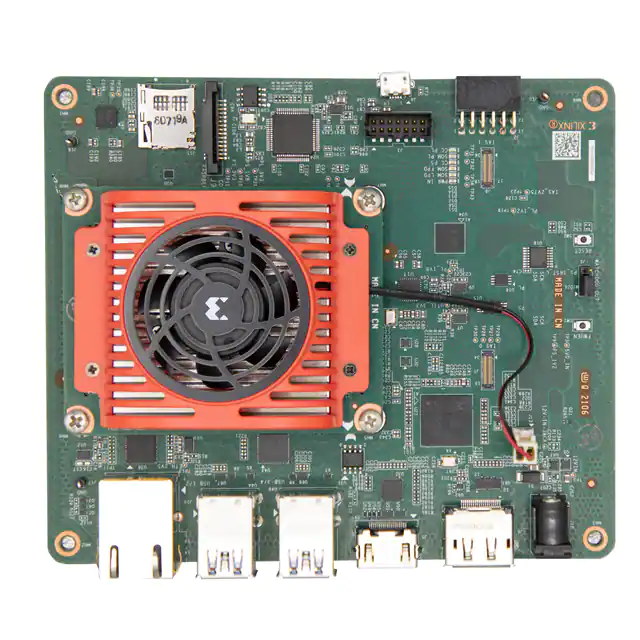
- Part No.:
- SK-KV260-G-ED
- Manufacturer:
- AMD
- Package:
- Datasheet:
-
 SK-KV260-G-ED.pdf
- Description:
- KRIA KV260 VISION AI STARTER ED
- Quantity:
- Payment:

- Shipping:

Inventory:1,946
Please send an inquiry. Send us your inquiry, and we will respond immediately.
Product details
Overview
SK-KV260-G-ED from Xilinx is a non-production evaluation platform built around the K26 system-on-module (SOM), integrating a Zynq UltraScale+ MPSoC, 4 GB DDR4 memory, Infineon TPM2.0, and OnSemi AP1302 13MP image signal processor - designed for rapid prototyping of vision AI applications in smart city infrastructure, security cameras, and retail analytics.
For engineers reviewing the SK-KV260-G-ED datasheet, pinout, applications, or equivalent options, this kit delivers out-of-box Vitis™-accelerated vision pipelines, pre-built ML inference stacks, and full Vivado® hardware customization support - enabling direct transition from evaluation to carrier-card-based production design.
Technical Context
The SK-KV260-G-ED implements a dual-domain architecture: the PS (ARM Cortex-A53 + R5F) handles OS-level vision preprocessing and control, while the PL (256K logic cells, 1.2K DSP slices) executes custom-accelerated kernels for real-time object detection, pose estimation, and video analytics. It supports MIPI CSI-2 x2 and Raspberry Pi camera interfaces for sensor ingestion, and DisplayPort 1.2a/HDMI 1.4 for multi-stream output.
Power sequencing is tightly coordinated between carrier card and SOM: a +12V input powers onboard regulators generating +5V (VCC_SOM), which enables PS/PL power domains only after power-good assertion and deassertion of POWER_OFF_C2M_L; reset is controlled via PS_POR_L with 25 ms delay before I/O release.
Key Specifications
| Parameter | Value and Actual Design Meaning |
|---|---|
| Form factor | SOM + carrier card assembly - enables modular development and custom carrier design. |
| Dimensions (full kit) | 123 mm × 140 mm × 36 mm - fits standard lab bench and embedded prototyping enclosures. |
| Thermal solution | Active cooling (heat sink + fan) rated for 15W max dissipation - sustains sustained ML inference workloads. |
| Memory | 4 GB DDR4 (4 × 512 Mb × 16-bit) - supports high-bandwidth frame buffering for 1080p@30fps+ video pipelines. |
| Boot sources | 512 Mb QSPI flash primary + microSD card secondary - enables secure boot and flexible firmware/image updates. |
| Security | Zynq UltraScale+ hardware root of trust + Infineon TPM2.0 - provides measured boot and cryptographic key protection. |
| Camera interfaces | MIPI CSI-2 ×2 + Raspberry Pi camera interface - allows concurrent multi-sensor ingestion (e.g., RGB + IR). |
| Video outputs | DisplayPort 1.2a ×1 + HDMI 1.4 ×1 - supports dual-display visualization and real-time result overlay. |
Availability
SK-KV260-G-ED is available at Aetrix Electronics and suitable for smart city infrastructure prototyping, industrial machine vision validation, and retail analytics algorithm development requiring stable component supply and long-term evaluation platform availability.
Supply support for SK-KV260-G-ED includes scheduled delivery planning, volume procurement assistance, BOM continuity management, traceable sourcing, and lifecycle availability coordination for OEM customers, industrial embedded developers, connected-device designers, and electronics production programs.
Manufacturer
Xilinx, now part of AMD, is a leader in adaptive computing solutions, delivering FPGA, ACAP, and SoC platforms for AI acceleration, data center, and embedded systems.
The Kria product line targets vision-centric edge AI developers - providing pre-validated hardware/software stacks that reduce time-to-deployment for ML-driven imaging applications without requiring low-level RTL expertise.
FAQ
What is the difference between SK-KV260-G-ED and SK-KV260-G?
The SK-KV260-G-ED is identical to SK-KV260-G in hardware and mechanical design but ships with device encryption disabled in the Zynq UltraScale+ MPSoC. This allows unrestricted access to bitstream configuration and debugging capabilities during early-stage development, whereas SK-KV260-G enables AES-256 encryption for secure boot and IP protection in production-intent evaluation.
Does SK-KV260-G-ED include the K26 SOM or is it sold separately?
The SK-KV260-G-ED includes the complete Kria KV260 Vision AI Starter Kit: K26 SOM (XCK26-C), carrier card, thermal solution (heat sink + fan), and all necessary interconnects. No additional SOM purchase is required - the SOM is permanently mounted and integrated into the assembled kit.
Can SK-KV260-G-ED be used for production deployment?
No - SK-KV260-G-ED is explicitly designated as a non-production evaluation kit. While it uses the same K26 SOM silicon as production-grade modules, its carrier card, thermal solution, and qualification level are not certified for continuous operation or industrial reliability. For production use, customers must integrate the C- or I-grade K26 SOM into a custom carrier card meeting target environmental and regulatory requirements.
Which software tools support SK-KV260-G-ED out of the box?
SK-KV260-G-ED is natively supported in Xilinx Vitis™ 2021.2+ and Vivado® 2021.2+ toolchains. Pre-built images include the kv260_base platform, accelerated vision applications (e.g., face detection, people counting), and the platformstats utility for real-time SOM power telemetry via INA260 I²C monitoring.
What camera sensors are compatible with SK-KV260-G-ED?
SK-KV260-G-ED supports MIPI CSI-2 sensors compliant with the OnSemi AP1302 ISP interface (e.g., AR0234, AS0210) on its two IAS connectors, plus Raspberry Pi HQ Camera via the dedicated RPi interface. Sensor compatibility requires matching voltage rails (2.75V/1.8V/1.2V) and timing constraints defined in UG1089 and DS987.
SK-KV260-G-ED Specifications
- Product attributes
- Attribute value
- Manufacturer:
- AMD
- Series:
- Zynq® UltraScale+™ Kria™
- Packaging:
- Box
- Product Status:
- Discontinued at Digi-Key
- Type:
- FPGA + MCU/MPU SoC
- For Use With/Related Products:
- SM-K26, XCK26
- Platform:
- Kria KV260 Vision AI Starter Encryption Disabled
- Contents:
- Board(s)
SK-KV260-G-ED FAQ
1.How can I place an order for SK-KV260-G-ED through Aetrix?
Please submit a Request for Quotation (RFQ) for SK-KV260-G-ED on Aetrix. Our sales agent will provide a competitive quotation and guide you through the order confirmation once you accept the terms.
2.Are the price and stock information for SK-KV260-G-ED reliable?
The price and inventory of SK-KV260-G-ED are updated periodically and may fluctuate due to market conditions. Stock and pricing data are typically refreshed every 24 hours. Quotation validity for SK-KV260-G-ED is usually 5 days.
3.What payment methods are accepted for SK-KV260-G-ED?
We accept Wire Transfer, PayPal, Credit Card, Western Union, MoneyGram, and Escrow for SK-KV260-G-ED transactions.
Note: Certain payment methods may incur a processing fee.
4.How is shipping managed for SK-KV260-G-ED?
SK-KV260-G-ED orders can be shipped via leading logistics carriers, including DHL, UPS, FedEx, TNT, or Registered Mail.
Once your SK-KV260-G-ED order is processed, you will receive an email with the shipment details and tracking number.
Note: Tracking information may take up to 24 hours to appear. Express delivery typically takes 3–5 business days.
5.How can I obtain technical support or documentation for SK-KV260-G-ED?
For technical support, including SK-KV260-G-ED datasheets, pinout diagrams, or application guidance, please contact our engineering support team. They can provide detailed documentation and assistance for your SK-KV260-G-ED requirements.
6.How does Aetrix verify that SK-KV260-G-ED is sourced from the original manufacturer or authorized distributors?
All SK-KV260-G-ED products on Aetrix are procured from qualified distributors and authorized channels. Our dedicated quality assurance team conducts strict verification, including traceability checks and, if necessary, third-party testing. This ensures that SK-KV260-G-ED meets industry standards.
7.What is the process for return or replacement of SK-KV260-G-ED?
All SK-KV260-G-ED units undergo pre-shipment inspection (PSI). If there is an issue with SK-KV260-G-ED, returns or replacements are accepted under the following conditions:
1.Quantity discrepancies, incorrect items, or visible external defects (such as breakage or corrosion), acknowledged by Aetrix.
2.The issue is reported within 90 days of delivery.
3.The SK-KV260-G-ED part is unused and in its original packaging.
Return procedure for SK-KV260-G-ED:
1.Submit a request within 90 days.
2.Obtain a Return Material Authorization (RMA) from Aetrix.
SK-KV260-G-ED Tags

-
EK-10M08E144
Intel
-
DK-DEV-10M08E144-B
Intel
-
XYLONI
Efinix, Inc.
-
410-328-35
Digilent, Inc.
-
410-376
Digilent, Inc.
-
EK-10CL025U256
Intel
-
P0082
Terasic Inc.
-
SLG4DVKADV
Renesas
-
TEBA0841-02
Trenz Electronic GmbH
-
MPFS-DISCO-KIT
Microchip Technology
-
P0466
Terasic Inc.
-
410-370
Digilent, Inc.
Tech Hub

A practical engineering and sourcing framework covering lifecycle verification, lifetime-buy calculations, replacement qualification, supplier checks and counterfeit-risk controls.

TTL and CMOS logic families differ in thresholds, loading, output drive, power and timing. This engineering guide compares 74HC and 74HCT, calculates noise margins and checks 3.3 V/5 V compatibility.

A practical engineering guide to 3.3V and 5V logic compatibility, input thresholds, resistor dividers, translator ICs, MOSFET level shifting, I2C pull-ups, timing limits and power-sequencing risks.

The 74HC595 uses push-pull logic outputs, while the TPIC6B595 uses 50 V open-drain DMOS sinks for higher-power loads. This guide compares timing, current limits, 3.3 V interfacing, load wiring, thermal…

The 74HC595 converts serial data into eight stable parallel outputs. This guide covers pin functions, shift and storage timing, OE and MR behavior, drive-current limits, cascading, voltage compatibilit…

A technical comparison of level-sensitive latches and edge-triggered flip-flops, covering timing windows, setup and hold limits, master–slave operation, time borrowing, race-through, HDL inference and…

A D latch stores one bit while Enable controls when data can pass. This reference covers gate-level operation, truth tables, transparency, setup and hold timing, LE versus OE, common ICs and practical …

An SR latch stores one bit through cross-coupled feedback. This engineering reference covers NOR and NAND implementations, truth tables, forbidden-state recovery, gated operation, switch debouncing, fa…

Latch circuits retain one bit through feedback. This technical reference covers SR and D latches, truth tables, transparency, timing limits, latch-versus-flip-flop behavior, applications and common log…

An engineering guide to LED driver operation, constant-current and constant-voltage outputs, linear and switching topologies, dimming, IC selection, calculations, replacement compatibility, and fault c…


