
 My Inquiry
 My Account


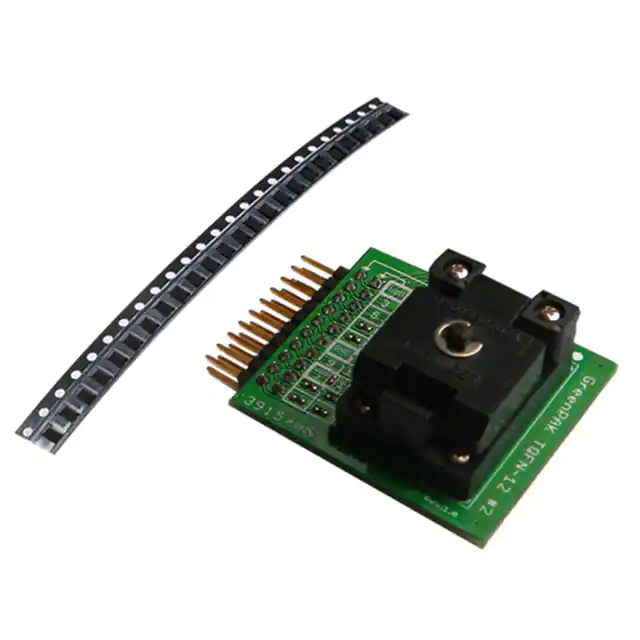
Renesas SLG46536V-SKT
- Part No.:
- SLG46536V-SKT
- Manufacturer:
- Renesas
- Category:
- Programming Adapters, Sockets
- Package:
- Datasheet:
-
 SLG46536V-SKT.pdf
- Description:
- SLG4SA14DS-20X22 SOCKET ADAPTER
- Quantity:
- Payment:

- Shipping:

Inventory:4,875
Please send an inquiry. Send us your inquiry, and we will respond immediately.
Product details
Overview
SLG46536V-SKT from Renesas Electronics is a programmable mixed-signal matrix IC featuring 14-pin STQFN (2 × 2.2 × 0.55 mm, 0.4 mm pitch), three analog comparators (ACMP0–ACMP2), I²C serial interface (up to 400 kHz), and 16×8 RAM with OTP-configurable NVM. It operates from 1.8 V ±5% to 5 V ±10% across –40 °C to +85 °C and supports configurable RC oscillators (25 kHz / 2 MHz / 25 MHz) for timing-critical embedded logic functions.
For engineers reviewing the SLG46536V-SKT datasheet, SLG46536V-SKT pinout, SLG46536V-SKT application, or SLG46536V-SKT equivalent, this device serves as a low-power, field-programmable alternative to discrete logic + analog signal conditioning in space-constrained PC peripherals, handheld electronics, and datacom power management subsystems.
Technical Context
The SLG46536V-SKT implements a reconfigurable interconnect matrix routing signals between 14 GPIO pins, three ACMPs, two deglitch filters with edge detection, and 26 combination-function macrocells-including LUTs (2-bit, 3-bit, 4-bit), DFFs, counters/delays (5× 8-bit, 2× 16-bit), and a programmable pattern generator. Its I²C interface enables runtime configuration and read-back protection via NVM lock.
Power management includes dual-side rail partitioning (Pins 2–8 vs. 10–14), POR with programmable thresholds (PONTHR = 1.41–1.66 V), and selectable oscillator startup modes (fast-start or auto-power). All macrocells support independent drive strength (1X/2X/4X NMOS OD, push-pull) and Schmitt-trigger inputs with adjustable hysteresis (25/50/200 mV).
Key Specifications
| Parameter | Value and Actual Design Meaning |
|---|---|
| Supply Voltage Range | 1.8 V ±5% to 5 V ±10% - supports direct interfacing with 1.8 V, 3.3 V, and 5 V logic domains without level shifters. |
| I²C Clock Frequency | Up to 400 kHz - compliant with standard-mode I²C, enabling host MCU configuration and status polling. |
| ACMP Input Range | Positive input: 0 to VDD; negative input: 0 to 1.2 V - allows flexible reference selection and rail-to-rail sensing. |
| Propagation Delay (ACMP) | 1.55–216.6 µs - selectable low-bandwidth mode reduces noise sensitivity; high-speed mode enables <3 µs response at 5 V. |
| Oscillator Options | 25 kHz / 2 MHz / 25 MHz RC oscillators - provides clock sources for timers, PWM, and state machines without external crystals. |
| Package | 14-pin STQFN (2.0 × 2.2 × 0.55 mm, 0.4 mm pitch) - ultra-compact footprint ideal for portable and dense PCB layouts. |
| Operating Temperature | –40 °C to +85 °C - qualified for industrial and consumer-grade embedded applications. |
Pinout & Package
14-pin STQFN package (2.0 × 2.2 × 0.55 mm, 0.4 mm pitch), top view: Pin 1 = VDD, Pin 2 = GPI, Pins 3–5/8/10–14 = GPIO (with mixed ACMP/oscillator/Vref/I²C functions), Pin 6 = SCL/GPIO, Pin 7 = SDA/GPIO, Pin 9 = GND.
| Pin/Terminal | Circuit Role | Design Meaning |
|---|---|---|
| 1 | VDD | Main power supply input - powers both sides of internal rail partitioning (Pins 2–8 and 10–14). |
| 2 | GPI | Dedicated input-only pin - used for critical control signals requiring no output contention. |
| 3–5, 8, 10–14 | GPIO | Configurable I/O with OE control, ACMP inputs (Pins 4–5, 8, 10), Vref sourcing (Pins 5, 10), or external clock (Pin 14). |
| 6 | SCL/GPIO | I²C clock line (NMOS open-drain only) - requires external pull-up; also usable as general-purpose input/output. |
| 7 | SDA/GPIO | I²C data line (NMOS open-drain only) - bidirectional, supports ACK/NACK; also configurable as GPIO. |
| 9 | GND | Ground reference - common return path for all analog and digital circuitry. |
Key Features
| Feature | Design Value |
|---|---|
| One-Time-Programmable NVM | Stores full interconnect and macrocell configuration permanently - eliminates boot-time firmware load and ensures deterministic startup behavior. |
| Three Analog Comparators | Each supports programmable hysteresis (25/50/200 mV), gain (1x/0.5x/0.33x/0.25x), and low-bandwidth mode - enables robust voltage monitoring and threshold detection. |
| 26 Macrocells | Includes LUTs (2-/3-/4-bit), DFFs, counters/delays (5× 8-bit, 2× 16-bit), and edge-detect filters - replaces dozens of discrete logic gates and timing components. |
| I²C Interface | Standard-mode (400 kHz) slave interface with read-back protection - allows in-system reconfiguration and diagnostics without JTAG. |
| Multi-Voltage Oscillators | On-chip 25 kHz / 2 MHz / 25 MHz RC oscillators - eliminates external timing components while supporting wake-up, PWM, and system clocking. |
Applications
| USB-C Power Delivery Controller | Smart Battery Fuel Gauge |
|---|---|
|
Use Scenario: Monitors CC line voltage, VBUS presence, and overvoltage conditions in USB-C PD sink implementations. IC Role / Device Role / Timing Role: Mixed-signal logic engine performing real-time comparator-based fault detection, debounce filtering, and I²C-mediated status reporting to host MCU. Use Value: Replaces 3–5 discrete comparators, RC filters, and logic gates with single-chip solution occupying <2.5 mm² PCB area and consuming <1 µA quiescent current. |
Use Scenario: Tracks battery cell voltage, temperature, and charge/discharge current thresholds in portable medical devices. IC Role / Device Role / Timing Role: Configurable analog front-end and state machine managing ADC trigger timing, alert generation, and SMBus-compatible communication. Use Value: Enables accurate voltage window detection (±10 mV offset) and programmable delay-based sampling synchronization without external precision references. |
| Industrial Sensor Signal Conditioning | PC Motherboard Fan Control |
|
Use Scenario: Conditions outputs from thermistors, RTDs, or Hall-effect sensors in factory automation modules. IC Role / Device Role / Timing Role: Programmable gain amplifier + comparator + deglitch filter + PWM generator - all within one die. Use Value: Delivers <1.5 µs propagation delay (ACMP @ 5 V) and 200 mV hysteresis for noise-immune sensor triggering in EMI-heavy environments. |
Use Scenario: Implements tachometer input decoding, thermal throttling logic, and PWM fan speed control on desktop/server motherboards. IC Role / Device Role / Timing Role: Digital timing core generating precise 25 kHz PWM with duty-cycle modulation based on thermal sensor feedback. Use Value: Integrates 16-bit counter/delay macrocells and GPIO-driven PWM output - eliminates need for dedicated fan controller IC and associated passive components. |
Equivalent & Alternatives
The following parts are listed as comparable options for similar programmable mixed-signal logic applications.
| Alternative Part | Technical Difference | Application Difference | Selection Advice |
|---|---|---|---|
| SLG46537V | Same architecture but adds crystal oscillator input (XIN/XOUT) and 1 additional GPIO - no change to macrocell count or ACMP count. | Required when system-level timing demands ppm-stable reference (e.g., USB audio clock recovery) beyond RC oscillator accuracy. | Select SLG46537V only if external crystal integration is mandatory; SLG46536V-SKT suffices for all RC-oscillator-based use cases. |
| SLG46620V | Higher macrocell count (32 vs. 26), adds 2nd I²C master port and 12-bit SAR ADC - larger 20-pin STQFN package (3.5 × 3.5 mm). | Needed for designs requiring on-chip analog-to-digital conversion or dual-bus I²C bridging (e.g., sensor hub with local ADC + host I²C). | Choose SLG46620V when ADC or second I²C channel is required; SLG46536V-SKT remains optimal for pure logic+comparator+PWM applications. |
Compared with SLG46537V and SLG46620V, the SLG46536V-SKT delivers the smallest footprint and lowest static power for applications that rely exclusively on RC oscillators and do not require ADC or crystal-referenced timing - making it the most cost- and space-efficient choice for fan control, USB-C PD monitoring, and basic sensor interface tasks.
Availability
SLG46536V-SKT is available at Aetrix Electronics and suitable for USB-C power delivery controllers, smart battery fuel gauges, industrial sensor signal conditioners, PC motherboard fan controllers, and handheld electronics requiring stable component supply and long-term production continuity.
Supply support for SLG46536V-SKT includes scheduled delivery planning, volume procurement assistance, BOM continuity management, traceable sourcing, and lifecycle availability coordination for OEM customers, industrial embedded developers, connected-device designers, and electronics production programs.
Manufacturer
Renesas Electronics Corporation is a global semiconductor leader specializing in microcontrollers, analog, power, and mixed-signal solutions for automotive, industrial, and IoT markets.
The GreenPAK family - including SLG46536V-SKT - was designed to replace discrete logic, analog comparators, and timing circuits with field-programmable, ultra-low-power mixed-signal ICs for space- and cost-sensitive embedded systems.
FAQ
What is the primary function of the SLG46536V-SKT in an embedded system?
The SLG46536V-SKT serves as a programmable mixed-signal matrix IC that replaces discrete logic gates, analog comparators, RC timing networks, and basic state machines. It configures its internal interconnect, macrocells (LUTs, DFFs, counters), and three ACMPs via one-time-programmable NVM to implement custom signal conditioning, sequencing, and control logic - all within a 2.0 × 2.2 mm STQFN package. This makes SLG46536V-SKT ideal for compact, low-power embedded subsystems where board space and BOM count are critical.
Does the SLG46536V-SKT support I²C communication, and what are its timing limits?
Yes, the SLG46536V-SKT supports standard-mode I²C communication with SCL and SDA pins (Pins 6 and 7) operating as NMOS open-drain outputs. It complies with I²C specifications up to 400 kHz clock frequency, with minimum tLOW = 1300 ns, tHIGH = 600 ns, and tSU_DAT = 100 ns. The I²C interface enables host MCU configuration, register read-back, and status monitoring - and SLG46536V-SKT retains full functionality even when I²C is disabled in the NVM configuration.
Can the SLG46536V-SKT generate precise timing delays, and what is the resolution?
Yes, the SLG46536V-SKT includes five 8-bit and two 16-bit counter/delay macrocells, each capable of generating programmable delays with sub-microsecond resolution. At 5 V supply, typical delay resolution is 10–20 ns per step for short delays (e.g., 10–100 ns), scaling to ~225 ns per step for longer delays (e.g., 1 µs range). Measured delay accuracy is ±10% over temperature and voltage - sufficient for debouncing, pulse stretching, and synchronous logic timing in SLG46536V-SKT-based designs.
How many analog comparators does the SLG46536V-SKT include, and what input ranges do they support?
The SLG46536V-SKT integrates three independent analog comparators (ACMP0, ACMP1, ACMP2). Each accepts a positive input ranging from 0 to VDD and a negative input ranging from 0 to 1.2 V - enabling flexible configurations such as rail-to-rail sensing, fixed-reference comparison, or differential measurement with external resistive dividers. ACMP offset voltage is specified at ±10.9 mV over temperature, and built-in hysteresis options (25/50/200 mV) improve noise immunity in SLG46536V-SKT applications like power fault detection.
Is the SLG46536V-SKT pin-compatible with other GreenPAK devices, and can it be substituted directly?
No, the SLG46536V-SKT is not pin-compatible with other GreenPAK devices due to its unique 14-pin STQFN layout and specific pin assignments (e.g., Pin 2 = GPI only, Pins 6/7 = I²C-only open-drain). While SLG46537V shares the same pinout and macrocell structure, SLG46620V uses a 20-pin STQFN and different GPIO mapping. Substitution requires PCB redesign and NVM reconfiguration - SLG46536V-SKT must be selected based on its exact feature set, not assumed interchangeable.
SLG46536V-SKT Specifications
- Product attributes
- Attribute value
- Manufacturer:
- Renesas
- Series:
- GreenPAK™
- Packaging:
- Bag
- Product Status:
- Active
- Module/Board Type:
- Socket Module - QFN
- For Use With/Related Products:
- SLG46536
SLG46536V-SKT FAQ
1.How can I place an order for SLG46536V-SKT through Aetrix?
Please submit a Request for Quotation (RFQ) for SLG46536V-SKT on Aetrix. Our sales agent will provide a competitive quotation and guide you through the order confirmation once you accept the terms.
2.Are the price and stock information for SLG46536V-SKT reliable?
The price and inventory of SLG46536V-SKT are updated periodically and may fluctuate due to market conditions. Stock and pricing data are typically refreshed every 24 hours. Quotation validity for SLG46536V-SKT is usually 5 days.
3.What payment methods are accepted for SLG46536V-SKT?
We accept Wire Transfer, PayPal, Credit Card, Western Union, MoneyGram, and Escrow for SLG46536V-SKT transactions.
Note: Certain payment methods may incur a processing fee.
4.How is shipping managed for SLG46536V-SKT?
SLG46536V-SKT orders can be shipped via leading logistics carriers, including DHL, UPS, FedEx, TNT, or Registered Mail.
Once your SLG46536V-SKT order is processed, you will receive an email with the shipment details and tracking number.
Note: Tracking information may take up to 24 hours to appear. Express delivery typically takes 3–5 business days.
5.How can I obtain technical support or documentation for SLG46536V-SKT?
For technical support, including SLG46536V-SKT datasheets, pinout diagrams, or application guidance, please contact our engineering support team. They can provide detailed documentation and assistance for your SLG46536V-SKT requirements.
6.How does Aetrix verify that SLG46536V-SKT is sourced from the original manufacturer or authorized distributors?
All SLG46536V-SKT products on Aetrix are procured from qualified distributors and authorized channels. Our dedicated quality assurance team conducts strict verification, including traceability checks and, if necessary, third-party testing. This ensures that SLG46536V-SKT meets industry standards.
7.What is the process for return or replacement of SLG46536V-SKT?
All SLG46536V-SKT units undergo pre-shipment inspection (PSI). If there is an issue with SLG46536V-SKT, returns or replacements are accepted under the following conditions:
1.Quantity discrepancies, incorrect items, or visible external defects (such as breakage or corrosion), acknowledged by Aetrix.
2.The issue is reported within 90 days of delivery.
3.The SLG46536V-SKT part is unused and in its original packaging.
Return procedure for SLG46536V-SKT:
1.Submit a request within 90 days.
2.Obtain a Return Material Authorization (RMA) from Aetrix.
SLG46536V-SKT Tags
-
AC102015
Microchip Technology
-
LGA SOCKET SML
Telit Cinterion
-
SI5332-32SKT-DK
Skyworks Solutions Inc.
-
SI5332-40SKT-DK
Skyworks Solutions Inc.
-
SI538X4X-64SKT-DK
Skyworks Solutions Inc.
-
PA-SOD6SM18-28
Logical Systems Inc.
-
SI538X4X-44SKT-DK
Skyworks Solutions Inc.

-
SLG47528V-SKT
Renesas Electronics Operations Services Limited
-
SLG47525V-SKT
Renesas Electronics Operations Services Limited
-
LSOCTS08EA-1
BPM Microsystems
-
ATSTK600-UC3A0X-144
Microchip Technology
-
LSOCS08EA-1
BPM Microsystems
Tech Hub

TTL and CMOS logic families differ in thresholds, loading, output drive, power and timing. This engineering guide compares 74HC and 74HCT, calculates noise margins and checks 3.3 V/5 V compatibility.

A practical engineering guide to 3.3V and 5V logic compatibility, input thresholds, resistor dividers, translator ICs, MOSFET level shifting, I2C pull-ups, timing limits and power-sequencing risks.

The 74HC595 uses push-pull logic outputs, while the TPIC6B595 uses 50 V open-drain DMOS sinks for higher-power loads. This guide compares timing, current limits, 3.3 V interfacing, load wiring, thermal…

The 74HC595 converts serial data into eight stable parallel outputs. This guide covers pin functions, shift and storage timing, OE and MR behavior, drive-current limits, cascading, voltage compatibilit…

A technical comparison of level-sensitive latches and edge-triggered flip-flops, covering timing windows, setup and hold limits, master–slave operation, time borrowing, race-through, HDL inference and…

A D latch stores one bit while Enable controls when data can pass. This reference covers gate-level operation, truth tables, transparency, setup and hold timing, LE versus OE, common ICs and practical …

An SR latch stores one bit through cross-coupled feedback. This engineering reference covers NOR and NAND implementations, truth tables, forbidden-state recovery, gated operation, switch debouncing, fa…

Latch circuits retain one bit through feedback. This technical reference covers SR and D latches, truth tables, transparency, timing limits, latch-versus-flip-flop behavior, applications and common log…

An engineering guide to LED driver operation, constant-current and constant-voltage outputs, linear and switching topologies, dimming, IC selection, calculations, replacement compatibility, and fault c…

Operational amplifier guide covering op amp basics, feedback, ideal vs real op amps, common configurations, buffer circuits, offset, bias current, gain-bandwidth, slew rate, rail-to-rail limits and sel…


