
 My Inquiry
 My Account


NXP Semiconductors SLN-IOT-GPI
- Part No.:
- SLN-IOT-GPI
- Manufacturer:
- NXP Semiconductors
- Category:
- RF, RFID, Wireless Evaluation Boards
- Package:
- Datasheet:
-
 SLN-IOT-GPI.pdf
- Description:
- SLN-IOT-GPI
- Quantity:
- Payment:

- Shipping:

Inventory:2,910
Please send an inquiry. Send us your inquiry, and we will respond immediately.
Product details
Overview
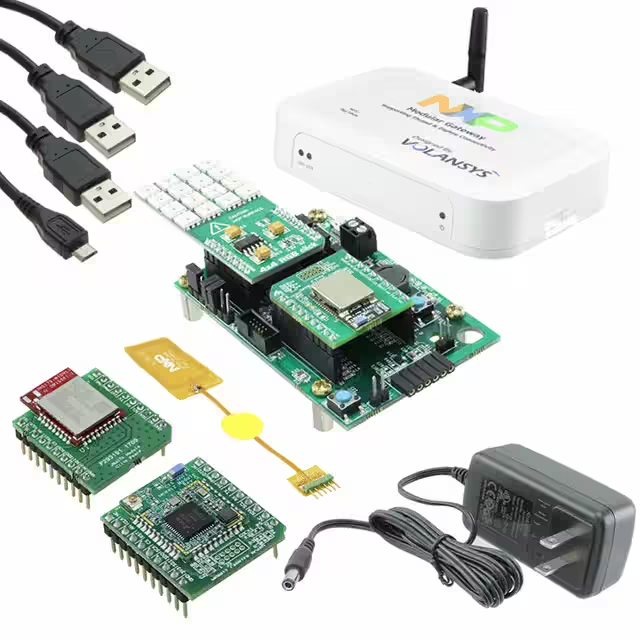
SLN-IOT-GPI from NXP is a complete, pre-integrated development platform for secure IoT systems, combining a Modular IoT Gateway (i.MX6UL + KW41Z/JN5179) and Modular Edge Node with ZigBee 3.0, Thread, NFC commissioning, Wi-Fi/Ethernet cloud uplink, and A70CM secure element - deployed in smart cities, building automation, and large-node industrial networks.
For engineers reviewing the SLN-IOT-GPI datasheet, SLN-IOT-GPI pinout, SLN-IOT-GPI application, or SLN-IOT-GPI equivalent, this platform delivers production-ready Linux Yocto and FreeRTOS BSPs, FCC/CE/IC certification, multi-protocol mesh support (≥250 nodes), OTA multicast updates, and smartphone-controlled NFC tap-to-commission - all validated for commercial LNN deployments.
Technical Context
The SLN-IOT-GPI integrates two hardware domains: a gateway based on i.MX6UL ARM Cortex-A7 (500 MHz) with DDR3L RAM (512 MB), NAND flash (up to 1 GB), Ethernet PHY (10/100 Mbps), Wi-Fi/BLE 4.1 module, and PN7120 NFC controller; and edge nodes powered by Kinetis KW41Z (Thread) or JN5179 (ZigBee 3.0) SoCs with SPI/I2C/UART/ADC/PWM/GPIO interfaces.
Software architecture separates gateway and edge responsibilities: the gateway runs Linux Yocto BSP with MQTT client, Thread host SDK, cloud registration, Wi-Fi startup scripts, and NFC commissioning logic; edge nodes run FreeRTOS BSP with Thread/ZigBee end-device stacks, secure boot, DTLS, and CoAP/6LoWPAN protocol layers - coordinated via border router and fog analytics modules.
Key Specifications
| Parameter | Value and Actual Design Meaning |
|---|---|
| Gateway Processor | i.MX6UL ARM Cortex-A7 @ 500 MHz - enables real-time Linux-based fog processing and multi-protocol bridging |
| Memory | 512 MB DDR3L RAM + up to 1 GB NAND flash - supports full Linux Yocto image, protocol stacks, and OTA update storage |
| Wireless Protocols | ZigBee 3.0 (JN5179), Thread (KW41Z), Wi-Fi 802.11b/g/n, BLE 4.1 - enables dual-mesh (ZigBee+Thread) edge networking and dual-cloud uplink (Wi-Fi/Ethernet) |
| NFC Commissioning | PN7120 NFC controller - allows unpowered device onboarding via smartphone tap, critical for large-scale field deployment |
| Security | A70CM secure element + secure boot + DTLS/TLS - provides hardware-rooted key management, encrypted OTA, and authenticated cloud registration |
| Node Scale Support | ≥250 nodes per network - validated for lighting control, HVAC monitoring, and sensor aggregation in commercial buildings |
| OS & BSP | Production-ready Linux Yocto (gateway) and FreeRTOS (edge) BSPs - include drivers, MQTT, CoAP, 6LoWPAN, and cloud integration libraries |
Availability
SLN-IOT-GPI is available at Aetrix Electronics and suitable for smart city infrastructure, industrial building automation, and agricultural sensor network deployments requiring stable component supply, certified wireless compliance, and long-term firmware maintainability.
Supply support for SLN-IOT-GPI includes scheduled delivery planning, volume procurement assistance, BOM continuity management, traceable sourcing, and lifecycle availability coordination for OEM customers, industrial embedded developers, connected-device designers, and electronics production programs.
Manufacturer
NXP Semiconductors is a global semiconductor company specializing in secure connectivity solutions for automotive, industrial, and IoT applications, with leadership in ARM-based MCUs, RF transceivers, and trusted execution environments.
The SLN-IOT-GPI belongs to NXP's Modular IoT Framework product line, designed to accelerate secure, scalable, and certifiable IoT system development across commercial and industrial large-node network use cases.
FAQ
What is the SLN-IOT-GPI and how does it differ from a standard evaluation board?
The SLN-IOT-GPI is not an evaluation board but a complete, pre-integrated development platform comprising both gateway and edge node hardware, production-grade Linux and FreeRTOS BSPs, certified multi-protocol stacks (ZigBee 3.0, Thread, Wi-Fi), NFC commissioning, and cloud integration tools - enabling immediate prototyping of commercial LNN deployments without stack porting or certification effort. Unlike single-function eval kits, SLN-IOT-GPI delivers out-of-box interoperability between its modular components.
Which wireless protocols does the SLN-IOT-GPI support natively, and are they concurrent?
The SLN-IOT-GPI supports ZigBee 3.0 (via JN5179 module), Thread (via KW41Z module), Wi-Fi 802.11b/g/n, and BLE 4.1 - all concurrently operational. The gateway simultaneously manages ZigBee and Thread edge networks while maintaining independent Wi-Fi and Ethernet cloud uplinks, verified in NXP's MODIOTFRAMEWORKFS documentation and supported by dual-radio hardware partitioning.
Does the SLN-IOT-GPI include production-ready security features for cloud-connected IoT devices?
Yes, the SLN-IOT-GPI integrates A70CM secure element, hardware-accelerated crypto (AES/SHA), secure boot, DTLS/TLS, and key management services - all enabled in the shipped BSPs. These features enforce device identity, encrypted OTA updates, mutual authentication with cloud platforms, and NFC-secured commissioning, meeting requirements for certified commercial IoT deployments as documented in NXP's security white papers and IDEX user guides.
Can the SLN-IOT-GPI scale to large node networks, and what is the validated maximum node count?
The SLN-IOT-GPI is explicitly validated for Large Node Networks (LNNs) supporting ≥250 edge nodes per gateway, as confirmed in NXP's target applications and framework documentation. This scalability relies on optimized Thread border router performance, multicast OTA delivery, low-latency ZigBee 3.0 polling, and NFC-assisted batch commissioning - all tested in smart lighting and HVAC monitoring reference deployments.
What software development resources ship with the SLN-IOT-GPI out of the box?
The SLN-IOT-GPI ships with pre-compiled Android/iOS smartphone apps, Linux Yocto BSP (including MQTT client, Thread host SDK, Wi-Fi configuration scripts, and NFC commissioning daemon), FreeRTOS BSP for edge nodes (with Thread/ZigBee end-device stacks), source build instructions, hardware design files (schematics, layout, BOM), and enclosure CAD - all accessible via NXP's official download portal under the SLN-IOT-GPI product page.
SLN-IOT-GPI Specifications
- Product attributes
- Attribute value
- Manufacturer:
- NXP Semiconductors
- Series:
- i.MX
- Packaging:
- Bulk
- Product Status:
- Obsolete
- Type:
- Gateway
- Frequency:
- -
- Contents:
- Board(s), Cable(s), Power Supply, Accessories
- Utilized IC / Part:
- i.MX 6UltraLite
SLN-IOT-GPI FAQ
1.How can I place an order for SLN-IOT-GPI through Aetrix?
Please submit a Request for Quotation (RFQ) for SLN-IOT-GPI on Aetrix. Our sales agent will provide a competitive quotation and guide you through the order confirmation once you accept the terms.
2.Are the price and stock information for SLN-IOT-GPI reliable?
The price and inventory of SLN-IOT-GPI are updated periodically and may fluctuate due to market conditions. Stock and pricing data are typically refreshed every 24 hours. Quotation validity for SLN-IOT-GPI is usually 5 days.
3.What payment methods are accepted for SLN-IOT-GPI?
We accept Wire Transfer, PayPal, Credit Card, Western Union, MoneyGram, and Escrow for SLN-IOT-GPI transactions.
Note: Certain payment methods may incur a processing fee.
4.How is shipping managed for SLN-IOT-GPI?
SLN-IOT-GPI orders can be shipped via leading logistics carriers, including DHL, UPS, FedEx, TNT, or Registered Mail.
Once your SLN-IOT-GPI order is processed, you will receive an email with the shipment details and tracking number.
Note: Tracking information may take up to 24 hours to appear. Express delivery typically takes 3–5 business days.
5.How can I obtain technical support or documentation for SLN-IOT-GPI?
For technical support, including SLN-IOT-GPI datasheets, pinout diagrams, or application guidance, please contact our engineering support team. They can provide detailed documentation and assistance for your SLN-IOT-GPI requirements.
6.How does Aetrix verify that SLN-IOT-GPI is sourced from the original manufacturer or authorized distributors?
All SLN-IOT-GPI products on Aetrix are procured from qualified distributors and authorized channels. Our dedicated quality assurance team conducts strict verification, including traceability checks and, if necessary, third-party testing. This ensures that SLN-IOT-GPI meets industry standards.
7.What is the process for return or replacement of SLN-IOT-GPI?
All SLN-IOT-GPI units undergo pre-shipment inspection (PSI). If there is an issue with SLN-IOT-GPI, returns or replacements are accepted under the following conditions:
1.Quantity discrepancies, incorrect items, or visible external defects (such as breakage or corrosion), acknowledged by Aetrix.
2.The issue is reported within 90 days of delivery.
3.The SLN-IOT-GPI part is unused and in its original packaging.
Return procedure for SLN-IOT-GPI:
1.Submit a request within 90 days.
2.Obtain a Return Material Authorization (RMA) from Aetrix.
SLN-IOT-GPI Tags
-
113991054
Seeed Technology Co., Ltd
-
SC0918
Raspberry Pi

-
113991114
Seeed Technology Co., Ltd
-
ESP32-C6-DEVKITM-1-N4
Espressif Systems
-
ESP32-DEVKITM-1
Espressif Systems
-
C008
M5Stack Technology Co., Ltd.
-
ESP32-C3-DEVKITC-02
Espressif Systems
-
ESP32-C6-DEVKITC-1-N8
Espressif Systems
-
DFR0478
DFRobot
-
102010448
Seeed Technology Co., Ltd
-
ESP32-DEVKITC-32E
Espressif Systems
-
ESP32-DEVKITC-32UE
Espressif Systems
Tech Hub

A practical engineering guide to 3.3V and 5V logic compatibility, input thresholds, resistor dividers, translator ICs, MOSFET level shifting, I2C pull-ups, timing limits and power-sequencing risks.

The 74HC595 uses push-pull logic outputs, while the TPIC6B595 uses 50 V open-drain DMOS sinks for higher-power loads. This guide compares timing, current limits, 3.3 V interfacing, load wiring, thermal…

The 74HC595 converts serial data into eight stable parallel outputs. This guide covers pin functions, shift and storage timing, OE and MR behavior, drive-current limits, cascading, voltage compatibilit…

A technical comparison of level-sensitive latches and edge-triggered flip-flops, covering timing windows, setup and hold limits, master–slave operation, time borrowing, race-through, HDL inference and…

A D latch stores one bit while Enable controls when data can pass. This reference covers gate-level operation, truth tables, transparency, setup and hold timing, LE versus OE, common ICs and practical …

An SR latch stores one bit through cross-coupled feedback. This engineering reference covers NOR and NAND implementations, truth tables, forbidden-state recovery, gated operation, switch debouncing, fa…

Latch circuits retain one bit through feedback. This technical reference covers SR and D latches, truth tables, transparency, timing limits, latch-versus-flip-flop behavior, applications and common log…

An engineering guide to LED driver operation, constant-current and constant-voltage outputs, linear and switching topologies, dimming, IC selection, calculations, replacement compatibility, and fault c…

Operational amplifier guide covering op amp basics, feedback, ideal vs real op amps, common configurations, buffer circuits, offset, bias current, gain-bandwidth, slew rate, rail-to-rail limits and sel…

Jumper cables guide covering safe connection order, red and black clamp placement, final ground connection, cable gauge, length, clamp quality, copper vs CCA cables, jump starter comparison and battery…


