
 My Inquiry
 My Account


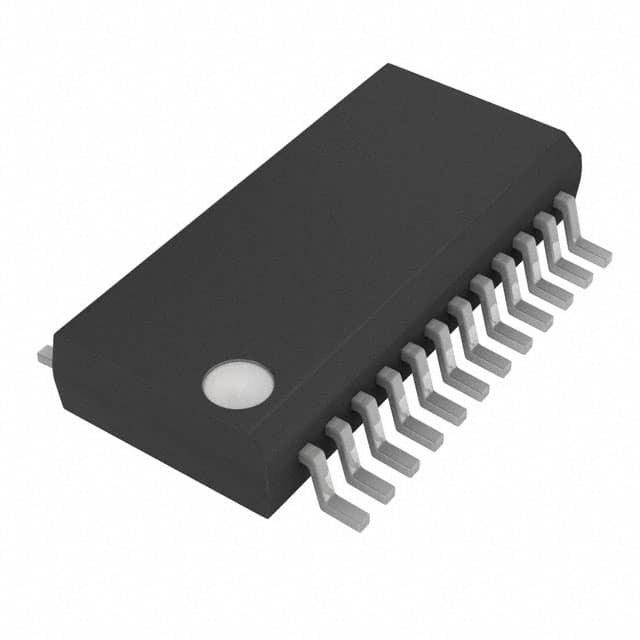
Texas Instruments SN74CBT3383DBQR
- Part No.:
- SN74CBT3383DBQR
- Manufacturer:
- Texas Instruments
- Category:
- Signal Switches, Multiplexers, Decoders
- Package:
- 24-SSOP (0.154", 3.90mm Width)
- Datasheet:
-
 SN74CBT3383DBQR.pdf
- Description:
- IC BUS FET EXCHG SW 5X2:2 24SSOP
- Quantity:
- Payment:

- Shipping:

Inventory:3,517
Please send an inquiry. Send us your inquiry, and we will respond immediately.
Product details
Overview
SN74CBT3383DBQR from Texas Instruments is a 10-bit TTL-compatible bus-exchange switch in 24-pin SSOP package, featuring 5 Ω typical on-state resistance, <1 ns propagation delay, bidirectional signal flow, and dual-mode operation (bus switch or 5-bit nibble swap) for high-speed data routing in enterprise server backplanes.
For engineers reviewing the SN74CBT3383DBQR datasheet, SN74CBT3383DBQR pinout, SN74CBT3383DBQR application, or SN74CBT3383DBQR equivalent, key selection criteria include its 4.5–5.5 V supply range, 200 MHz bandwidth capability, low 6 pF off-state capacitance, and active-low BE / active-high BX control logic for deterministic bus topology reconfiguration.
Technical Context
The SN74CBT3383DBQR implements a CMOS-based analog bus switch architecture with no internal level-shifting or buffering-signals pass through with near-zero added delay. Its functional modes are fully determined by two digital control inputs: BE (active-low enable) and BX (active-high exchange select), enabling either direct A↔B passthrough or crossed A1↔B2/A2↔B1 mapping per 2-bit pair.
All 10 channels operate simultaneously and independently under identical electrical conditions: rON remains flat across input voltage (0–5 V) and temperature (0–70 °C), and channel-to-channel skew is minimized by matched layout and symmetric I/O structure. No power sequencing or biasing is required beyond standard 5-V decoupling.
Key Specifications
| Parameter | Value and Actual Design Meaning |
|---|---|
| VCC Range | 4.5 V to 5.5 V - supports standard 5-V TTL/CMOS system rails without regulation overhead |
| rON (Typ) | 5 Ω - ensures minimal voltage drop and signal attenuation at 128 mA max channel current |
| tpd (Max) | 1.5 ns - enables reliable 200 MHz data transfer with sub-cycle timing margin |
| Cio(OFF) | 6 pF - reduces capacitive loading on adjacent traces and preserves signal integrity in dense routing |
| ICC (Max) | 50 µA - delivers ultra-low static power for always-on bus isolation in power-sensitive systems |
| Operating Temp | 0 °C to 70 °C - qualified for commercial-grade industrial and networking equipment environments |
| ESD HBM | ±3000 V - meets JEDEC JS-001 for robust handling during board assembly and field service |
Pinout & Package
SN74CBT3383DBQR uses a 24-pin SSOP (DBQ) package measuring 8.65 mm × 3.90 mm × 1.2 mm max height, with gull-wing leads, RoHS-compliant NiPdAu finish, and moisture sensitivity level MSL-2 (260 °C peak reflow).
| Pin/Terminal | Circuit Role | Design Meaning |
|---|---|---|
| 1 (BE) | Active-low enable input | Drives all 10 switches ON when low; high-Z state disables all paths regardless of BX |
| 13 (BX) | Bus exchange select input | Selects nibble-swap mode (A1↔B2, A2↔B1) when high; ignored if BE is high |
| 2–5, 6–9, 10–11, 14–15, 16–19, 20–23 | Bidirectional I/O pairs (1A1/1B1 through 5A2/5B2) | Each pair supports full-duplex signal routing with identical AC/DC characteristics in both directions |
| 12 (GND) | Ground reference | Single ground pin serves entire device; requires low-inductance connection to minimize ground bounce |
| 24 (VCC) | Power supply | Must be decoupled with 0.1 µF ceramic capacitor placed ≤2 mm from pin per TI layout guidelines |
Key Features
| Feature | Design Value |
|---|---|
| High-bandwidth data path | Up to 200 MHz operation verified with 50 pF load - supports Gigabit Ethernet PHY interconnect and DDR memory trace multiplexing |
| Flat on-state resistance | 5 Ω typical across 0–5 V input range - eliminates duty-cycle distortion in clock or data signals |
| TTL/3.3-V/5-V compatible control | VIH = 2.0 V min, VIL = 0.8 V max - interoperates directly with legacy 5-V logic and modern 3.3-V microcontrollers |
| Bidirectional zero-delay switching | No internal latching or direction control - signal flow direction is determined solely by external driver/receiver placement |
| Low off-state capacitance | 6 pF typical - prevents crosstalk and maintains impedance continuity when channels are disabled |
Applications
| Enterprise Server Backplane | Ethernet Switch Fabric |
|---|---|
|
Use Scenario: Dynamic reconfiguration of CPU-to-I/O hub links during hot-swap or firmware update cycles. IC Role / Device Role / Timing Role: Bus-exchange switch enabling real-time rerouting of 10-bit address/data lanes between redundant PCIe root complexes. Use Value: Eliminates need for discrete mux ICs or FPGA-based routing logic, reducing BOM count and latency by >2 ns per hop. |
Use Scenario: Sharing a single 10-Gbps SerDes lane between two MAC controllers in a compact layer-2 switch ASIC. IC Role / Device Role / Timing Role: Bidirectional 5-bit nibble-swapping switch synchronizing burst-mode packet headers across dual ingress paths. Use Value: Enables deterministic 1.5 ns max propagation delay for time-critical control-plane arbitration without PLL jitter accumulation. |
| Rack-Mount Industrial PC | Modular Test Equipment Backplane |
|
Use Scenario: Isolating and swapping peripheral expansion slots (e.g., PCIe x4 vs. SATA Gen3) via front-panel DIP switch control. IC Role / Device Role / Timing Role: Low-capacitance bus switch providing galvanic isolation and signal integrity preservation during hot-plug events. Use Value: Maintains <6 pF off-state loading to prevent reflection-induced eye closure on 8 GT/s differential lanes. |
Use Scenario: Reconfiguring signal routing between modular instrument cards (e.g., AWG, DMM, logic analyzer) in automated test systems. IC Role / Device Role / Timing Role: 10-bit exchange switch controlled by microcontroller GPIO to map shared trigger/data buses to selected modules. Use Value: Delivers 5 Ω rON stability across 0–70 °C ambient, ensuring consistent rise/fall times in calibrated measurement paths. |
Equivalent & Alternatives
The following parts are listed as comparable options for similar bus-switching applications.
| Alternative Part | Technical Difference | Application Difference | Selection Advice |
|---|---|---|---|
| SN74CBTD3383DBQR | Includes integrated 5-V tolerant level shifters; higher rON (7 Ω typ); 10 µA higher ICC | Required when interfacing 3.3-V controllers to 5-V peripherals; not drop-in compatible due to different VIH/VIL thresholds | Choose only if mixed-voltage domain bridging is needed; otherwise SN74CBT3383DBQR offers lower delay and power |
| SN74LVC1G3157DCKR | Single-pole double-throw (SPDT) switch; 3.3-V only; 6 Ω rON; 500 MHz bandwidth | Supports high-speed point-to-point routing but lacks multi-bit synchronization or nibble-swap functionality | Use for isolated signal path selection; not suitable for coordinated 10-bit bus reconfiguration |
Compared with SN74CBTD3383DBQR and SN74LVC1G3157DCKR, the SN74CBT3383DBQR uniquely combines synchronized 10-bit control, true bidirectional zero-delay operation, and 5-V native compatibility-making it irreplaceable for deterministic bus topology management in server and networking hardware.
Availability
SN74CBT3383DBQR is available at Aetrix Electronics and suitable for enterprise servers, Ethernet switches, and industrial PCs requiring stable component supply with guaranteed long-term sourcing and full traceability.
Supply support for SN74CBT3383DBQR includes scheduled delivery planning, volume procurement assistance, BOM continuity management, traceable sourcing, and lifecycle availability coordination for OEM customers, industrial embedded developers, connected-device designers, and electronics production programs.
Manufacturer
Texas Instruments is a global semiconductor leader specializing in analog, embedded processing, and connectivity technologies, with over 50 years of innovation in high-reliability interface solutions.
The SN74CBT3383DBQR belongs to TI's CBT (Crosspoint Bus Technology) family, engineered specifically for low-latency, high-fidelity bus switching in mission-critical communications infrastructure where signal integrity and deterministic timing are non-negotiable.
FAQ
What is the maximum operating frequency supported by the SN74CBT3383DBQR?
The SN74CBT3383DBQR is characterized for reliable operation up to 200 MHz, as confirmed by TI's switching characteristics testing with 50 pF load. This performance holds across the full 4.5–5.5 V supply range and 0–70 °C temperature range. Layout-dependent parasitics may reduce practical bandwidth, so adherence to TI's recommended trace length and decoupling guidelines is essential to achieve the rated frequency in production designs using SN74CBT3383DBQR.
Does the SN74CBT3383DBQR require external pull-up or pull-down resistors on its control pins?
No, the SN74CBT3383DBQR does not require external biasing on BE or BX control inputs. Its VIH (2.0 V min) and VIL (0.8 V max) thresholds are designed for direct interfacing with standard 5-V TTL or 3.3-V CMOS outputs. TI specifies that control inputs may be driven actively high or low without resistive termination-provided source impedance remains ≤500 Ω to meet timing requirements. This simplifies PCB design and reduces component count in systems using SN74CBT3383DBQR.
Can the SN74CBT3383DBQR be used in hot-swap applications?
Yes, the SN74CBT3383DBQR supports hot-swap operation when used with proper power sequencing: VCC must be stable before asserting BE low, and BE must be returned high before VCC ramp-down. Its ±3000 V HBM ESD rating and low 6 pF off-state capacitance minimize transient coupling during insertion. However, TI recommends adding series current-limiting resistors (≤10 Ω) on I/O lines in live-backplane environments to suppress inrush-verified in reference designs for SN74CBT3383DBQR-based server midplanes.
How does the bus-exchange function of the SN74CBT3383DBQR differ from standard multiplexing?
The bus-exchange function in SN74CBT3383DBQR is a synchronized, hardware-defined nibble swap-not software-configurable multiplexing. When BX = high and BE = low, all five 2-bit pairs (1A1/1B1 through 5A2/5B2) simultaneously cross-connect: 1A1 ↔ 1B2, 1A2 ↔ 1B1, etc. This enables atomic byte-level bus reordering without timing skew between lanes-unlike discrete 2:1 muxes which require independent enable control and introduce channel-to-channel delay variation. The feature is intrinsic to SN74CBT3383DBQR's silicon architecture.
What is the thermal performance of the SN74CBT3383DBQR in its SSOP (DBQ) package?
In its 24-pin SSOP (DBQ) package, the SN74CBT3383DBQR has a junction-to-ambient thermal resistance (RθJA) of 61.0 °C/W, measured under JEDEC JESD51-2 conditions. At maximum rated ICC (50 µA) and worst-case rON (7 Ω), total power dissipation remains below 15 mW-resulting in negligible self-heating (<1 °C rise) even in sealed enclosures. No heatsinking is required for SN74CBT3383DBQR in standard commercial airflow environments.
SN74CBT3383DBQR Specifications
- Product attributes
- Attribute value
- Manufacturer:
- Texas Instruments
- Series:
- 74CBT
- Package/Case:
- 24-SSOP (0.154", 3.90mm Width)
- Packaging:
- Tape & Reel (TR)
- Product Status:
- Active
- Type:
- Bus FET Exchange Switch
- Circuit:
- 5 x 2:2
- Independent Circuits:
- 1
- Current - Output High, Low:
- -
- Voltage Supply Source:
- Single Supply
- Voltage - Supply:
- 4.5V ~ 5.5V
- Operating Temperature:
- -40°C ~ 85°C
- Grade:
- -
- Qualification:
- -
- Mounting Type:
- Surface Mount
- Supplier Device Package:
- 24-SSOP
SN74CBT3383DBQR FAQ
1.How can I place an order for SN74CBT3383DBQR through Aetrix?
Please submit a Request for Quotation (RFQ) for SN74CBT3383DBQR on Aetrix. Our sales agent will provide a competitive quotation and guide you through the order confirmation once you accept the terms.
2.Are the price and stock information for SN74CBT3383DBQR reliable?
The price and inventory of SN74CBT3383DBQR are updated periodically and may fluctuate due to market conditions. Stock and pricing data are typically refreshed every 24 hours. Quotation validity for SN74CBT3383DBQR is usually 5 days.
3.What payment methods are accepted for SN74CBT3383DBQR?
We accept Wire Transfer, PayPal, Credit Card, Western Union, MoneyGram, and Escrow for SN74CBT3383DBQR transactions.
Note: Certain payment methods may incur a processing fee.
4.How is shipping managed for SN74CBT3383DBQR?
SN74CBT3383DBQR orders can be shipped via leading logistics carriers, including DHL, UPS, FedEx, TNT, or Registered Mail.
Once your SN74CBT3383DBQR order is processed, you will receive an email with the shipment details and tracking number.
Note: Tracking information may take up to 24 hours to appear. Express delivery typically takes 3–5 business days.
5.How can I obtain technical support or documentation for SN74CBT3383DBQR?
For technical support, including SN74CBT3383DBQR datasheets, pinout diagrams, or application guidance, please contact our engineering support team. They can provide detailed documentation and assistance for your SN74CBT3383DBQR requirements.
6.How does Aetrix verify that SN74CBT3383DBQR is sourced from the original manufacturer or authorized distributors?
All SN74CBT3383DBQR products on Aetrix are procured from qualified distributors and authorized channels. Our dedicated quality assurance team conducts strict verification, including traceability checks and, if necessary, third-party testing. This ensures that SN74CBT3383DBQR meets industry standards.
7.What is the process for return or replacement of SN74CBT3383DBQR?
All SN74CBT3383DBQR units undergo pre-shipment inspection (PSI). If there is an issue with SN74CBT3383DBQR, returns or replacements are accepted under the following conditions:
1.Quantity discrepancies, incorrect items, or visible external defects (such as breakage or corrosion), acknowledged by Aetrix.
2.The issue is reported within 90 days of delivery.
3.The SN74CBT3383DBQR part is unused and in its original packaging.
Return procedure for SN74CBT3383DBQR:
1.Submit a request within 90 days.
2.Obtain a Return Material Authorization (RMA) from Aetrix.
SN74CBT3383DBQR Tags

-
SN74HC138DR
Texas Instruments
-
TC7SB3157CFU,LF(CT
Toshiba Semiconductor and Storage
-
74CBTLV3257PW,118
Nexperia USA Inc.

-
SN74CBTLV3257PWR
Texas Instruments
-
74CBTLV3257GUX
Nexperia USA Inc.
-
74HC154BQ,118
Nexperia USA Inc.

-
P3S0200GMX
NXP USA Inc.
-
SN74CB3Q3245PWR
Texas Instruments
-
SN74CB3Q3257RGYR
Texas Instruments
-
TCA9543APWR
Texas Instruments
-
TCA9546APWR
Texas Instruments
-
SN74HC138N
Texas Instruments
Tech Hub

A practical engineering guide to 3.3V and 5V logic compatibility, input thresholds, resistor dividers, translator ICs, MOSFET level shifting, I2C pull-ups, timing limits and power-sequencing risks.

The 74HC595 uses push-pull logic outputs, while the TPIC6B595 uses 50 V open-drain DMOS sinks for higher-power loads. This guide compares timing, current limits, 3.3 V interfacing, load wiring, thermal…

The 74HC595 converts serial data into eight stable parallel outputs. This guide covers pin functions, shift and storage timing, OE and MR behavior, drive-current limits, cascading, voltage compatibilit…

A technical comparison of level-sensitive latches and edge-triggered flip-flops, covering timing windows, setup and hold limits, master–slave operation, time borrowing, race-through, HDL inference and…

A D latch stores one bit while Enable controls when data can pass. This reference covers gate-level operation, truth tables, transparency, setup and hold timing, LE versus OE, common ICs and practical …

An SR latch stores one bit through cross-coupled feedback. This engineering reference covers NOR and NAND implementations, truth tables, forbidden-state recovery, gated operation, switch debouncing, fa…

Latch circuits retain one bit through feedback. This technical reference covers SR and D latches, truth tables, transparency, timing limits, latch-versus-flip-flop behavior, applications and common log…

An engineering guide to LED driver operation, constant-current and constant-voltage outputs, linear and switching topologies, dimming, IC selection, calculations, replacement compatibility, and fault c…

Operational amplifier guide covering op amp basics, feedback, ideal vs real op amps, common configurations, buffer circuits, offset, bias current, gain-bandwidth, slew rate, rail-to-rail limits and sel…

Jumper cables guide covering safe connection order, red and black clamp placement, final ground connection, cable gauge, length, clamp quality, copper vs CCA cables, jump starter comparison and battery…


