
 My Inquiry
 My Account


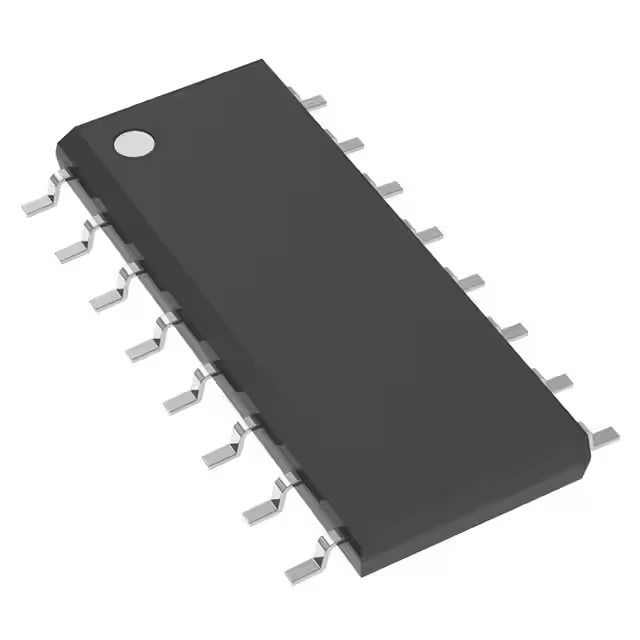
Texas Instruments SN74LS247D
- Part No.:
- SN74LS247D
- Manufacturer:
- Texas Instruments
- Category:
- Display Drivers
- Package:
- 16-SOIC (0.154", 3.90mm Width)
- Datasheet:
-
 SN74LS247D.pdf
- Description:
- IC DRVR 7 SEGMENT 16SOIC
- Quantity:
- Payment:

- Shipping:

Inventory:4,713
Please send an inquiry. Send us your inquiry, and we will respond immediately.
Product details
Overview
SN74LS247D from Texas Instruments is a 7-segment BCD-to-7-segment decoder/driver IC designed for direct interface with common-anode LED displays. It features active-low outputs, open-collector drivers capable of sinking up to 40 mA per segment, TTL-compatible inputs, and built-in lamp test and blanking functions. It operates over 0°C to 70°C and is packaged in a 16-pin SOIC (D) package.
For engineers reviewing the SN74LS247D datasheet, SN74LS247D pinout, SN74LS247D application, or SN74LS247D equivalent, key selection considerations include its active-low open-collector output architecture, common-anode LED drive capability, integrated ripple-blanking input for cascaded display systems, and compatibility with standard TTL logic levels in industrial panel meters and legacy instrumentation.
Technical Context
The SN74LS247D implements combinational logic decoding of 4-bit binary-coded decimal (BCD) inputs (A0–A3) into seven active-low segment outputs (a–g), with additional control inputs: Lamp Test (LT̅), Ripple Blanking Input (RBI̅), and Blank Input/Output (BI̅/RBO̅). Its open-collector outputs require external pull-up resistors to VCC and are optimized for driving common-anode LEDs without external current-limiting transistors.
It uses bipolar TTL process technology, ensuring compatible voltage thresholds (VIH = 2.0 V min, VIL = 0.8 V max), propagation delays under 45 ns (typical), and guaranteed operation across the commercial temperature range (0°C to 70°C). The BI̅/RBO̅ function enables daisy-chained blanking for multi-digit displays while maintaining independent digit control.
Key Specifications
| Parameter | Value and Actual Design Meaning |
|---|---|
| Logic Family | 74LS TTL - ensures interoperability with legacy LS-series logic and predictable noise margins. |
| Output Type | Active-low open-collector - requires external pull-ups; enables direct common-anode LED drive with flexible voltage rail selection. |
| Max Output Sink Current | 40 mA per segment - supports bright LED segments without external driver stages. |
| Propagation Delay | 45 ns (max at VCC = 5 V, TA = 25°C) - suitable for static and low-frequency multiplexed display applications. |
| Supply Voltage Range | 4.75 V to 5.25 V - tight tolerance aligns with standard TTL power distribution and minimizes supply regulation overhead. |
| Operating Temperature | 0°C to 70°C - validated for commercial-grade instrumentation and panel-mounted equipment. |
| Input Compatibility | TTL-level (VIL ≤ 0.8 V, VIH ≥ 2.0 V) - eliminates need for level-shifting when interfacing with 74LS/74S logic. |
Pinout & Package
SN74LS247D is housed in a 16-pin SOIC (D) package, 7.5 mm wide, with 1.27 mm pitch, compliant with JEDEC MS-012 and RoHS requirements. Pin 1 is located at the top-left corner adjacent to the notch or dot marking.
| Pin/Terminal | Circuit Role | Design Meaning |
|---|---|---|
| 1 (A0) | BCD Input Bit 0 | Least-significant BCD digit input; TTL-compatible, referenced to GND. |
| 2 (A1) | BCD Input Bit 1 | Second BCD digit input; synchronous with A0–A3 for valid decode cycle. |
| 3 (A2) | BCD Input Bit 2 | Third BCD digit input; must be stable during setup/hold windows relative to clockless decode timing. |
| 4 (A3) | BCD Input Bit 3 | Most-significant BCD digit input; defines decimal value 0–9; values 10–15 yield blanked outputs. |
| 5 (BI̅/RBO̅) | Blank Input / Ripple Blanking Output | Active-low blanking input; when asserted, forces all outputs high; also serves as cascaded blanking output when RBI̅ is active and inputs = 0. |
| 6 (LT̅) | Lamp Test Input | Active-low; overrides all decoding to force all segment outputs low - verifies LED continuity and wiring integrity. |
| 7 (RBI̅) | Ripple Blanking Input | Active-low; enables zero-suppression in multi-digit displays when all preceding digits are zero and LT̅ is inactive. |
| 8 (GND) | Ground Reference | Power return path for logic and output drivers; must be low-impedance to minimize ground bounce in multi-segment switching. |
| 9 (a) | Segment a Output | Open-collector output driving top horizontal LED segment; sinks current when active (low). |
| 10 (b) | Segment b Output | Open-collector output driving upper-right vertical LED segment; shares same sink capability and timing as other segments. |
| 11 (c) | Segment c Output | Open-collector output driving lower-right vertical LED segment; electrically identical to pins 9–15. |
| 12 (d) | Segment d Output | Open-collector output driving bottom horizontal LED segment; used in '8' and '0' digit rendering. |
| 13 (e) | Segment e Output | Open-collector output driving lower-left vertical LED segment; critical for '6', '8', '9' and '0'. |
| 14 (f) | Segment f Output | Open-collector output driving upper-left vertical LED segment; required for '4', '5', '6', '8', '9'. |
| 15 (g) | Segment g Output | Open-collector output driving middle horizontal LED segment; distinguishes '8' from '0' and enables '3', '9'. |
| 16 (VCC) | Positive Supply | +5 V DC supply; must be decoupled locally with 0.1 µF ceramic capacitor to suppress switching noise. |
Key Features
| Feature | Design Value |
|---|---|
| Integrated Lamp Test | Single-pin activation (LT̅) forces all seven outputs low - enables rapid visual verification of LED wiring and segment functionality without software intervention. |
| Ripple Blanking Architecture | BI̅/RBO̅ and RBI̅ pins support hierarchical blanking in multi-digit displays - suppresses leading zeros automatically without microcontroller overhead. |
| Common-Anode LED Drive | Open-collector outputs eliminate need for external PNP transistors or high-side switches - reduces BOM count and PCB area in discrete display designs. |
| TTL-Compatible Inputs | Direct connection to 74LS/74S logic families without level shifters - preserves signal integrity and simplifies inter-stage coupling in legacy digital systems. |
| Commercial Temperature Range | Validated operation from 0°C to 70°C - meets reliability requirements for non-automotive industrial control panels and benchtop test equipment. |
Applications
| Industrial Panel Meters | Legacy Test Equipment Displays |
|---|---|
Use Scenario: Front-panel 4-digit numeric readout in programmable power supplies and multimeters. IC Role / Device Role / Timing Role: BCD-to-7-segment decoder driving common-anode LED digits via discrete current-limiting resistors. Use Value: Eliminates need for microcontroller-based display firmware and external driver ICs - reduces system cost and boot-time dependency on embedded code. | Use Scenario: Numeric display subsystem in 1980s-era oscilloscopes and logic analyzers requiring TTL-native interfaces. IC Role / Device Role / Timing Role: Static segment driver receiving parallel BCD from counter/timing ASICs; no clock required. Use Value: Matches original design intent and pinout of vintage instruments - enables drop-in replacement during repair or refurbishment. |
| Appliance Control Panels | Education & Lab Training Boards |
Use Scenario: Temperature and timer display in microwave ovens and washing machines using discrete LED modules. IC Role / Device Role / Timing Role: Decode output from microcontroller GPIO port configured as parallel BCD bus. Use Value: Offloads segment mapping logic from MCU - frees CPU cycles for sensor processing and motor control in resource-constrained 8-bit systems. | Use Scenario: Hands-on digital logic labs where students wire BCD sources (switches, counters) to physical LED displays. IC Role / Device Role / Timing Role: Teaching tool demonstrating combinational logic, active-low signaling, and open-collector bus behavior. Use Value: Clear visual feedback of truth-table behavior with real-world current-sinking loads - reinforces foundational TTL concepts beyond simulation. |
Equivalent & Alternatives
The following parts are listed as comparable options for similar BCD-to-7-segment decoder applications.
| Alternative Part | Technical Difference | Application Difference | Selection Advice |
|---|---|---|---|
| SN74LS47N | Same logic function and pinout; differs only in PDIP packaging (16-pin N) and marking ('74LS47' vs 'LS247'); identical electrical specs and timing. | Requires through-hole PCB layout; not surface-mount compatible; same thermal and drive characteristics. | Select SN74LS47N only for through-hole prototyping or legacy board rework where SOIC footprint is unavailable. |
| SN74LS248N | Active-high outputs (for common-cathode LEDs); otherwise identical BCD decode logic, pinout, and timing; different output polarity necessitates redesign of LED orientation and pull-up/down networks. | Drives common-cathode displays instead of common-anode; incompatible without circuit modification. | Choose SN74LS248N only when migrating to common-cathode LED modules or when redesigning display hardware to simplify current sourcing. |
Compared with SN74LS247D, SN74LS47N offers identical functionality in through-hole form for legacy assembly, while SN74LS248N provides complementary output polarity for common-cathode systems - neither is pin-compatible without layout or LED polarity changes, but both serve the same core BCD decoding purpose in distinct hardware contexts.
Availability
SN74LS247D is available at Aetrix Electronics and suitable for industrial panel meters, legacy test equipment refurbishment, and appliance control panels requiring stable component supply and long-term obsolescence mitigation.
Supply support for SN74LS247D includes scheduled delivery planning, volume procurement assistance, BOM continuity management, traceable sourcing, and lifecycle availability coordination for OEM customers, industrial embedded developers, connected-device designers, and electronics production programs.
Manufacturer
Texas Instruments is a U.S.-based semiconductor company founded in 1930, specializing in analog, embedded processing, and logic ICs with global manufacturing and quality certification across automotive, industrial, and consumer markets.
The SN74LS247D belongs to TI's legacy 74LS logic family, engineered specifically for reliable, low-power BCD-to-7-segment decoding in commercial-grade instrumentation and industrial control interfaces.
FAQ
What is the primary function of the SN74LS247D?
The SN74LS247D is a BCD-to-7-segment decoder/driver IC that converts 4-bit binary-coded decimal inputs into active-low signals for driving common-anode LED displays. It integrates lamp test, blanking, and ripple-blanking functions, and is implemented in bipolar TTL technology for compatibility with legacy digital systems. The SN74LS247D does not require a clock and operates combinatorially.
Can the SN74LS247D drive common-cathode LED displays?
No, the SN74LS247D cannot directly drive common-cathode LED displays because it features active-low open-collector outputs designed for sinking current into common-anode configurations. To use common-cathode LEDs, select the SN74LS248N instead - it provides identical decode logic but with active-high outputs. Rewiring or adding external inverters is not recommended due to timing and drive capability constraints in the SN74LS247D.
What is the maximum sink current per output pin on the SN74LS247D?
Each output pin (a–g) of the SN74LS247D is rated to sink up to 40 mA continuously under specified conditions (VCC = 5 V, TA = 25°C). This allows direct driving of standard LED segments without external transistor buffers. Total device current must remain within the absolute maximum rating of 70 mA for VCC and 80 mA for GND to avoid thermal overstress.
How does the ripple blanking feature work on the SN74LS247D?
The SN74LS247D implements ripple blanking via the RBI̅ (Ripple Blanking Input) and BI̅/RBO̅ (Blank Input/Ripple Blanking Output) pins. When RBI̅ is low and all BCD inputs are zero, BI̅/RBO̅ goes low - blanking the current digit and propagating the blanking signal to the next most-significant digit. This enables automatic suppression of leading zeros in multi-digit displays without microcontroller involvement. The SN74LS247D requires proper cascading wiring between adjacent devices for correct operation.
Is the SN74LS247D still in active production?
The SN74LS247D is marked as Obsolete by Texas Instruments per official packaging documentation, though functional equivalents like SN74LS247DR and SN74LS247DR.A remain Active. Aetrix Electronics maintains inventory and supply-chain continuity for SN74LS247D to support legacy system maintenance, repair, and obsolescence management - ensuring availability even after TI discontinuation.
SN74LS247D Specifications
- Product attributes
- Attribute value
- Manufacturer:
- Texas Instruments
- Series:
- -
- Package/Case:
- 16-SOIC (0.154", 3.90mm Width)
- Packaging:
- Tube
- Product Status:
- Obsolete
- Display Type:
- LED
- Configuration:
- 7 Segment
- Interface:
- BCD
- Digits or Characters:
- -
- Current - Supply:
- 7 mA
- Voltage - Supply:
- 4.75V ~ 5.25V
- Operating Temperature:
- 0°C ~ 70°C
- Grade:
- -
- Qualification:
- -
- Mounting Type:
- Surface Mount
- Supplier Device Package:
- 16-SOIC
SN74LS247D FAQ
1.How can I place an order for SN74LS247D through Aetrix?
Please submit a Request for Quotation (RFQ) for SN74LS247D on Aetrix. Our sales agent will provide a competitive quotation and guide you through the order confirmation once you accept the terms.
2.Are the price and stock information for SN74LS247D reliable?
The price and inventory of SN74LS247D are updated periodically and may fluctuate due to market conditions. Stock and pricing data are typically refreshed every 24 hours. Quotation validity for SN74LS247D is usually 5 days.
3.What payment methods are accepted for SN74LS247D?
We accept Wire Transfer, PayPal, Credit Card, Western Union, MoneyGram, and Escrow for SN74LS247D transactions.
Note: Certain payment methods may incur a processing fee.
4.How is shipping managed for SN74LS247D?
SN74LS247D orders can be shipped via leading logistics carriers, including DHL, UPS, FedEx, TNT, or Registered Mail.
Once your SN74LS247D order is processed, you will receive an email with the shipment details and tracking number.
Note: Tracking information may take up to 24 hours to appear. Express delivery typically takes 3–5 business days.
5.How can I obtain technical support or documentation for SN74LS247D?
For technical support, including SN74LS247D datasheets, pinout diagrams, or application guidance, please contact our engineering support team. They can provide detailed documentation and assistance for your SN74LS247D requirements.
6.How does Aetrix verify that SN74LS247D is sourced from the original manufacturer or authorized distributors?
All SN74LS247D products on Aetrix are procured from qualified distributors and authorized channels. Our dedicated quality assurance team conducts strict verification, including traceability checks and, if necessary, third-party testing. This ensures that SN74LS247D meets industry standards.
7.What is the process for return or replacement of SN74LS247D?
All SN74LS247D units undergo pre-shipment inspection (PSI). If there is an issue with SN74LS247D, returns or replacements are accepted under the following conditions:
1.Quantity discrepancies, incorrect items, or visible external defects (such as breakage or corrosion), acknowledged by Aetrix.
2.The issue is reported within 90 days of delivery.
3.The SN74LS247D part is unused and in its original packaging.
Return procedure for SN74LS247D:
1.Submit a request within 90 days.
2.Obtain a Return Material Authorization (RMA) from Aetrix.
SN74LS247D Tags
-
PCA8561AHN/AY
NXP Semiconductors
-
SN74LS47N
Texas Instruments

-
PCF85176T/1Y
NXP Semiconductors
-
PCF85176H/1,518
NXP Semiconductors
-
BU9796AMUV-E2
Rohm Semiconductor
-
PCA85176H/Q900/1,5
NXP Semiconductors
-
PCF8537AH/1,518
NXP Semiconductors
-
LM3914VX/NOPB
Texas Instruments
-
PCF85134HL/1,118
NXP Semiconductors
-
AS1115-BSST
ams-OSRAM USA INC.
-
PCA8534AH/Q900/1,5
NXP Semiconductors
-
LM3914V/NOPB
Texas Instruments
Tech Hub

A practical engineering guide to 3.3V and 5V logic compatibility, input thresholds, resistor dividers, translator ICs, MOSFET level shifting, I2C pull-ups, timing limits and power-sequencing risks.

The 74HC595 uses push-pull logic outputs, while the TPIC6B595 uses 50 V open-drain DMOS sinks for higher-power loads. This guide compares timing, current limits, 3.3 V interfacing, load wiring, thermal…

The 74HC595 converts serial data into eight stable parallel outputs. This guide covers pin functions, shift and storage timing, OE and MR behavior, drive-current limits, cascading, voltage compatibilit…

A technical comparison of level-sensitive latches and edge-triggered flip-flops, covering timing windows, setup and hold limits, master–slave operation, time borrowing, race-through, HDL inference and…

A D latch stores one bit while Enable controls when data can pass. This reference covers gate-level operation, truth tables, transparency, setup and hold timing, LE versus OE, common ICs and practical …

An SR latch stores one bit through cross-coupled feedback. This engineering reference covers NOR and NAND implementations, truth tables, forbidden-state recovery, gated operation, switch debouncing, fa…

Latch circuits retain one bit through feedback. This technical reference covers SR and D latches, truth tables, transparency, timing limits, latch-versus-flip-flop behavior, applications and common log…

An engineering guide to LED driver operation, constant-current and constant-voltage outputs, linear and switching topologies, dimming, IC selection, calculations, replacement compatibility, and fault c…

Operational amplifier guide covering op amp basics, feedback, ideal vs real op amps, common configurations, buffer circuits, offset, bias current, gain-bandwidth, slew rate, rail-to-rail limits and sel…

Jumper cables guide covering safe connection order, red and black clamp placement, final ground connection, cable gauge, length, clamp quality, copper vs CCA cables, jump starter comparison and battery…


