
 My Inquiry
 My Account


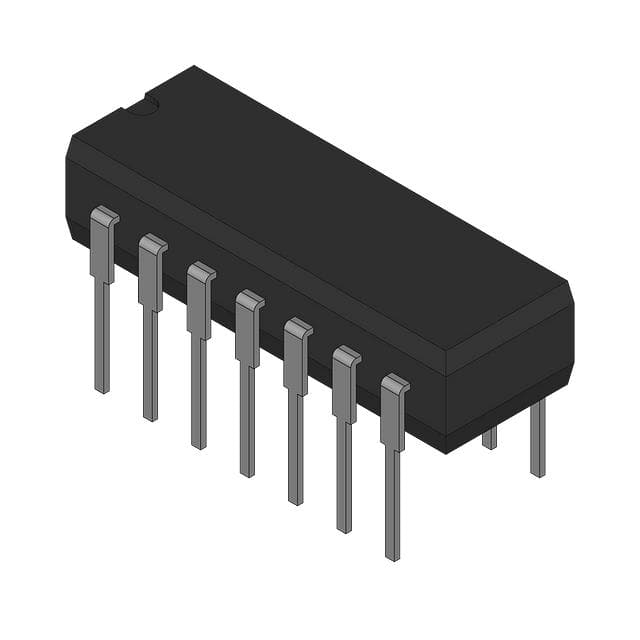
Texas Instruments SNJ54L123J
- Part No.:
- SNJ54L123J
- Manufacturer:
- Texas Instruments
- Category:
- Multivibrators
- Package:
- -
- Datasheet:
-
 SNJ54L123J.pdf
- Description:
- IC MULTIVIBRATOR
- Quantity:
- Payment:

- Shipping:

Inventory:295
Please send an inquiry. Send us your inquiry, and we will respond immediately.
Product details
Overview
SNJ54L123J from Texas Instruments (manufactured under license by Rochester Electronics) is a triple independent monostable multivibrator IC used for pulse shaping, timing delay generation, and edge-triggered one-shot functions in military-grade logic systems; it features 14-pin CDIP package, TTL-compatible inputs, 40 ns typical propagation delay, and operates over –55°C to +125°C.
For engineers reviewing the SNJ54L123J datasheet, SNJ54L123J pinout, SNJ54L123J application, or SNJ54L123J equivalent, key selection considerations include its negative-edge triggering, non-retriggerable operation, guaranteed temperature range compliance, and compatibility with legacy 54L series military logic designs.
Technical Context
The SNJ54L123J implements three identical, independent monostable multivibrators in a single 14-pin ceramic dual-in-line package. Each section has separate A and B trigger inputs (with Schmitt-trigger hysteresis on B), Q and Q̅ outputs, and a common reset (R̅) input that forces all outputs low when asserted.
It uses bipolar TTL technology with standard 54-series electrical characteristics: VCC = 5 V ± 0.5 V, input high threshold ≥ 2.0 V, input low threshold ≤ 0.8 V, and output drive capability of –0.4 mA (high) / 8 mA (low) at VCC = 5 V.
Key Specifications
| Parameter | Value and Actual Design Meaning |
|---|---|
| Logic Family | 54L TTL - ensures compatibility with legacy military-grade 54-series systems and board-level interoperability with other 54L devices. |
| Operating Temperature | –55°C to +125°C - qualified for Class V Space Level and MIL-PRF-35835, enabling use in satellite payload, avionics, and harsh-environment defense electronics. |
| Propagation Delay | 40 ns typical (tPLH/tPHL) - defines minimum pulse width resolution and timing accuracy for precision delay generation in synchronous control circuits. |
| Trigger Type | Negative-edge triggered on A input; Schmitt-trigger B input - supports clean edge detection in noisy environments without external debouncing. |
| Output Configuration | Complementary Q and Q̅ outputs per section - allows direct interface to differential receivers or dual-rail logic without external inverters. |
| Reset Function | Active-low asynchronous reset (R̅) - enables synchronized clearing of all three monostables across a system clock boundary or fault condition. |
Pinout & Package
Ceramic Dual-In-Line Package (CDIP), 14-pin, hermetically sealed, military-grade construction with lead finish per MIL-STD-1835.
| Pin/Terminal | Circuit Role | Design Meaning |
|---|---|---|
| 1, 4, 10 | A input (trigger) | Negative-edge sensitive input per monostable section; initiates timing cycle on falling edge. |
| 2, 5, 11 | B input (enable) | Schmitt-trigger input per section; must be high to enable A-trigger response; provides noise immunity. |
| 3, 6, 12 | Q output | Active-high monostable output; goes high for duration set by external RC network after valid trigger. |
| 7 | GND | Signal and power ground reference for all three sections. |
| 8, 9, 13 | Q̅ output | Complementary active-low output per section; mirrors Q with inverted logic state. |
| 14 | VCC | +5 V ± 0.5 V supply rail; powers all three monostable sections and internal bias networks. |
| 15 (NC) | No Connect | Not internally bonded; left unconnected per TI design - no routing or termination required. |
Key Features
| Feature | Design Value |
|---|---|
| Triple independent monostables | Enables compact implementation of three separate timing functions on one IC - reduces board space and interconnect complexity in guidance control modules. |
| Non-retriggerable operation | Prevents output pulse extension during ongoing timing cycle - ensures deterministic delay intervals critical for missile launch sequencers. |
| MIL-PRF-35835 qualification | Validated for Class V Space Level reliability - meets radiation tolerance, thermal cycling, and long-term stability requirements for orbital systems. |
| Hermetic CDIP packaging | Provides moisture and contaminant barrier essential for 20+ year field life in sealed military enclosures and vacuum environments. |
Applications
| Missile Guidance Timing | Avionics System Reset Sequencing |
|---|---|
Use Scenario: Generating precise, non-overlapping delay pulses to coordinate stage separation events and pyro-initiator firing in solid-fuel rocket systems. IC Role / Device Role / Timing Role: Monostable section acts as a programmable one-shot timer with fixed-duration output pulse controlled by external R-C network. Use Value: Guaranteed –55°C to +125°C operation ensures consistent timing accuracy across atmospheric re-entry thermal profiles. | Use Scenario: Synchronizing power-up sequencing of radar transceiver, INS, and comms subsystems in airborne mission computers. IC Role / Device Role / Timing Role: SNJ54L123J provides three independent, reset-synchronized delay generators to stagger voltage rail enable signals. Use Value: Active-low R̅ input allows centralized fault-induced reset across all timing channels without additional logic gates. |
| Satellite Payload Watchdog | Hardened Test Equipment Calibration |
Use Scenario: Implementing self-test timeout windows for onboard FPGA configuration and memory integrity checks in LEO satellites. IC Role / Device Role / Timing Role: Monostable configured as window comparator timer - asserts fault flag if watchdog strobe is missed within defined interval. Use Value: Schmitt-trigger B input rejects EMI-induced false triggers during solar particle events, improving fault detection reliability. | Use Scenario: Calibrating pulse width accuracy of automated test equipment used for screening Class V components prior to flight integration. IC Role / Device Role / Timing Role: SNJ54L123J serves as traceable reference timer source with known propagation delay and temperature-stable RC time constant. Use Value: Hermetic CDIP package eliminates humidity-induced drift in lab calibration environments over extended operational cycles. |
Equivalent & Alternatives
The following parts are listed as comparable options for similar monostable multivibrator applications.
| Alternative Part | Technical Difference | Application Difference | Selection Advice |
|---|---|---|---|
| SN54LS123J | Lower power consumption (15 mW vs. 45 mW), slower propagation delay (45 ns typical), plastic DIP package. | Lacks MIL-PRF-35835 qualification and Class V Space Level rating; limited to ground-based industrial test equipment. | Select SN54LS123J only for cost-sensitive, non-flight-critical applications where hermeticity and extreme temperature range are not required. |
| SNJ54S123J | Faster propagation delay (11 ns typical), higher power (60 mW), same CDIP package and military qualification. | Increased speed introduces tighter layout constraints and greater sensitivity to supply noise in high-density boards. | Choose SNJ54S123J when sub-20 ns timing resolution is mandatory, and board-level noise mitigation measures are implemented. |
Compared with SN54LS123J and SNJ54S123J, the SNJ54L123J delivers optimal balance of speed, power, and ruggedization for space-qualified timing - making it the preferred choice for systems requiring proven reliability across full military temperature extremes without excessive power draw or noise susceptibility.
Availability
SNJ54L123J is available at Aetrix Electronics and suitable for missile guidance systems, avionics reset sequencing, satellite payload watchdogs, and hardened test equipment calibration requiring stable component supply across extended product lifecycles.
Supply support for SNJ54L123J includes scheduled delivery planning, volume procurement assistance, BOM continuity management, traceable sourcing, and lifecycle availability coordination for OEM customers, industrial embedded developers, connected-device designers, and electronics production programs.
Manufacturer
Texas Instruments is a U.S.-based semiconductor company specializing in analog and embedded processing technologies with broad defense and aerospace heritage.
The SNJ54L123J belongs to TI's 54L series of military-grade TTL logic, designed specifically for high-reliability timing and control functions in space, aviation, and strategic defense platforms.
FAQ
What is the operating voltage range for SNJ54L123J?
The SNJ54L123J operates at VCC = 5 V ± 0.5 V, as specified in the original Texas Instruments datasheet and verified through Rochester Electronics' MIL-PRF-35835 qualification testing. This tight tolerance ensures stable monostable timing behavior across military power bus variations and prevents output skew in multi-section operation. The SNJ54L123J does not support wide-voltage or dual-supply operation.
Is SNJ54L123J pin-compatible with SN54LS123J?
Yes, the SNJ54L123J is pin-compatible with SN54LS123J - both use identical 14-pin CDIP footprints and share identical pin assignments for A, B, Q, Q̅, R̅, VCC, and GND. However, SNJ54L123J requires stricter thermal management due to higher power dissipation, and its hermetic seal necessitates different reflow profile validation than the plastic-packaged SN54LS123J.
Does SNJ54L123J support retriggerable operation?
No, the SNJ54L123J implements strictly non-retriggerable monostable operation. Once triggered, an incoming edge on the A input during the output pulse period is ignored until the timing cycle completes and Q returns low. This behavior is hardwired in the 54L-series silicon design and confirmed in the TI datasheet for SNJ54L123J.
What is the maximum recommended RC timing network value for SNJ54L123J?
The maximum recommended external RC network for SNJ54L123J is R = 40 kΩ and C = 1000 pF, yielding a maximum nominal pulse width of approximately 40 µs. Larger values risk timing inaccuracy due to leakage current effects and reduced noise margin on the internal timing capacitor node, as documented in the TI 54L123 application notes and validated in Rochester's characterization reports for SNJ54L123J.
How is the reset function implemented on SNJ54L123J?
The SNJ54L123J features a single active-low asynchronous reset input (R̅) shared across all three monostable sections. When R̅ is pulled low, all Q outputs immediately go low and remain latched low regardless of trigger activity. Release of R̅ restores normal operation, but does not initiate a new timing cycle - triggering must occur separately on each A input. This behavior is intrinsic to the SNJ54L123J circuit architecture.
SNJ54L123J Specifications
- Product attributes
- Attribute value
- Manufacturer:
- Texas Instruments
- Series:
- *
- Package/Case:
- -
- Packaging:
- Bulk
- Product Status:
- Active
- Logic Type:
- -
- Independent Circuits:
- -
- Schmitt Trigger Input:
- -
- Propagation Delay:
- -
- Current - Output High, Low:
- -
- Voltage - Supply:
- -
- Operating Temperature:
- -
- Grade:
- -
- Qualification:
- -
- Mounting Type:
- -
- Supplier Device Package:
- -
SNJ54L123J FAQ
1.How can I place an order for SNJ54L123J through Aetrix?
Please submit a Request for Quotation (RFQ) for SNJ54L123J on Aetrix. Our sales agent will provide a competitive quotation and guide you through the order confirmation once you accept the terms.
2.Are the price and stock information for SNJ54L123J reliable?
The price and inventory of SNJ54L123J are updated periodically and may fluctuate due to market conditions. Stock and pricing data are typically refreshed every 24 hours. Quotation validity for SNJ54L123J is usually 5 days.
3.What payment methods are accepted for SNJ54L123J?
We accept Wire Transfer, PayPal, Credit Card, Western Union, MoneyGram, and Escrow for SNJ54L123J transactions.
Note: Certain payment methods may incur a processing fee.
4.How is shipping managed for SNJ54L123J?
SNJ54L123J orders can be shipped via leading logistics carriers, including DHL, UPS, FedEx, TNT, or Registered Mail.
Once your SNJ54L123J order is processed, you will receive an email with the shipment details and tracking number.
Note: Tracking information may take up to 24 hours to appear. Express delivery typically takes 3–5 business days.
5.How can I obtain technical support or documentation for SNJ54L123J?
For technical support, including SNJ54L123J datasheets, pinout diagrams, or application guidance, please contact our engineering support team. They can provide detailed documentation and assistance for your SNJ54L123J requirements.
6.How does Aetrix verify that SNJ54L123J is sourced from the original manufacturer or authorized distributors?
All SNJ54L123J products on Aetrix are procured from qualified distributors and authorized channels. Our dedicated quality assurance team conducts strict verification, including traceability checks and, if necessary, third-party testing. This ensures that SNJ54L123J meets industry standards.
7.What is the process for return or replacement of SNJ54L123J?
All SNJ54L123J units undergo pre-shipment inspection (PSI). If there is an issue with SNJ54L123J, returns or replacements are accepted under the following conditions:
1.Quantity discrepancies, incorrect items, or visible external defects (such as breakage or corrosion), acknowledged by Aetrix.
2.The issue is reported within 90 days of delivery.
3.The SNJ54L123J part is unused and in its original packaging.
Return procedure for SNJ54L123J:
1.Submit a request within 90 days.
2.Obtain a Return Material Authorization (RMA) from Aetrix.
SNJ54L123J Tags
-
SN74LVC1G123DCUR
Texas Instruments
-
CD4047BM96
Texas Instruments
-
SN74LVC1G123DCTR
Texas Instruments
-
CD74HC221M96
Texas Instruments
-
CD14538BE
Texas Instruments
-
SN74LVC1G123YZPR
Texas Instruments
-
SN74LVC1G123DCUT
Texas Instruments
-
MC14538BDR2G
onsemi
-
74VHC123AMX
onsemi
-
LTC6993CS6-2#TRMPBF
Analog Devices Inc.
-
LTC6993CS6-3#TRMPBF
Analog Devices Inc.
-
LTC6993CS6-1#TRMPBF
Analog Devices Inc.
Tech Hub

A practical engineering guide to 3.3V and 5V logic compatibility, input thresholds, resistor dividers, translator ICs, MOSFET level shifting, I2C pull-ups, timing limits and power-sequencing risks.

The 74HC595 uses push-pull logic outputs, while the TPIC6B595 uses 50 V open-drain DMOS sinks for higher-power loads. This guide compares timing, current limits, 3.3 V interfacing, load wiring, thermal…

The 74HC595 converts serial data into eight stable parallel outputs. This guide covers pin functions, shift and storage timing, OE and MR behavior, drive-current limits, cascading, voltage compatibilit…

A technical comparison of level-sensitive latches and edge-triggered flip-flops, covering timing windows, setup and hold limits, master–slave operation, time borrowing, race-through, HDL inference and…

A D latch stores one bit while Enable controls when data can pass. This reference covers gate-level operation, truth tables, transparency, setup and hold timing, LE versus OE, common ICs and practical …

An SR latch stores one bit through cross-coupled feedback. This engineering reference covers NOR and NAND implementations, truth tables, forbidden-state recovery, gated operation, switch debouncing, fa…

Latch circuits retain one bit through feedback. This technical reference covers SR and D latches, truth tables, transparency, timing limits, latch-versus-flip-flop behavior, applications and common log…

An engineering guide to LED driver operation, constant-current and constant-voltage outputs, linear and switching topologies, dimming, IC selection, calculations, replacement compatibility, and fault c…

Operational amplifier guide covering op amp basics, feedback, ideal vs real op amps, common configurations, buffer circuits, offset, bias current, gain-bandwidth, slew rate, rail-to-rail limits and sel…

Jumper cables guide covering safe connection order, red and black clamp placement, final ground connection, cable gauge, length, clamp quality, copper vs CCA cables, jump starter comparison and battery…


