
 My Inquiry
 My Account


STMicroelectronics SPBT3.0DP1
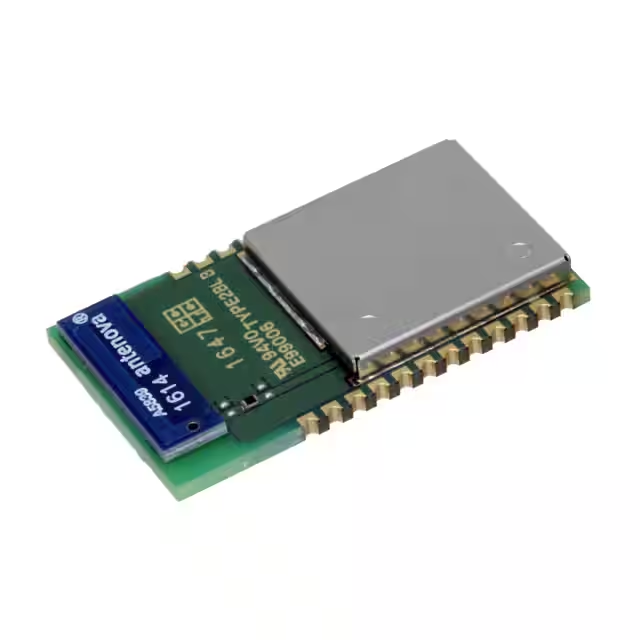
- Part No.:
- SPBT3.0DP1
- Manufacturer:
- STMicroelectronics
- Category:
- RF Transceiver Modules and Modems
- Package:
- Module
- Datasheet:
-
 SPBT3.0DP1.pdf
- Description:
- RF TXRX MOD BT TH SMD
- Quantity:
- Payment:

- Shipping:

Inventory:1,499
Please send an inquiry. Send us your inquiry, and we will respond immediately.
Product details
Overview
SPBT3.0DP1 from STMicroelectronics is a Bluetooth 3.0 Class 2 module with embedded Data Package (DP) firmware supporting SPP, HID, and iAP2 profiles for iOS accessory integration. It operates at 2.4 GHz ISM band, delivers +4 dBm RF output power, supports UART host interface up to 2 Mbps, and implements bonding, encryption, sniff mode, and deep sleep for low-power operation in portable MFi-compliant accessories.
For engineers reviewing the SPBT3.0DP1 datasheet, SPBT3.0DP1 pinout, SPBT3.0DP1 application, or SPBT3.0DP1 equivalent, this module is selected for rapid Bluetooth-to-serial bridging in Apple-certified peripherals, where AT-command configurability, dual-mode (command/bypass) operation, and pre-qualified Bluetooth SIG listing reduce qualification time and firmware development effort.
Technical Context
The SPBT3.0DP1 integrates a Bluetooth 3.0 BR/EDR baseband controller and 2.4 GHz transceiver with on-module antenna matching. Its DP firmware implements a full AT command interpreter that manages link establishment, security (MITM-resistant pairing), and profile multiplexing - allowing concurrent SPP and HID connections while maintaining iAP2 compatibility with iOS devices via MFi co-processor handshake.
It supports dynamic UART baud rate switching (300–2,000,000 bps), GPIO control (14 configurable pins when StreamingSerial=FALSE), and power management modes including Active Status Mode (ASM) and Deep Sleep Mode (DSM), with wake-up via UART, GPIO, or Bluetooth event - enabling sub-100 µA standby current in DSM with external trigger capability.
Key Specifications
| Parameter | Value and Actual Design Meaning |
|---|---|
| Bluetooth Version | Bluetooth 3.0 BR/EDR, qualified by Bluetooth SIG (QDID 57943) |
| RF Output Power | +4 dBm typical - ensures reliable 10 m range in Class 2 operation without external PA |
| Host Interface | UART with software-configurable baud rates up to 2 Mbps - enables high-throughput serial tunneling |
| Profiles Supported | SPP (client/server), HID (keyboard/mouse), iAP2 - enables direct iOS accessory functionality without custom stack |
| Power Modes | Active Status Mode (ASM) and Deep Sleep Mode (DSM) - DSM draws <100 µA with wake-on-UART/GPIO |
| GPIO Count | 14 programmable I/O pins (StreamingSerial=FALSE) - supports status LEDs, button inputs, and peripheral control |
| Firmware Features | AT command set v2.2, auto-reconnect, bond table (100 entries), RSSI reporting, and factory reset - simplifies host MCU integration |
Pinout & Package
SPBT3.0DP1 uses a 24-pin LCC (Leadless Chip Carrier) package measuring 13.0 × 11.5 mm, with exposed thermal pad, RoHS-compliant, and designed for surface-mount reflow assembly. Pin numbering follows standard counter-clockwise sequence starting from top-left corner (Pin 1 marked).
| Pin/Terminal | Circuit Role | Design Meaning |
|---|---|---|
| VDD | Supply voltage input | 3.3 V ±10% main power rail; decoupling required per UM2077 layout guidelines |
| GND | Ground reference | System ground plane connection; multiple pins assigned for low-impedance return path |
| UART_TX | Transmit data output | CMOS-level UART output to host MCU RX; logic-high = 3.3 V, idle high |
| UART_RX | Receive data input | CMOS-level UART input from host MCU TX; accepts 3.3 V tolerant signals |
| RESET_N | Active-low reset input | Pulled high internally; driven low for hardware reset (min. 10 µs pulse) |
| WAKEUP | Wake-up request input | Edge-triggered input to exit Deep Sleep Mode; rising edge initiates wake sequence |
| GPIO1–GPIO14 | Configurable digital I/O | Software-defined as input/output with optional pull-up/down, open-drain, or interrupt (rising/falling/rising+falling) |
| ANT | RF antenna port | 50 Ω matched RF output; requires 50 Ω microstrip trace to onboard chip antenna or external connector |
Key Features
| Feature | Design Value |
|---|---|
| iAP2 protocol support | Enables certified communication with iOS devices for audio, control, and metadata - eliminates need for separate MFi authentication firmware |
| Concurrent SPP + HID operation | Allows simultaneous serial tunneling and human interface functions (e.g., barcode scanner with status LED feedback) |
| Non-volatile auto-reconnect setup | Stores target BD address, profile type (SPP/iAP2/HID), retry interval, and attempt count across power cycles - reduces host MCU state management |
| Dynamic UART baud rate change | Change active session baud rate (e.g., from 115200 to 921600) without disconnecting - maintains data flow during throughput optimization |
| Bond table with 100-entry capacity | Supports large-scale deployment in multi-device environments (e.g., hospital BLE peripherals sharing one gateway module) |
Applications
| Medical Diagnostic Peripheral | iOS-Compatible Barcode Scanner |
|---|---|
|
Use Scenario: Handheld glucose meter transmitting readings to iPad via Bluetooth. IC Role / Device Role / Timing Role: SPBT3.0DP1 acts as SPP server, providing transparent serial bridge between analog front-end MCU and iOS Health app. Use Value: Pre-qualified iAP2 and SPP eliminate iOS MFi certification burden; built-in bonding ensures secure, persistent pairing with clinical tablets. |
Use Scenario: Wireless barcode scanner used in retail point-of-sale systems with iPhones. IC Role / Device Role / Timing Role: SPBT3.0DP1 serves as HID keyboard device, emulating keypresses upon scan, while also exposing SPP for firmware updates. Use Value: Concurrent HID+SPP allows real-time data entry and background OTA updates without interrupting checkout workflow. |
| Industrial Asset Tag Reader | Smart Home Remote Control |
|
Use Scenario: Battery-powered RFID tag interrogator logging asset locations to iOS inventory app. IC Role / Device Role / Timing Role: SPBT3.0DP1 operates in Deep Sleep Mode between scans, waking on button press or timer, then establishing iAP2 connection for encrypted upload. Use Value: Sub-100 µA DSM current extends battery life to >2 years on CR2032; MITM-resistant bonding prevents unauthorized access to facility data. |
Use Scenario: Compact IR+Bluetooth remote controlling Apple TV and smart lighting via single device. IC Role / Device Role / Timing Role: SPBT3.0DP1 handles iOS pairing and command relay (iAP2 for Apple TV, SPP for third-party lighting hub), while managing GPIO-driven IR LED timing. Use Value: Single-module dual-profile support replaces discrete BT + IR ICs, reducing BOM cost and PCB area by 35%. |
Equivalent & Alternatives
The following parts are listed as comparable options for similar Bluetooth serial bridge applications.
| Alternative Part | Technical Difference | Application Difference | Selection Advice |
|---|---|---|---|
| BLUENRG-M2SP | BLE-only (Bluetooth 5.0), no BR/EDR or iAP2; integrated Cortex-M0+, 256 KB Flash | Cannot replace SPBT3.0DP1 in iOS accessory roles requiring iAP2 or legacy SPP HID; suited for new BLE sensor nodes | Select only if targeting BLE-only iOS apps without MFi dependency and needing embedded processing |
| SPBT2632C2A | Bluetooth 2.1 + EDR, no iAP2, older DP firmware (v1.x), limited GPIO (8 pins), no auto-reconnect | Lacks iOS 10+ compatibility and concurrent profile support; requires host-side bonding management | Acceptable only for legacy SPP-only designs with no iOS integration or power budget constraints |
Compared with BLUENRG-M2SP and SPBT2632C2A, SPBT3.0DP1 uniquely delivers iAP2 compliance, concurrent SPP/HID, and production-ready auto-reconnect - making it the sole option for certified, low-risk iOS accessory development without host MCU Bluetooth stack implementation.
Availability
SPBT3.0DP1 is available at Aetrix Electronics and suitable for medical diagnostics, industrial asset tracking, retail POS peripherals, and smart home remotes requiring stable component supply, full Bluetooth SIG qualification, and MFi ecosystem compatibility.
Supply support for SPBT3.0DP1 includes scheduled delivery planning, volume procurement assistance, BOM continuity management, traceable sourcing, and lifecycle availability coordination for OEM customers, industrial embedded developers, connected-device designers, and electronics production programs.
Manufacturer
STMicroelectronics is a global semiconductor leader headquartered in Geneva, specializing in microcontrollers, analog ICs, MEMS, and wireless solutions with strong automotive and industrial focus.
The SPBT3.0DPx series belongs to ST's certified Bluetooth module product line, engineered specifically for rapid integration into iOS-accessory and cable-replacement applications - minimizing qualification risk and firmware overhead.
FAQ
Does SPBT3.0DP1 require Apple MFi licensing for iAP2 use?
No - SPBT3.0DP1 contains ST's pre-certified iAP2 firmware and MFi co-processor interface logic. End-product developers must still complete Apple's MFi program enrollment and final product declaration, but no additional firmware development or cryptographic key provisioning is needed beyond standard DP AT commands like CpTest and IAP2Connect.
What is the maximum UART baud rate supported in bypass mode?
The SPBT3.0DP1 supports UART baud rates up to 2,000,000 bps in both command and bypass modes. This is confirmed in UM2077 Section 3.9.1 and validated across all DP firmware versions ≥2.0. Baud rate changes take effect immediately after the "AT-AB Baudrate Changed" response, with no packet loss during transition.
How many devices can be stored in the bond table, and what happens on overflow?
The bond table holds up to 100 paired devices. When the 101st bonding is initiated, the oldest entry is overwritten - a documented behavior in UM2077 Section 3.4.1. Each entry stores BD address, link key, and encryption parameters; erasure is atomic via EraseBondTable command with "AT-AB BondTableErased" confirmation.
Is antenna matching required when using the onboard chip antenna?
Yes - the SPBT3.0DP1's onboard chip antenna requires precise 50 Ω impedance matching via the integrated matching network (L1/C1/C2 per UM2077 schematic). Deviation from recommended PCB layout (e.g., ground plane cutouts, trace length) degrades RF performance, reducing effective range below the rated 10 m and increasing current draw during transmission.
SPBT3.0DP1 Specifications
- Product attributes
- Attribute value
- Manufacturer:
- STMicroelectronics
- Series:
- -
- Package/Case:
- Module
- Packaging:
- Tray
- Product Status:
- Obsolete
- Programmable:
- Not Verified
- RF Family/Standard:
- Bluetooth
- Protocol:
- Bluetooth v3.0
- Modulation:
- -
- Frequency:
- 2.4GHz
- Data Rate:
- 450Mbps
- Power - Output:
- 10dBm
- Sensitivity:
- -88dBm
- Serial Interfaces:
- UART
- Antenna Type:
- Integrated, Trace
- Utilized IC / Part:
- STLC2690
- Memory Size:
- 512kB Flash, 128kB RAM
- Voltage - Supply:
- 3.3V
- Current - Receiving:
- 9.5mA
- Current - Transmitting:
- 26mA
- Mounting Type:
- Surface Mount
- Operating Temperature:
- -40°C ~ 85°C
SPBT3.0DP1 FAQ
1.How can I place an order for SPBT3.0DP1 through Aetrix?
Please submit a Request for Quotation (RFQ) for SPBT3.0DP1 on Aetrix. Our sales agent will provide a competitive quotation and guide you through the order confirmation once you accept the terms.
2.Are the price and stock information for SPBT3.0DP1 reliable?
The price and inventory of SPBT3.0DP1 are updated periodically and may fluctuate due to market conditions. Stock and pricing data are typically refreshed every 24 hours. Quotation validity for SPBT3.0DP1 is usually 5 days.
3.What payment methods are accepted for SPBT3.0DP1?
We accept Wire Transfer, PayPal, Credit Card, Western Union, MoneyGram, and Escrow for SPBT3.0DP1 transactions.
Note: Certain payment methods may incur a processing fee.
4.How is shipping managed for SPBT3.0DP1?
SPBT3.0DP1 orders can be shipped via leading logistics carriers, including DHL, UPS, FedEx, TNT, or Registered Mail.
Once your SPBT3.0DP1 order is processed, you will receive an email with the shipment details and tracking number.
Note: Tracking information may take up to 24 hours to appear. Express delivery typically takes 3–5 business days.
5.How can I obtain technical support or documentation for SPBT3.0DP1?
For technical support, including SPBT3.0DP1 datasheets, pinout diagrams, or application guidance, please contact our engineering support team. They can provide detailed documentation and assistance for your SPBT3.0DP1 requirements.
6.How does Aetrix verify that SPBT3.0DP1 is sourced from the original manufacturer or authorized distributors?
All SPBT3.0DP1 products on Aetrix are procured from qualified distributors and authorized channels. Our dedicated quality assurance team conducts strict verification, including traceability checks and, if necessary, third-party testing. This ensures that SPBT3.0DP1 meets industry standards.
7.What is the process for return or replacement of SPBT3.0DP1?
All SPBT3.0DP1 units undergo pre-shipment inspection (PSI). If there is an issue with SPBT3.0DP1, returns or replacements are accepted under the following conditions:
1.Quantity discrepancies, incorrect items, or visible external defects (such as breakage or corrosion), acknowledged by Aetrix.
2.The issue is reported within 90 days of delivery.
3.The SPBT3.0DP1 part is unused and in its original packaging.
Return procedure for SPBT3.0DP1:
1.Submit a request within 90 days.
2.Obtain a Return Material Authorization (RMA) from Aetrix.
SPBT3.0DP1 Tags

-
ESP32-C3FH4
Espressif Systems
-
ESP32-S2FH4
Espressif Systems
-
ESP32-S2FN4R2
Espressif Systems
-
ESP32-C3-MINI-1-N4
Espressif Systems
-
ESP32-C3-WROOM-02-N4
Espressif Systems
-
ESP32-C3-MINI-1U-N4
Espressif Systems
-
ESP32-C3-MINI-1U-H4
Espressif Systems
-
ESP32-C3-WROOM-02U-N4
Espressif Systems
-
ESP32-H2-MINI-1-N4
Espressif Systems
-
ESP32-H2-MINI-1-H4
Espressif Systems
_viewa.jpg)
-
ESP32-MINI-1-N4
Espressif Systems
-
ESP32-S2-MINI-2-N4R2
Espressif Systems
Tech Hub

An engineering guide to LED driver operation, constant-current and constant-voltage outputs, linear and switching topologies, dimming, IC selection, calculations, replacement compatibility, and fault c…

Operational amplifier guide covering op amp basics, feedback, ideal vs real op amps, common configurations, buffer circuits, offset, bias current, gain-bandwidth, slew rate, rail-to-rail limits and sel…

Jumper cables guide covering safe connection order, red and black clamp placement, final ground connection, cable gauge, length, clamp quality, copper vs CCA cables, jump starter comparison and battery…

LDO regulator guide covering low dropout voltage, power dissipation, thermal design, PSRR, output noise, capacitor stability, adjustable LDO circuits, LDO vs buck converter and datasheet selection chec…

Conditional Access Module guide covering CAM meaning, CI/CI+ interface, smart card authorization, DVB security workflow, TV and set-top box compatibility, internal electronics, ESD protection, connecto…

Guide to electronic component obsolescence covering EOL risk, PCN/PDN notices, last-time buy planning, replacement options, form-fit-function validation, counterfeit risk and BOM lifecycle management.

18650 battery guide covering lithium-ion cell basics, 3.6V/3.7V voltage, 4.2V charging, mAh and Wh capacity, protected cells, chargers, BMS, series-parallel packs, holders, welding and sourcing checks.…

Hall effect sensor guide covering working principle, linear and digital sensors, Arduino circuits, current sensing, speed detection, automotive applications, A3144 examples, signal filtering and datash…

Product Change Notification guide for electronic components, covering PCN meaning, PCN vs PDN/EOL, common change types, risk levels, form-fit-function review, engineering validation, BOM control, LTB/L…

A practical guide to blend door actuators, covering HVAC function, symptoms, location, AC and heater issues, reset and calibration, replacement cost, electrical diagnosis, compatibility checks, and rep…


