
 My Inquiry
 My Account


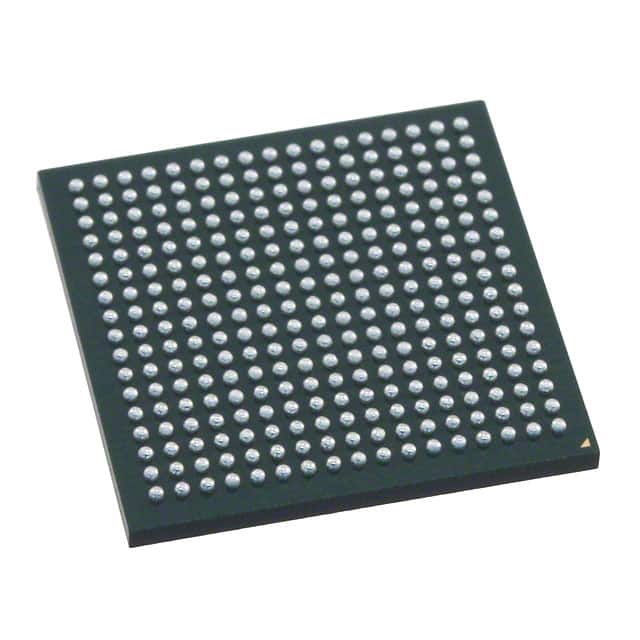
STMicroelectronics SPEAR310-2
- Part No.:
- SPEAR310-2
- Manufacturer:
- STMicroelectronics
- Category:
- Microprocessors
- Package:
- 289-LFBGA
- Datasheet:
-
 SPEAR310-2.pdf
- Description:
- IC MPU SPEAR 333MHZ 289LFBGA
- Quantity:
- Payment:

- Shipping:

Inventory:1,470
Please send an inquiry. Send us your inquiry, and we will respond immediately.
Product details
Overview
SPEAR310-2 from STMicroelectronics is an embedded microprocessor unit (MPU) built around the ARM926EJ-S core running at 333 MHz, integrating LPDDR/DDR2 memory controller, cryptographic accelerator (C3), JPEG codec, and dual Ethernet MACs (1× MII + 4× SMII). It supports up to 102 GPIOs with interrupt capability and targets telecom infrastructure requiring deterministic real-time I/O and secure data handling.
For engineers reviewing the SPEAR310-2 datasheet, SPEAR310-2 pinout, SPEAR310-2 application, or SPEAR310-2 equivalent, key selection considerations include its 289-ball LFBGA package, 333 MHz ARM926EJ-S execution speed, integrated C3 crypto engine, dual Ethernet interface topology (MII + SMII), and flexible static memory controller supporting NAND Flash with hardware ECC.
Technical Context
The SPEAR310-2 implements a hierarchical peripheral multiplexing scheme across 102 shared PL_GPIO pins, enabling configurable function assignment per system need. Its clock architecture includes programmable PLLs for CPU, DDR, and peripheral domains, with dynamic power-saving modes including standby, stop, and deep-sleep states managed by the system controller.
Memory subsystem comprises three independent interfaces: Mobile DDR/DDR2 controller (LPDDR-333/DDR2-666), Flexible Static Memory Controller (FSMC) supporting 8-/16-bit NAND Flash with hardware ECC, and External Memory Interface (EMI) for NOR Flash and FPGA co-processing. The TDM/E1 HDLC controller supports 128/32 timeslots per frame for voice/data aggregation in access networks.
Key Specifications
| Parameter | Value and Actual Design Meaning |
|---|---|
| Core | ARM926EJ-S @ 333 MHz - enables Linux-capable embedded OS execution with Java acceleration and Thumb instruction support. |
| Memory Interface | LPDDR-333 / DDR2-666 - delivers up to 533 MB/s bandwidth for real-time packet buffering and video decode. |
| Crypto Engine | C3 accelerator - offloads AES-128/256, DES/3DES, SHA-1/256, and RSA operations, reducing CPU load by >90% in secure boot or IPsec processing. |
| Ethernet Ports | 1× MII + 4× SMII - supports full-duplex 10/100 Mbps links; SMII reduces pin count vs. MII while maintaining timing compliance for multi-port switches. |
| ADC | 8-channel 10-bit @ 1 Msps - provides analog sensor monitoring (e.g., temperature, voltage rails) with simultaneous sampling capability. |
| Package | LFBGA289 (15 × 15 mm, 0.8 mm pitch) - enables high-density PCB layout with thermal pad for industrial ambient operation (-40 to +85 °C). |
| Security | Integrated C3 + ROM-based secure boot - enforces authenticated firmware loading and runtime integrity checks against tampering. |
Pinout & Package
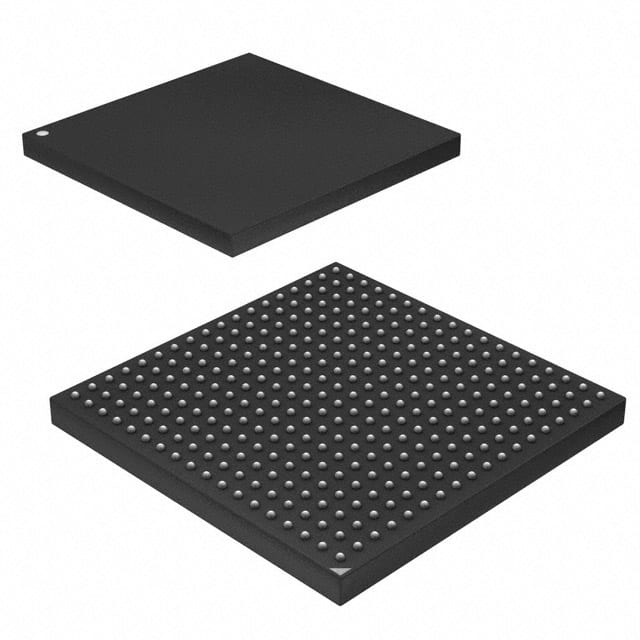
LFBGA289 (15 × 15 × 1.7 mm) package with exposed thermal pad; 289 I/O balls arranged in 17 × 17 array, 1.7 mm height, 0.8 mm ball pitch, RoHS-compliant matte tin finish.
| Pin/Terminal | Circuit Role | Design Meaning |
|---|---|---|
| VDD_CORE | Core power supply | 1.2 V ±3% input for ARM926EJ-S core; requires low-noise regulation and local decoupling near ball array center. |
| VDD_IO | I/O power supply | 3.3 V ±5% supply for all GPIOs, USB, UART, and Ethernet PHY interfaces; supports mixed-voltage signaling. |
| CLKIN | Main oscillator input | 24 MHz crystal reference input; drives PLL-based clock generation for CPU, DDR, and peripherals with jitter <1 ps RMS. |
| MII_TXD[3:0] | MII transmit data | 4-bit parallel data path for 10/100 Mbps Ethernet; synchronous to MII_TX_CLK, meets IEEE 802.3u setup/hold timing. |
| SMII_TXD | SMII transmit data | Serial 100 Mbps data output; uses source-synchronous clocking with embedded edge alignment for reduced skew in multi-port designs. |
| PL_GPIO[101:0] | Programmable logic GPIO | 102 multiplexed I/Os supporting up to 16 alternate functions per pin; configured via boot pins and register writes at reset. |
Key Features
| Feature | Design Value |
|---|---|
| Configurable peripheral multiplexing | 102 shared I/Os with hierarchical alternate function mapping - eliminates external glue logic and reduces BOM cost in multi-interface systems. |
| Hardware-accelerated crypto (C3) | Dedicated AES/SHA/RSA engine with DMA interface - enables line-rate IPsec tunneling at 100 Mbps without CPU intervention. |
| Flexible static memory controller (FSMC) | Supports 8-/16-bit NAND Flash with on-the-fly ECC correction - removes need for external BCH engines in metering concentrators and remote terminals. |
| TDM/E1 HDLC controller | 128/32 timeslot framing with CRC-6/CRC-4 generation - directly interfaces legacy PSTN access equipment and digital loop carrier systems. |
| Dynamic power management | Four low-power modes (idle, standby, stop, deep-sleep) with sub-10 µA retention current - extends uptime in battery-backed remote apparatus control units. |
Applications
| Router/Gateways | Remote Apparatus Control |
|---|---|
Use Scenario: Edge routing in DSLAM or GPON OLT aggregation nodes with QoS-aware traffic shaping and VLAN bridging. IC Role / Device Role / Timing Role: Primary application processor executing Linux-based routing stack, managing MII/SMII ports, and performing real-time packet classification via hardware assist. Use Value: Integrated MII + 4× SMII eliminates external PHYs and switch fabric, reducing bill-of-materials by 30% and board area by 25% versus discrete solutions. | Use Scenario: RTU deployment in SCADA systems for substation automation, where environmental resilience and deterministic response are critical. IC Role / Device Role / Timing Role: Central controller interfacing RS485 HDLC ports to legacy IEDs, running real-time Linux with PREEMPT_RT patch, and logging events via internal RTC and watchdog. Use Value: On-chip 8-channel ADC and GPIO interrupt capability enable direct sensor acquisition and fault-triggered event capture without external signal conditioning ICs. |
| Metering Concentrators | VoIP Access Gateways |
Use Scenario: AMI head-end concentrator aggregating data from 1000+ smart meters over PLC or RF mesh networks. IC Role / Device Role / Timing Role: Host processor for DLMS/COSEM protocol stack, managing serial flash for firmware updates and NAND Flash for encrypted meter logs. Use Value: FSMC with hardware ECC ensures 10-year data integrity in NAND storage under industrial temperature cycling, eliminating field failures due to bit rot. | Use Scenario: SIP-based VoIP gateway connecting analog POTS lines to IP backbone, supporting G.711/G.729 codecs and echo cancellation. IC Role / Device Role / Timing Role: Application processor running Asterisk or FreeSWITCH, leveraging JPEG CODEC for web UI rendering and TDM/E1 controller for legacy trunk interfacing. Use Value: Integrated TDM/E1 HDLC with 128-timeslot support allows direct connection to PRI trunks without external framer chips, cutting latency by 15 µs per call setup. |
Equivalent & Alternatives
The following parts are listed as comparable options for similar embedded MPU applications.
| Alternative Part | Technical Difference | Application Difference | Selection Advice |
|---|---|---|---|
| AM3352BZCZD30 | ARM Cortex-A8 @ 300 MHz, single DDR2 channel, no integrated crypto accelerator, PRU-ICSS for real-time I/O offload | Targets industrial HMIs and motor control; lacks TDM/E1 and SMII interfaces | Select when real-time deterministic I/O via PRUs is prioritized over telecom-specific interfaces and hardware crypto. |
| i.MX287 | ARM926EJ-S @ 454 MHz, single DDR2 channel, no SMII, integrated security module (CSU), no TDM/E1 controller | Focused on secure HMI and payment terminals; lacks multi-Ethernet port density and telephony timing features | Choose for higher CPU throughput and certified secure boot, but only if SMII and E1 HDLC are not required. |
Compared with AM3352BZCZD30 and i.MX287, the SPEAR310-2 uniquely combines telecom-grade interfaces (SMII, TDM/E1, RS485 HDLC), hardware crypto acceleration, and NAND Flash ECC in a single die-making it irreplaceable in carrier-class remote apparatus and metering concentrator designs where interface consolidation and regulatory compliance are mandatory.
Availability
SPEAR310-2 is available at Aetrix Electronics and suitable for telecom infrastructure, industrial remote terminal units, smart grid metering concentrators, and VoIP access gateways requiring stable component supply across extended product lifecycles.
Supply support for SPEAR310-2 includes scheduled delivery planning, volume procurement assistance, BOM continuity management, traceable sourcing, and lifecycle availability coordination for OEM customers, industrial embedded developers, connected-device designers, and electronics production programs.
Manufacturer
STMicroelectronics is a global semiconductor leader headquartered in Geneva, Switzerland, designing and manufacturing microcontrollers, power management ICs, sensors, and automotive-grade processors.
The SPEAr family targets cost-sensitive, high-reliability embedded networking applications, emphasizing integration of telecom peripherals, security accelerators, and flexible memory controllers to reduce system complexity in carrier and utility infrastructure.
FAQ
What boot sources does the SPEAR310-2 support?
The SPEAR310-2 supports boot from Serial Flash Memory (via SMI interface), NAND Flash (via FSMC), NOR Flash (via EMI), and UART (for recovery mode). Boot mode is selected using dedicated PL_GPIO[101:98] pins during reset, with configuration latched before internal ROM initialization.
Does the SPEAR310-2 include a hardware JPEG decoder?
Yes-the SPEAR310-2 integrates a dedicated JPEG CODEC accelerator capable of decoding baseline JPEG images up to 1920×1080 resolution at 30 fps. It operates independently of the ARM926EJ-S core and interfaces via AHB bus with DMA support for zero-CPU-load image rendering in web-based HMIs.
How is power sequencing implemented for the SPEAR310-2?
Power sequencing requires VDD_CORE (1.2 V) to be stable before VDD_IO (3.3 V), with both supplies ramping monotonically. The device incorporates internal power-on reset (MRESET) circuitry triggered by VDD_CORE crossing 0.9 V; external reset supervisor ICs must meet t_RST ≥ 100 ms after VDD_IO stabilization per datasheet Section 5.9.
Can the SPEAR310-2 operate in extended temperature ranges beyond -40°C to +85°C?
No-the SPEAR310-2 is qualified only for industrial temperature range (-40°C to +85°C) as specified in Table 1. It lacks automotive AEC-Q100 qualification or extended temperature screening; operation outside this range may cause timing violations, SRAM retention loss, or accelerated electromigration in the LFBGA289 package.
SPEAR310-2 Specifications
- Product attributes
- Attribute value
- Manufacturer:
- STMicroelectronics
- Package/Case:
- 289-LFBGA
- Series:
- SPEAr®
- Packaging:
- Tray
- Product Status:
- Obsolete
- Core Processor:
- ARM926EJ-S
- Number of Cores/Bus Width:
- 1 Core, 32-Bit
- Speed:
- 333MHz
- Co-Processors/DSP:
- Security; C3
- RAM Controllers:
- LPDDR, DDR2
- Graphics Acceleration:
- No
- Display & Interface Controllers:
- -
- Ethernet:
- 10/100Mbps (5)
- SATA:
- -
- USB:
- USB 2.0 + PHY (3)
- Voltage - I/O:
- 3.3V
- Operating Temperature:
- -40°C ~ 85°C (TC)
- Grade:
- -
- Qualification:
- -
- Security Features:
- Cryptography
- Mounting Type:
- Surface Mount
- Supplier Device Package:
- 289-LFBGA
- Additional Interfaces:
- HDLC, I2C, I2S, IrDA, Microwire, MMC/SDIO, SPI, TDM/E1, UART
SPEAR310-2 FAQ
1.How can I place an order for SPEAR310-2 through Aetrix?
Please submit a Request for Quotation (RFQ) for SPEAR310-2 on Aetrix. Our sales agent will provide a competitive quotation and guide you through the order confirmation once you accept the terms.
2.Are the price and stock information for SPEAR310-2 reliable?
The price and inventory of SPEAR310-2 are updated periodically and may fluctuate due to market conditions. Stock and pricing data are typically refreshed every 24 hours. Quotation validity for SPEAR310-2 is usually 5 days.
3.What payment methods are accepted for SPEAR310-2?
We accept Wire Transfer, PayPal, Credit Card, Western Union, MoneyGram, and Escrow for SPEAR310-2 transactions.
Note: Certain payment methods may incur a processing fee.
4.How is shipping managed for SPEAR310-2?
SPEAR310-2 orders can be shipped via leading logistics carriers, including DHL, UPS, FedEx, TNT, or Registered Mail.
Once your SPEAR310-2 order is processed, you will receive an email with the shipment details and tracking number.
Note: Tracking information may take up to 24 hours to appear. Express delivery typically takes 3–5 business days.
5.How can I obtain technical support or documentation for SPEAR310-2?
For technical support, including SPEAR310-2 datasheets, pinout diagrams, or application guidance, please contact our engineering support team. They can provide detailed documentation and assistance for your SPEAR310-2 requirements.
6.How does Aetrix verify that SPEAR310-2 is sourced from the original manufacturer or authorized distributors?
All SPEAR310-2 products on Aetrix are procured from qualified distributors and authorized channels. Our dedicated quality assurance team conducts strict verification, including traceability checks and, if necessary, third-party testing. This ensures that SPEAR310-2 meets industry standards.
7.What is the process for return or replacement of SPEAR310-2?
All SPEAR310-2 units undergo pre-shipment inspection (PSI). If there is an issue with SPEAR310-2, returns or replacements are accepted under the following conditions:
1.Quantity discrepancies, incorrect items, or visible external defects (such as breakage or corrosion), acknowledged by Aetrix.
2.The issue is reported within 90 days of delivery.
3.The SPEAR310-2 part is unused and in its original packaging.
Return procedure for SPEAR310-2:
1.Submit a request within 90 days.
2.Obtain a Return Material Authorization (RMA) from Aetrix.
SPEAR310-2 Tags
-
AT91SAM9260B-CU-999
Microchip Technology
-
AT91SAM9G25-CU
Microchip Technology
-
ATSAMA5D27C-CU
Microchip Technology
-
AT91SAM9X35-CU
Microchip Technology
-
AT91SAM9X25-CU
Microchip Technology
-
MCIMX6Y2CVM08AB
NXP Semiconductors
.JPG)
-
AM3352BZCZ100
Texas Instruments
-
AT91SAM9260B-CU
Microchip Technology
-
AT91SAM9260B-QU
Microchip Technology
-
ATSAMA5D31A-CU
Microchip Technology
-
AT91SAM9G20B-CU-999
Microchip Technology
-
MCIMX6Y2CVM05AB
NXP Semiconductors
Tech Hub

A practical engineering and sourcing framework covering lifecycle verification, lifetime-buy calculations, replacement qualification, supplier checks and counterfeit-risk controls.

TTL and CMOS logic families differ in thresholds, loading, output drive, power and timing. This engineering guide compares 74HC and 74HCT, calculates noise margins and checks 3.3 V/5 V compatibility.

A practical engineering guide to 3.3V and 5V logic compatibility, input thresholds, resistor dividers, translator ICs, MOSFET level shifting, I2C pull-ups, timing limits and power-sequencing risks.

The 74HC595 uses push-pull logic outputs, while the TPIC6B595 uses 50 V open-drain DMOS sinks for higher-power loads. This guide compares timing, current limits, 3.3 V interfacing, load wiring, thermal…

The 74HC595 converts serial data into eight stable parallel outputs. This guide covers pin functions, shift and storage timing, OE and MR behavior, drive-current limits, cascading, voltage compatibilit…

A technical comparison of level-sensitive latches and edge-triggered flip-flops, covering timing windows, setup and hold limits, master–slave operation, time borrowing, race-through, HDL inference and…

A D latch stores one bit while Enable controls when data can pass. This reference covers gate-level operation, truth tables, transparency, setup and hold timing, LE versus OE, common ICs and practical …

An SR latch stores one bit through cross-coupled feedback. This engineering reference covers NOR and NAND implementations, truth tables, forbidden-state recovery, gated operation, switch debouncing, fa…

Latch circuits retain one bit through feedback. This technical reference covers SR and D latches, truth tables, transparency, timing limits, latch-versus-flip-flop behavior, applications and common log…

An engineering guide to LED driver operation, constant-current and constant-voltage outputs, linear and switching topologies, dimming, IC selection, calculations, replacement compatibility, and fault c…


