
 My Inquiry
 My Account


STMicroelectronics SPSGRF-868
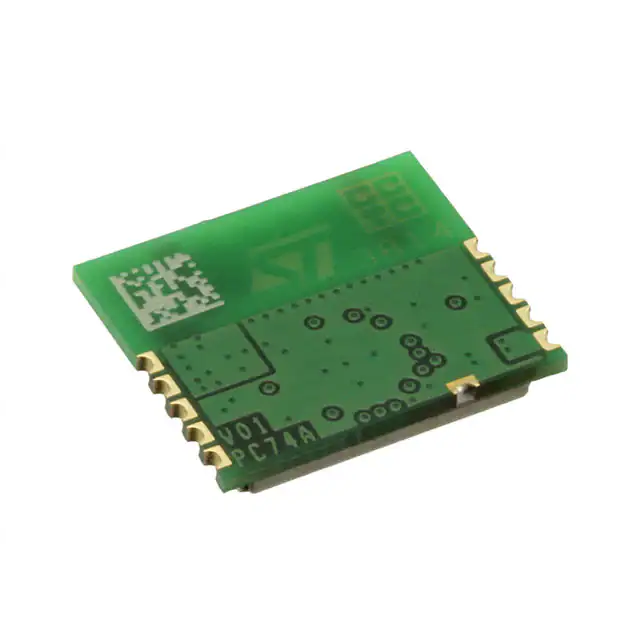
- Part No.:
- SPSGRF-868
- Manufacturer:
- STMicroelectronics
- Category:
- RF Transceiver Modules and Modems
- Package:
- Module
- Datasheet:
-
 SPSGRF-868.pdf
- Description:
- RF TXRX MOD ISM<1GHZ CHIP SMD
- Quantity:
- Payment:

- Shipping:

Inventory:1,832
Please send an inquiry. Send us your inquiry, and we will respond immediately.
Product details
Overview
SPSGRF-868 from STMicroelectronics is a CE-certified, sub-GHz 868 MHz programmable RF transceiver module based on the SPIRIT1 transceiver and integrated BALF-SPI-01D3 balun. It delivers -118 dBm receiver sensitivity, +11.6 dBm programmable output power, 1–500 kbps air data rate, and operates from -40 °C to +85 °C with on-board antenna. It enables rapid wireless integration in metering and industrial sensor nodes without RF design expertise.
For engineers reviewing the SPSGRF-868 datasheet, SPSGRF-868 pinout, SPSGRF-868 application, or SPSGRF-868 equivalent, key selection considerations include its certified 868 MHz SRD band operation, SPI interface compatibility, GPIO programmability, and regulatory compliance for European deployments.
Technical Context
The SPSGRF-868 implements a state-machine-controlled radio architecture with dedicated READY, LOCK, TX, RX, SLEEP, and STANDBY modes managed exclusively via SPI commands. Its internal controller handles LO generation, mode transitions, and FIFO management without external timing sources beyond the onboard XO.
It integrates a matched 868 MHz antenna path with embedded balun, supports six modulation schemes (2-FSK, GFSK, MSK, GMSK, OOK, ASK), and enforces ETSI EN 300 220-2 V3.2.1 compliance limits - including +5.3 dBm radiated output power and strict spectral mask adherence - through firmware-enforced RF parameter constraints.
Key Specifications
| Parameter | Value and Actual Design Meaning |
|---|---|
| Carrier Frequency | 868 MHz SRD band (863–870 MHz); enables license-free operation across EU member states. |
| Receiver Sensitivity | -118 dBm at 1.2 kbps; supports long-range, low-power reception in noisy industrial environments. |
| Max Output Power | +11.6 dBm conducted; radiated output limited to +5.3 dBm per ETSI compliance requirements. |
| Air Data Rate | 1–500 kbps; configurable for trade-offs between range (low rate) and throughput (high rate). |
| Supply Voltage | 1.8–3.6 V; compatible with single-cell Li-ion, Li-SOCl₂, or 3.3 V logic rails. |
| Operating Temp | -40 °C to +85 °C; qualified for outdoor metering and uncontrolled industrial enclosures. |
| Interface | SPI (≤8 MHz clock); minimal host MCU resource usage with no UART or USB overhead. |
Pinout & Package
The SPSGRF-868 is housed in an 11-pin surface-mount module (4-layer PCB) with exposed thermal pad, measuring 12.4 mm × 15.0 mm × 2.4 mm (L×W×H). Pin layout follows a single-row edge connector configuration optimized for compact PCB integration and RF isolation.
| Pin/Terminal | Circuit Role | Design Meaning |
|---|---|---|
| VIN (Pin 5) | Power Input | 1.8–3.6 V supply input; powers entire module including RF front-end and digital core. |
| GND (Pin 6) | Ground Reference | Primary analog/digital ground; must be low-impedance and isolated from noisy system grounds. |
| SDN (Pin 11) | Shutdown Control | Active-high enable; places module in <0.1 µA shutdown state with all I/O in Hi-Z. |
| SPI_CS (Pin 10) | SPI Slave Select | Chip-select signal; asserts SPI transaction window for register read/write and command execution. |
| SPI_CLK (Pin 7) | SPI Clock Input | Up to 8 MHz synchronous clock; defines timing for SPI data sampling and command latency. |
| SPI_MOSI (Pin 9) | SPI Data In | Host-to-module serial data path for configuration, packet loading, and control commands. |
| SPI_MISO (Pin 8) | SPI Data Out | Module-to-host serial data path for status registers, RSSI values, and received packet payloads. |
| GPIO[0]–[3] (Pins 1–4) | Programmable I/O | Four multi-function pins supporting digital I/O, wake-on-event, and temperature sensing (GPIO[0] only). |
Key Features
| Feature | Design Value |
|---|---|
| Integrated Balun & Antenna Matching | Eliminates external RF matching network, reducing BOM count and layout sensitivity for 868 MHz operation. |
| Firmware-Enforced Regulatory Compliance | Prevents accidental violation of ETSI EN 300 220-2 spectral masks and output power limits via embedded guardrails. |
| Multi-Modulation Support | 2-FSK/GFSK/MSK/GMSK/OOK/ASK enables interoperability with legacy and proprietary protocols in AMR networks. |
| Low-Power State Machine | STANDBY mode retains FIFO and register state at <0.6 mA, enabling instant wake-and-transmit without reinitialization. |
| Onboard Temperature Sensor | Integrated analog temperature output on GPIO[0] supports environmental compensation without external sensors. |
Applications
| Smart Utility Metering | Industrial Wireless Sensor Networks |
|---|---|
Use Scenario: Battery-powered gas/water/electricity meters transmitting consumption data hourly over distances up to 1 km in urban environments. IC Role / Device Role / Timing Role: Primary RF transceiver handling packet assembly, modulation, channel access, and regulatory-compliant transmission in SRD band. Use Value: CE certification eliminates need for end-product RF testing; -118 dBm sensitivity ensures reliable link budget in obstructed underground or metal-cabinet installations. | Use Scenario: Distributed vibration, temperature, and pressure monitoring nodes on factory machinery with 5+ year battery life. IC Role / Device Role / Timing Role: Low-duty-cycle transceiver managing scheduled wake-up, sensor reading, and burst transmission using STANDBY retention mode. Use Value: Programmable 1–500 kbps data rate allows optimization for sensor resolution vs. battery lifetime; GPIO[0] temperature output enables self-calibration. |
| Home & Building Automation | Fire & Security Alarm Systems |
Use Scenario: Wireless door/window contact sensors and HVAC controllers communicating via star topology to central gateway in residential buildings. IC Role / Device Role / Timing Role: Sub-GHz transceiver providing robust penetration through walls and floors with interference immunity against 2.4 GHz congestion. Use Value: On-board 868 MHz antenna and integrated balun simplify PCB layout; GFSK modulation ensures stable BER under multipath conditions. | Use Scenario: Smoke/CO detectors and panic buttons transmitting alarm events with guaranteed delivery and low latency in commercial facilities. IC Role / Device Role / Timing Role: Certified RF link ensuring regulatory-accepted reliability for life-safety signaling without custom antenna tuning. Use Value: +11.6 dBm programmable output power enables margin for aging batteries; SDN pin allows full system power gating during standby. |
Equivalent & Alternatives
The following parts are listed as comparable options for similar sub-GHz transceiver module applications.
| Alternative Part | Technical Difference | Application Difference | Selection Advice |
|---|---|---|---|
| SPSGRF-915 | 915 MHz ISM band; FCC/IC certified; identical pinout and firmware interface; radiated output +2.2 dBm. | Targeted at North American deployments requiring FCC Part 15.247 compliance instead of ETSI. | Select when designing for US/Canada markets or needing higher-frequency propagation characteristics in open terrain. |
| CC1312R1F3RGZT | TI SimpleLink™ SoC; integrates ARM Cortex-M4F MCU, 352 KB RAM, and 352 KB flash; requires full firmware development. | Demands host software stack (e.g., TI RTOS, BLE-5.0 PHY adaptation); not pre-certified as a module. | Choose only if application requires local processing, protocol stack flexibility, or multi-band support beyond 868 MHz. |
Compared with SPSGRF-915, the SPSGRF-868 offers lower radiated output (+5.3 dBm vs. +2.2 dBm) but superior regulatory alignment for EU metering; versus CC1312R1F3RGZT, it trades MCU capability for plug-and-play CE certification and zero RF design effort.
Availability
SPSGRF-868 is available at Aetrix Electronics and suitable for automatic meter reading (AMR), industrial wireless sensor networks (WSN), home/building automation, and fire/security alarm systems requiring stable component supply, full regulatory documentation, and long-term production continuity.
Supply support for SPSGRF-868 includes scheduled delivery planning, volume procurement assistance, BOM continuity management, traceable sourcing, and lifecycle availability coordination for OEM customers, industrial embedded developers, connected-device designers, and electronics production programs.
Manufacturer
STMicroelectronics is a global semiconductor leader headquartered in Geneva, Switzerland, specializing in microcontrollers, analog ICs, MEMS, and power management solutions for industrial, automotive, and consumer markets.
The SPSGRF series belongs to ST's certified RF module product line, designed specifically to accelerate time-to-market for battery-powered, regulatory-compliant wireless endpoints in utility, industrial, and smart infrastructure applications.
FAQ
Is the SPSGRF-868 module pre-certified for CE marking?
Yes, the SPSGRF-868 carries full CE marking under ETSI EN 300 220-2 V3.2.1 and EN 301 489-3 V2.1.1. This includes conducted and radiated emissions, immunity, and RF performance validation. Integrators may leverage this modular certification to streamline final product approval without repeating RF testing, provided mechanical integration respects the antenna keep-out zone and grounding guidelines specified in the datasheet.
What is the maximum achievable range with the SPSGRF-868 in typical outdoor deployment?
In line-of-sight outdoor conditions with clear Fresnel zone, the SPSGRF-868 achieves up to 1.2 km range at 1.2 kbps using 2-FSK modulation and -118 dBm sensitivity. Real-world range in urban or indoor settings typically falls between 200–500 m due to building attenuation and multipath; actual distance depends on antenna placement, data rate, and environmental RF noise-not on module firmware or host MCU configuration.
Can GPIO[0] be used simultaneously as temperature sensor output and digital I/O?
No-GPIO[0] operates in mutually exclusive modes: either as a 10-bit analog temperature sensor output (0.5 mV/°C scale, referenced to VIN) or as a standard digital I/O. Mode selection is configured via SPI register writes before entering operational states; switching between modes requires transitioning through READY state and reinitializing the GPIO subsystem, introducing latency unsuitable for real-time dual-use.
Does the SPSGRF-868 support over-the-air firmware updates?
No-the SPSGRF-868 contains no internal flash memory or bootloader; it is a fixed-function transceiver module with configuration stored in volatile registers. All "firmware" behavior-including modulation type, data rate, frequency, and power level-is set dynamically via SPI commands from the host MCU. Persistent settings must be reloaded after each power cycle or SDN-initiated shutdown.
SPSGRF-868 Specifications
- Product attributes
- Attribute value
- Manufacturer:
- STMicroelectronics
- Series:
- -
- Package/Case:
- Module
- Packaging:
- Tray
- Product Status:
- Obsolete
- Programmable:
- Not Verified
- RF Family/Standard:
- General ISM < 1GHz
- Protocol:
- -
- Modulation:
- 2-FSK, ASK, GFSK, GMSK, MSK, OOK
- Frequency:
- 868MHz
- Data Rate:
- 500kbps
- Power - Output:
- 11.6dBm
- Sensitivity:
- -118dBm
- Serial Interfaces:
- SPI
- Antenna Type:
- Integrated, Chip
- Utilized IC / Part:
- SPIRIT1
- Memory Size:
- -
- Voltage - Supply:
- 1.8V ~ 3.6V
- Current - Receiving:
- 10mA
- Current - Transmitting:
- 9mA ~ 22mA
- Mounting Type:
- Surface Mount
- Operating Temperature:
- -40°C ~ 85°C
SPSGRF-868 FAQ
1.How can I place an order for SPSGRF-868 through Aetrix?
Please submit a Request for Quotation (RFQ) for SPSGRF-868 on Aetrix. Our sales agent will provide a competitive quotation and guide you through the order confirmation once you accept the terms.
2.Are the price and stock information for SPSGRF-868 reliable?
The price and inventory of SPSGRF-868 are updated periodically and may fluctuate due to market conditions. Stock and pricing data are typically refreshed every 24 hours. Quotation validity for SPSGRF-868 is usually 5 days.
3.What payment methods are accepted for SPSGRF-868?
We accept Wire Transfer, PayPal, Credit Card, Western Union, MoneyGram, and Escrow for SPSGRF-868 transactions.
Note: Certain payment methods may incur a processing fee.
4.How is shipping managed for SPSGRF-868?
SPSGRF-868 orders can be shipped via leading logistics carriers, including DHL, UPS, FedEx, TNT, or Registered Mail.
Once your SPSGRF-868 order is processed, you will receive an email with the shipment details and tracking number.
Note: Tracking information may take up to 24 hours to appear. Express delivery typically takes 3–5 business days.
5.How can I obtain technical support or documentation for SPSGRF-868?
For technical support, including SPSGRF-868 datasheets, pinout diagrams, or application guidance, please contact our engineering support team. They can provide detailed documentation and assistance for your SPSGRF-868 requirements.
6.How does Aetrix verify that SPSGRF-868 is sourced from the original manufacturer or authorized distributors?
All SPSGRF-868 products on Aetrix are procured from qualified distributors and authorized channels. Our dedicated quality assurance team conducts strict verification, including traceability checks and, if necessary, third-party testing. This ensures that SPSGRF-868 meets industry standards.
7.What is the process for return or replacement of SPSGRF-868?
All SPSGRF-868 units undergo pre-shipment inspection (PSI). If there is an issue with SPSGRF-868, returns or replacements are accepted under the following conditions:
1.Quantity discrepancies, incorrect items, or visible external defects (such as breakage or corrosion), acknowledged by Aetrix.
2.The issue is reported within 90 days of delivery.
3.The SPSGRF-868 part is unused and in its original packaging.
Return procedure for SPSGRF-868:
1.Submit a request within 90 days.
2.Obtain a Return Material Authorization (RMA) from Aetrix.
SPSGRF-868 Tags

-
ESP32-C3FH4
Espressif Systems
-
ESP32-S2FH4
Espressif Systems
-
ESP32-S2FN4R2
Espressif Systems
-
ESP32-C3-MINI-1-N4
Espressif Systems
-
ESP32-C3-WROOM-02-N4
Espressif Systems
-
ESP32-C3-MINI-1U-N4
Espressif Systems
-
ESP32-C3-MINI-1U-H4
Espressif Systems
-
ESP32-C3-WROOM-02U-N4
Espressif Systems
-
ESP32-H2-MINI-1-N4
Espressif Systems
-
ESP32-H2-MINI-1-H4
Espressif Systems
_viewa.jpg)
-
ESP32-MINI-1-N4
Espressif Systems
-
ESP32-S2-MINI-2-N4R2
Espressif Systems
Tech Hub

An engineering guide to LED driver operation, constant-current and constant-voltage outputs, linear and switching topologies, dimming, IC selection, calculations, replacement compatibility, and fault c…

Operational amplifier guide covering op amp basics, feedback, ideal vs real op amps, common configurations, buffer circuits, offset, bias current, gain-bandwidth, slew rate, rail-to-rail limits and sel…

Jumper cables guide covering safe connection order, red and black clamp placement, final ground connection, cable gauge, length, clamp quality, copper vs CCA cables, jump starter comparison and battery…

LDO regulator guide covering low dropout voltage, power dissipation, thermal design, PSRR, output noise, capacitor stability, adjustable LDO circuits, LDO vs buck converter and datasheet selection chec…

Conditional Access Module guide covering CAM meaning, CI/CI+ interface, smart card authorization, DVB security workflow, TV and set-top box compatibility, internal electronics, ESD protection, connecto…

Guide to electronic component obsolescence covering EOL risk, PCN/PDN notices, last-time buy planning, replacement options, form-fit-function validation, counterfeit risk and BOM lifecycle management.

18650 battery guide covering lithium-ion cell basics, 3.6V/3.7V voltage, 4.2V charging, mAh and Wh capacity, protected cells, chargers, BMS, series-parallel packs, holders, welding and sourcing checks.…

Hall effect sensor guide covering working principle, linear and digital sensors, Arduino circuits, current sensing, speed detection, automotive applications, A3144 examples, signal filtering and datash…

Product Change Notification guide for electronic components, covering PCN meaning, PCN vs PDN/EOL, common change types, risk levels, form-fit-function review, engineering validation, BOM control, LTB/L…

A practical guide to blend door actuators, covering HVAC function, symptoms, location, AC and heater issues, reset and calibration, replacement cost, electrical diagnosis, compatibility checks, and rep…


