
 My Inquiry
 My Account


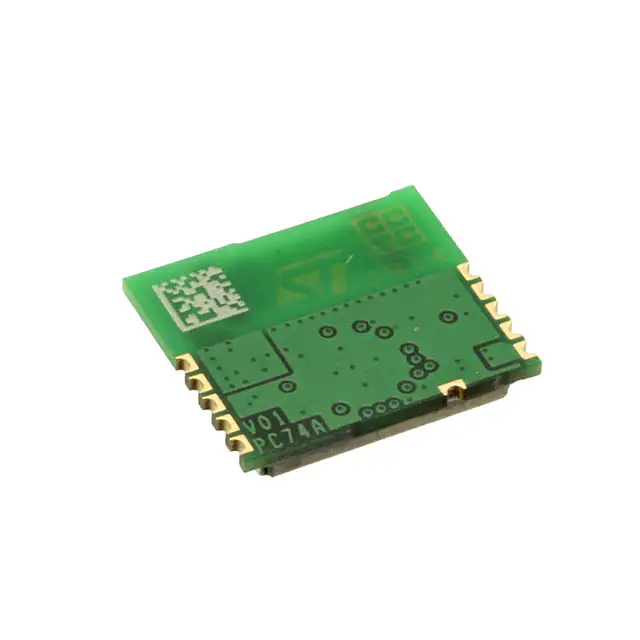
STMicroelectronics SPSGRF-915
- Part No.:
- SPSGRF-915
- Manufacturer:
- STMicroelectronics
- Category:
- RF Transceiver Modules and Modems
- Package:
- Module
- Datasheet:
-
 SPSGRF-915.pdf
- Description:
- RF TXRX MOD ISM<1GHZ CHIP SMD
- Quantity:
- Payment:

- Shipping:

Inventory:3,657
Please send an inquiry. Send us your inquiry, and we will respond immediately.
Product details
Overview
SPSGRF-915 from STMicroelectronics is an FCC- and IC-certified sub-GHz RF transceiver module operating at 902–928 MHz, built around the SPIRIT1 transceiver with integrated BALF-SPI-01D3 balun and on-board antenna. It supports 2-FSK/GFSK/MSK/GMSK/OOK/ASK modulation, delivers up to +11.6 dBm output power, achieves -118 dBm receiver sensitivity, and operates across -40 °C to +85 °C for wireless sensor networks and industrial telemetry.
For engineers reviewing the SPSGRF-915 datasheet, SPSGRF-915 pinout, SPSGRF-915 application, or SPSGRF-915 equivalent, key selection criteria include its certified 915 MHz ISM band operation, programmable +11.6 dBm transmit power, -118 dBm sensitivity, SPI interface compatibility, and 4-pin GPIO flexibility for low-power embedded wireless node design.
Technical Context
The SPSGRF-915 implements a state-machine-controlled RF subsystem with dedicated READY, LOCK, TX, RX, SLEEP, and STANDBY modes managed exclusively via SPI commands. Its internal controller handles LO synthesis, mode transitions, and FIFO management without requiring external timing or configuration logic.
It integrates a calibrated RF front-end with programmable output power (from -30 dBm to +11.6 dBm), configurable air data rates (1–500 kbps), and hardware-accelerated packet handling - all accessible through a standard 4-wire SPI interface operating up to 8 MHz, with SDN pin enabling full shutdown (<0.1 µA).
Key Specifications
| Parameter | Value and Actual Design Meaning |
|---|---|
| Operating Frequency Band | 902–928 MHz ISM band - enables FCC/IC-compliant deployment in North America without additional RF tuning. |
| Receiver Sensitivity | -118 dBm @ 1 kbps, 2-FSK - supports long-range, low-power reception in noisy industrial environments. |
| Max RF Output Power | +11.6 dBm conducted - provides robust link budget while staying within FCC Part 15.247 radiated limits when used with on-board antenna. |
| Air Data Rate | 1–500 kbps - balances throughput and range; 500 kbps usable for high-speed telemetry, 1 kbps for ultra-low-power wake-on-radio. |
| Supply Voltage Range | 1.8 V to 3.6 V - compatible with single-cell Li-ion, Li-SOCl₂, or 3.3 V system rails without level-shifting. |
| Operating Temperature | -40 °C to +85 °C - qualified for outdoor metering, building automation, and factory-floor monitoring. |
| Shutdown Current | 0.1 µA - enables multi-year battery life in intermittent-sensing applications using deep-sleep duty cycling. |
Pinout & Package
SPSGRF-915 uses a compact 11-pin surface-mount module (4-layer PCB) with exposed thermal pad; dimensions are 13.0 mm × 13.0 mm × 2.0 mm (L×W×H). All pins are 0.5 mm pitch, RoHS-compliant, and designed for reflow per IPC/JEDEC J-STD-020C.
| Pin/Terminal | Circuit Role | Design Meaning |
|---|---|---|
| VIN (Pin 5) | Power Input | 1.8–3.6 V main supply; powers entire RF and digital subsystems; requires local 100 nF + 10 µF decoupling. |
| GND (Pin 6) | Ground Reference | Dedicated ground return; must be connected to low-impedance system ground plane with multiple vias. |
| SDN (Pin 11) | Shutdown Control | Active-high enable; pulls module into <0.1 µA shutdown state; must be driven by 1.8–3.6 V logic. |
| SPI_CLK (Pin 7) | SPI Clock Input | Up to 8 MHz clock input; synchronizes all register reads/writes and command execution. |
| SPI_MISO (Pin 8) | SPI Data Output | Master-in/slave-out; returns status, RSSI, and packet payload during read operations. |
| SPI_MOSI (Pin 9) | SPI Data Input | Master-out/slave-in; accepts configuration registers, packet payloads, and command instructions. |
| SPI_CS (Pin 10) | SPI Chip Select | Active-low slave select; must be asserted before each SPI transaction and deasserted after completion. |
| GPIO[0]–[3] (Pins 1–4) | Programmable I/O | Four bidirectional pins supporting digital I/O, interrupt generation, and analog temperature sensing (GPIO[0] only). |
Key Features
| Feature | Design Value |
|---|---|
| FCC & IC Modular Certification | FCC ID: S9NSPSGRF; IC ID: 8976C-SPSGRF - eliminates need for end-product RF certification testing and reduces time-to-market. |
| Integrated Balun + Antenna | BALF-SPI-01D3 balun and tuned 915 MHz on-board antenna - removes external matching network and RF layout complexity. |
| Multi-Modulation Support | 2-FSK, GFSK, MSK, GMSK, OOK, ASK - enables interoperability with legacy protocols and optimization for noise immunity or spectral efficiency. |
| Low-Power State Machine | Hardware-managed READY/LOCK/TX/RX/SLEEP/STANDBY states - offloads host MCU from timing-critical RF sequencing. |
| Configurable Transmit Power | 32-step programmable output from -30 dBm to +11.6 dBm - allows precise link budget tuning and regulatory compliance enforcement. |
Applications
| Smart Utility Metering | Industrial Wireless Sensor Node |
|---|---|
|
Use Scenario: Battery-powered gas/water/electricity meters transmitting consumption data hourly to collector gateways in dense urban deployments. IC Role / Device Role / Timing Role: Certified RF transceiver handling packetized AMR data over 915 MHz ISM band with adaptive power control and wake-on-RSSI. Use Value: Eliminates RF design effort and certification cost; -118 dBm sensitivity ensures reliable reception at >1 km range in obstructed environments. |
Use Scenario: Distributed vibration, temperature, and pressure sensors on rotating machinery, reporting condition data every 5 minutes via star topology. IC Role / Device Role / Timing Role: Low-latency, low-duty-cycle transceiver managing scheduled TX bursts and autonomous RX windows with hardware CRC and auto-ACK. Use Value: 0.1 µA shutdown current extends 2xAA battery life beyond 10 years; +11.6 dBm output maintains link integrity near EMI sources. |
| Wireless Fire Alarm Node | Home Automation Hub Interface |
|
Use Scenario: Smoke/heat detectors in commercial buildings transmitting alarm events with guaranteed delivery to central panel within 500 ms. IC Role / Device Role / Timing Role: Deterministic RF link layer with configurable retry count, packet whitening, and fast mode switching (RX→TX in LOCK state). Use Value: Meets UL 217/UL 268 response-time requirements; FCC/IC certification ensures legal deployment without site-specific RF audits. |
Use Scenario: Smart lighting and HVAC controllers receiving encrypted commands from mobile apps via gateway, operating in mixed 2.4 GHz/915 MHz environments. IC Role / Device Role / Timing Role: Coexistence-optimized transceiver with programmable channel agility and low adjacent-channel rejection susceptibility. Use Value: 915 MHz band avoids 2.4 GHz congestion; 4 GPIOs enable direct connection to relays, triacs, and status LEDs without external logic. |
Equivalent & Alternatives
The following parts are listed as comparable options for similar sub-GHz transceiver module applications.
| Alternative Part | Technical Difference | Application Difference | Selection Advice |
|---|---|---|---|
| SX1276IMLTRT (Semtech) | Lora modulation support; higher max output (+20 dBm); no integrated balun or antenna; requires external RF matching. | Better suited for long-range, low-data-rate LPWAN; lacks modular certification - end-product must undergo full FCC/IC testing. | Select when LoRaWAN protocol stack or >10 km range is required; avoid if certification timeline or board space is constrained. |
| CC1312R1F3RGZT (TI) | ARM Cortex-M4F SoC with integrated RF; supports Sub-1 GHz + 2.4 GHz; higher active current (6.9 mA RX); larger QFN package. | Enables firmware-defined protocols and sensor fusion; targets complex edge-node processing rather than plug-and-play RF connectivity. | Select when local data preprocessing or dual-band operation is needed; avoid if minimal BOM count and fastest integration are priorities. |
Compared with SX1276IMLTRT and CC1312R1F3RGZT, SPSGRF-915 trades raw range and processing capability for out-of-box regulatory compliance, smallest footprint, and lowest integration risk - making it optimal for volume OEMs shipping certified wireless endpoints into North American markets.
Availability
SPSGRF-915 is available at Aetrix Electronics and suitable for smart utility metering, industrial wireless sensor networks, and wireless fire alarm systems requiring stable component supply, full regulatory documentation, and long-term production continuity.
Supply support for SPSGRF-915 includes scheduled delivery planning, volume procurement assistance, BOM continuity management, traceable sourcing, and lifecycle availability coordination for OEM customers, industrial embedded developers, connected-device designers, and electronics production programs.
Manufacturer
STMicroelectronics is a global semiconductor leader headquartered in Geneva, Switzerland, designing and manufacturing microcontrollers, analog ICs, MEMS, and RF solutions for industrial, automotive, and consumer markets.
The SPSGRF series belongs to ST's certified wireless connectivity product line, engineered specifically to accelerate development of FCC/IC/CE-compliant sub-GHz IoT endpoints with zero RF design overhead.
FAQ
Is SPSGRF-915 FCC and IC certified as a standalone module?
Yes. SPSGRF-915 holds modular transmitter certification under FCC ID S9NSPSGRF and IC ID 8976C-SPSGRF. It is approved for stand-alone use in final products, provided OEMs follow labeling, manual, and antenna placement guidelines specified in the datasheet. No additional RF testing is required for integration.
What is the maximum achievable range with SPSGRF-915 in open-field conditions?
In open-field line-of-sight with +11.6 dBm output and -118 dBm sensitivity, theoretical free-space range exceeds 3 km. Real-world performance depends on antenna efficiency, environmental obstructions, and interference; typical indoor range is 100–300 m, and outdoor urban range is 300–800 m.
Can GPIO pins be used for analog temperature sensing?
Only GPIO[0] (Pin 4) supports analog temperature measurement with ±2 °C accuracy across -40 °C to +85 °C. The other three GPIOs (Pins 1–3) are digital-only and support configurable pull-up/down, interrupt generation, and drive strength control - no ADC functionality.
Does SPSGRF-915 require external crystal or oscillator?
Yes. The module includes an onboard 26 MHz crystal (XO) that serves as the reference clock for the SPIRIT1 transceiver. No external crystal is needed - the XO is fully integrated and factory-calibrated; users must not replace or bypass it.
SPSGRF-915 Specifications
- Product attributes
- Attribute value
- Manufacturer:
- STMicroelectronics
- Series:
- -
- Package/Case:
- Module
- Packaging:
- Tray
- Product Status:
- Obsolete
- Programmable:
- Not Verified
- RF Family/Standard:
- General ISM < 1GHz
- Protocol:
- -
- Modulation:
- 2-FSK, ASK, GFSK, GMSK, MSK, OOK
- Frequency:
- 915MHz
- Data Rate:
- 500kbps
- Power - Output:
- 11.6dBm
- Sensitivity:
- -118dBm
- Serial Interfaces:
- SPI
- Antenna Type:
- Integrated, Chip
- Utilized IC / Part:
- SPIRIT1
- Memory Size:
- -
- Voltage - Supply:
- 1.8V ~ 3.6V
- Current - Receiving:
- 10mA
- Current - Transmitting:
- 9mA ~ 22mA
- Mounting Type:
- Surface Mount
- Operating Temperature:
- -40°C ~ 85°C
SPSGRF-915 FAQ
1.How can I place an order for SPSGRF-915 through Aetrix?
Please submit a Request for Quotation (RFQ) for SPSGRF-915 on Aetrix. Our sales agent will provide a competitive quotation and guide you through the order confirmation once you accept the terms.
2.Are the price and stock information for SPSGRF-915 reliable?
The price and inventory of SPSGRF-915 are updated periodically and may fluctuate due to market conditions. Stock and pricing data are typically refreshed every 24 hours. Quotation validity for SPSGRF-915 is usually 5 days.
3.What payment methods are accepted for SPSGRF-915?
We accept Wire Transfer, PayPal, Credit Card, Western Union, MoneyGram, and Escrow for SPSGRF-915 transactions.
Note: Certain payment methods may incur a processing fee.
4.How is shipping managed for SPSGRF-915?
SPSGRF-915 orders can be shipped via leading logistics carriers, including DHL, UPS, FedEx, TNT, or Registered Mail.
Once your SPSGRF-915 order is processed, you will receive an email with the shipment details and tracking number.
Note: Tracking information may take up to 24 hours to appear. Express delivery typically takes 3–5 business days.
5.How can I obtain technical support or documentation for SPSGRF-915?
For technical support, including SPSGRF-915 datasheets, pinout diagrams, or application guidance, please contact our engineering support team. They can provide detailed documentation and assistance for your SPSGRF-915 requirements.
6.How does Aetrix verify that SPSGRF-915 is sourced from the original manufacturer or authorized distributors?
All SPSGRF-915 products on Aetrix are procured from qualified distributors and authorized channels. Our dedicated quality assurance team conducts strict verification, including traceability checks and, if necessary, third-party testing. This ensures that SPSGRF-915 meets industry standards.
7.What is the process for return or replacement of SPSGRF-915?
All SPSGRF-915 units undergo pre-shipment inspection (PSI). If there is an issue with SPSGRF-915, returns or replacements are accepted under the following conditions:
1.Quantity discrepancies, incorrect items, or visible external defects (such as breakage or corrosion), acknowledged by Aetrix.
2.The issue is reported within 90 days of delivery.
3.The SPSGRF-915 part is unused and in its original packaging.
Return procedure for SPSGRF-915:
1.Submit a request within 90 days.
2.Obtain a Return Material Authorization (RMA) from Aetrix.
SPSGRF-915 Tags

-
ESP32-C3FH4
Espressif Systems
-
ESP32-S2FH4
Espressif Systems
-
ESP32-S2FN4R2
Espressif Systems
-
ESP32-C3-MINI-1-N4
Espressif Systems
-
ESP32-C3-WROOM-02-N4
Espressif Systems
-
ESP32-C3-MINI-1U-N4
Espressif Systems
-
ESP32-C3-MINI-1U-H4
Espressif Systems
-
ESP32-C3-WROOM-02U-N4
Espressif Systems
-
ESP32-H2-MINI-1-N4
Espressif Systems
-
ESP32-H2-MINI-1-H4
Espressif Systems
_viewa.jpg)
-
ESP32-MINI-1-N4
Espressif Systems
-
ESP32-S2-MINI-2-N4R2
Espressif Systems
Tech Hub

An engineering guide to LED driver operation, constant-current and constant-voltage outputs, linear and switching topologies, dimming, IC selection, calculations, replacement compatibility, and fault c…

Operational amplifier guide covering op amp basics, feedback, ideal vs real op amps, common configurations, buffer circuits, offset, bias current, gain-bandwidth, slew rate, rail-to-rail limits and sel…

Jumper cables guide covering safe connection order, red and black clamp placement, final ground connection, cable gauge, length, clamp quality, copper vs CCA cables, jump starter comparison and battery…

LDO regulator guide covering low dropout voltage, power dissipation, thermal design, PSRR, output noise, capacitor stability, adjustable LDO circuits, LDO vs buck converter and datasheet selection chec…

Conditional Access Module guide covering CAM meaning, CI/CI+ interface, smart card authorization, DVB security workflow, TV and set-top box compatibility, internal electronics, ESD protection, connecto…

Guide to electronic component obsolescence covering EOL risk, PCN/PDN notices, last-time buy planning, replacement options, form-fit-function validation, counterfeit risk and BOM lifecycle management.

18650 battery guide covering lithium-ion cell basics, 3.6V/3.7V voltage, 4.2V charging, mAh and Wh capacity, protected cells, chargers, BMS, series-parallel packs, holders, welding and sourcing checks.…

Hall effect sensor guide covering working principle, linear and digital sensors, Arduino circuits, current sensing, speed detection, automotive applications, A3144 examples, signal filtering and datash…

Product Change Notification guide for electronic components, covering PCN meaning, PCN vs PDN/EOL, common change types, risk levels, form-fit-function review, engineering validation, BOM control, LTB/L…

A practical guide to blend door actuators, covering HVAC function, symptoms, location, AC and heater issues, reset and calibration, replacement cost, electrical diagnosis, compatibility checks, and rep…


